

We may earn a commission when you buy through links on this page, at no extra cost to you. Learn more.
Rodney Strong red wine is a Sonoma County portfolio led by Cabernet Sauvignon, with Russian River Valley Pinot Noir and red blends offering different levels of body, tannin, and flavor. Choose an Alexander Valley Cabernet for a structured, dark-fruited red, a Russian River Valley Pinot Noir for brighter acidity and gentler tannins, or Symmetry for a blended style. The appellation and vineyard name on the label are useful clues to the wine’s character.
Rodney Strong’s range is rooted in Sonoma County, California, but the wines do not all taste alike. Vineyard location, grape variety, and collection tier shape the differences, so choose by matching the bottle’s style to your palate and meal.
Rodney Strong Red Wine: Portfolio at a Glance
The range covers Cabernet Sauvignon, Pinot Noir, and red blends, moving from broadly sourced Sonoma County wines to focused vineyard-designated releases. The producer organizes its wines into Sonoma, Estates, Reserves, and Limited collections, which helps explain why bottles carrying the same winery name can vary in concentration and detail.
Rodney Strong began in Sonoma County in 1959, and the Klein family has led the winery since 1989. The producer says it farms 12 estate vineyards. Its Sonoma Collection is sourced primarily from estate sites, while Estates wines emphasize matching grape varieties to the soils and growing conditions of particular appellations.
The Reserves are made at the winery’s Artisan facility, where the producer describes cluster and berry sorting, cold soaking, extended maceration, and a free-run-only protocol. The Limited Collection focuses on Russian River Valley and Knights Valley, including Pinot Noir and Cabernet Sauvignon. Readers comparing the red range with the lighter Chardonnay and Sauvignon Blanc styles can consult Rodney Strong white wine; the wider Wine Brands section offers context on how other producers organize their portfolios.
This structure is more helpful than assuming every Rodney Strong red is a Cabernet. A county-designated Cabernet is a practical starting point; a vineyard-designated Cabernet tells a more specific site story; Pinot Noir offers a different balance of freshness and tannin; and a red blend combines grape varieties to create a chosen style.
Sonoma Appellations and Vineyards Behind the Reds
Sonoma County has 19 American Viticultural Areas, and its coastal, valley, and hillside sites produce differences in ripeness, acidity, and structure. Rodney Strong highlights Alexander Valley for Cabernet Sauvignon and Russian River Valley for Pinot Noir, while Knights Valley contributes another distinct Cabernet expression.
Alexander Valley became an AVA in 1984. Sonoma County Winegrowers’ regional overview explains how warm days, marine air, and cool nights support ripeness while preserving freshness. It reports Sonoma County summer average highs from the 70s to low 90s Fahrenheit and nighttime temperatures in warmer inland districts in the 40s and low 50s. Those conditions help explain why Alexander Valley Cabernet can offer ripe black fruit without relying on sheer weight alone.
Alexander’s Crown is one of the winery’s signature sites. Rodney Strong says the vineyard was established in 1971, rises about 360 feet above the valley floor, and covers roughly 66 acres, mostly planted to Cabernet Sauvignon with a small Merlot block. Its first Cabernet release in 1974 became Sonoma County’s first single-vineyard Cabernet. Gravelly loam soils and afternoon ocean breezes are associated with ripe red fruit, rounded tannins, and balanced acidity.
Rockaway and Brothers Ridge show how varied Alexander Valley can be. Rockaway sits above Geyserville at about 750 feet, with gravelly clay over fractured sandstone; its Cabernet is associated with dark plum, red currant, tobacco, and baking spice. Brothers Ridge lies in the hills near Cloverdale above 1,000 feet, with Cabernet Sauvignon and smaller plantings of Merlot and Malbec on west-facing slopes. Russian River Valley is cooler: the AVA was established in 1983, and Rod Strong was planting Pinot Noir there as early as 1968. Coastal fog makes it a natural source for a red with more freshness and less tannin than Cabernet.
How the Main Bottlings Taste
Cabernet Sauvignon is the backbone of the brand’s best-known red wines, but the Sonoma County, Alexander Valley, Knights Valley, and single-vineyard labels are not interchangeable. Pinot Noir and Symmetry provide alternatives: one is a varietal red with a lighter tannin profile, while the other is a blended wine built around fruit, spice, and texture.
Cabernet Sauvignon generally has high tannin, giving it a firm grip and making it a strong partner for protein-rich, fatty food. Rodney Strong describes its Sonoma County Cabernet with dark cherry, plum, baking spice, black pepper, violet, and cassis. An independent review recorded 14.5% alcohol by volume and noted spiced plum, dark chocolate, mint, and cinnamon. The Alexander Valley Cabernet offers a more specific appellation expression; a Wine Enthusiast review awarded a bottling 91 points and recorded 14.5% alcohol by volume, with black cherry, spiced plum, dark coffee, cocoa, blackberry, and rich tannin. The Rodney Strong Alexander Valley Cabernet review is a vintage-specific reference, not a guarantee that every release will taste identical.
The single-vineyard Cabs have more focused site identities. Alexander’s Crown leans toward black currant, blackberry, violet, and rounded tannins; Rockaway is associated with dark plum, red currant, tobacco, leather, and baking spice; Brothers Ridge is described through blackberry, plum, cassis, chocolate, and firm structure. Reserve Cabernet adds another tier, with winery notes describing blackberry, black currant, cocoa, crushed violet, and a lingering vanilla finish. Russian River Valley Pinot Noir is the lighter counterpoint: a reviewed release showed 14.5% alcohol by volume alongside black cherry, cranberry, rose petal, roasted mushroom, savory notes, and orange-peel acidity. Pinot Noir usually has low-to-medium tannin and high acidity, so it feels more lifted and less grippy than Cabernet. Symmetry, the signature red blend, brings red and dark fruit, plum, vanilla, dried fruit, baking spice, and a supple mouthfeel.
| Bottling or style | Region or source | What to expect |
|---|---|---|
| Sonoma County Cabernet Sauvignon | Sonoma County | Dark cherry, plum, baking spice, black pepper, violet, and cassis |
| Alexander Valley Cabernet Sauvignon | Alexander Valley | Black cherry, blackberry, cocoa, dark coffee, and firm tannin; reviewed bottling at 14.5% ABV |
| Alexander’s Crown Cabernet Sauvignon | Alexander Valley; 66-acre vineyard at about 360 feet | Black currant, blackberry, violet, rounded tannins, and balanced acidity |
| Rockaway Cabernet Sauvignon | Alexander Valley; vineyard at about 750 feet | Dark plum, red currant, tobacco, leather, and baking spice |
| Brothers Ridge Cabernet Sauvignon | Alexander Valley; hills above 1,000 feet | Blackberry, plum, cassis, chocolate, and firm structure |
| Russian River Valley Pinot Noir | Russian River Valley | Black cherry, cranberry, flowers, mushroom, savory notes, and lively acidity |
| Symmetry Red Wine | Sonoma County | Red and dark fruit, plum, vanilla, dried fruit, baking spice, and supple texture |
Choosing a Bottle for Your Taste
Start with body and tannin rather than prestige terms: Cabernet Sauvignon is the clearest fit if you like dense, structured reds and often serve steak or lamb. Sonoma County Cabernet offers the broadest regional expression, Alexander Valley is more specific, and single-vineyard wines narrow the focus to Alexander’s Crown, Rockaway, or Brothers Ridge.
Choose Russian River Valley Pinot Noir if you prefer brighter acidity and less tannin. It can still have ripe fruit and concentration, but it usually suits poultry, pork, mushrooms, and dishes where Cabernet would dominate. Merlot typically has medium, softer tannins than Cabernet Sauvignon, making it a sensible alternative for someone who likes plush red fruit but wants less grip. The choice is not simply “light” or “full”: Pinot Noir can show ripe fruit and meaningful concentration, while a well-made Cabernet can still retain freshness. Let the appellation and the dish guide the decision, then use the producer’s vintage-specific notes to refine it.
A blend is a good option when the goal is balance rather than one grape’s signature. Symmetry is the producer’s signature red Meritage, combining fruit, spice, and a supple, layered impression. Readers interested in how Bordeaux varieties are used by other producers can compare it with Baron Philippe de Rothschild wine, a companion read for understanding Cabernet-led blends and classic varietal families. The regional wording also helps: “Sonoma County” is broader than “Alexander Valley” or “Knights Valley,” while a vineyard name such as Rockaway or Alexander’s Crown is narrower still. Alcohol level is another clue, but not a shortcut for quality or body: independent reviews have recorded 14.5% ABV in both Cabernet and Pinot Noir bottlings, even though their tannin and acidity differ. For a meal, the balance of tannin, acidity, fat, and seasoning is more useful than a score alone.
Food Pairings for Cabernet, Pinot Noir, and Blends
Cabernet Sauvignon suits savory dishes such as grilled ribeye, strip steak, lamb chops, short ribs, and burgers because protein and fat soften its high tannin. Char, pepper, rosemary, aged cheddar, and firm sheep’s-milk cheese can also match its dark fruit and oak spice.
Use Pinot Noir for dishes that need freshness rather than force. Roast chicken, duck breast, pork tenderloin, seared salmon, and mushroom risotto suit its lower-to-medium tannin and higher acidity. Earthy mushrooms connect with savory notes in Russian River Valley Pinot Noir, while acidity refreshes the palate. Oily fish can clash with strongly tannic reds, so Pinot Noir is a safer red direction than a powerful young Cabernet with salmon or another rich fish.
Symmetry and other red blends can cover a broad middle ground. Try them with meatloaf, grilled sausages, roast pork, tomato-based pasta with moderate seasoning, or aged Gouda. Food with pronounced acidity needs a wine with equal or higher acidity, so a bright tomato sauce is often more comfortable with Pinot Noir than with a heavy, tannic Cabernet. Be cautious with chili heat: alcohol and tannin can make spicy dishes feel hotter, so a high-alcohol Cabernet is not the easiest match for hot wings, chili oil, or fiery barbecue sauce. A softer red blend or milder seasoning is a better direction.
Serving, Decanting, and Storing Rodney Strong Reds
Serving temperature changes how the wine feels: full-bodied reds such as Cabernet Sauvignon are best around 60–65°F, while lighter Pinot Noir is better at 55–60°F. A warm room can make alcohol seem more prominent, so a brief chill may help Cabernet show its fruit and structure more clearly.
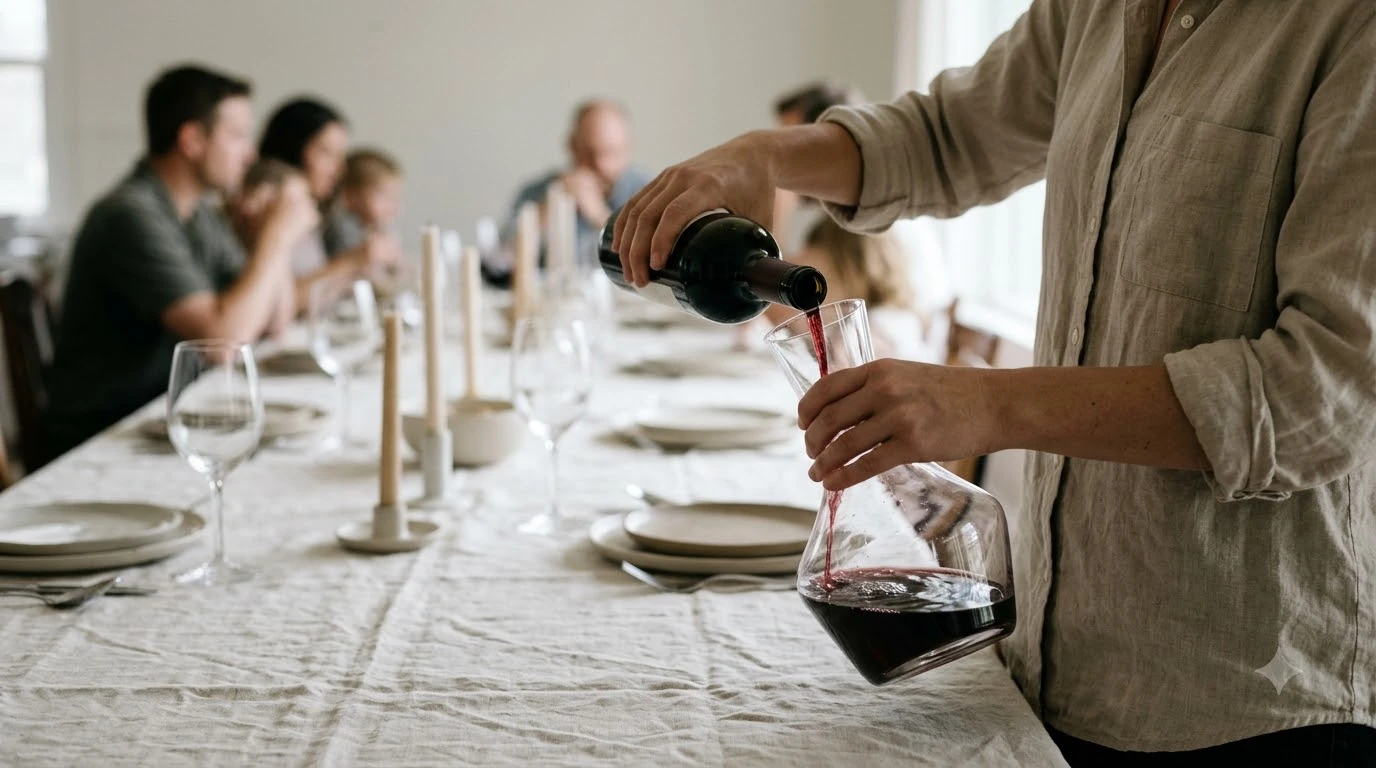
Young, full-bodied Cabernet Sauvignon can benefit from 30–60 minutes in a decanter. Air softens the initial impression of firm tannin and allows fruit and savory aromas to open, especially in a dense single-vineyard or Reserve release. Pinot Noir usually needs less time: pour a taste, give it a few minutes in the glass, and decide whether more air is needed. Older wines may need gentler handling rather than a long exposure to oxygen.
Tip: Serve Cabernet at 60–65°F and Pinot Noir at 55–60°F. For a young, full-bodied Cabernet, start with 30 minutes of air, taste it, and extend toward 60 minutes only if the tannins still feel tight.
A standard 750 ml bottle gives about five 5-ounce pours. Store unopened bottles on their sides in a cool, dark place near 55°F, away from sunlight and frequent temperature changes. If a bottle is unfinished, reseal it and refrigerate it; most still wines are at their best within 3–5 days. Let the wine warm slightly in the glass before serving again rather than leaving the bottle on a warm counter for hours.
Frequently Asked Questions
These answers cover the winery’s Healdsburg location, the people overseeing its wines, and practical details about the broader red-variety range and current releases.
Where is Rodney Strong Vineyards located?
The winery and tasting room are at 11455 Old Redwood Highway in Healdsburg, California. Healdsburg sits in Sonoma County, close to several of the appellations represented in the winery’s portfolio.
Who leads the winemaking team?
Rodney Strong identifies Justin Seidenfeld as its SVP of Winemaking and Winegrowing and Greg Morthole as winemaker. Their roles connect vineyard decisions with cellar practices across the winery’s Sonoma-focused collections.
What does “Meritage” mean on Symmetry?
Meritage is a term used for blends built from traditional Bordeaux grape varieties rather than a single named grape. Rodney Strong identifies Symmetry as its signature red Meritage, so the name signals a blended style, not a Cabernet Sauvignon varietal bottling.
Does Rodney Strong make red wines besides Cabernet and Pinot Noir?
Yes. The winery’s broader varietal categories include Merlot, Zinfandel, Malbec, and Cabernet Franc as well as Cabernet Sauvignon and Pinot Noir. Those grapes may appear as varietal wines or as components in blends, depending on the release.
How can I check which Rodney Strong red wines are currently available?
The winery’s product locator is designed to search for its wines at nearby stores and restaurants, as well as direct purchasing options. It is a better way to check a specific release than assuming every Reserve, Limited, or single-vineyard bottling is distributed in every market.
Rodney Strong’s red portfolio is easiest to understand by starting with the grape and then narrowing the choice by Sonoma appellation or vineyard. Cabernet drinkers have several levels of site expression to explore, while Pinot Noir and Symmetry give the range a different rhythm. Match the wine’s tannin and acidity to the food, serve it at the right temperature, and the bottle’s regional character will be easier to appreciate.
More in Wine Brands
 Underwood Wine Price: Compare Bottles, Cans, and Pack SizesUpdated Nov 21, 2026
 Zenato Wine Price: Compare Styles and Choose the Right BottleUpdated Nov 21, 2026
 Zuccardi Wine Price: Compare Bottles and Find the Right RangeUpdated Nov 21, 2026
 Yellow Tail Moscato Review: Taste, Sweetness and Serving TipsUpdated Nov 21, 2026
 Wolf Blass Yellow Label Review: Choose Your Best StyleUpdated Nov 21, 2026
 Wolffer Estate Rose Review: Choose the Right Bottle for Your TableUpdated Nov 21, 2026