

We may earn a commission when you buy through links on this page, at no extra cost to you. Learn more.
nebbiolo vs pinot noir comes down to structure: Nebbiolo usually has firmer, more drying tannins and a powerful frame, while Pinot Noir is generally lighter, silkier, and more immediately approachable. Both can be pale in color, high in acidity, and scented with red fruit and flowers, which explains why they are sometimes compared. Choose Nebbiolo for depth, savory complexity, and age-worthy structure; choose Pinot Noir for delicate texture, bright fruit, and flexible food pairings.
These grapes can look deceptively similar in the glass, but they create different experiences at the table. The comparison is easiest when you separate grape variety from regional style: a young Langhe Nebbiolo is not the same kind of wine as a mature Barolo, just as a cool-climate Burgundy Pinot Noir differs from a ripe California bottling.
The Main Differences at a Glance
Nebbiolo and Pinot Noir share bright acidity, relatively pale color, and an aromatic profile that can include flowers and red berries. Their clearest difference is tannin: Nebbiolo usually grips the gums and cheeks more firmly, while Pinot Noir tends to feel finer, softer, and less drying.
| Feature | Nebbiolo | Pinot Noir |
|---|---|---|
| Typical body | Medium to full, often firmly structured | Light to medium, sometimes medium-bodied |
| Tannin | High; often firm and drying when young | Low to medium; usually fine or silky |
| Acidity | High | High |
| Common fruit | Sour cherry, red plum, cranberry | Strawberry, raspberry, cherry |
| Signature non-fruit notes | Rose, violet, tar, licorice, truffle | Forest floor, mushroom, tea, herbs |
| Suggested serving temperature | 60–65°F for structured examples | 55–60°F for lighter examples |
| Decanting guide | 30–60 minutes for young, full examples | Usually pour directly; older bottles need care |
The table describes broad tendencies, not guarantees. Langhe Nebbiolo is often fresher and less forceful than Barolo or Barbaresco, while Pinot Noir ranges from taut, savory Burgundy or Oregon styles to riper, rounder California examples.
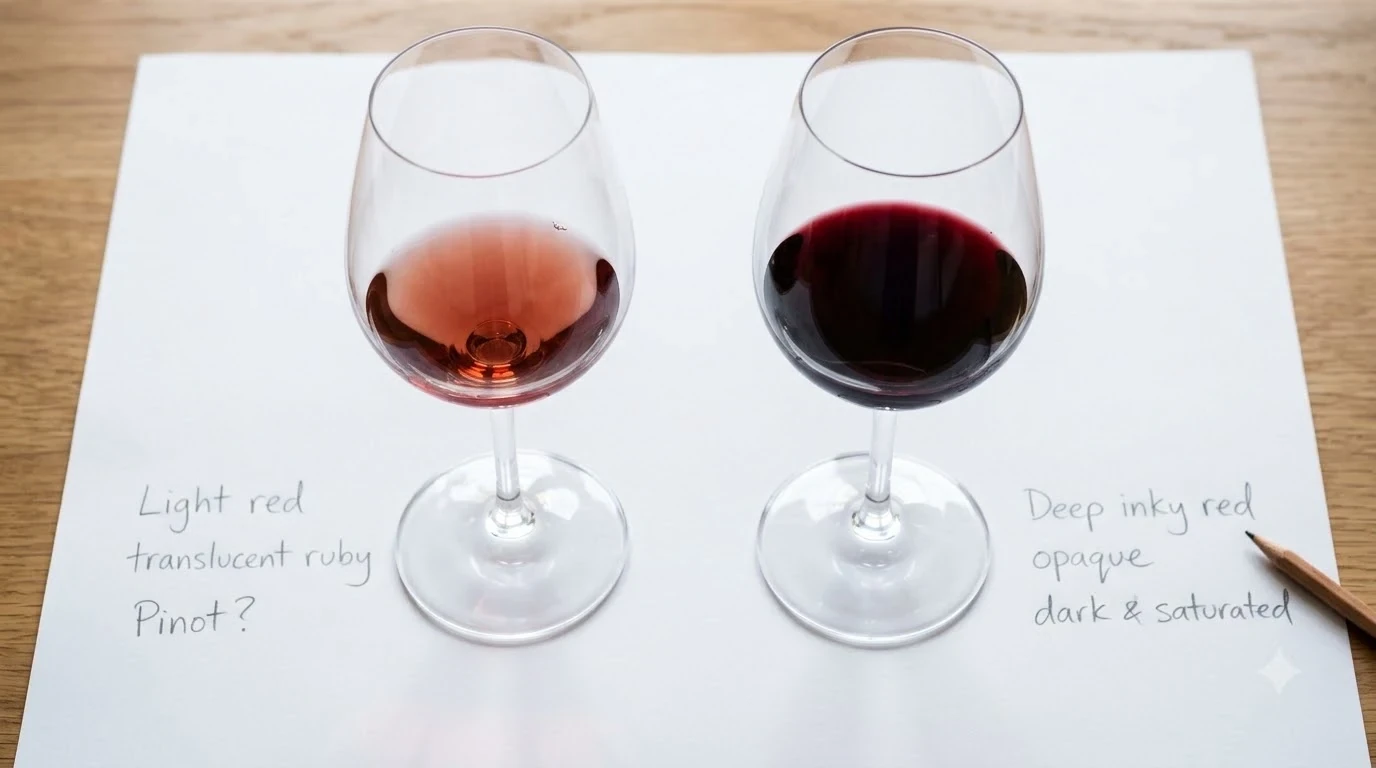
Color is a poor shortcut: Nebbiolo can look translucent despite strong tannins, and a darker Pinot is not automatically heavy. Focus on palate feel rather than the shade in the glass.
Origins and Growing Conditions Shape the Style
Nebbiolo is strongly associated with Piedmont in northwestern Italy, especially the Langhe hills around Barolo and Barbaresco. Pinot Noir has its historic benchmark in Burgundy, France, but it is now grown in cool and moderate wine regions across Europe, the United States, New Zealand, Australia, and Chile.
The Langhe wine consortium describes Nebbiolo as a demanding, late-ripening grape. It can bud in April but is typically harvested in the second half of October; suitable hillside sites are often 200 to 450 meters above sea level, with sun exposure and protection from spring frost. Nebbiolo favors calcareous and tufaceous soils and benefits from day-to-night temperature shifts. These conditions help explain why slopes and villages can produce distinct expressions of the same grape.
Barolo and Barbaresco are both made from 100 percent Nebbiolo, but they are distinct denominations with their own growing zones and rules. Barolo comes from 11 municipalities in the Langhe, while the Barbaresco production area includes Barbaresco, Neive, Treiso, and part of Alba. Outside those famous names, bottles labeled Langhe Nebbiolo or Nebbiolo d’Alba can offer a more direct, often earlier-drinking expression of the grape. The consortium’s Nebbiolo grape profile explains the variety’s demanding site requirements and late harvest.
Pinot Noir is thin-skinned and sensitive to moisture, sun, and disease pressure. Cooler climates help preserve its acidity and delicacy: Burgundy may show cranberry, dark cherry, rose, mushroom, and forest-floor character, while warmer sites can give riper raspberry, cherry, pomegranate, cedar, or cola spice. The grape thrives in places as varied as Oregon’s Willamette Valley, California’s Russian River Valley, New Zealand’s Central Otago, and Burgundy; climate, clone, soil, harvest, and cellar choices shape each style. Wine Enthusiast’s Pinot Noir guide details how climate changes the grape’s aroma and texture.
Aromas, Flavors, and Texture in the Glass
Both wines can begin with red fruit and floral aromas, but Nebbiolo’s perfume often feels more lifted and savory, while Pinot Noir’s fruit can seem more immediate and delicate. The contrast becomes clearer with age, when Nebbiolo can develop tar, leather, truffle, and dried spice, and Pinot Noir can gain mushroom, forest-floor, tea, and earthy notes.
In a young Nebbiolo, look for sour cherry, cranberry, red plum, rose petal, and violet. Some examples also suggest anise, licorice, fennel, or dried herbs. With bottle age, the fruit may move from fresh and tart toward dried cherry, while notes of tobacco, leather, earth, and truffle become more noticeable. The famous tar-and-rose description captures the variety’s combination of floral lift and savory depth, but not every bottle will show tar clearly. Vineyard, vintage, ripeness, extraction, and oak use all influence the balance.
Pinot Noir usually offers a more transparent fruit register. Strawberry, raspberry, red cherry, and sometimes black cherry are common, with rose, mint, pine, tea, or forest floor adding complexity. In cooler regions, the fruit can be tart and restrained, and the wine may feel brisk and finely drawn. In warmer regions, ripe cherry, pomegranate, cola spice, cedar, and a plusher texture can make Pinot feel broader without turning it into a high-tannin red.
Texture can be more revealing than a single aroma. Nebbiolo may leave a powdery, chalky grip along the gums, especially as a young Barolo; Pinot Noir usually glides more easily, with tannins framing rather than dominating the fruit. New oak can blur the difference by adding vanilla, toast, smoke, and texture. Compare how dry your gums feel and whether the finish is floral, earthy, spicy, or woody.
Tannin, Acidity, Alcohol, and Aging Potential
High acidity is a point of overlap, but tannin is the main structural divide. Nebbiolo combines high acidity with high tannin, creating a firm wine that can seem angular in youth; Pinot Noir also has lively acidity, but its generally lower tannin makes it feel more supple.
Tannin comes mainly from grape skins, seeds, and sometimes oak, and it creates a drying sensation rather than a sour taste. In Nebbiolo, that sensation can be pronounced even when the wine looks pale. A young Barolo may have bright cherry and rose aromas but still feel tightly wound because its tannins have not softened. Pinot Noir’s thinner skins usually contribute less tannin, so its structure is more often carried by acidity, fine-grained tannin, and the intensity of the fruit. Some warm-climate or heavily extracted Pinots are firmer, but they generally remain less tannic than classic Nebbiolo.
Alcohol varies with site and vintage. Wine Enthusiast gives Pinot Noir a broad range of 12 to 15 percent alcohol by volume; cooler-climate examples often fall between 12 and 13.5 percent, while warmer-climate examples can reach 13.5 to 15 percent. Nebbiolo can also feel warming in concentrated Piedmont styles. Because alcohol and tannin amplify chili heat, neither grape is the best default for very spicy food.
The best-known Nebbiolo wines are built for development. Barolo requires at least three years of aging after the two months following harvest, including one and a half years in oak; its Riserva designation is permitted after five years. Barbaresco requires at least two years, including nine months in oak, and can be labeled Riserva after four years. Those rules do not mean every Nebbiolo needs a decade: Langhe Nebbiolo and Nebbiolo d’Alba are often intended for earlier drinking. Pinot Noir also ages, particularly from Burgundy and carefully made examples in Oregon, California, or New Zealand, but a fresh regional bottling may be best while its strawberry and cherry notes remain vivid. A strong village or premier-cru Burgundy can develop savory depth over time. Nebbiolo’s firmer tannin and acidity provide a more obvious aging framework; Pinot’s evolution is often subtler, moving toward dried fruit, mushroom, earth, and spice. Follow the producer’s suggested window rather than assuming every bottle improves indefinitely.
Tip: For a young, structured Barolo or Barbaresco, try a 30- to 60-minute decant and serve it around 60–65°F. A delicate Pinot Noir is usually better slightly cooler, around 55–60°F, so its fruit stays fresh and its alcohol feels less prominent.
Food Pairings for Each Grape
Pinot Noir is usually the more flexible partner for lighter meals, while Nebbiolo is a natural match for dishes with richer textures and savory depth. The deciding factors are tannin, acidity, fat, salt, and the intensity of the cooking rather than the grape’s prestige or color.
Choose Pinot Noir with roast chicken, duck breast, pork tenderloin, mushroom risotto, lentils, or grilled salmon. Its high acidity refreshes the palate, while low-to-medium tannin avoids the clash that a strongly tannic red can create with oily fish. Mushrooms, thyme, and roasted root vegetables echo Pinot’s savory side; lighter Burgundy or cool-climate Oregon examples suit herbs and gentle pan sauces better than dense, sweet glazes.
Nebbiolo is suited to grilled or braised beef, lamb, osso buco, rich sausage, truffle dishes, and slow-cooked ragù. Its tannin meets protein and fat, and its acidity cuts through butter, marrow, or concentrated sauce. Piedmontese pairings such as tajarin with meat ragù or risotto with shaved truffle have enough flavor to stand beside the wine. A younger Langhe Nebbiolo is often easier with pizza or tomato-based pasta than a highly structured Barolo.
Seasoning changes the match. Salt and fat soften tannin, so aged cheese or marbled steak can make Nebbiolo seem less severe. Acidic dishes need a wine with equal or greater acidity; sharp tomato sauce can flatten a low-acid red, while both grapes usually have enough freshness. Wine should be at least as sweet as a dessert or sweet glaze, so dry examples of either grape are poor matches for genuinely sweet dishes. Chili heat is amplified by alcohol and tannin, so avoid a powerful young Barolo with spicy food. For another take on lighter red pairings, compare grenache vs pinot noir, where Grenache often brings riper fruit and softer tannin. The contrast in pinot noir vs shiraz can help explain when a fuller, more structured red fits grilled meat or peppery sauces; the broader Wine vs Wine approach is useful when two grapes share aromas but differ in structure.
How to Choose, Serve, and Store a Bottle
Choose by the meal and the texture you enjoy. Start with Nebbiolo for a firm red with braised meat; choose Pinot Noir for a more supple match with poultry, salmon, or mushrooms.
For a first Nebbiolo, consider Langhe Nebbiolo or Nebbiolo d’Alba before moving to Barolo or Barbaresco. These less forceful styles show cherry, rose, and bright acidity without demanding years of bottle age. To explore the top denominations, compare Barolo and Barbaresco from the same vintage and producer; a Barbaresco may feel more immediately graceful, while Barolo can seem more imposing, although site and producer matter.
For Pinot Noir, let region set expectations. Burgundy often emphasizes savory complexity; Oregon’s Willamette Valley balances red fruit with freshness; warmer California regions may deliver rounder cherry and cola notes. Decide whether you prefer tart cranberry and earthy detail or ripe cherry and a broader palate. For a red-versus-white comparison, see pinot noir vs sauvignon blanc.
Serve lighter Pinot around 55–60°F and fuller Pinot closer to 60–65°F. Structured Nebbiolo is comfortable around 60–65°F; too much warmth can make alcohol seem more prominent. A 750-milliliter bottle yields about five standard 5-ounce pours. Decant young, full-bodied Nebbiolo for 30 to 60 minutes; handle older bottles gently because sediment and fragile aromas can be disturbed by excess air. Store both wines in a cool, dark place near 55°F, with cork-finished bottles on their sides, away from sunlight, kitchen heat, and temperature swings. After opening, recork and refrigerate; most still wines keep for roughly 3 to 5 days, though delicate older Pinot may fade sooner. Bring the remaining wine back toward serving temperature before pouring.
Frequently Asked Questions
What does the name Nebbiolo mean?
The name is commonly linked to the Italian word “nebbia,” meaning fog. One explanation points to the pale bloom that can make the berries look misted; another connects the name to the autumn fog that may arrive around Nebbiolo’s late harvest in Piedmont.
Why do some Nebbiolo wines say Barolo instead of Nebbiolo?
Barolo is a protected regional denomination made from 100 percent Nebbiolo, so the place name takes prominence on the label. The same principle applies to Barbaresco, while bottles from broader appellations are more likely to display names such as Langhe Nebbiolo or Nebbiolo d’Alba.
Does Pinot Noir have another name in Italy?
Yes. Pinot Noir is commonly called Pinot Nero in Italy. In Germany it is known as Spätburgunder, a useful clue when shopping for German examples from regions such as Baden or the Ahr.
Can Pinot Noir be used for sparkling wine?
Yes. Pinot Noir is one of the principal grapes used in Champagne, where it may be blended with Chardonnay and Pinot Meunier before the second fermentation in bottle. It is also used for rosé and sparkling wines in other regions, not only for still red wine.
How many Pinot Noir clones are there?
Wine Enthusiast notes that roughly 1,000 Pinot Noir clones exist around the world. Clonal diversity gives growers options for adapting to different climates and vineyard conditions, and it is one reason two Pinot Noir wines from neighboring sites can still have distinct personalities.
Nebbiolo and Pinot Noir reward different kinds of attention: one offers firm tannin, savory complexity, and the structure to develop over time; the other favors fragrance, finesse, and a more flexible place at the table. Try them side by side with roast duck or mushroom risotto, then compare the finish and texture rather than the color alone. The best choice is the bottle whose structure fits the food and the experience you want.
More in Wine vs Wine
 Nero d’Avola vs Pinot Noir: Taste, Body, and Pairing DifferencesUpdated Nov 21, 2026
 Chenin Blanc vs Pinot Blanc: Key Differences in Taste, Acidity, and PairingsUpdated Nov 21, 2026
 Chardonnay vs Shiraz: Key Differences in Taste, Serving, and PairingUpdated Nov 21, 2026
 Chardonnay vs Verdejo: How Spain’s Crisp White Compares to the World’s ChameleonUpdated Nov 21, 2026
 Chardonnay vs Sancerre: Key Differences in Taste, Grapes, and PairingUpdated Nov 21, 2026
 Chardonnay vs Malbec: Key Differences in Taste, Body, and PairingUpdated Nov 21, 2026