

We may earn a commission when you buy through links on this page, at no extra cost to you. Learn more.
Muscadine history stretches back thousands of years in the southeastern United States, making Vitis rotundifolia the oldest continuously cultivated wine grape native to North America. Indigenous communities foraged and dried the thick-skinned berries long before European explorers documented them along the Carolina coast in the 1500s. By the early twentieth century, North Carolina muscadine bottlings briefly ranked among the best-selling wines in the country before Prohibition reshaped the regional industry.
Unlike the Mediterranean grapes behind Cabernet Sauvignon or Chardonnay, muscadine evolved specifically for the heat, humidity, and native pests of the American South. Tracing its path from wild riverbanks to modern tasting rooms reveals why this resilient fruit occupies a singular chapter in American viticulture.
What Muscadine Is and Why Its Genetics Stand Apart
Muscadine (Vitis rotundifolia) is a distinct North American grape species belonging to the subgenus Muscadinia rather than the European wine grape family Vitis vinifera. Its thick skin, large golf-ball-sized berries, and extra pair of chromosomes set it apart both botanically and in the glass.
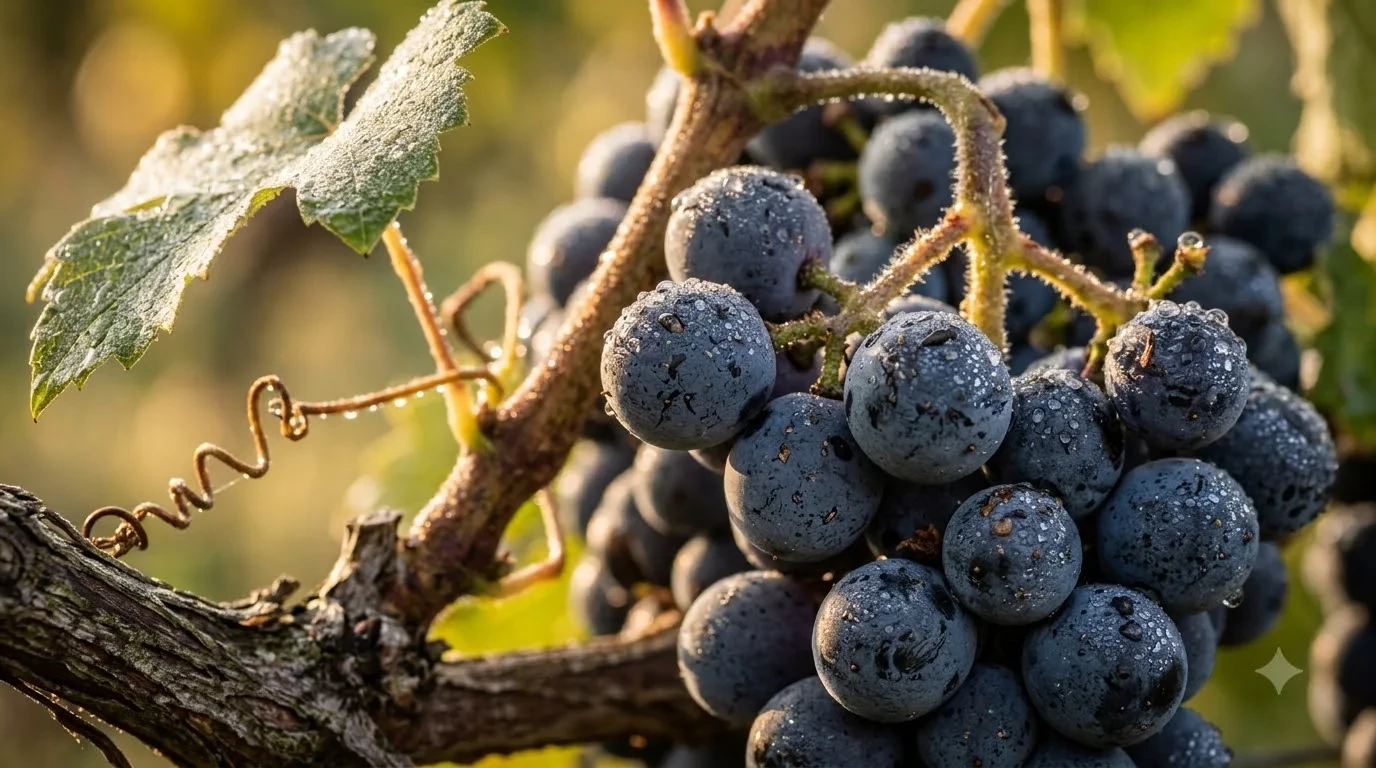
While European wine grapes carry 38 chromosomes, muscadine carries 40, creating a genetic barrier that makes traditional crossbreeding with familiar Wine by Type categories difficult. Instead of growing in tight, cone-shaped bunches, muscadines hang in loose clusters of just a few heavy berries that ripen unevenly from August through October. Each individual grape detaches cleanly from the stem at peak ripeness, leaving behind a dry stem scar rather than tearing the skin.
That thick hull evolved as natural armor against Pierce’s disease, fungal rot, and the root-eating louse phylloxera—the very pest that devastated European vineyards in the nineteenth century. Because of this built-in resilience, single vines can grow more than 35 feet in a single season and yield up to 90 pounds of fruit without the heavy chemical interventions required by European varieties in humid climates. For anyone curious about how to pronounce muscadine, the standard American pronunciation rhymes with “wine” at the end rather than “dean.”
Indigenous Roots and Early Colonial Encounters
Long before European ships reached the Atlantic coast, Indigenous peoples across the Southeast harvested wild muscadines as a staple food, medicine, and fermented drink. European chroniclers later encountered those established vines in the sixteenth century, sparking centuries of cultivation and folklore along the coastal plain.
Native American tribes including the Cherokee, Seminole, and Algonquian peoples gathered both dark-purple and bronze berries from fertile river bottomlands stretching from Virginia to Texas. They preserved excess harvests by sun-drying the whole grapes into winter raisins, baked the tough skins into early versions of fruit dumplings, and brewed teas and poultices from the bark and leaves. Early colonial sketches even show Indigenous farmers building wooden scaffolds to support sprawling vines and maximize fruit yields.
Written European records of the grape began in 1524, when Florentine explorer Giovanni da Verrazzano noted abundant wild “white” vines growing naturally along North Carolina’s Cape Fear River Valley. Sixty years later, Sir Walter Raleigh’s scouts on Roanoke Island reported vines so thick they climbed straight into the treetops. In Manteo on Roanoke Island, a gnarled scuppernong known as the “Mother Vine”—widely cited as dating back to around 1584—still produces fruit today, though historians continue to debate whether Croatan farmers or early English colonists first trained it.
The Rise of Scuppernong and Antebellum Southern Vineyards
During the eighteenth and nineteenth centuries, muscadine moved from wild forest thickets into organized Southern vineyards, led by a famous bronze mutation discovered in eastern North Carolina. By the 1840s and 1850s, coastal wineries had turned North Carolina into the leading wine-producing state in the United States.
In 1755, a hunter named Isaac Alexander documented a remarkably large, greenish-bronze muscadine growing along a stream feeding North Carolina’s Scuppernong River—a name derived from the Algonquian word ascopo, meaning sweet bay tree. Cultivators propagated cuttings from that vine across the South, and Scuppernong became so dominant that many Southerners still use the word as a blanket term for every bronze muscadine, even though true Scuppernong is only one specific cultivar.
As Wine Enthusiast notes, muscadines also carried deep cultural significance for enslaved laborers and later Black American farmers across the antebellum and post-Civil War South. Because wild vines grew freely along woodland edges, foraging and selling muscadines provided vital nutrition and an independent source of income in states from Virginia to Georgia. Meanwhile, commercial estates like Medoc Vineyard in Halifax County, founded in 1835 by Sidney Weller, pioneered trellising systems and bulk winemaking that helped North Carolina operate roughly 25 wineries prior to the Civil War.
Paul Garrett, Virginia Dare, and the Prohibition Collapse
At the turn of the twentieth century, one ambitious North Carolina vintner transformed regional muscadine wine into a national phenomenon before federal prohibition wiped out the industry. Paul Garrett’s flagship bottling, Virginia Dare, briefly stood as the best-selling wine in America.
Born in Halifax County, Garrett took over operations tied to the historic Medoc Vineyard and built Garrett & Co. into a multi-state powerhouse with five wineries in North Carolina alone. Named after the first English child born on Roanoke Island, his sweet white Scuppernong wine won top honors at international expositions in Paris and St. Louis around 1900. Demand grew so rapidly that Garrett eventually blended North Carolina muscadine juice with California grapes to keep shelves stocked from coast to coast.
That momentum came to an abrupt halt as statewide dry laws swept the South in 1908, followed by national Prohibition in 1920. Unlike California wineries that survived by shipping sacramental wine or grape bricks, most Southern muscadine vineyards were uprooted or abandoned, and Garrett & Co. ceased trading entirely by the time of Paul Garrett’s death in 1940. While old-world styles like those covered in port history maintained unbroken European cellars through the twentieth century, American muscadine winemaking had to rebuild nearly from scratch after World War II.
Post-War Revival and Modern Dry Winemaking
A steady revival began in the 1950s and 1970s as agricultural researchers bred self-fertile cultivars and family wineries reopened across North Carolina and Georgia. Today, roughly 3,200 acres of muscadines grow commercially across the Southeast, and a new generation of winemakers is pushing the grape well beyond its sweet reputation.
Early wild cultivars like Scuppernong have only female flowers, meaning growers had to interplant non-fruiting male vines for pollination. Starting in the mid-twentieth century, university breeding programs in North Carolina and Georgia introduced self-fertile (“perfect-flowered”) cultivars such as Carlos, Noble, and Ison, dramatically improving vineyard efficiency. In 1975, the Fussell family launched Duplin Winery in Rose Hill, North Carolina, helping spark renewed commercial interest—especially after late-1990s research highlighted high concentrations of polyphenols and ellagic acid in muscadine skins.
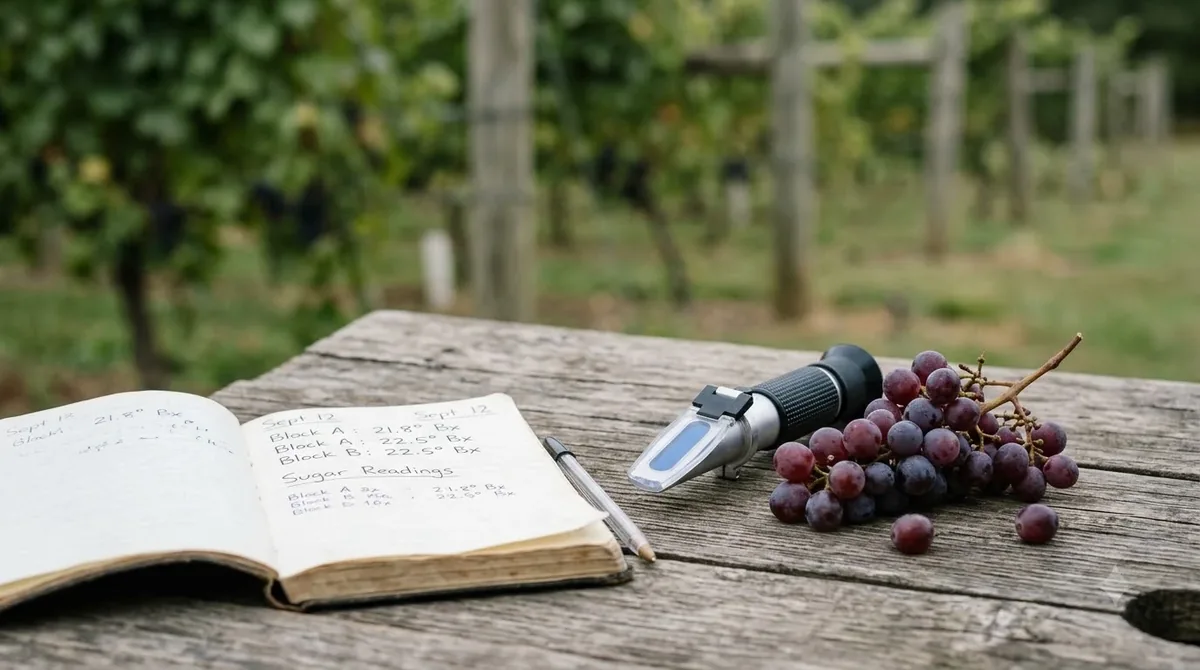
As Wine Folly explains, ripe muscadines naturally register only 10 to 15 Brix in sugar compared to 20 or higher in European grapes, which historically led vintners to add sugar before fermentation and finish wines sweet. Today, producers such as Overmountain Vineyards, Cypress Bend, and Windsor Run Cellars in North Carolina—alongside Tilford Winery in Georgia—are experimenting with dry fermentations, carbonic maceration, and sparkling styles that showcase bright citrus, saline, and pine-resin aromatics without heavy residual sugar.
| Era | Key Milestone | Primary Region | Dominant Wine Style |
|---|---|---|---|
| Pre-1500s | Indigenous tribes forage, sun-dry, and ferment wild vines | Southeastern U.S. coastal plain and river valleys | Wild fermented fruit beverages and medicinal tonics |
| 1524–1584 | Verrazzano logs wild vines; Roanoke Island “Mother Vine” established | Cape Fear River Valley and Roanoke Island, NC | Small-scale colonial and indigenous table fermentations |
| 1755–1860 | Scuppernong cultivar discovered; 25 wineries operate in NC | Eastern North Carolina and coastal Georgia | Sweet and fortified amber Scuppernong wines |
| 1890s–1919 | Paul Garrett’s Virginia Dare becomes America’s top-selling wine | Halifax County, NC and multistate cellars | Sweet white Scuppernong and blended table wines |
| 1950s–Present | Self-fertile cultivars bred; Duplin and boutique cellars revive industry | NC, GA, SC, MS, and FL (approx. 3,200 acres) | Sweet, off-dry, dry still, and sparkling red, white, and rosé |
Tip: Because muscadine wines oxidize faster than European varietals, store bottles in the refrigerator and serve both whites and reds chilled between 55°F and 60°F within one to three years of release.
Frequently Asked Questions
Is muscadine the oldest wine grape in America?
Yes, Vitis rotundifolia is the oldest cultivated wine grape species native to North America. Indigenous peoples harvested wild muscadines for millennia, and the famous “Mother Vine” scuppernong on North Carolina’s Roanoke Island dates back roughly 400 years to the late sixteenth century.
What is the difference between a muscadine and a scuppernong?
Muscadine is the overarching grape species (Vitis rotundifolia), which includes more than 100 dark-purple and bronze varieties. Scuppernong is a specific bronze-skinned muscadine cultivar first documented along North Carolina’s Scuppernong River in 1755, though Southerners frequently use the name informally for any green or bronze muscadine.
Are muscadine and Muscat the same grape?
No, despite their similar names, muscadine and Muscat are completely unrelated species. Muscat belongs to the European Vitis vinifera family with 38 chromosomes, whereas muscadine is an American Muscadinia species with 40 chromosomes, thicker skins, and distinct tropical, saline, and foxy aromas.
Why are most muscadine wines sweet?
Ripe muscadine grapes naturally hold lower sugar levels (around 10 to 15 Brix) and brisk acidity compared to European wine grapes. Historically, winemakers added cane sugar before fermentation to reach roughly 10 to 11.5 percent alcohol and balance the tart, thick-skinned fruit, though dry expressions are increasingly common today.
From ancient Indigenous harvests along Southern riverbanks to modern small-lot dry fermentations, muscadine history reflects a uniquely American approach to grape growing. Exploring these bottles offers a direct taste of a native vine that survived pests, wars, and Prohibition to remain rooted in its home soil.
More in Wine Types & Grapes
 What Does Ruby Port Taste Like? Flavor Notes, Styles, and Serving TipsUpdated Nov 21, 2026
 What Does Ribolla Gialla Taste Like? Crisp White and Amber Styles ExplainedUpdated Nov 21, 2026
 What Does Semillon Taste Like? Flavor Profile, Styles & PairingsUpdated Nov 21, 2026
 What Does Scuppernong Taste Like? Flavor, Styles, and Pairing GuideUpdated Nov 21, 2026
 What Does Saperavi Taste Like? Flavors, Styles, and Pairing GuideUpdated Nov 21, 2026
 What Does Natural Wine Taste Like? Flavors, Styles, and Serving TipsUpdated Nov 21, 2026