

We may earn a commission when you buy through links on this page, at no extra cost to you. Learn more.
The best wine fridge for small spaces is a slim, compact unit that holds a steady temperature in the footprint you have, with shelves that can be reached without emptying the whole cabinet. Small kitchens, studio apartments, and narrow hallways leave little room for a cabinet, so the main choices are width, depth, and height. A narrow unit with removable shelves often holds more usable bottles than a wide model that wastes space at the sides.
Space is the first limit most buyers hit. A cabinet that looks right on a showroom floor can block a doorway or push the counter out of line once it is installed. The useful question is not how many bottles a unit lists, but how many you can store and reach comfortably in the space you have. This guide covers the unit types that suit tight rooms, the measurements to check before buying, and the features that make a small cabinet easier to live with.
Quick Comparison
Small-space cabinets fall into a few groups. Slim freestanding units give the most capacity per square foot of floor, under-counter models fit beneath existing counters, and built-in columns replace a cabinet opening. Each one trades width against height, depth, or installation effort. The table below compares the main types by the factors that matter in a small room.
| Type | Footprint | Storage per square foot | Best placement |
|---|---|---|---|
| Slim freestanding single-zone | Narrow and tall | Good when shelves are removable | Kitchen corner, hallway, beside a wall |
| Under-counter | Fits beneath a standard counter | Moderate; limited by counter height | Kitchenette, small bar, apartment counter |
| Freestanding dual-zone | Usually wider than single-zone | Good for two wine styles | Living room or open kitchen |
| Built-in column | Set by the cabinet opening | High when the opening is planned | Kitchen run with a planned gap |
Best for Narrow Kitchen Corners
A narrow kitchen corner or the gap between a cabinet and a wall suits a slim freestanding unit. It uses vertical space that is often wasted and keeps the cabinet close to the counter.
Why it stands out: A slim cabinet fits into a space that a standard unit cannot reach. Removable shelves make the most of the height, and the cabinet’s depth stays close to the wall.
Keep in mind: Leave room at the back and sides for the cooling vents. A cabinet pushed tight against a wall can run warm, which affects the steady setting you are paying for.
Best for Under-Counter Installs
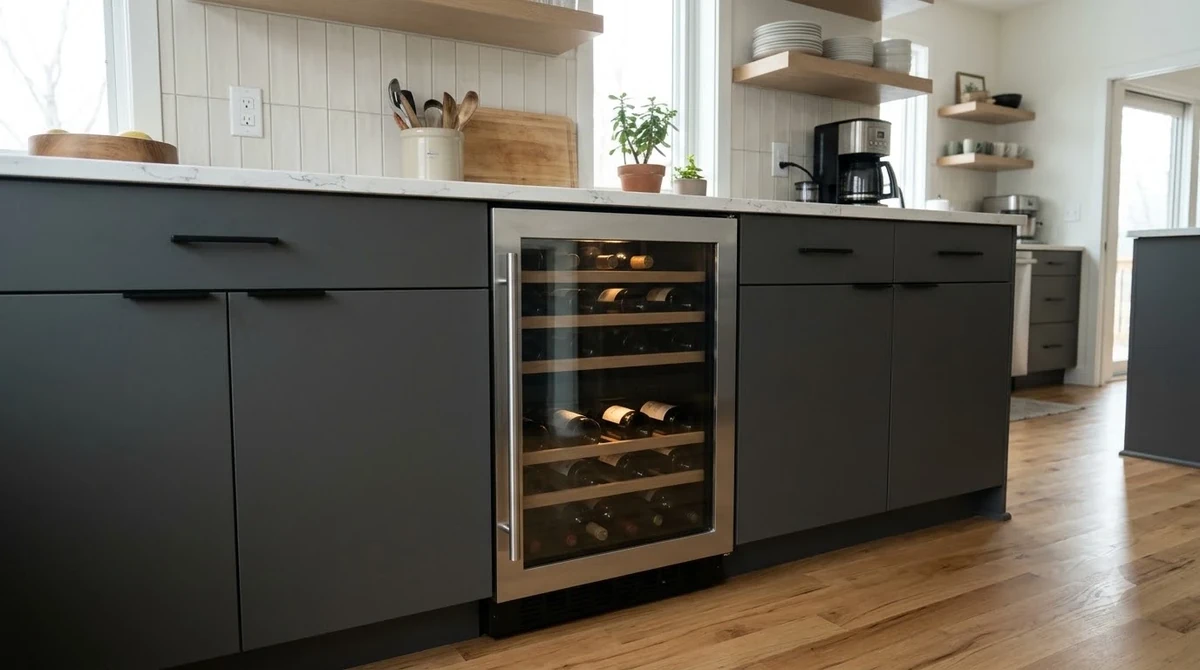
An under-counter model fits beneath a standard counter and suits a small kitchenette, a studio apartment, or a compact bar. It keeps the bottles at a comfortable height and out of the way.
Why it stands out: An under-counter unit uses space that is already there, and the counter top hides the cabinet. It is often the easiest choice for a small room that needs a finished look.
Keep in mind: Counter height limits the interior, so a tall magnum or an oversized bottle may not fit. Measure the tallest bottle you own before buying.
Best for Studio Apartments
A studio apartment has one main room, so the wine fridge sits in view of the bed, sofa, and kitchen. A compact dual-zone cabinet can serve two wine styles without taking up a second corner.
Why it stands out: A single cabinet covers the wine collection, and a dual-zone model can keep reds and whites apart. The unit can double as a visual feature when it matches the rest of the room.
Because the whole apartment is one room, the cabinet’s sound and light are noticed at all hours. Place it where the compressor noise will not sit beside the bed, and choose a finish that blends with the rest of the furniture so the cabinet does not dominate the room.
Keep in mind: Studio apartments often have less airflow and more heat from the kitchen. Choose a unit with a steady setting and keep it away from the stove and the sunniest wall.
Best for Living Rooms and Open Plans
In an open plan, the wine cabinet becomes part of the living area. A freestanding model with a neat finish suits this setting, especially when it sits beside a sideboard or media unit.
Why it stands out: A freestanding unit does not need a cabinet opening, so it can move with you. A glass door or a tidy front rack can show a few favorite bottles.
Keep in mind: Glass doors let in light, so keep the cabinet away from direct sun. The Wikipedia article on wine cellars lists light among the factors that can spoil wine, so the placement matters as much as the size.

Best for Built-In Columns in Small Kitchens
A built-in column replaces a tall cabinet and keeps the look of a planned kitchen. In a small room, a column with a narrow face can add storage without crowding the counter.
Why it stands out: A built-in fits flush with the cabinetry and uses the depth of the wall rather than the floor. The shelf layout is usually fixed, so the planning step does most of the work.
Keep in mind: Once the opening is cut, changing the interior is hard. Measure the tallest bottle, the door swing, and the vent clearance before ordering.
How to Choose
Start with the space, not the bottle count. Measure the width, depth, and height of the spot you have, then subtract room for the door swing and the vents. A cabinet that leaves a few inches on each side is easier to live with than one that fills the gap exactly.
Next, check the interior. Removable shelves make a small cabinet more flexible, because you can set one row for magnums and keep the rest for everyday bottles. Shelves that slide out are easier to load in a tight kitchen than fixed racks at the back.
Consider the temperature. A small room can get warm from the stove, a sunny window, or a heating vent. The Wikipedia article on wine cellars gives 13 °C (55 °F) as ideal for short-term storage and long-term aging, with 10 to 14 °C (50 to 57 °F) as a normal aging range. A cabinet that holds a steady setting in a warm room is more useful than one that only lists a low minimum.
Finally, think about noise. A compressor in a small apartment is close to the living area and the bedroom, so check the noise rating or the reviews from owners who use the unit in a similar room. Some owners find that a cabinet placed on a rug or a firm mat sounds quieter, because the mat absorbs some of the vibration from the floor.
Plan the first week, too. Let the cabinet run for a day before loading it, so the temperature settles, and then add the bottles gradually. That routine helps you spot any rise in temperature early, while the room and the cabinet are still easy to adjust.
Frequently Asked Questions
What is the best size for a small-space wine fridge?
There is no single size. Measure the space first, then choose the widest unit that still leaves room for the door and vents. A slim model with removable shelves often works better than a wide model that holds fewer bottles.
Can a small wine fridge hold a magnum?
Some do, but compact units are often sized for 750 ml bottles. Check the interior height and shelf layout against the tallest bottle you own before buying.
Should a wine fridge go in a warm kitchen?
A warm room makes it harder for a cabinet to hold its setting. Keep the unit away from the stove, ovens, and direct sun, and leave the recommended space around the vents. The Wikipedia article on wine cellars notes that large temperature swings can affect wine.
Is a built-in wine fridge worth it in a small kitchen?
It can be, if the opening is planned for the cabinet and the look matters to you. A built-in takes more work to install and is harder to change later, so measure the space carefully before committing.
A wine fridge for a small space works best when the footprint, shelves, and temperature all match the room. Measure the spot, choose a shelf layout that fits your bottles, and keep the vents clear. For related options, see the best bar wine fridge and the best wine fridge for an apartment. For more room-by-room ideas, browse the by-room guides, and for a quick reference on bottle volume, see how many glasses are in a bottle of wine.
More in By Room & User
 Wine Fridge in Bedroom: Choose Quiet Storage That Fits Your SpaceUpdated Nov 20, 2026
 Wine Fridge in Living Room: Choose the Right Size, Style, and SetupUpdated Nov 20, 2026
 Wine Fridge In Dining Room: Choose the Right Size and StyleUpdated Nov 20, 2026
 Wine Fridge In Pantry: Choose the Right Size and SetupUpdated Nov 20, 2026
 Wine Fridge In Kitchen: Choose the Right Fit and PlacementUpdated Nov 20, 2026
 Wine Fridge In Garage: Choose a Cooler That Handles Temperature SwingsUpdated Nov 20, 2026