

We may earn a commission when you buy through links on this page, at no extra cost to you. Learn more.
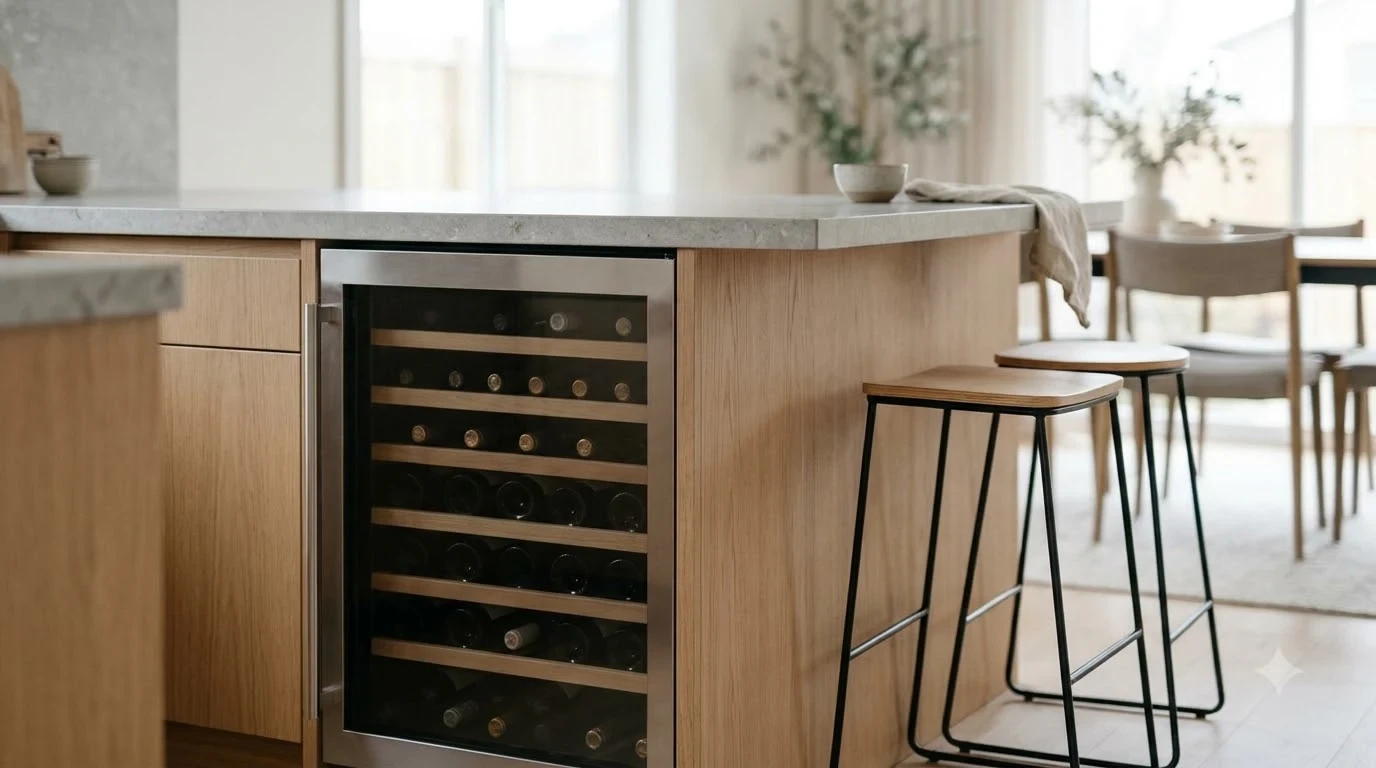
A wine fridge in kitchen spaces works best when its installation type, ventilation requirements, bottle capacity, and temperature controls match the available cabinetry and everyday cooking routine. For an undercounter installation, choose a front-venting model specifically approved for built-in use. For an open corner or unused stretch of floor, a freestanding refrigerator can provide more placement flexibility. The right choice keeps bottles accessible without creating ventilation problems or interfering with kitchen storage.
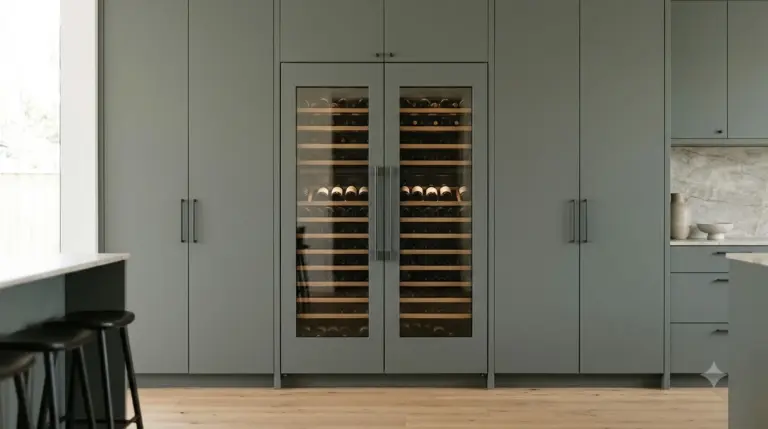
A kitchen wine refrigerator is both a practical storage appliance and a design decision. It can fit beneath a countertop, occupy a dedicated cabinet opening, sit at the end of a kitchen island, or stand independently beside a dining area. However, a refrigerator that looks appropriately sized is not necessarily suitable for an enclosed cabinet. Its ventilation system, door movement, electrical access, and clearance requirements determine where it can safely operate. This guide explains how to choose the right configuration, compare important features, and plan a convenient installation.
Who Should Choose a Kitchen Wine Refrigerator?
A kitchen wine refrigerator is particularly useful for households that regularly serve wine, entertain guests, or want bottles stored separately from everyday groceries. A compact 12-to-24-bottle appliance can suit occasional drinking, while a larger 40-to-50-bottle cabinet offers more flexibility for households with several wine styles.
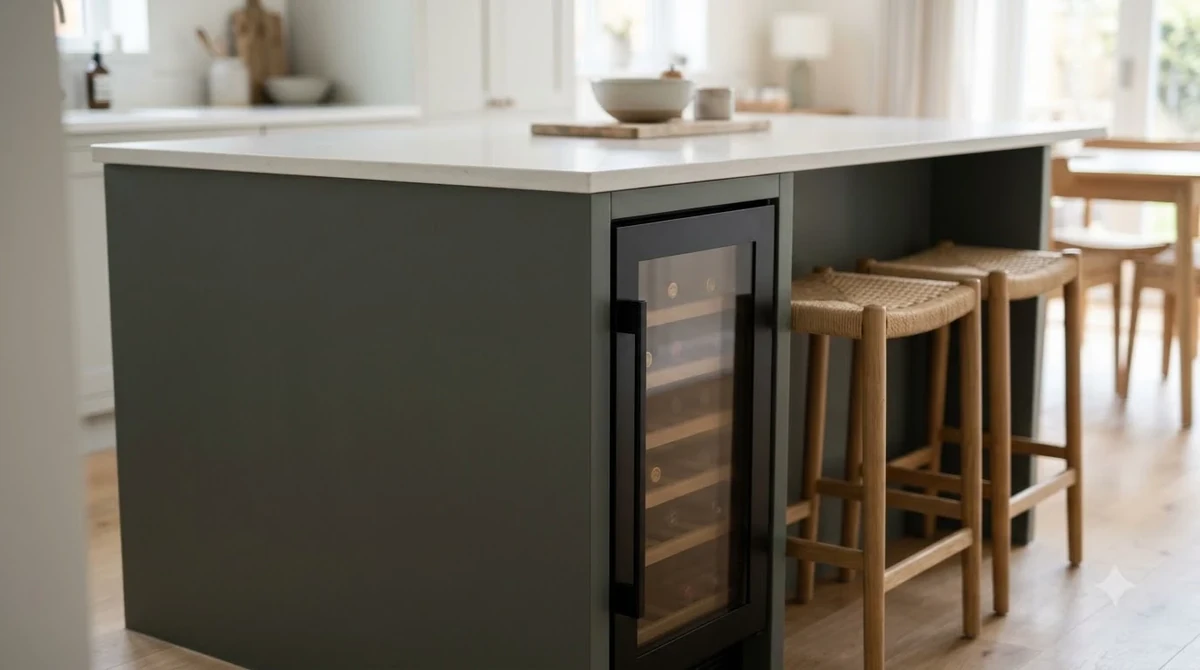
Home cooks and regular wine drinkers benefit from having bottles close to the dining table and food preparation area. Instead of searching through a crowded household refrigerator, they can organize sparkling wine, whites, rosé, and reds in a dedicated space. A dual-zone appliance can be especially convenient for households that regularly serve both chilled whites and moderately cool reds.
Kitchen renovators should consider a built-in refrigerator before finalizing cabinet dimensions. Choosing the appliance early makes it easier to coordinate the opening, electrical connection, ventilation grille, door hinges, and surrounding panels. A planned installation generally produces a cleaner result than trying to squeeze a refrigerator into an existing cabinet after the kitchen is finished.
Apartment residents and smaller households may prefer a narrow freestanding unit or a compact undercounter model. A dedicated appliance can preserve the main refrigerator’s shelf space while providing a convenient place for a modest collection. For smaller homes, a useful starting point is this guide to an apartment wine fridge, which considers limited floor space and practical storage capacity.
Not every kitchen needs a large wine cellar. If the household usually keeps six to twelve bottles available, a smaller appliance may be sufficient. Conversely, collectors who purchase wine by the case should consider whether the kitchen is the best location for their entire collection. A separate storage room or dedicated wine cabinet may offer more capacity and fewer interruptions from everyday kitchen activity.
Key Factors to Compare Before Buying
The most important buying considerations are installation compatibility, cabinet dimensions, bottle capacity, temperature zones, and operating noise. Comparing these five factors before choosing a model helps avoid an appliance that fits physically but performs poorly in its intended location.
| Factor | What to compare | Practical kitchen consideration |
|---|---|---|
| Installation | Built-in, undercounter, or freestanding | Front ventilation is essential for most enclosed cabinet installations. |
| Width | Approximately 15 or 24 inches | Match the refrigerator to the planned cabinet opening. |
| Capacity | 12, 24, 36, or 50 bottles | Allow extra capacity for wider Champagne and Burgundy bottles. |
| Temperature zones | One or two independent zones | Dual-zone storage accommodates different serving preferences. |
| Operating noise | Manufacturer’s decibel specification | Important in open-plan kitchens and adjoining dining areas. |
| Door clearance | Hinge direction and open-door depth | Check nearby drawers, islands, and dishwasher doors. |
| Ventilation | Front grille or rear and side clearance | Keep the specified air passages unobstructed. |
Installation type and ventilation
This is the first feature to compare because installation mistakes can affect the entire appliance. Built-in refrigerators are generally designed to release warm air through a front grille. Freestanding refrigerators may instead release heat through the back or sides and require open space around their cabinets.
Whynter explains this distinction in its built-in wine refrigerator installation guidance. Its panel-ready units use front ventilation, while rear-venting freestanding appliances need additional breathing room. This difference is particularly important when installing a refrigerator between kitchen cabinets.
Dimensions and usable capacity
Two common nominal widths for undercounter appliances are 15 inches and 24 inches. A narrow unit can occupy a smaller cabinet opening, while a wider refrigerator generally provides more storage flexibility. However, the nominal width is not the same as the required cabinet cutout width.
Capacity also deserves careful attention. Manufacturers commonly calculate bottle counts using standard 750 ml Bordeaux-shaped bottles. Champagne, Pinot Noir, and wider Burgundy bottles may occupy more shelf space. A refrigerator advertised for 40 bottles may therefore accommodate fewer bottles from a collection containing several different shapes.
Temperature zones and controls
A single-zone appliance maintains one consistent temperature throughout the cabinet. This arrangement is useful when the majority of stored wine needs similar conditions, such as a collection focused on reds or bottles kept at a consistent storage temperature.
A dual-zone appliance offers separate temperature settings. One section can accommodate whites and sparkling wines, while the other holds reds at a different temperature. The added flexibility is helpful for households that regularly serve different wines with dinner.
Noise and everyday convenience
A kitchen refrigerator should be convenient without becoming distracting. Compressor operation and internal fans produce some noise, so compare the manufacturer’s decibel specifications rather than relying only on descriptions such as quiet or low-noise.
Also consider the position of the controls, interior lighting, shelf construction, door alarm, and lock. These features can make everyday use more straightforward, especially when the appliance is installed beneath a countertop and accessed frequently.
Step-by-Step: Planning the Right Kitchen Installation
A successful installation begins with measuring the available space and identifying the appliance’s ventilation route. Following these six steps helps coordinate the refrigerator with existing cabinets, electrical access, and kitchen traffic.
-
Choose the intended location.
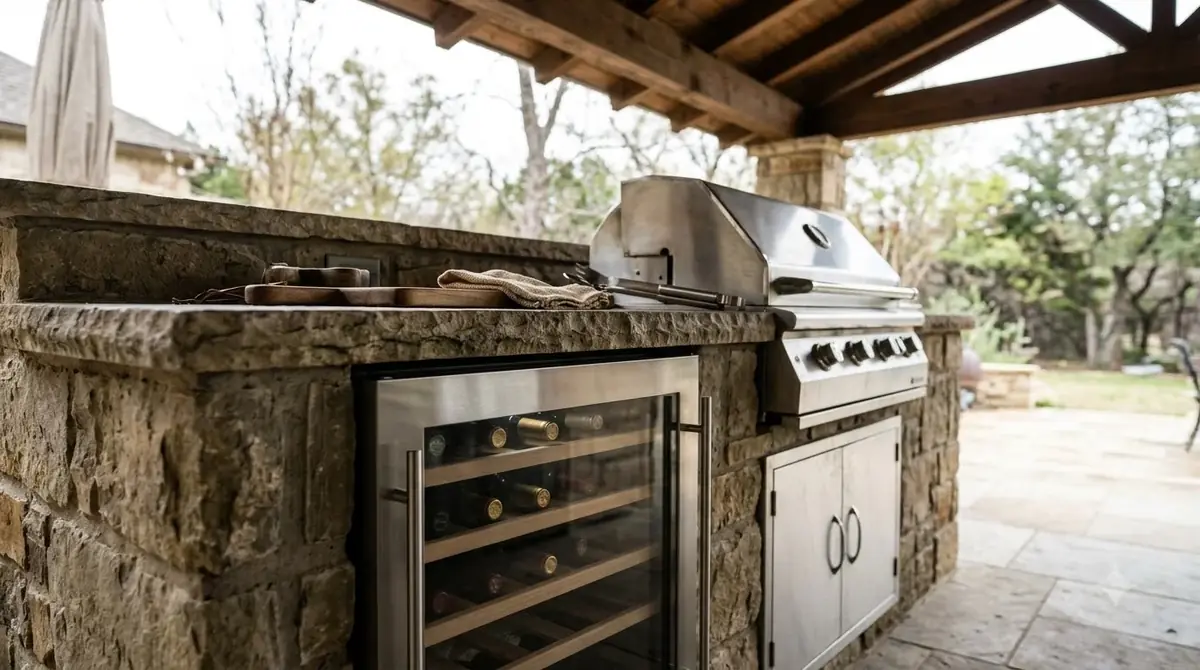
Identify whether the refrigerator will sit beneath a countertop, inside a dedicated cabinet, beside a kitchen island, or in an open corner. Consider how often bottles will be accessed and whether someone can open the door without blocking the cooking area. Avoid placing the appliance directly beside a stove, oven, radiator, or sunny window.
-
Measure the available opening.
Record the opening’s width, height, and depth in inches. Measure the space at several points because cabinet walls and floors are not always perfectly square. Include the countertop underside, toe kick, adjacent handles, and any protruding trim in the measurements.
-
Check the installation specification.
Find the manufacturer’s installation diagram for the exact refrigerator model. Confirm whether it is rated for built-in installation and identify the required ventilation openings. Never assume that a freestanding refrigerator can be installed in a closed cabinet simply because its external dimensions fit.
-
Plan electricity and service access.
Locate an appropriate grounded electrical outlet that remains accessible according to the manufacturer’s requirements. Check the power cord position and make sure it cannot become trapped behind the cabinet. Allow sufficient room to pull the appliance forward for servicing when necessary.
-
Check the door swing and shelf movement.
Determine whether the hinges should be positioned on the left or right. Measure the fully opened door, not just the closed appliance. Check whether neighboring drawers, dishwasher doors, kitchen stools, or walkways will interfere with opening the refrigerator and removing a loaded shelf.
-
Position, level, and commission the refrigerator.
Place the appliance on a suitable level surface, adjust its feet, and ensure the ventilation grille remains exposed. Follow the manufacturer’s transportation and startup instructions before connecting it to power. Set the temperature, allow the cabinet to stabilize, and confirm that the door seals properly.
A useful example is the Zephyr PRW24C01CG installation diagram. Its specified undercounter opening requires at least 24 inches of width and 34 inches of height, with at least 1 inch behind the unit for the electrical connection. The manufacturer also specifies 2-1/4 inches of door-handle clearance beside an adjacent wall. These are model-specific figures, not universal requirements for every 24-inch wine refrigerator.
Tip: Before ordering a refrigerator or modifying cabinets, make a full-size outline of the appliance’s footprint and mark the door’s opening path with painter’s tape. This simple exercise can reveal collisions with drawers, dishwasher doors, island seating, and nearby walkways before installation begins.
Types of Kitchen Wine Refrigerators Explained
Kitchen installations generally fall into three configurations: built-in, undercounter, and freestanding. The best option depends on the cabinet design, available floor space, and the ventilation system rather than appearance alone.
Built-in wine refrigerators
A built-in wine refrigerator is designed to fit within a specified cabinet opening. Many models use a front ventilation grille that releases warm air into the room instead of requiring open space behind the appliance.
This configuration is suitable for fitted kitchens where a coordinated appearance matters. Some refrigerators offer panel-ready doors that accept matching cabinetry, allowing the appliance to blend with neighboring cabinet fronts. Others use stainless steel or black glass doors as a visible design feature.
Front ventilation does not mean that every clearance requirement disappears. Some manufacturers specify small side or top gaps, a particular toe-kick arrangement, or additional ventilation openings. The exact installation drawing remains the deciding document.
Undercounter wine refrigerators
An undercounter refrigerator occupies a dedicated space beneath the kitchen worktop. This is a particularly practical arrangement for households that serve wine regularly because bottles remain close to food preparation and dining areas.
Some undercounter models are fully built-in appliances, while others are intended for freestanding placement beneath an open counter with additional clearance. The terms should not be treated as interchangeable. Look for explicit approval for the intended installation before purchasing.
A 24-inch-wide undercounter model may suit a larger kitchen cabinet run, while a 15-inch unit can work in a narrower opening. The available depth and height are equally important, especially when the countertop and cabinet toe kick are already installed.
Freestanding wine refrigerators
A freestanding refrigerator works well when the kitchen has an open corner, an unused wall section, or enough floor space beside a dining area. It generally offers simpler placement because it does not need to match a fitted cabinet opening.
However, freestanding appliances need the ventilation clearances specified by their manufacturers. A refrigerator that releases heat through the rear or side panels should not be pushed into a tightly enclosed kitchen cabinet. Restricted airflow can make the cooling system work harder and affect temperature stability.
Single-zone and dual-zone configurations
Single-zone refrigerators offer straightforward temperature management and are often suitable for collections centered on one style of wine. Dual-zone refrigerators provide greater flexibility when the same household stores reds, whites, and sparkling wines for different occasions.
For example, a household that frequently serves Sauvignon Blanc and Pinot Noir may appreciate two separate settings. Sauvignon Blanc generally benefits from cooler serving temperatures, while Pinot Noir is typically served slightly warmer than most chilled whites.
For an installation incorporated into a kitchen island, consider a dedicated kitchen island wine refrigerator guide. Island placement introduces additional questions about cabinet depth, ventilation, seating clearance, and access from both sides of the kitchen.
Common Kitchen Wine Refrigerator Buying Mistakes
Many installation problems come from choosing an appliance based on appearance or bottle capacity before checking its technical requirements. Paying attention to ventilation, heat exposure, and accessibility helps prevent avoidable problems.
Putting a freestanding model inside an enclosed cabinet
This is one of the most important mistakes to avoid. A refrigerator designed to release heat from its rear or sides needs the open space specified in its manual. Enclosing it can trap warm air and reduce its cooling efficiency.
Whynter specifically distinguishes its front-venting built-in appliances from rear-venting freestanding models. Although a built-in model can generally be operated independently with suitable airflow, the reverse arrangement is not automatically acceptable.
Measuring only the refrigerator’s front width
External width does not establish whether an appliance will fit a cabinet recess. The opening also needs to accommodate height, depth, adjustable feet, ventilation, power connections, and the door handle.
A refrigerator that technically fits may still prevent an adjacent drawer from opening. Measure the complete installation rather than relying on a single width measurement.
Ignoring nearby heat sources
Placing a wine refrigerator beside an oven or cooking range can expose its exterior to additional heat. Direct sunlight through a kitchen window can also increase the workload on the cooling system.
Choose a position away from heat-producing appliances and strong sunlight. A location at the end of a cabinet run or beside a dining area may be more practical than the narrow space immediately next to the cooking zone.
Buying based on advertised bottle capacity alone
Capacity figures generally use standard Bordeaux bottles. A collection containing larger Champagne bottles, Burgundy bottles, and unusual bottle shapes may occupy considerably more space.
Check whether the shelves are removable, adjustable, or designed to accommodate different bottle diameters. Flexible shelving can be more useful than a higher advertised capacity with fixed, tightly spaced racks.
Forgetting the door and service access
A door that opens toward a dishwasher or cabinet drawer can make everyday access inconvenient. Similarly, a refrigerator installed so tightly that it cannot be pulled forward may complicate repairs and routine maintenance.
Consider the kitchen’s busiest activities, including meal preparation and cleanup. The refrigerator should be accessible without obstructing the person using the sink, dishwasher, or cooking surface.
Choosing unnecessary features
A touchscreen, elaborate lighting system, and multiple temperature zones may look appealing, but not every household needs them. Someone storing a small collection of everyday reds may be better served by a straightforward single-zone refrigerator.
Prioritize reliable temperature control, appropriate capacity, shelf flexibility, ventilation, and practical door access. Additional features should solve a genuine storage or convenience problem.
Care, Placement, and Wine Storage Tips
A properly installed wine refrigerator still needs suitable operating conditions and regular maintenance. Keeping its ventilation clear, maintaining stable temperatures, and avoiding unnecessary door openings can help it perform consistently in an active kitchen.
Choose a suitable temperature setting
For longer-term storage of a mixed collection, approximately 55°F is a useful general target. The ideal setting for a particular bottle depends on the wine style and whether it is being stored or prepared for serving.
Typical serving temperatures differ by wine type:
- Sparkling wines: 40–50°F.
- Light-bodied white wines and rosé: 45–50°F.
- Full-bodied white wines: 50–55°F.
- Light-bodied red wines: 55–60°F.
- Full-bodied red wines: 60–65°F.
- Sweet white wines: 43–50°F.
These are serving ranges rather than universal long-term storage settings. A single-zone refrigerator may be better used as a consistent storage cabinet, with individual bottles briefly adjusted before serving. A dual-zone model provides more flexibility for households that want several styles ready to drink.
Protect the refrigerator’s ventilation system
Inspect the front grille periodically and remove accumulated dust according to the manufacturer’s cleaning instructions. Never cover ventilation openings with decorative panels, rugs, storage baskets, or other kitchen accessories.
Keep the surrounding cabinetry clean and avoid placing items directly against the ventilation opening. If the refrigerator starts running unusually frequently or its internal temperature becomes inconsistent, check for blocked airflow and unsuitable ambient conditions.
Maintain stable storage conditions
Wine benefits from reasonably consistent temperatures. Frequent fluctuations caused by placing bottles in a warm kitchen corner or repeatedly exposing the appliance to direct sunlight are undesirable for long-term storage.
Keep the refrigerator away from ovens, heating appliances, and direct sunlight. Avoid positioning it in an area exposed to water splashes or excessive moisture. The manufacturer may also specify a permitted ambient operating-temperature range that must be respected.
Organize bottles for easier access
Group bottles by style, intended serving temperature, or drinking occasion. For example, sparkling wines can occupy a designated section, while everyday whites and reds remain easy to identify on their respective shelves.
Most wine refrigerators store bottles horizontally or at a slight angle. This arrangement uses shelf space efficiently and is appropriate for traditional cork-finished bottles. Keep bottles organized rather than packing every available space with oversized containers.
Clean and maintain the appliance
Clean interior surfaces with a soft cloth and an appropriate mild cleaning solution. Avoid abrasive materials and harsh chemicals that can damage finishes, shelves, and seals. Follow the manufacturer’s directions before removing shelves or cleaning ventilation components.
Inspect the door gasket periodically to make sure it remains clean and seals properly. Check that the appliance is level and that its shelves are correctly positioned. A poorly leveled cabinet can contribute to vibration and unwanted noise.
For additional room-by-room placement ideas, the By room planning resource can help compare the practical differences between kitchen, dining room, bar, and other household installations.
Frequently Asked Questions
Can a wine refrigerator be installed next to a regular refrigerator?
Yes, provided both appliances have the clearances and ventilation required by their manufacturers. Pay attention to heat transfer between the cabinets and ensure neither appliance blocks the other’s air intake or exhaust. The surrounding kitchen design should also allow both doors to open fully.
Does a kitchen wine refrigerator need a carbon filter?
Some wine refrigerators include an activated carbon filter intended to help manage odors inside the storage cabinet. Filter availability and replacement intervals differ between manufacturers. A carbon filter is a feature to compare rather than a requirement that applies to every kitchen wine refrigerator.
Can wine bottles be stored in a refrigerator during a power outage?
An unopened refrigerator generally retains its internal cool air for some time, although the duration depends on insulation, room temperature, and how often its door is opened. Keep the door closed during an interruption and monitor the temperature when electricity returns. Extended outages may require a separate plan for protecting valuable bottles.
How long should a wine refrigerator run before the first bottles are loaded?
There is no universal waiting period because cooling time depends on the cabinet size, starting temperature, and refrigeration system. Allow the appliance to reach its selected operating temperature before filling it. Consult the manufacturer’s startup instructions for the specific model.
Can an ordinary beverage refrigerator replace a wine refrigerator?
Not necessarily. Beverage refrigerators are often designed for colder drink storage and may use flat shelves intended for cans and bottles rather than contoured wine racks. A dedicated wine refrigerator generally offers more appropriate bottle support and temperature settings for a wine collection.
The best kitchen wine refrigerator is one that fits the available space without compromising ventilation, bottle access, or temperature control. For most planned cabinet installations, a properly sized front-venting built-in or undercounter model is the practical starting point, while a freestanding unit makes sense where open space is available. Measure carefully, compare single-zone and dual-zone configurations, and choose an appliance that suits the way the household actually stores and serves wine.
More in By Room & User
 Wine Fridge in Bedroom: Choose Quiet Storage That Fits Your SpaceUpdated Nov 20, 2026
 Wine Fridge in Living Room: Choose the Right Size, Style, and SetupUpdated Nov 20, 2026
 Wine Fridge In Dining Room: Choose the Right Size and StyleUpdated Nov 20, 2026
 Wine Fridge In Pantry: Choose the Right Size and SetupUpdated Nov 20, 2026
 Wine Fridge In Garage: Choose a Cooler That Handles Temperature SwingsUpdated Nov 20, 2026
 Wine Fridge In Cabinet: How to Choose the Right Built-In FitUpdated Nov 20, 2026