

We may earn a commission when you buy through links on this page, at no extra cost to you. Learn more.
A wine fridge in dining room spaces works best when its capacity, cooling system, ventilation, and appearance suit both your wine collection and your available floor space. A compact freestanding cooler can fit beside a sideboard, while a front-venting built-in model can create a more integrated furniture arrangement. The right choice keeps bottles at stable temperatures, makes serving convenient, and avoids turning an attractive dining area into an appliance installation problem.
A dining room is a practical location for wine storage because bottles are close to the table, glassware, and entertaining area. Unlike a kitchen refrigerator, a dedicated wine cooler is designed around wine storage temperatures, bottle shelving, and convenient access. However, dining rooms present their own challenges: furniture arrangements, foot traffic, natural light, room temperature, and noise all influence which refrigerator makes sense. Before choosing a model, consider how many bottles you actually keep, whether you serve red and white wines regularly, and how much space you can dedicate to the appliance.
Who Should Choose a Dining Room Wine Refrigerator?
A dining room wine refrigerator is particularly useful for households that entertain regularly, keep several wine styles available, or want convenient access to bottles during meals. The best arrangement combines practical storage with an appliance that looks appropriate alongside the room’s furniture.
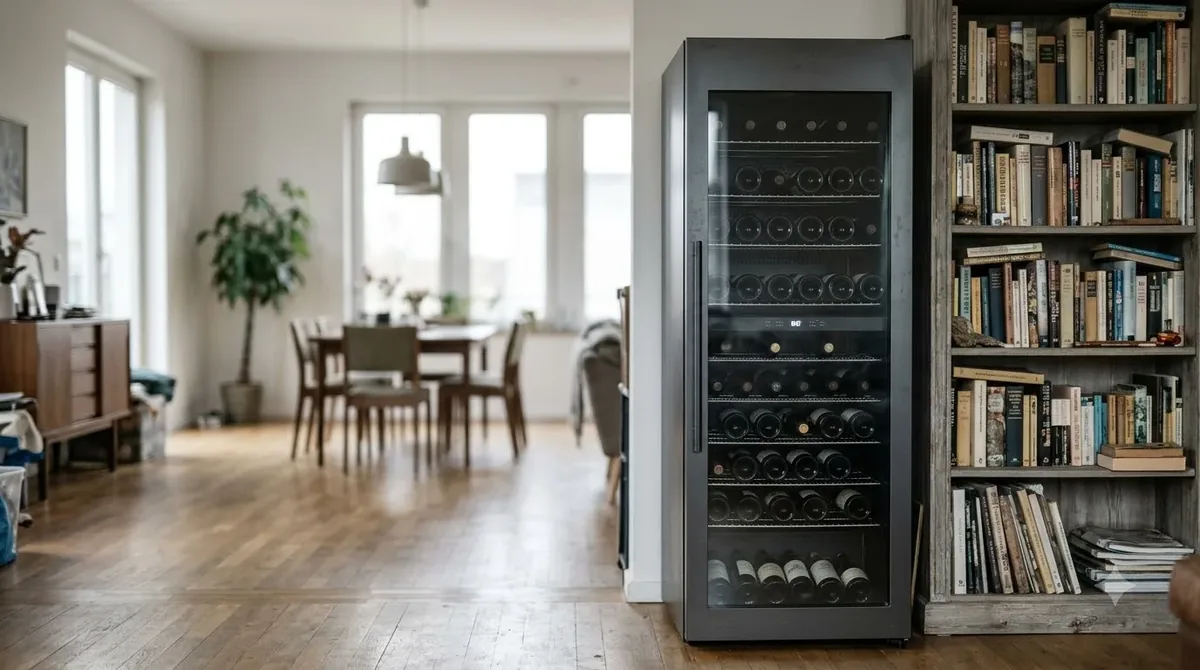
For regular dinner hosts, a wine cooler near a dining room sideboard or serving cabinet can make opening and selecting bottles easier. Instead of walking between the dining room and kitchen, hosts can retrieve a chilled Sauvignon Blanc, sparkling wine, or bottle of Pinot Noir close to the table. This is especially useful during gatherings when several bottles may be served throughout an evening.
It is also a sensible arrangement for people who want a dedicated place for wine without converting a basement, pantry, or spare room into a storage area. A standalone refrigerator can become part of the dining room furniture arrangement, particularly when its exterior, door finish, and shelving complement the surrounding wood, metal, or glass finishes.
Choose capacity according to actual use
Start with the number of bottles you regularly keep rather than the maximum number you might eventually collect. A household that usually has 8 to 12 bottles available for meals may not need a large cabinet designed for an extensive collection. A compact refrigerator with some additional room can be more practical than a tall appliance that dominates the room.
Consider your purchasing habits, too. Someone who buys wine by the case will need considerably more capacity than someone who purchases a few bottles each week. Remember that advertised capacities generally assume standard Bordeaux-style bottles. Champagne bottles, Burgundy bottles, and wider formats can reduce the usable total.
Consider the room’s everyday activities
A dining room is not necessarily a temperature-controlled storage environment. Large windows, afternoon sunlight, heating registers, and nearby fireplaces can create warmer conditions than the rest of the house. Choose a location away from these sources of heat and avoid placing the cooler where direct sunlight shines through its glass door.
For households with an open dining and living area, operating noise deserves special attention. A refrigerator that cycles frequently or vibrates against furniture may become distracting during quiet meals. Look for published operating-noise information, read owner feedback about compressor cycling, and make sure the installation surface is stable.
Key Factors to Compare Before Buying
The most important comparison points are bottle capacity, installation type, temperature zones, cooling technology, and noise. These factors determine whether a wine refrigerator works comfortably in the dining room rather than simply fitting into an available opening.
Use the following comparison as a starting point. The measurements and temperatures are practical planning references, not specifications shared by every manufacturer.
| Factor | What to consider | Dining room priority |
|---|---|---|
| Capacity | 12–24 bottles for a compact collection; 30–50 for a larger selection | High |
| Cooling zones | 1 zone for consistent storage; 2 zones for separate serving preferences | High |
| Storage temperature | Approximately 55°F for general long-term storage | High |
| Light red serving | 55–60°F | Medium |
| Full red serving | 60–65°F | Medium |
| Light white and rosé serving | 45–50°F | High |
| Sparkling wine serving | 40–50°F | Medium |
| Freestanding clearance | Several inches around the appliance, depending on its manual | Very high |
| Built-in ventilation | Front ventilation with the required grille clearance | Very high |
Capacity and usable shelf space
A 12- to 24-bottle cooler is a reasonable starting category for a smaller dining room. A 30- to 50-bottle appliance provides more flexibility for households that serve different wines or purchase multiple bottles at a time. Larger collections may justify a tall cabinet, provided there is enough space for the door to open and guests to move around it.
Do not rely entirely on the advertised bottle count. Wine bottles are not all the same size. A standard Bordeaux bottle has a relatively narrow profile, while Champagne and some Burgundy bottles have wider bodies. Shelves that accommodate standard bottles neatly may become difficult to use when several wider bottles are added.
Cooling zones and temperature controls
A single-zone refrigerator maintains one target temperature throughout its main compartment. This is a practical option when most bottles are stored for future use at a consistent temperature. Vinotemp identifies approximately 55°F to 58°F as a desirable long-term storage range for red and white wines.
A dual-zone refrigerator has two separately controlled compartments. This arrangement is useful when one section needs to hold white wines and sparkling wines colder while another section keeps red wines closer to their preferred serving temperatures. It can reduce the need to move bottles between appliances before dinner.
Noise, lighting, and door design
Dining rooms are social spaces, so noise matters more than it might in a basement or utility room. Compressor systems can produce operating sounds as they cycle. Thermoelectric units may be quieter, although their cooling performance can be more sensitive to surrounding room temperatures.
Also consider the door. A UV-protective glass panel can help limit light exposure, while a reversible door may make placement easier near a wall or sideboard. Interior LED lighting is useful for selecting bottles without keeping the door open. Wooden shelf fronts and stainless steel trim can help the appliance coordinate with existing furniture.
Consumer Reports’ wine refrigerator buying guide also recommends comparing temperature uniformity, adjustable shelving, shelf stops, noise, and energy consumption. These details are particularly relevant when the appliance will sit close to a dining table or living area.
For a broader comparison of room-specific installation considerations, the By room wine refrigerator guide provides another useful starting point.
Step-by-Step: How to Plan the Right Dining Room Installation
Measure the complete installation area before shopping, then match the refrigerator’s ventilation design and bottle capacity to the room. A few measurements and practical checks can prevent an appliance from becoming an expensive furniture-placement problem.
-
Measure the available floor or cabinet space.
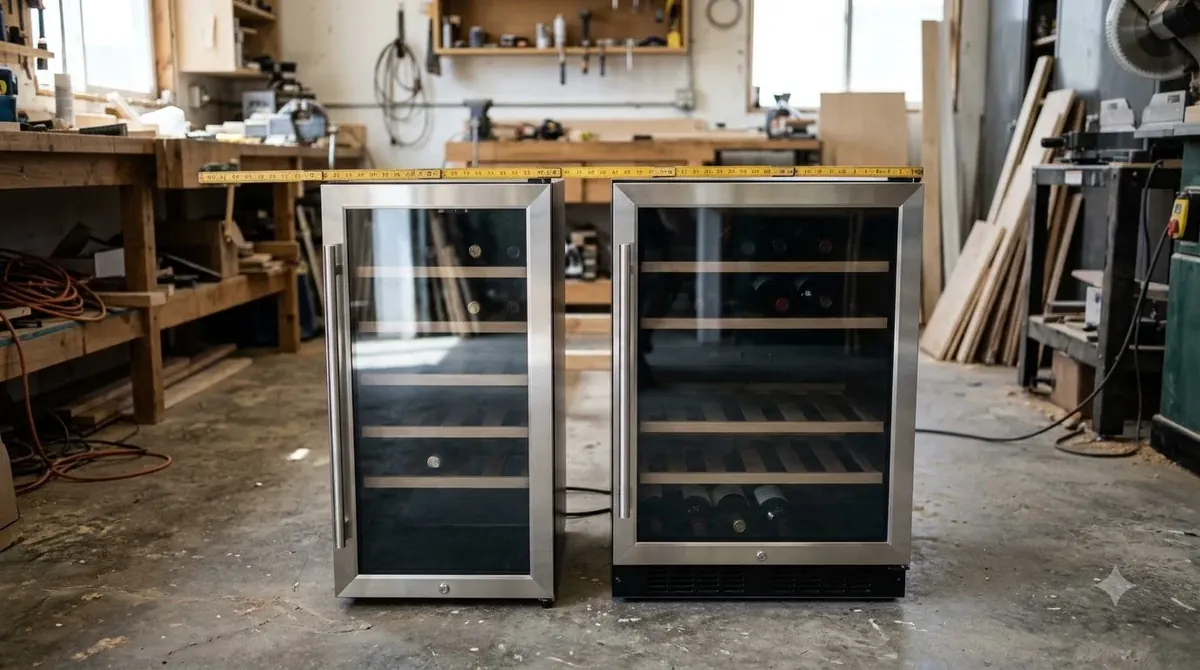
Measure the width, height, and depth of the intended location. Include the handle, door, feet, and any decorative trim in your planning. If the cooler will sit beside a sideboard, leave room for its door to open without striking the furniture.
-
Decide between freestanding and built-in installation.
A freestanding cooler is designed to stand independently and usually requires open space around its sides or rear. A built-in refrigerator is designed for installation within cabinetry and generally uses front ventilation. Never assume that a freestanding model can be placed inside an enclosed cabinet simply because its dimensions fit.
-
Check the ventilation requirements.
Read the installation manual before deciding on the final position. Danby describes approximately 2 to 3 inches of clearance around the sides and back as a typical recommendation for many freestanding wine coolers, while individual models can require different arrangements. A Midea manual specifies more than 30 cm above and more than 10 cm at the sides and rear for the particular model it covers. These figures are not interchangeable universal standards.
-
Check the surrounding room temperature.
Avoid locations beside fireplaces, heating radiators, sunny windows, and hot-air vents. A cooler that operates in a particularly warm location may struggle to maintain its selected temperature. Choose a position in the conditioned interior of the home rather than an exposed porch or unusually hot room.
-
Choose the bottle capacity.
Count the bottles you normally store and leave some spare capacity for future purchases. If you regularly serve Champagne or Burgundy, inspect the rack spacing carefully. Look for adjustable or removable shelves so the refrigerator can accommodate different bottle shapes.
-
Select the appropriate temperature arrangement.
Choose a single-zone cooler for consistent storage or a dual-zone design if you regularly keep different wine styles ready for serving. Compare the actual temperature ranges of the compartments rather than relying only on the words single-zone or dual-zone in a product description.
-
Check the electrical connection and floor.
Use an appropriately grounded electrical outlet and avoid routing the power cord through a doorway or walking path. Make sure the floor is level and sturdy enough to support the fully loaded appliance. A hard, stable surface is preferable to an unstable or uneven furniture platform.
-
Test everyday access before finalizing the position.
Open the door fully, slide out a shelf, and consider how someone will remove a bottle while another person is sitting nearby. Check that the appliance does not interfere with dining chairs, cabinet doors, or the normal route between the dining room and kitchen.
Tip: Make a cardboard outline of the refrigerator’s width and depth and place it on the floor before purchasing. Use another piece of cardboard to represent the open door. This simple exercise helps reveal problems with chair clearance, walking space, and nearby furniture before the appliance arrives.
Wine Refrigerator Types and Styles Explained
Dining room wine refrigerators generally fall into freestanding, built-in, compact, and dual-zone categories. The best style depends on whether the appliance should stand visibly as furniture, fit beneath a counter, or provide separate temperatures for different wines.
Freestanding wine refrigerators
A freestanding wine refrigerator is often the simplest choice for an existing dining room. It does not require custom cabinetry and can sit beside a sideboard, against an appropriate wall, or in an unused corner. Smaller models can be especially useful when the room has limited floor space.
The main consideration is ventilation. Many freestanding refrigerators release heat through their rear or sides, so placing one inside a tight enclosure can restrict airflow. Keep the required clearance open, including any space above the appliance. A freestanding model should not be treated as a built-in refrigerator simply because it has a similar exterior appearance.
For a home that already has a dedicated entertaining area, a bar wine fridge may be a better match if the primary goal is keeping bottles close to a serving counter rather than furnishing the dining room itself.
Built-in and under-counter wine refrigerators
A built-in wine refrigerator is designed to integrate with cabinetry. Its front-venting configuration allows it to release heat through the front grille, provided that the required installation openings remain unobstructed.
This design is particularly attractive beside a dining room buffet or within a purpose-built serving cabinet. However, built-in appliances require more careful planning. Measure the cabinet opening, door swing, electrical connection, and ventilation path before ordering. The manufacturer may specify additional rear access or service clearance even when the appliance is front-vented.
Do not place a built-in cooler behind a closed decorative cabinet door unless its installation instructions explicitly permit that arrangement. Restricting the front ventilation grille can compromise cooling performance.
Compact countertop and small-capacity models
Compact wine refrigerators can work for households that keep only a limited number of bottles. Their smaller dimensions make them suitable for some dining room furniture arrangements, although a countertop model still needs sufficient airflow and a surface capable of supporting its weight.
Check the actual depth and door clearance rather than judging the appliance by its advertised bottle count. A narrow refrigerator can be convenient, but a shelf arrangement that makes every bottle difficult to reach may become frustrating during dinner parties.
Single-zone and dual-zone refrigerators
Single-zone models are appropriate for people who prioritize steady storage conditions. They can hold a collection of reds, whites, or a mixture of wines at a consistent temperature. A setting near 55°F is a useful general storage target.
Dual-zone models are more versatile for entertaining. One compartment can be set for chilled whites and sparkling wines, while the other accommodates reds. The precise temperature range and compartment arrangement vary by manufacturer, so compare both zones before purchasing.
For a household that regularly serves Cabernet Sauvignon, Pinot Noir, Chardonnay, and Sauvignon Blanc at the same gathering, separate compartments can be more convenient than repeatedly transferring bottles between the wine refrigerator and kitchen refrigerator.
Common Mistakes When Placing a Wine Fridge in a Dining Room
The biggest installation mistakes involve restricted ventilation, excess sunlight, poor measurements, and choosing a refrigerator based entirely on its appearance. These problems can affect cooling performance and make the appliance inconvenient to use.
Enclosing a freestanding cooler
A common mistake is buying a freestanding model because it fits a particular furniture opening and then surrounding it with decorative panels. The refrigerator may look integrated, but its ventilation system may depend on open space around the cabinet.
Heat removed from the interior must be released somewhere. If the exhaust area is blocked, the cooling system may have difficulty maintaining the desired temperature and may run longer than expected. Choose a built-in model when the intention is to create a recessed installation.
Putting the refrigerator beside a heat source
Dining rooms sometimes include fireplaces, large windows, radiators, and heating vents. These features can make an otherwise suitable corner a poor location for wine storage.
Vinotemp and Midea both advise avoiding direct sunlight and heat sources. A shaded interior wall is generally preferable to a sunny window area. The same principle applies to glass-fronted cabinets that receive strong afternoon sunlight.
Buying according to advertised bottle capacity alone
A refrigerator advertised for 24 bottles may not accommodate 24 bottles of every shape. Larger sparkling wine bottles and wide Burgundy bottles can take up additional rack space. Some models also require removing a shelf to accommodate unusually tall bottles.
Look for rack dimensions, shelf adjustability, and examples of compatible bottle shapes. A refrigerator with fewer advertised spaces but more adaptable shelves can be more useful than one with a higher theoretical capacity.
Ignoring the door swing and dining furniture
A wine cooler positioned too close to a dining chair can make bottle retrieval awkward. The same problem occurs when a door opens against a wall or when pull-out shelves cannot extend completely.
Allow enough clearance to open the door, retrieve a bottle, and return it without moving nearby furniture. Think about the room when guests are seated, not just when the dining table is empty.
Choosing cooling technology without considering the room
Thermoelectric technology is often attractive because of its relatively quiet operation. However, these coolers can be less effective when the surrounding room becomes warm. A compressor-based model may be more appropriate when the dining room experiences larger seasonal temperature changes.
Neither technology is automatically the right choice for every household. Compare operating noise, cooling performance, room-temperature requirements, and owner feedback before deciding.
Care and Storage Tips for a Dining Room Wine Refrigerator
Good maintenance helps a dining room wine refrigerator operate consistently and keeps bottles organized. Pay particular attention to ventilation, door seals, temperature settings, and the way bottles are arranged inside the compartment.
Maintain a consistent storage temperature
For general long-term storage, approximately 55°F is a useful target. Stable temperature is more important than frequently changing the controls to match the serving temperature of individual bottles.
Wine does not need to be stored at its ideal drinking temperature. Storage and serving are different purposes. A wine refrigerator can keep bottles at a stable temperature while individual bottles are chilled or allowed to warm slightly before serving.
For example, light whites and rosé are generally served at 45–50°F, while full-bodied whites are better around 50–55°F. Light reds are commonly served at 55–60°F, and full-bodied reds around 60–65°F. Sparkling wines are typically served at 40–50°F, with sweet whites around 43–50°F.
Arrange bottles to make access easier
Store bottles horizontally when they have natural cork closures and are intended for longer storage. This helps maintain contact between the wine and cork. Follow the refrigerator manufacturer’s rack instructions, and avoid forcing bottles into spaces that are too narrow.
Keep bottles from touching the back wall or blocking internal air circulation. Midea specifically warns against allowing bottles to touch the rear wall of the model covered by its manual. This helps preserve airflow throughout the compartment.
Organize the shelves by style or intended use. For example, keep sparkling wine together, lighter whites on accessible shelves, and reds in a separate section when the refrigerator’s layout allows it. This makes selecting bottles during meals much easier.
Reduce unnecessary temperature changes
Opening the refrigerator repeatedly allows warmer room air to enter. During a dinner party, group the bottles you expect to serve rather than opening the door every few minutes to decide what comes next.
Digital temperature controls can make adjustments easier without repeatedly opening the door. A separate thermometer can also help verify that the actual interior temperature is reasonably consistent with the selected setting.
Keep the appliance clean and level
Wipe the exterior with a soft cloth and use cleaning products suitable for the manufacturer’s specified materials. Clean interior shelves periodically and remove spills before they become difficult to clean. Avoid abrasive products that could damage glass, metal, or wooden shelf finishes.
Check that the refrigerator remains level and that its feet are stable. An uneven appliance may vibrate against nearby furniture, potentially increasing operating noise. Make sure ventilation grilles remain free of dust and obstructions.
Plan for open bottles separately
A wine refrigerator is useful for unopened bottles, but opened wine requires different handling. Recorked still wines generally keep for about 3–5 days in the refrigerator, while sparkling wines typically keep for about 1–3 days when properly sealed. Fortified wines can last several weeks after opening, depending on the style.
For a dining room entertaining setup, a dedicated place for wine stoppers and sparkling wine closures can make post-dinner storage more convenient. Return opened bottles to appropriate refrigerated storage rather than leaving them on a warm sideboard overnight.
For smaller homes where the dining area also serves as a living space, an apartment wine fridge guide can help identify more compact storage arrangements. A larger collection that does not need immediate access may be better suited to a basement wine fridge, leaving the dining room available for entertaining.
Frequently Asked Questions
Can a wine refrigerator be installed in a dining room without a cabinet?
Yes. A freestanding wine refrigerator can operate as an independent appliance without custom cabinetry. It still needs a level surface, an appropriate electrical connection, and the ventilation clearance specified by its manufacturer. A decorative sideboard is optional rather than a requirement.
Does a wine refrigerator need a dedicated electrical circuit?
Not every residential wine refrigerator requires its own dedicated circuit. Electrical requirements depend on the appliance’s power rating and the home’s existing electrical installation. Check the manufacturer’s electrical specifications and consult a qualified electrician if the circuit capacity or outlet arrangement is uncertain.
Can a wine refrigerator be placed on a wooden dining room floor?
Yes, provided the floor is level, structurally suitable, and capable of supporting the loaded refrigerator. Protect delicate flooring from scratches by using appropriate non-slip protective pads if permitted by the appliance manufacturer. Avoid unstable furniture platforms that could move when the door or shelves are opened.
How long should a new wine cooler run before bottles are added?
The initial cooling period depends on the refrigerator’s design and instructions. Some manufacturers recommend allowing the appliance to stabilize for several hours before loading it, while others specify a particular startup procedure. A Midea manual, for example, instructs users to wait half an hour before connecting power after initial placement. Allow the interior to reach its intended operating temperature before adding a full collection.
Can a wine refrigerator store wine glasses and accessories?
Wine glasses, corkscrews, and other accessories should generally be stored outside the refrigerated compartment. Glassware takes up space intended for bottles and can interfere with airflow or shelf movement. A nearby dining room sideboard or dedicated serving drawer is a more practical place for these items.
The best wine fridge for a dining room balances useful capacity, quiet operation, stable temperatures, and an installation style that suits the furniture arrangement. Measure the available space, verify ventilation requirements, and choose between single-zone and dual-zone storage according to the wines you serve most often. With the right placement and a little planning, a wine refrigerator can become a practical and attractive part of the dining room rather than an appliance that gets in the way.
More in By Room & User
 Wine Fridge in Bedroom: Choose Quiet Storage That Fits Your SpaceUpdated Nov 20, 2026
 Wine Fridge in Living Room: Choose the Right Size, Style, and SetupUpdated Nov 20, 2026
 Wine Fridge In Pantry: Choose the Right Size and SetupUpdated Nov 20, 2026
 Wine Fridge In Kitchen: Choose the Right Fit and PlacementUpdated Nov 20, 2026
 Wine Fridge In Garage: Choose a Cooler That Handles Temperature SwingsUpdated Nov 20, 2026
 Wine Fridge In Cabinet: How to Choose the Right Built-In FitUpdated Nov 20, 2026