

We may earn a commission when you buy through links on this page, at no extra cost to you. Learn more.
A wine fridge in cabinet should be a built-in or undercounter model specifically designed for enclosed installation, with ventilation that matches the cabinet layout. The most important features are front-facing or manufacturer-approved ventilation, accurate cutout dimensions, suitable bottle capacity, and accessible electrical connections. Choosing the right configuration prevents overheating, makes everyday access easier, and helps maintain stable wine storage conditions.
A dedicated wine refrigerator can turn an unused section of kitchen cabinetry, an island, or a dining room built-in into practical wine storage. However, fitting a refrigerator into an existing cabinet involves more than finding an appliance with the right width. Its cooling system needs an appropriate airflow path, the door must open without obstruction, and the surrounding cabinetry must accommodate the manufacturer’s installation requirements. This guide explains how to choose a wine refrigerator for different cabinet locations, compare important specifications, and plan an installation that works for both your kitchen and your wine collection.
Who Should Choose a Wine Refrigerator for Cabinet Installation
A cabinet-installed wine refrigerator is particularly useful for homeowners who want convenient bottle storage without dedicating floor space to a separate wine cooler. It suits kitchens, islands, dining room cabinetry, and entertaining areas where bottles should remain accessible but out of sight.
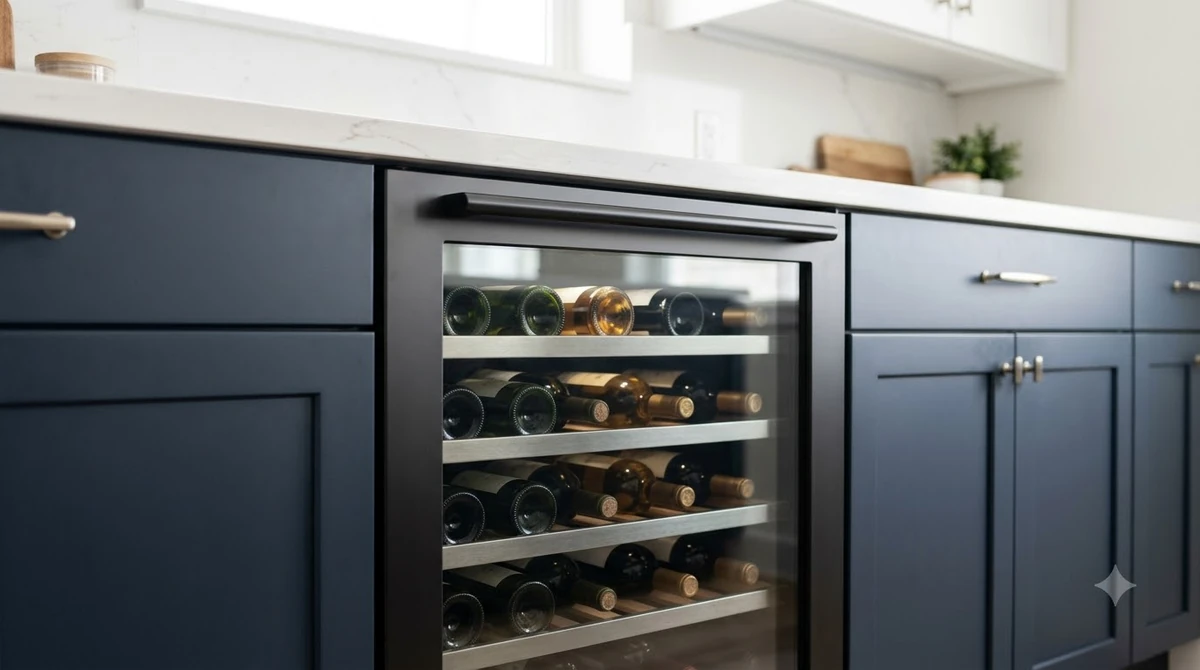
For a kitchen renovation, an undercounter wine fridge can occupy a dedicated opening beside the dishwasher, beneath a countertop, or at the end of a cabinet run. A built-in model with a finished front panel or stainless-steel door can complement existing appliances. A narrower unit may also fit into a cabinet arrangement where a conventional 24-inch appliance would be too wide.
Cabinet installation also works for households that regularly serve several wine styles. A single-zone refrigerator can maintain one consistent temperature for a collection primarily intended for long-term storage or for bottles that are ready to serve at a similar temperature. A dual-zone model provides separate temperature settings for different categories, such as sparkling wine and red wine.
There are several situations where a cabinet refrigerator is not the right solution. Renters with existing kitchen cabinetry may prefer a freestanding unit that does not require modifications. People with substantial collections may need a larger dedicated cellar rather than a compact undercounter appliance. Anyone considering a standard freestanding wine cooler for a closed cabinet should reconsider: the rear and side ventilation requirements can make that arrangement unsuitable.
Choosing the right room within the home
The kitchen is usually the most convenient location for everyday access, but it is not automatically the best environment. Ovens, dishwashers, direct sunlight, and warm cooking areas can create additional heat around an appliance. A cabinet away from these sources is preferable.
For a dedicated entertaining area, a bar wine fridge can provide convenient access to bottles without occupying valuable kitchen workspace. Apartment owners may prefer a smaller apartment wine fridge when cabinet dimensions and available electrical connections limit their choices.
People with more room may also consider a basement wine fridge, particularly when they want greater storage capacity or a separate place for bottles that are not needed every day. The best location depends on the appliance’s permitted operating environment, the collection size, and how frequently bottles are accessed.
Key Factors to Compare Before Buying
The best wine fridge for cabinet installation is the one that fits the available opening while meeting its ventilation and operating requirements. Compare installation dimensions, cooling configuration, capacity, temperature zones, and electrical access before considering appearance or additional features.
| Factor | What to compare | Why it matters |
|---|---|---|
| Installation type | Built-in, undercounter, or freestanding | Determines whether enclosed installation is permitted |
| Width | 12, 15, or 24 inches as common planning categories | Helps establish the required cabinet opening |
| Height | Approximately 18, 24, 34, or 35 inches as common appliance formats | Determines compatibility with the available cabinet space |
| Depth | Approximately 18–24 inches as a planning range | Affects door alignment and cabinet projection |
| Capacity | 12–50 or more standard bottles | Determines how many bottles can be stored conveniently |
| Temperature zones | Single-zone or dual-zone | Determines whether different wine categories can have separate settings |
| Ventilation | Front grille or manufacturer-specified cabinet openings | Allows heat to escape during operation |
| Electrical access | Grounded outlet and reachable connection | Simplifies installation, maintenance, and safe operation |
The dimensions in this table are general planning categories, not universal installation specifications. Actual appliance dimensions and required cabinet cutouts differ by manufacturer and model. For example, Vintec specifies a height of 820–870 mm, a width of 295–300 mm, and a total depth of 591 mm for its VWS020SBA-X and VBS020SBA-X models. Their required minimum cutout width is 320 mm. Those figures illustrate why a nominal appliance size should never be treated as the exact cabinet opening.
Installation dimensions and cabinet fit
Measure the interior width at the top, middle, and bottom of the proposed opening. Measure height on both sides and depth from the finished front edge to the nearest obstruction. Cabinet openings can be slightly uneven, especially in older kitchens, so relying on a single measurement can cause installation problems.
Remember that the refrigerator body and the opening are two separate measurements. The opening must accommodate the appliance, the required ventilation space, adjustment feet, and any rear spacer or electrical connection specified by the manufacturer. Door handles, hinges, and ventilation grilles can also extend beyond the appliance body.
Capacity and bottle dimensions
Advertised bottle capacity is usually calculated using standard 750 ml Bordeaux-style bottles. A refrigerator listed for 30 bottles may hold fewer if your collection includes Champagne, Burgundy, Pinot Noir, or unusually shaped bottles.
Consider the types of wine you actually buy. If your collection includes several sparkling wines, wide-bodied bottles may occupy additional shelf space. Adjustable shelves and removable racks are useful because they allow the interior arrangement to accommodate different bottle shapes.
Single-zone versus dual-zone cooling
A single-zone wine fridge is suitable for a collection that shares one consistent storage or serving temperature. It is often simpler to organize and can be a practical choice when the main objective is keeping a modest collection in one cabinet.
A dual-zone wine fridge is useful when you regularly keep white and red wines ready for different serving temperatures. It also helps households that want one compartment for sparkling wines and another for reds. However, two temperature zones do not automatically mean better long-term storage. For a collection intended primarily for aging, consistent temperature is more important than having multiple serving settings.
Step-by-Step: How to Plan the Cabinet Installation
A successful installation begins with selecting the correct appliance category, followed by careful measurements and ventilation planning. Completing these steps before ordering helps prevent expensive cabinet modifications and unsuitable purchases.

-
Identify the cabinet location.
Choose the kitchen cabinet, island, dining room unit, or bar area where the wine refrigerator will sit. Consider nearby ovens, dishwashers, radiators, windows, and other sources of heat. Avoid direct sunlight and locations exposed to excessive moisture.
-
Confirm that the appliance is approved for built-in use.
Look for explicit manufacturer descriptions such as built-in, undercounter, or integrated installation. Do not assume that a compact refrigerator can be enclosed simply because its dimensions fit the cabinet. A freestanding-only appliance may need substantial rear and side clearance.
-
Measure the complete cabinet opening.
Record the width, height, and depth in inches, including any restrictions caused by hinges, pipes, electrical outlets, or internal cabinet supports. Compare these figures with the appliance’s installation diagram rather than its general product dimensions.
-
Plan the ventilation path.
Identify where the appliance takes in air and releases heat. A front-venting undercounter refrigerator generally uses a grille near the bottom of the front panel. Other designs may require ventilation through the cabinetry. Keep all required openings unobstructed.
-
Check electrical access.
Confirm that a suitable grounded outlet is available and remains accessible according to the manufacturer’s installation instructions. Plan the cord route so it cannot become trapped behind the refrigerator. Avoid relying on an extension cord as a substitute for an appropriate outlet.
-
Check the door and surrounding cabinetry.
Open the refrigerator door fully and confirm that it clears neighboring cabinet doors, drawers, handles, and kitchen walkways. Check whether the hinge can be reversed if the proposed location requires a different opening direction.
-
Install, level, and test the refrigerator.
Follow the manufacturer’s instructions for the rear spacer, adjustable feet, clearances, and electrical connection. Level the unit before loading bottles. Allow the specified settling and initial operating period before placing the collection inside.
These steps should be completed before final cabinet construction whenever possible. If the installation involves cutting cabinetry, changing electrical connections, or altering a kitchen island, a qualified installer can help verify that the proposed layout is appropriate.
Types of Cabinet Wine Refrigerators Explained
Cabinet wine refrigerators are available in several installation formats, each designed for a different arrangement of kitchen or living space. The most useful distinction is whether the appliance is designed for an enclosed opening, a tall cabinet, or freestanding placement.
Front-venting undercounter refrigerators
These are among the most practical choices for a kitchen cabinet installation. Their ventilation system is designed to release heat through a grille at the front, usually beneath the door. This arrangement allows the refrigerator to sit between cabinets without requiring the same open space around the rear as a freestanding appliance.
However, front ventilation does not mean that every built-in appliance can be installed with absolutely no additional clearance. Manufacturers may require specific gaps at the sides, top, or rear for installation, servicing, and airflow. Vintec, for example, specifies 10 mm at each side and 30 mm above and behind for its applicable VWS020SBA-X and VBS020SBA-X installation.
Fully integrated cabinet models
Fully integrated appliances are designed to coordinate with a surrounding cabinet arrangement. Depending on the model, the installation may accommodate a furniture panel or a particular decorative front. This creates a more continuous appearance across the kitchen.
Do not assume that a refrigerator described as built-in can accept a custom cabinet door. Some front-venting models are specifically not designed to be concealed behind a separate joinery door. Confirm the door arrangement and ventilation requirements before ordering custom cabinetry.
Tall cabinet wine refrigerators
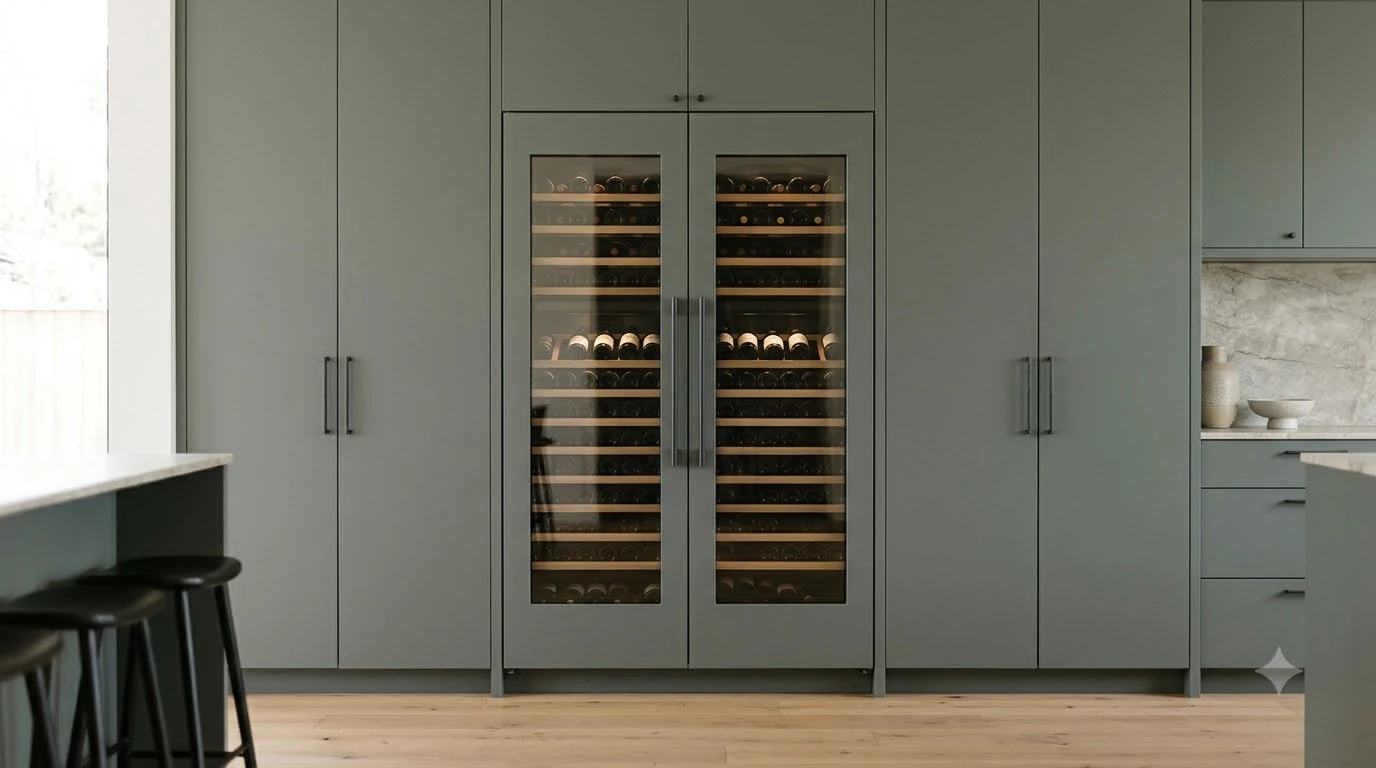
A tall cabinet wine refrigerator is designed for a vertical cabinet opening rather than a standard undercounter position. This arrangement may be useful in a pantry-style kitchen or a dedicated appliance wall.
Different models can have substantially different ventilation arrangements. The CDA FWV601 installation manual, for example, identifies its appliance as suitable for a tall larder-style kitchen cabinet and specifically states that it is not suitable for installation beneath a worktop because of its ventilation requirements. This illustrates why installation categories must be checked individually.
Compact and narrow wine fridges
Narrow refrigerators are useful when the kitchen has a limited amount of unused cabinetry. A 12-inch or 15-inch planning category may be suitable for a small collection, although the actual appliance width and required cutout must be verified.
Compact units can provide practical storage for bottles used frequently, but shelf spacing becomes particularly important. If your collection includes several Champagne bottles or wider Burgundy bottles, compare the interior layout rather than relying entirely on the advertised bottle count.
Freestanding wine refrigerators
Freestanding units are designed to operate with open space around their ventilation areas. They are appropriate for a kitchen corner, dining room, or open bar area where the refrigerator does not need to be enclosed.
They are not interchangeable with built-in models. Whynter explains that its freestanding-only category releases heat from the rear and requires approximately 4–6 inches of clearance at the back and sides. Its built-in wine refrigerator and ventilation guidance also explains why enclosing a rear-venting freestanding unit can restrict airflow and affect cooling performance.
Common Mistakes When Installing a Wine Fridge in Cabinetry
Most cabinet installation problems involve inadequate ventilation, incorrect measurements, or choosing the wrong appliance category. Avoiding these mistakes is more important than selecting a refrigerator with an elaborate control panel or decorative lighting.
Assuming every compact wine fridge is built-in compatible
A small appliance may appear suitable for a kitchen cabinet because it fits within the available width. However, physical fit does not establish installation compatibility. Rear-venting freestanding models need air circulation that a closed cabinet cannot provide.
Always confirm the permitted installation method before purchasing. If the manufacturer’s documentation identifies the model as freestanding-only, choose another location or a different appliance.
Blocking the front ventilation grille
Front ventilation is a defining feature of many undercounter refrigerators. Covering the grille with a decorative plinth, kickboard, or cabinet trim can prevent the cooling system from releasing heat correctly.
The Vintec manual specifies a minimum airflow allowance of 150 cm² when a kickboard is placed in front of the relevant ventilation grille. This is a model-specific requirement, not a universal opening size for all wine refrigerators.
Using appliance dimensions instead of cutout dimensions
A refrigerator with a nominal width of 12 inches does not necessarily require a 12-inch cabinet opening. Installation gaps and servicing space can increase the required opening dimensions.
For example, the Vintec VWS020SBA-X has a stated width of 295–300 mm but requires a minimum cutout width of 320 mm. A cabinet built to the appliance’s body width alone would not meet that installation requirement.
Installing beside an oven or another heat source
A refrigerator placed immediately beside an oven or cooking appliance may experience additional heat exposure. This can make it more difficult to maintain the intended internal temperature, especially if the surrounding cabinetry also limits airflow.
Whenever possible, choose a cabinet location away from direct sunlight and strong heat sources. If the kitchen layout makes this difficult, consult the appliance documentation and installer before committing to the position.
Ignoring door clearance
A wine refrigerator can fit perfectly inside its opening and still be inconvenient to use. Nearby drawers, handles, cabinet doors, and kitchen islands may prevent the appliance door from opening fully.
Check the hinge position, door swing, and handle projection before installation. Also consider whether the racks can slide out far enough to remove a bottle without striking the adjacent cabinetry.
Choosing capacity without considering the collection
Advertised bottle counts are based on standardized bottle dimensions. Wider bottles and unusual shapes can reduce the usable capacity considerably.
Consider how many bottles you normally keep on hand and how your collection is distributed. A smaller appliance with flexible shelving can be more practical than a larger unit whose rack configuration does not suit your bottles.
Care, Storage, and Temperature Tips for Cabinet Wine Refrigerators
A properly installed wine refrigerator should provide a stable environment without requiring complicated maintenance. Keep its ventilation openings clear, maintain suitable temperature settings, and avoid overloading shelves or obstructing internal airflow.
Choose the right temperature
Wine storage and serving temperatures are not identical. A cabinet refrigerator used mainly for storage should prioritize consistency, while one used for entertaining may benefit from settings that prepare bottles for serving.
Typical serving temperature ranges include:
- Sparkling wines: 40–50°F.
- Light-bodied white wines and rosé: 45–50°F.
- Full-bodied white wines: 50–55°F.
- Sweet white wines: 43–50°F.
- Light-bodied red wines: 55–60°F.
- Full-bodied red wines: 60–65°F.
These are general serving ranges rather than mandatory long-term storage settings. If your collection contains several wine categories, a dual-zone appliance can help prepare different bottles for serving without repeatedly changing the settings.
Maintain consistent conditions
Temperature stability is important for wine storage. Avoid placing a refrigerator where the surrounding cabinet becomes unusually hot during cooking or where direct sunlight repeatedly warms the appliance exterior.
Keep the door closed except when retrieving bottles, and avoid making frequent unnecessary temperature adjustments. If the appliance has an internal temperature display, use it to monitor the compartment rather than relying exclusively on the selected control setting.
Keep the ventilation system clean
Dust and household debris can accumulate around ventilation grilles. Inspect the front grille and accessible ventilation openings periodically. Clean the exterior using the method recommended by the manufacturer, and do not remove refrigeration components or electrical covers for routine cleaning.
Never place decorative objects, storage baskets, or kitchen items in front of the ventilation area. Even a refrigerator designed for a tight undercounter installation needs its specified airflow path.
Organize bottles correctly
Use the supplied shelves according to their intended configuration. Bottles with cork closures are generally stored horizontally when appropriate, keeping the cork in contact with the wine. Sparkling bottles and wider formats may require a different shelf arrangement.
Avoid forcing oversized bottles into narrow racks. Removing an adjustable shelf when necessary is preferable to placing excessive pressure on the bottle or shelf mechanism.
Prepare the appliance before loading
Follow the manufacturer’s instructions for initial setup. The Vintec VWS020SBA-X and VBS020SBA-X manual, for example, recommends waiting 24 hours before switching on the appliance and leaving the door open during that period to clear residual odors. It also instructs owners to attach the supplied rear spacer before installation. The Vintec installation and user manual provides the model-specific dimensions, ventilation instructions, and setup requirements.
Tip: Before loading your wine collection, verify that the refrigerator is level, the ventilation grille is unobstructed, and the internal temperature has stabilized. Leave enough shelf flexibility for Champagne and other wide-bodied bottles instead of filling every available position with standard bottles.
For a more detailed room-by-room approach to selecting a refrigerator, explore our By room planning resource. The available location, cabinet dimensions, and collection size should determine the appliance format rather than the other way around.
Frequently Asked Questions
Can a cabinet wine refrigerator operate during a power outage?
A wine refrigerator stops actively cooling when its electrical supply is interrupted. An unopened, insulated compartment can help slow temperature changes, but it does not provide indefinite temperature control. Avoid opening the door unnecessarily during an outage, and follow the appliance manufacturer’s instructions when power returns.
Does a wine fridge need a dedicated electrical circuit?
Electrical requirements vary by appliance, and not every compact wine refrigerator requires its own circuit. The installation instructions specify the permitted electrical supply and connection requirements. Have an electrician assess the circuit if the appliance will share a connection with several high-demand kitchen appliances.
Can two cabinet wine refrigerators be installed side by side?
Two units can sometimes be installed beside each other, but the arrangement must follow the clearance and ventilation specifications for both appliances. Check whether the manufacturer permits adjacent installation and whether the cabinet structure can support the combined weight. Door swing and access to both ventilation grilles also need to be considered.
Does a wine fridge need a humidity control setting?
Not every wine refrigerator includes an adjustable humidity control. Some models rely on their internal construction and operating conditions to maintain an appropriate storage environment. If you intend to age wine for extended periods, compare the manufacturer’s information about humidity management rather than assuming all compressor-based appliances offer the same features.
How long should a wine fridge last in a kitchen cabinet?
Service life varies with the cooling system, operating environment, installation quality, and maintenance. Restricted ventilation and excessive heat can increase operating demands, so correct installation is particularly important. Review the manufacturer’s warranty, service availability, and replacement-part support before selecting a model for a permanent cabinet opening.
A well-chosen wine fridge in cabinet combines convenient access, organized bottle storage, and a clean kitchen appearance. Prioritize built-in compatibility, accurate cutout measurements, unobstructed ventilation, and the right temperature configuration before choosing decorative features. With the correct appliance and a properly planned installation, your cabinet can become a practical and attractive home for your wine collection.
More in By Room & User
 Wine Fridge in Bedroom: Choose Quiet Storage That Fits Your SpaceUpdated Nov 20, 2026
 Wine Fridge in Living Room: Choose the Right Size, Style, and SetupUpdated Nov 20, 2026
 Wine Fridge In Dining Room: Choose the Right Size and StyleUpdated Nov 20, 2026
 Wine Fridge In Pantry: Choose the Right Size and SetupUpdated Nov 20, 2026
 Wine Fridge In Kitchen: Choose the Right Fit and PlacementUpdated Nov 20, 2026
 Wine Fridge In Garage: Choose a Cooler That Handles Temperature SwingsUpdated Nov 20, 2026