

We may earn a commission when you buy through links on this page, at no extra cost to you. Learn more.
The best basement wine fridge is a unit built for a cool, uneven room, with a thermostat that holds steady when the air is cooler than a kitchen and a cabinet that can handle a floor that is not level. Basements are often the coolest and most stable rooms in a house, which helps wine age, but they also bring damp air, drafts from foundation walls, and places where the ambient temperature drops below the range a standard unit expects. The right model keeps its setting in those conditions and gives you enough space for the bottles you already own.
Many people choose a basement for a wine fridge because it is out of the way and already cool. That is a good starting point, but it does not mean every cabinet will work. Some units lose their cooling ability when the room drops toward the low end of their range, while others run continuously in a space that rarely warms up. This guide explains which features matter in a basement, how to read the spec sheet, and what to do about moisture and placement before the cabinet arrives.
Quick Comparison
A basement wine fridge is judged less by its styling and more by how it handles ambient temperature, humidity, and floor conditions. Freestanding single-zone units are the simplest to place, while built-in or under-counter models suit a finished basement bar. The table below compares the common types by the factors that matter in a lower-level room.
| Type | Cool-room performance | Floor and damp tolerance | Best placement |
|---|---|---|---|
| Freestanding single-zone | Holds a steady setting in most rooms | Needs a level, dry floor | Storage room, wine cellar, corner of a finished basement |
| Freestanding dual-zone | Two settings; check the lower limit of each | Needs a level, dry floor | Finished basement with a seating area |
| Under-counter | Depends on the room and the cabinet’s vent space | Keep off bare concrete when possible | Basement bar or kitchenette |
| Built-in column | Set by the cabinetry and ventilation | Best with a finished wall and floor | Planned basement bar run |
Best for Cool, Stable Storage Rooms
A dedicated storage room with little daily traffic suits a unit that is built to hold a fixed setting for long periods. It is the simplest basement setup and often the most reliable.
Why it stands out: A room that stays cool and dark is close to what the Wikipedia article on wine cellars describes as the goal for storage, with a temperature around 13 °C (55 °F) for short-term storage and long-term aging. A single-zone unit with a clear setting is easy to keep at that point.
Keep in mind: If the room gets much colder than the lower limit of the cabinet, check the manufacturer’s rating for cool ambient conditions before buying. Some units are rated only for rooms above a certain temperature.
Best for Finished Basement Lounges
A finished basement with a seating area or bar needs a cabinet that looks at home in the room while keeping the wine at a steady temperature. Dual-zone models are often a good fit here.
Why it stands out: A dual-zone cabinet can hold reds at a warmer setting and whites or sparkling wine at a cooler one, which suits a room used for different kinds of wine. The finish is usually more polished than a utility unit.
Keep in mind: Lounge rooms are often warmer in the evening when people gather, so check how the cabinet responds when the door is opened frequently and the room warms up.
Best for Damp Basements
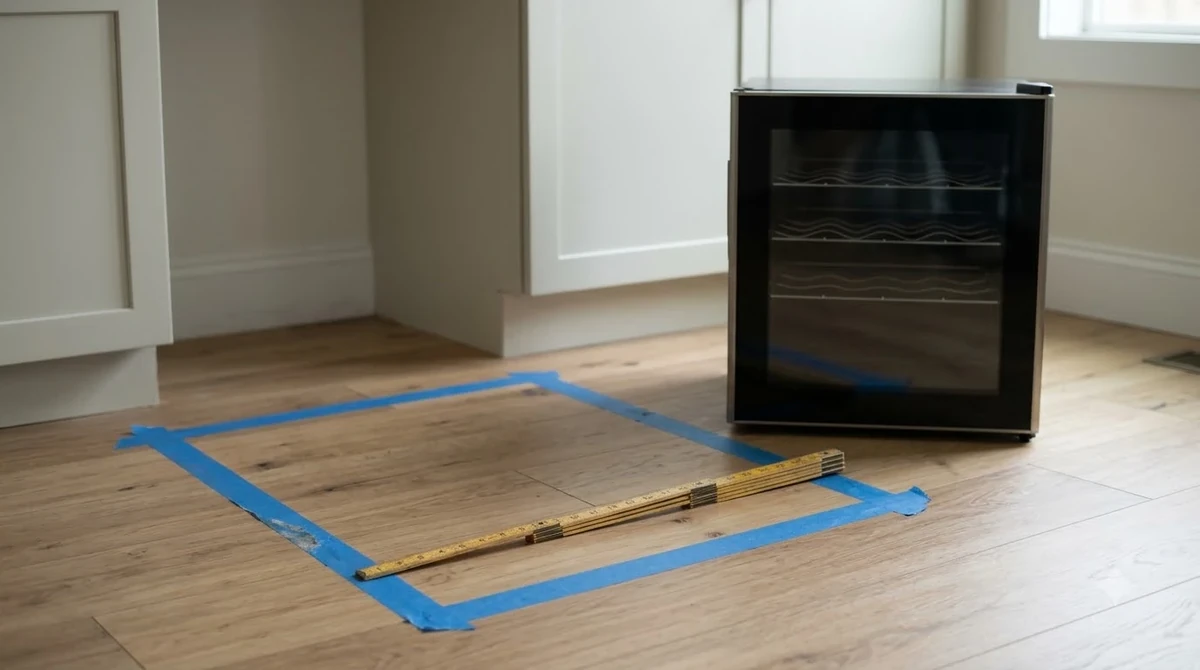
A basement with moisture on the walls or floor needs a cabinet that tolerates humidity and can sit on a raised base or a level, dry platform. Moisture is one of the most common problems in lower-level rooms.
Why it stands out: Keeping the cabinet off bare concrete and away from walls with visible moisture reduces the chance of condensation on the outside of the unit and in the cabinet’s vents.
Keep in mind: Humidity is not something a basic wine fridge controls well, so fix the source of damp air first. A dehumidifier or a dry corner away from walls makes a bigger difference than a feature list.
Best for Basement Bars
A basement bar combines wine storage with glassware, a sink, or a serving counter. A built-in or under-counter cabinet fits the rhythm of the space and keeps the bottles close to where they are poured.
Why it stands out: A bar cabinet keeps the bottles within reach and frees up floor space. It also makes it easier to match the cabinet’s finish to the rest of the bar.
Keep in mind: Built-in units need vent space around them, so check the clearance before the counter is installed. A tight opening can block airflow and shorten the cabinet’s life.

Best for Large Basement Collections
A basement is a common place for a larger collection, and a bigger cabinet or a combination of units may be the practical answer. The goal is to keep the most-used bottles near the top and the long-term stock in a cooler, steadier place.
Why it stands out: Two cabinets can separate the everyday bottles from the reserve collection, which keeps the frequently opened wine from being moved around.
When two cabinets share a basement, placing them on opposite walls rather than side by side gives each one room to vent. Keep a note of which bottles sit in which cabinet, so the reserve stock is not opened by mistake during a busy event.
Keep in mind: A larger unit needs more floor space and a stronger base. Check the weight rating and the floor level before choosing a model with a full-width cabinet.
How to Choose
Start by measuring the room’s temperature over a few days, at different times. A basement can be steady in one corner and drafty in another. Check the lowest and highest readings, then compare them with the operating range on the cabinet’s spec sheet.
Next, check humidity and floor conditions. Look for signs of moisture on the walls, floor, and any stored cardboard. Keep the cabinet away from bare concrete and walls that sweat, and choose a unit whose base and vents are easy to clear of dust.
Consider the door and the interior. A basement often has a tight stairway or a narrow door, so measure the cabinet’s footprint and height before ordering. Shelves that slide out make it easier to load bottles from the front, especially in a low-ceilinged room.
Finally, look at noise and vibration. A compressor in a quiet basement is easy to hear, and vibration can disturb sediment in older bottles. Place the cabinet on a firm, level base, and keep it away from the furnace and the water heater.
Frequently Asked Questions
Is a basement a good place for a wine fridge?
Often it is. A basement is usually cool and dark, which suits wine storage. The cabinet still needs a steady setting, a dry and level floor, and enough room for its vents.
What temperature should a basement wine fridge hold?
The Wikipedia article on wine cellars describes 13 °C (55 °F) as ideal for short-term storage and long-term aging, with 10 to 14 °C (50 to 57 °F) as a normal aging range. Set the cabinet to a steady value within that band.
Does humidity matter for a basement wine fridge?
Humidity matters, but it is hard to control with a basic cabinet. Reduce moisture in the room first, keep the unit off damp floors, and check the label and cork condition if a bottle has been stored for a long time.
Can a basement fridge go in a corner?
Yes, if the vents and door have enough clearance. Keep the back and sides open as the manufacturer directs, and leave room for the door to open fully so the bottles can be loaded without strain.
A basement wine fridge works well when the room is cool and steady, the floor is level and dry, and the cabinet has room to breathe. Measure the room, check the operating range, and choose shelves you can load comfortably. For a compact option in a smaller space, see the best bar wine fridge, or compare the best wine fridge for an apartment. For room-by-room options across the site, browse the by-room guides, and for a quick reference on bottle counts, see how many glasses are in a bottle of wine.
More in By Room & User
 Wine Fridge in Bedroom: Choose Quiet Storage That Fits Your SpaceUpdated Nov 20, 2026
 Wine Fridge in Living Room: Choose the Right Size, Style, and SetupUpdated Nov 20, 2026
 Wine Fridge In Dining Room: Choose the Right Size and StyleUpdated Nov 20, 2026
 Wine Fridge In Pantry: Choose the Right Size and SetupUpdated Nov 20, 2026
 Wine Fridge In Kitchen: Choose the Right Fit and PlacementUpdated Nov 20, 2026
 Wine Fridge In Garage: Choose a Cooler That Handles Temperature SwingsUpdated Nov 20, 2026