

We may earn a commission when you buy through links on this page, at no extra cost to you. Learn more.
The vintec under counter wine fridge is a premium built-in wine storage option for homeowners who want dedicated temperature-controlled space beneath a kitchen counter, with a choice of single-zone and dual-zone models. Vintec’s current US range includes the 41-bottle VWUS041BAB and 44-bottle VWUD044BAB. Both combine a compact under-counter footprint with wine-focused shelving, while the dual-zone version offers more flexibility for households that regularly serve both red and white wines.
A wine refrigerator needs to do more than keep bottles cold. It should maintain a suitable environment, protect bottles from unnecessary light and vibration, provide convenient access, and fit the available cabinetry without creating installation problems. Vintec positions its Premium collection toward buyers who prioritize wine preservation and presentation. This review examines the available models, manufacturer specifications, practical advantages, potential drawbacks, and the measurements worth checking before purchasing.
Specs and Key Features
The Vintec under-counter collection is built around two principal choices: a 41-bottle single-zone cabinet and a 44-bottle dual-zone cabinet. Both have similar external dimensions, but their temperature configurations serve different storage and entertaining requirements.
The VWUS041BAB is intended for buyers who want one consistent temperature throughout their collection. The VWUD044BAB provides two independently controlled temperature zones, making it more convenient to keep different wines ready for serving. Both models use Vintec’s Perfect Cradle shelving system and feature a glass-fronted design with a matte black border.
| Specification | VWUS041BAB | VWUD044BAB |
|---|---|---|
| Model type | Single-zone | Dual-zone |
| Easy bottle capacity | 41 bottles | 44 bottles |
| Maximum bottle capacity | 41 bottles | 44 bottles |
| Width | 23.8 inches | 23.8 inches |
| Depth | 23.5 inches | 23.5 inches |
| Height | 34.1–34.6 inches | 34.1–34.6 inches |
| Temperature zones | 1 | 2 |
| Temperature range | 41–64°F | 41–64°F per zone |
| Annual electricity consumption | 90 kWh | 100 kWh |
| Finish | Matte black border | Matte black border |
| Installation | Built-in or freestanding | Built-in or freestanding |
| Refrigerant | R600a | R600a |
These specifications come from Vintec’s US product listings. The listed annual electricity consumption is 90 kWh for the single-zone model and 100 kWh for the dual-zone model. Actual consumption can vary with room temperature, door openings, installation conditions, and operating settings.
The dual-zone VWUD044BAB has several additional documented features worth considering. Its triple-layer glass door includes a Low-E layer and argon gas, while UV-treated glass helps limit exposure to potentially damaging light. The cabinet also incorporates an audio and visual alert system, capacitive touch controls, and white LED lighting.
Vintec’s Perfect Cradle shelving is another important feature. The shelves use fully extendable, wide white oak slats with aluminum trim. Their spacing is designed to accommodate different 750 ml bottle shapes, including Champagne bottles, rather than limiting the collection to narrow Bordeaux-style bottles.
The manufacturer’s description also emphasizes five storage principles: stable temperature, humidity above 50%, UV protection, reduced vibration, and optimized airflow. These are relevant considerations for buyers who intend to store bottles for longer periods rather than simply chill wine before dinner.
For the complete manufacturer specifications, see the Vintec VWUD044BAB product specifications.
What Owners Like
The strongest reasons to consider a Vintec under-counter wine fridge are its wine-specific shelving, separate temperature zones on the larger configuration, and built-in appearance. These features make the collection easier to organize and allow different bottles to remain accessible without taking up a full refrigerator or kitchen cabinet.
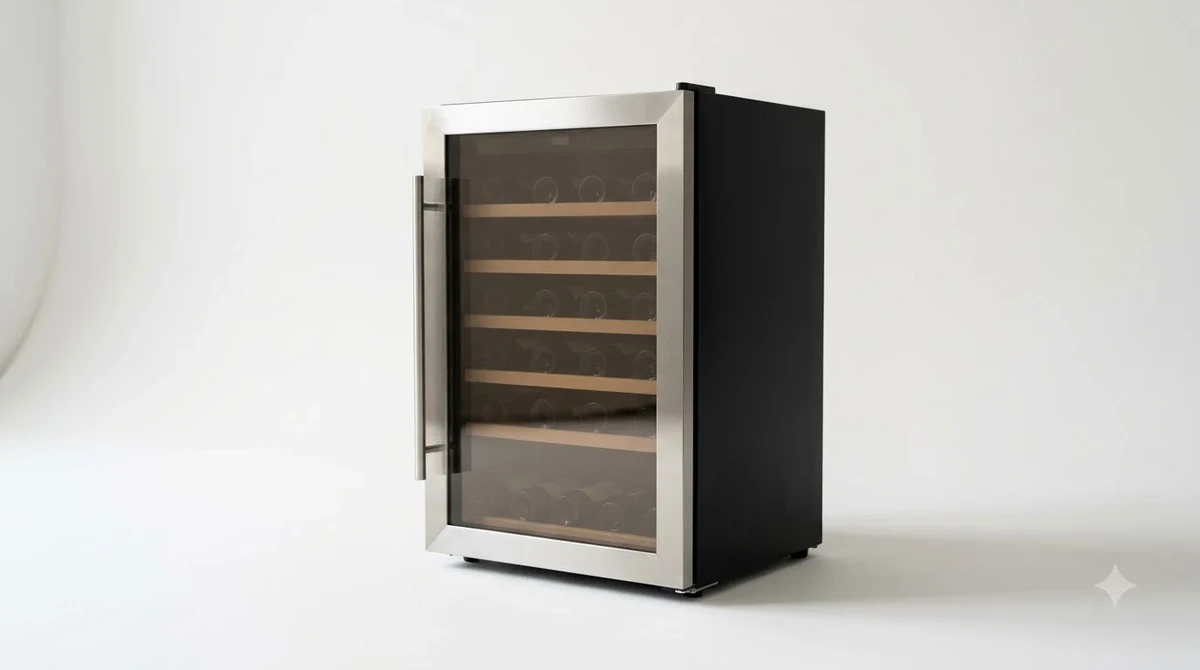
One practical advantage is the Perfect Cradle shelving. Standard wine refrigerators sometimes struggle with bottles that have wider shoulders, longer necks, or unusually shaped bases. Champagne and sparkling wine bottles can be particularly awkward because their dimensions differ from those of many conventional Bordeaux bottles.
Vintec addresses this issue with wider shelf spacing and extendable white oak supports. The shelves are designed to hold a variety of standard 750 ml bottles, reducing the need to rearrange an entire collection whenever a larger bottle is added. This is useful for households that regularly purchase Pinot Noir, Chardonnay, Champagne, and other wines in different bottle shapes.
The extendable design also helps with access. Instead of reaching deep into the cabinet and disturbing neighboring bottles, users can pull out a shelf to inspect labels and select a particular wine. This matters when the cabinet is positioned beneath a counter, where overhead access and visibility may be more restricted than with a tall freestanding wine cabinet.
Temperature stability is another major part of the product’s appeal. Vintec describes the variable-speed compressor as operating consistently to maintain the selected temperature. Its approach is intended to limit the fluctuations associated with compressors that repeatedly cycle on and off.
For a wine collection, stable conditions are generally more useful than simply achieving the lowest possible temperature. A bottle of Cabernet Sauvignon does not need to be stored at serving temperature throughout its life. The same applies to Chardonnay, Riesling, Champagne, and other styles. Consistency is particularly important when bottles are being kept for months rather than consumed within a few days.
The dual-zone VWUD044BAB is especially attractive for people who entertain regularly. A household might keep Sauvignon Blanc and sparkling wine in one zone while maintaining a warmer setting for Cabernet Sauvignon or Merlot in the other. That removes the need to move bottles between the wine cabinet and a conventional refrigerator before guests arrive.
Vintec’s recommended dual-zone settings provide a useful starting point: approximately 43–56°F for sparkling and white wines, and 60–64°F for red wines. These ranges allow different wine styles to be prepared for service without requiring separate appliances.
The visual presentation is also worth considering. Both US models have a matte black border and glass door, giving them a more integrated appearance than many basic countertop wine coolers. White LED lighting makes it easier to identify bottles, while the dark storage environment is intended to limit unnecessary light exposure.
Another positive feature is the reversible door hinge on the VWUD044BAB. Kitchen layouts vary considerably, and a door that opens in the wrong direction can make bottle access inconvenient. Reversibility provides another installation option, although buyers should still consider nearby drawers, cabinets, walls, and appliances before finalizing the position.
These features make Vintec particularly appealing to collectors who want a dedicated appliance rather than a general-purpose beverage refrigerator. The distinction is important: a wine cabinet is designed around bottle positioning, temperature management, and storage conditions, while a standard beverage cooler may prioritize rapid chilling and mixed drinks.
Common Complaints and Practical Limitations
The main potential disadvantages of the Vintec under-counter range are its limited bottle capacity, premium positioning, and installation requirements. Buyers should also understand that advertised maximum capacity does not guarantee the same number of accessible spaces when their collection contains larger bottles.
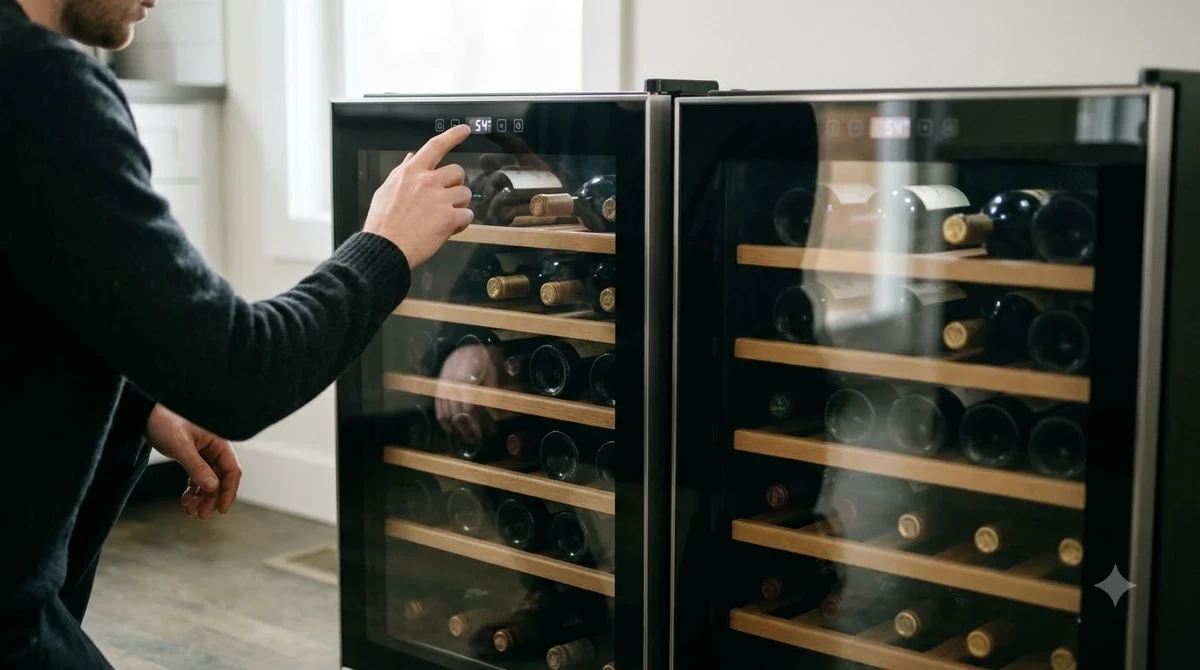
The first consideration is capacity. A 41-bottle or 44-bottle cabinet sounds generous, but the usable number depends on the collection. Vintec bases its maximum capacity figures on standard Bordeaux-shaped bottles. Wider Champagne bottles, certain Burgundy bottles, and other unusual formats can reduce the number that fits comfortably.
This is not a problem unique to Vintec. Bottle capacity is commonly calculated using a particular standard shape, while real wine collections contain bottles of varying diameters and lengths. Buyers who regularly purchase sparkling wines or large-format bottles should leave some unused space rather than planning around every advertised position.
The second limitation is the distinction between a wine cellar and a serving cabinet. A dual-zone appliance can accommodate different temperatures, but that does not mean every bottle should be stored at its ideal drinking temperature for long-term aging.
For general cellaring, Vintec recommends approximately 54–55°F for all wine categories. Its dual-zone cabinet can therefore be configured around one zone for cellaring and another for serving, or with separate serving temperatures for different wine styles. Buyers who mainly want long-term storage may find that the single-zone VWUS041BAB is sufficient.
Another consideration is the cabinet’s dimensions. Both current US models are approximately 23.8 inches wide and 23.5 inches deep, with a listed height range of 34.1–34.6 inches. These measurements are compact enough for many kitchen installations, but they should not be mistaken for a guarantee that the appliance will fit every standard cabinet opening.
Countertop height, floor level, surrounding panels, door swing, and access to the electrical connection can all affect installation. Even a small measurement error can create problems when an appliance is fitted between finished cabinets.
There is also a practical trade-off between capacity and kitchen space. A dedicated wine cabinet takes up room that might otherwise be used for drawers, cupboards, or another appliance. A household with only 10 or 12 bottles may not need a 41-bottle unit, especially if most of those bottles are intended for immediate consumption.
Noise is another consideration for any compressor-based refrigerator. Vintec describes its variable-speed compressor as designed for consistent temperature control, but that does not establish that the appliance is completely silent. Buyers installing it in an open-plan living and kitchen area should consider the location and the possibility of normal compressor and airflow sounds.
The dual-zone model also has slightly higher listed annual electricity consumption than the single-zone alternative: 100 kWh compared with 90 kWh. The difference is modest on paper, but it illustrates that additional temperature flexibility comes with a different operating specification.
Finally, the available published product specifications do not establish that every bottle arrangement, kitchen configuration, or room environment will produce identical results. The most sensible approach is to treat the manufacturer’s stated capacity and performance features as specifications, not guarantees of identical performance in every home.
Who Should Buy and Who Should Skip
The Vintec under-counter wine fridge makes the most sense for wine enthusiasts who have a dedicated kitchen installation space, maintain a collection of approximately 40 bottles, and value separate storage temperatures or carefully designed shelving. It is less compelling for casual drinkers who need only a few chilled bottles at a time.
The VWUS041BAB is the better functional match for:
- Collectors who store reds, whites, and sparkling wines together at a consistent cellaring temperature.
- Households that generally serve one wine category at a time.
- People who prefer straightforward temperature management over separate compartments.
- Buyers who want the listed 41-bottle capacity without needing dual-zone flexibility.
- Wine enthusiasts who prioritize stable storage conditions over serving multiple styles simultaneously.
For example, someone who buys several bottles of Bordeaux, Oregon Pinot Noir, and California Chardonnay for gradual consumption may find a single-zone cabinet perfectly adequate. The same storage temperature can be used for the entire collection, with individual bottles brought to suitable serving temperatures before opening.
The VWUD044BAB is the better functional match for:
- Households that regularly serve red and white wines during the same meal.
- People who keep Champagne, Sauvignon Blanc, and Chardonnay alongside Cabernet Sauvignon or Syrah.
- Collectors who want a separate serving zone and a separate cellaring zone.
- Home entertainers who want different wine styles ready without additional chilling time.
- Buyers who appreciate flexible bottle storage and fully extendable shelving.
Consider a dinner party where guests have different preferences. One group might enjoy chilled Sauvignon Blanc, another might prefer Chardonnay, and the main course might call for Cabernet Sauvignon. A dual-zone cabinet offers more flexibility for organizing those choices before guests arrive.
Wine pairing can make that flexibility particularly useful. For instance, Sauvignon Blanc works well with acidic dishes, seafood, and fresh herbs, while Merlot can complement dishes with softer textures and moderate richness. A chicken Marsala recipe is another occasion where having a suitable red available at a comfortable serving temperature can simplify meal planning.
Who should skip the range?
Buyers with very small collections should consider a smaller wine refrigerator. Someone who keeps only six to eight bottles for occasional weekend entertaining may be paying for storage capacity that remains unused. Likewise, people who primarily want to chill beer, soda, juice, and mixed drinks may be better served by a beverage center designed for a wider range of containers.
Renters and homeowners without a suitable installation opening should also be cautious. Although Vintec lists the current US cabinets as suitable for freestanding or built-in installation, the intended location still needs to provide the necessary clearance, a stable surface, and access to an appropriate electrical connection.
Buyers seeking extensive long-term aging capacity should consider whether 41 or 44 bottles will remain sufficient as their collection grows. A tall wine cabinet may be a more practical choice if the collection is likely to reach 100 bottles or more.
For shoppers comparing other appliances, the wine cooler model reviews section can help put different storage configurations and cabinet styles into perspective.
How It Compares to Alternatives
The most relevant comparison within Vintec’s current US under-counter collection is between the VWUS041BAB and VWUD044BAB. Their dimensions are nearly identical, so the buying decision is primarily about temperature flexibility, collection size, and the way wine is used in the household.
Both models are positioned as Premium wine cabinets. Both offer a glass-fronted design, a matte black border, and wine-specific storage. The key distinction is that the single-zone model provides one consistent temperature for all bottles, while the dual-zone model can maintain separate settings.
For buyers focused on long-term storage, one temperature zone is not necessarily a disadvantage. Vintec explains that red wines, white wines, and Champagne can all be cellared at approximately 54–55°F. A single-zone appliance can therefore be a sensible choice for a mixed collection that is stored rather than prepared for immediate service.
The dual-zone model is more useful when convenience is the priority. For example, a household might set one compartment between 43°F and 56°F for sparkling and white wines, while using the other between 60°F and 64°F for red wines. This arrangement reduces the need to change settings every time a different bottle is required.
There is a small difference in advertised capacity. The single-zone VWUS041BAB accommodates 41 bottles, while the dual-zone VWUD044BAB accommodates 44. The additional three positions should not be the deciding factor by themselves, because actual capacity depends on bottle dimensions and shelf arrangement.
| Buying consideration | VWUS041BAB | VWUD044BAB |
|---|---|---|
| Storage configuration | One temperature | Two temperatures |
| Best use | Mixed collection cellaring | Separate red and white serving |
| Capacity | 41 bottles | 44 bottles |
| Annual energy figure | 90 kWh | 100 kWh |
| Temperature flexibility | Single setting | Independent zones |
| External width | 23.8 inches | 23.8 inches |
| External depth | 23.5 inches | 23.5 inches |
Beyond Vintec, shoppers can compare under-counter wine refrigerators with freestanding wine cabinets and conventional beverage refrigerators. These categories solve different problems, even when their external dimensions appear similar.
A freestanding wine cabinet is often more appropriate for a dedicated wine room or a dining area where cabinetry is not available. It may also provide more capacity than an under-counter model. However, it occupies visible floor space and may not provide the integrated kitchen appearance that motivates buyers to choose a built-in appliance.
A beverage refrigerator, on the other hand, is designed around convenience and mixed drinks. Its shelves may accommodate cans, bottles, and other containers more readily, but its layout and temperature management may not be as appropriate for a collection of wine intended for extended storage.
Vintec’s Premium range also includes features intended to address light, vibration, humidity, and airflow. Those features are relevant for buyers who care about preserving their collection rather than simply cooling drinks. The dual-zone cabinet’s UV-treated glass, white oak shelving, and variable-speed compressor make that storage-oriented approach particularly clear.
Ultimately, the choice is straightforward: choose the VWUS041BAB for a consistent storage environment, or the VWUD044BAB if serving flexibility is more important. Neither configuration is automatically superior; the appropriate option depends on how frequently the collection is opened and consumed.
Installation, Setup and Everyday Care
Proper installation is essential for an under-counter wine cabinet, especially when it is surrounded by finished kitchen cabinetry. Before ordering, measure the opening, confirm the appliance’s actual dimensions, and make sure the door can open without hitting nearby handles, drawers, or walls.
For the current US models, Vintec lists a width of 23.8 inches, a depth of 23.5 inches, and a height range of 34.1–34.6 inches. These are product dimensions, not a substitute for the exact installation template and clearance instructions supplied for the model.
One important distinction is that Vintec also publishes installation drawings for a separate 50-bottle underbench range. That drawing specifies a product measuring 595 mm wide, 571 mm deep, and 820 mm high, with an installation opening measuring 635 mm wide, 601 mm deep, and 850 mm high.
Those dimensions should not be automatically applied to the current US VWUS041BAB or VWUD044BAB. The models belong to different product listings, and their installation requirements should be checked independently. This is particularly important when a contractor is preparing cabinetry before the appliance arrives.
- Identify the exact model. Confirm whether the intended purchase is the VWUS041BAB or VWUD044BAB. Their temperature configurations differ even though their external dimensions are similar.
- Measure the cabinet opening. Check the width, height, and depth at multiple points. Kitchen floors and cabinetry are not always perfectly level or square.
- Check the door swing. Make sure the door can open far enough to allow shelf extension and bottle removal. Consider the location of adjacent drawers and cabinet handles.
- Confirm the electrical connection. Follow the electrical requirements in the exact model’s installation documentation rather than assuming that another Vintec cabinet uses the same connection.
- Position and level the appliance. A stable, level installation helps reduce unnecessary vibration and keeps the shelves and door operating correctly.
- Allow the cabinet to stabilize. Once installed, follow the manufacturer’s operating instructions and allow the internal temperature to settle before loading the full collection.
- Arrange bottles carefully. Use complementary bottle shapes and avoid forcing oversized bottles into shelf spaces intended for narrower formats.
Tip: Do not order an under-counter wine cabinet based on the nominal width of your existing kitchen opening. Measure the complete opening and compare it with the installation drawing for the exact Vintec model. A difference of even a fraction of an inch can complicate a fitted installation.
Once installed, temperature selection should reflect the purpose of the cabinet. For general cellaring, approximately 54–55°F is a practical starting point for a mixed collection. If the dual-zone model is being used primarily for serving, Vintec’s recommended ranges provide a useful guide for sparkling, white, and red wines.
Serving temperatures should also be distinguished from storage temperatures. Sparkling wines are generally served around 40–50°F, light whites and rosé around 45–50°F, and fuller-bodied whites around 50–55°F. Light reds are often best around 55–60°F, while fuller-bodied reds can be served around 60–65°F.
These ranges help explain why dual-zone storage can be convenient. A bottle of sparkling wine and a bottle of Cabernet Sauvignon have different serving requirements, even though both can be stored together at a suitable cellaring temperature.
For everyday care, keep the door closed except when selecting or loading bottles. Frequent opening introduces warmer air and makes temperature recovery more difficult. Clean the exterior and accessible surfaces using appropriate non-abrasive materials, and follow Vintec’s instructions for filter maintenance and cleaning.
The air filter and airflow system deserve particular attention. Vintec identifies optimized airflow as one of its five storage principles, with filtered circulation intended to reduce unwanted odors and help maintain the cabinet environment. Maintenance should follow the instructions for the exact appliance rather than an assumed universal replacement schedule.
Keep the glass door clean, avoid obstructing the cabinet’s ventilation arrangements, and make sure bottles are not positioned where they interfere with the door seal. If the appliance produces unusual sounds, develops persistent temperature problems, or displays an alert, consult the model-specific troubleshooting information before attempting repairs.
Vintec provides a US user manual and product support search where owners can locate documentation using their appliance model number. Having the correct model identification is especially important when requesting replacement parts or service.
Frequently Asked Questions
Is Vintec an American wine refrigerator brand?
Vintec is an international wine-storage brand with a dedicated US product and support website. Its US under-counter collection is presented as part of the Premium range. The brand also maintains regional websites and product collections for other markets, so specifications and available models can differ between countries.
Can the Vintec dual-zone cabinet store wine at two different temperatures?
Yes. The VWUD044BAB has two independently controlled temperature zones, each with a listed operating range of 41–64°F. This makes it possible to configure separate storage or serving environments. The temperature settings should be selected according to the intended use of each compartment and the manufacturer’s operating instructions.
Can Vintec wine cabinets accommodate Burgundy bottles?
Vintec describes its Perfect Cradle shelving as accommodating different standard 750 ml bottle shapes, including Champagne. Burgundy bottles can vary considerably in shoulder shape and diameter, so the number that fits will depend on the individual bottle dimensions and shelf arrangement. A full-capacity Bordeaux loading pattern should not be assumed for every collection.
Does the Vintec VWUD044BAB have a door alarm?
The manufacturer lists an audio and visual alert system for the VWUD044BAB. The product specifications identify this as an alert feature, but buyers should consult the operating manual for the specific conditions that trigger an alert and the correct procedure for responding to it.
Where can owners find replacement parts for a Vintec wine fridge?
Vintec’s support process uses the appliance model number and Product Number Code, or PNC, to identify the correct product and parts information. These identifiers are printed on the appliance serial plate. Having both details available can help distinguish between similar models when arranging service or ordering components.
The Vintec under-counter wine fridge range is a strong option for buyers who want dedicated wine storage integrated into their kitchen. The 41-bottle single-zone cabinet suits straightforward cellaring, while the 44-bottle dual-zone model offers greater flexibility for households that regularly serve different wine styles. Before choosing either one, confirm the installation measurements, consider your actual bottle collection, and decide whether separate temperature zones will genuinely improve your everyday wine storage.
More in Model Reviews
 Magic Chef 44 Bottle Wine Cooler Review for Flexible StorageUpdated Nov 21, 2026
 Whynter 164 Bottle Wine Cooler Review: Capacity, Features, and FitUpdated Nov 21, 2026
 Insignia NS WC16BK6 Review: Compact 16-Bottle Wine StorageUpdated Nov 21, 2026
 Wine Enthusiast Electric Blue Omega Review: Opening, Pouring, and Preserving Made EasierUpdated Nov 21, 2026
 Koolatron 20 Bottle Wine Cooler Review: Features, Fit, and PerformanceUpdated Nov 21, 2026
 NewAir AWC 330E Review for Home Wine StorageUpdated Nov 21, 2026