

We may earn a commission when you buy through links on this page, at no extra cost to you. Learn more.
The magic chef 44 bottle wine cooler is a 44-bottle, dual-zone under-counter or freestanding cabinet that suits a mixed collection when separate temperature settings matter more than premium cellar features. The HMWC44DZ model divides capacity into 16 bottles in the upper zone and 28 in the lower zone, with both zones adjustable from 41°F to 61°F. Its stainless-steel and glass design is appealing, but owner feedback raises fair questions about shelf access and long-term cooling reliability.
This review focuses on the Magic Chef HMWC44DZ, the 44-bottle dual-zone wine cooler listed by the manufacturer. Its strongest selling points are flexible placement, a practical bottle split, reversible door swing and independent controls; the key buying checks are whether its dimensions fit your cabinetry and whether its feature set matches your expectations for wine storage.
Specs and Key Features
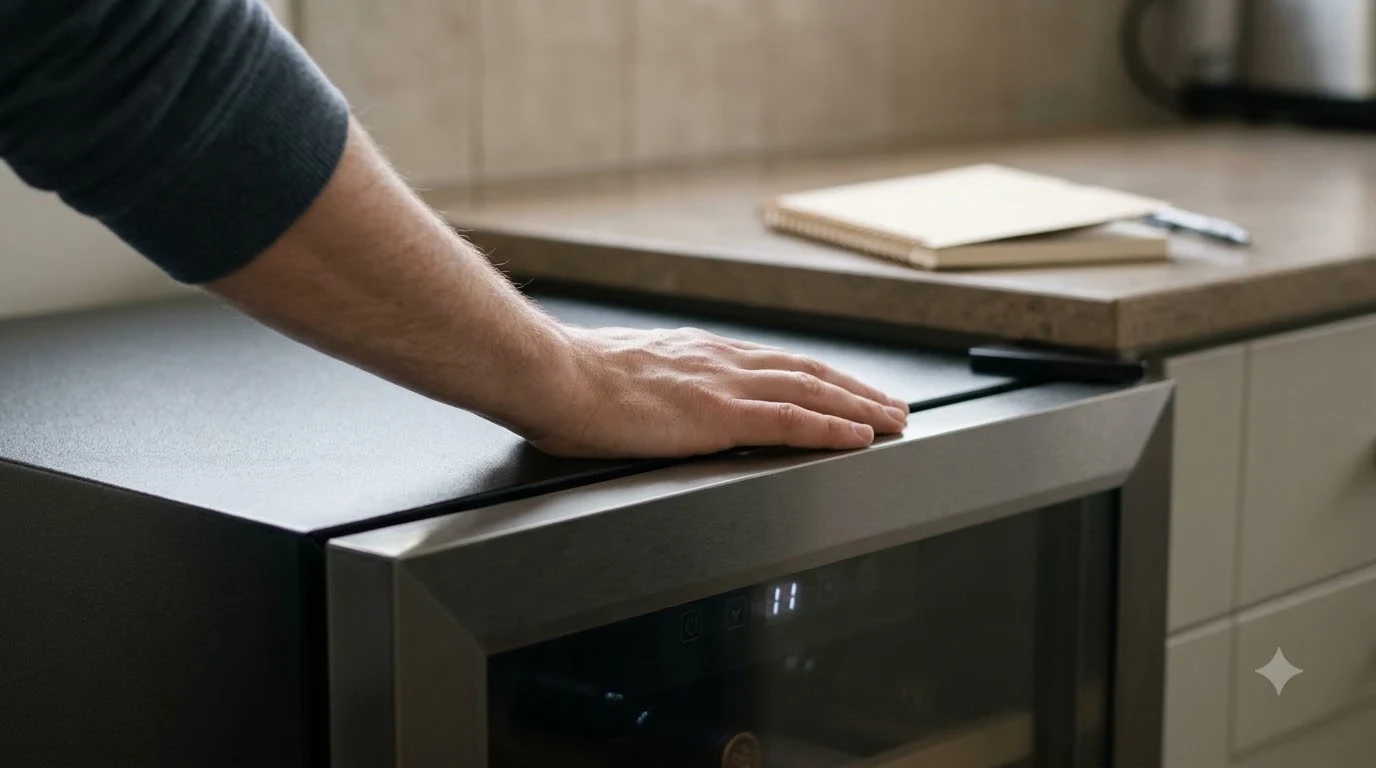
The HMWC44DZ is a compact, front-vented cabinet with two sealed temperature zones, a stated capacity of 44 bottles and a working range of 41°F to 61°F in each compartment. Its dimensions are close to a standard 24-inch under-counter footprint, but the door, handle and required opening clearance need to be considered before installation.
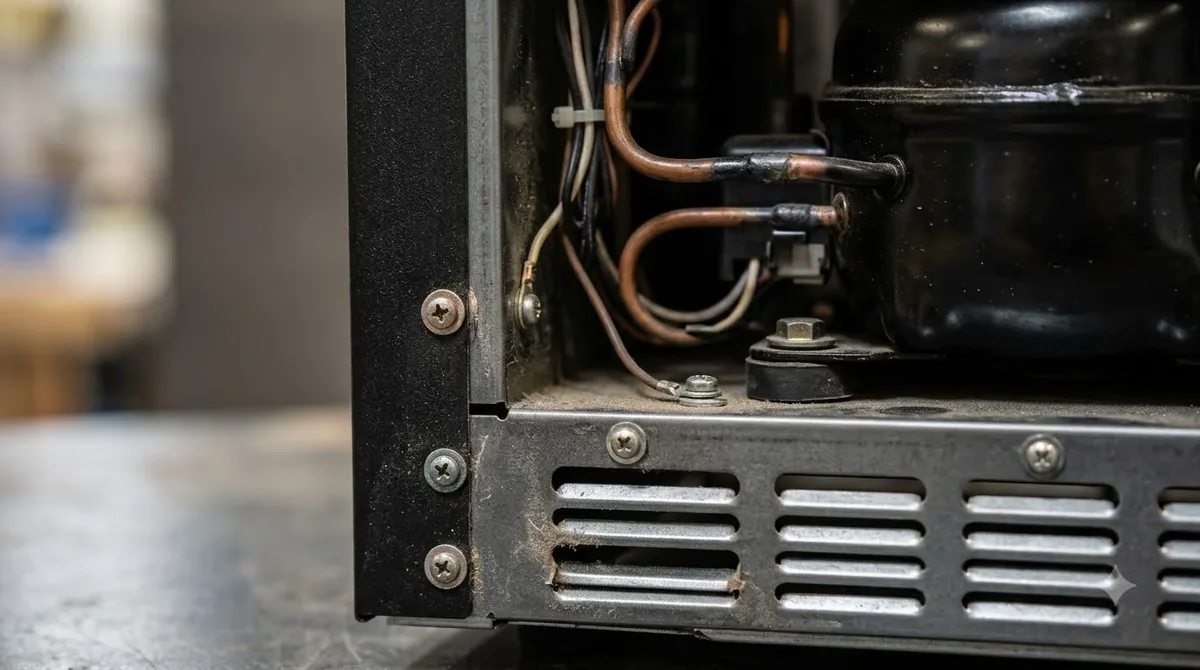
Magic Chef’s HMWC44DZ specifications confirm the 44-bottle capacity, two sealed zones and 41°F to 61°F range; the table below summarizes the published details alongside the manual’s electrical requirements.
| Specification | Magic Chef HMWC44DZ |
|---|---|
| Advertised capacity | Up to 44 wine bottles |
| Upper-zone capacity | 16 bottles |
| Lower-zone capacity | 28 bottles |
| Temperature range | 41°F–61°F in each zone |
| Cabinet dimensions | 23.4 in. W × 34.4 in. H × 24.4 in. D |
| Installation | Built-in or freestanding; front-vented |
| Door and lighting | Stainless-steel frame and handle, tempered glass, reversible door, two interior lights |
| Electrical connection | 115V AC, 60Hz, grounded three-prong outlet |
The split capacity is more useful than the headline number alone. Magic Chef assigns 16 bottles to the upper compartment and 28 to the lower one. The manual explains the layout: the upper zone uses two full-depth wine shelves, each designed for as many as eight bottles arranged with necks alternating front to back. The lower zone has two similar eight-bottle shelves plus two wire racks that each hold six bottles, giving it room for 28. That arrangement works for a collection that needs a larger lower section, although it is not a set of identical shelves from top to bottom.
Tip: Measure the finished opening and the door swing, not just the cabinet face. The manual says the door should project at least 1 inch beyond nearby cabinets so it can open and the shelves can be accessed.
The shelf design also explains why the full 44-bottle figure should be treated as a best-case capacity rather than a promise for every collection. The manual’s arrangement assumes bottles fit the intended orientation and standard shelf spacing. Wider Champagne bottles, Burgundy shapes, large-format bottles and bottles with unusually long necks can reduce the number that fit at once. Magic Chef says shelves can be removed for larger bottles, but they should be unloaded first; this is not the same as a fully loaded, pull-out presentation rack.
Both zones can be set independently from 41°F to 61°F in one-degree increments, according to the HMWC44DZ manual. The cabinet has separate interior lights, a reversible door and a stainless-steel door frame around tempered glass. The manufacturer describes it as suitable for built-in or freestanding use, while the retailer listing identifies it as front-vented and compressor-cooled. Those details make the unit more adaptable than a freestanding-only cabinet, provided the installation opening meets the manual’s requirements.
What Owners Like
Positive owner comments focus on the stainless finish, kitchen fit and the usefulness of the 16-bottle upper and 28-bottle lower zones. Some buyers also say the temperature stays close to the displayed setting in normal use.
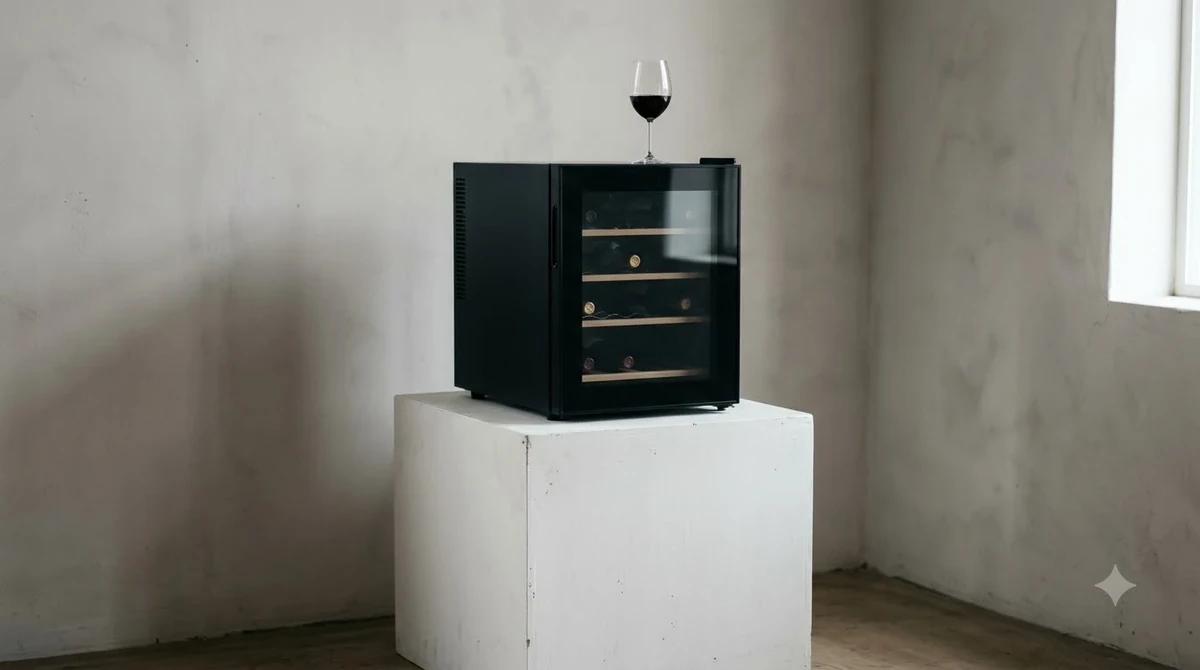
The stainless trim and glass door are a visible part of the HMWC44DZ’s appeal. Homeowners who installed it below a counter describe it as a good visual match for a renovated kitchen, and one reviewer specifically praised how the unit completed the look of the space. The two interior lights also make bottles easier to see without relying on an external kitchen light. That presentation matters if the cooler sits in an open kitchen, dining area or entertaining space rather than in a utility room.
Capacity is another practical positive. Forty-four bottles is enough for a household that buys wine regularly but does not want a full-height cellar cabinet. The 16-bottle upper zone can hold the wines that are most likely to be opened soon, while the 28-bottle lower zone provides a larger reserve. Separate controls also make it possible to keep sparkling wine or whites cooler than reds, rather than forcing every bottle into a single compromise setting.
Some owners report that the temperature is reasonably close to the number they select and that most of their bottles fit without difficulty. Those positive comments support the product’s basic proposition: a built-in-capable cooler with two temperature settings and a recognizable stainless-steel finish. They do not prove that every unit will maintain the same performance over years of use, so temperature stability should be assessed after installation rather than assumed from a short first impression.
Common Complaints
The main concerns in owner feedback are access to bottles on loaded shelves, cooling failures and operating noise. The one-year parts-and-labor warranty and five-year compressor-parts term are also important to weigh against those reports.
One buyer complained that the shelves could not be pulled out while bottles were on them, making it difficult to read labels in the back row without moving the bottles in front. That complaint is consistent with the manual’s instructions: unload a shelf before lifting it out of its guides. The shelves are removable for rearranging the interior, but the design is not equivalent to a ball-bearing display shelf that slides forward while fully loaded. If you keep many similar-looking bottles and want to browse labels without rearranging them, this limitation may become tiresome.
Other buyer comments describe the cooler failing to maintain its set temperature or no longer cooling even though the lights and controls still operate. A separate owner describes loud operation, compressor trouble and a repeat failure after a repair. These are individual reports, not a measured failure rate, but the consequences matter because wine is sensitive to prolonged temperature swings. A cabinet that stops cooling can put the contents at risk, and the written warranty excludes losses of stored contents due to appliance failure.
The HMWC44DZ user manual states that the warranty offers one year of parts and labor and five years of compressor parts coverage. That longer compressor term should not be read as five years of fully paid repair: after the first year, the owner is responsible for labor and transportation expenses related to compressor diagnosis and replacement. Shipping damage, improper installation and certain other conditions are also excluded. For a built-in appliance that may require cabinet work to remove, the cost and inconvenience of service deserve attention before installation. The retailer gives a 45-decibel answer in its product Q&A, but perceived noise also depends on room acoustics, floor level and compressor cycling. The manual lists vibration as a troubleshooting issue and recommends leveling the cabinet and keeping it clear of the wall.
Who Should Buy and Who Should Skip
The Magic Chef is a reasonable candidate for a household that wants 44-bottle capacity, two adjustable zones and an under-counter installation option. It is less suitable for buyers who need flexible loaded-shelf access, a wider temperature range or clearly specified cellar-grade features for long-term aging.
Consider it if you have a collection that changes between reds, whites and sparkling wines and you want to separate bottles by serving needs. Both zones span 41°F to 61°F, so the upper and lower compartments can be set differently rather than holding every bottle at one temperature. For reference, sparkling wine is commonly served around 40°F to 50°F, light whites and rosé around 45°F to 50°F, full-bodied whites around 50°F to 55°F, and light reds around 55°F to 60°F. The upper limit of 61°F will not chill every full-bodied red to its usual 60°F to 65°F serving range, but bottles can be warmed briefly after removal. A sparkling bottle from the cooler can also be ready for a cocktail such as an Aperol Spritz recipe while the other zone holds dinner wines.
The unit can also make sense for someone replacing a small beverage refrigerator or freeing up kitchen refrigerator space. For a dinner menu built around a chicken marsala recipe, a medium-bodied red in the lower compartment gives the second zone a practical role. It is designed to run as a built-in or freestanding appliance, and the reversible door helps when the hinge direction matters. Before buying, measure the actual opening, account for the 24.4-inch depth with the handle, and make sure the door can extend beyond nearby cabinet fronts. For built-in projects, the manual calls for a cutout at least 24 inches deep and shows a height opening of roughly 34½ to 35 inches; it also says the door should project at least one inch beyond surrounding cabinets.
Skip it if your priority is a precision-focused aging cabinet rather than convenient chilled storage. Magic Chef’s published specification list does not identify active humidity management, UV filtration or a dedicated vibration-isolation system. Those omissions do not mean the cooler cannot store wine, but buyers who want documented control of those variables should compare purpose-built wine-cellar models and review their technical specifications. Likewise, a collection dominated by large-format bottles or broad-shouldered sparkling bottles may not fit the stated capacity because the 44-bottle layout is based on a particular shelf arrangement. It is also a less compelling choice if the cabinet will sit in a hot garage, a sunlit room or a location where service access would be difficult. The manual warns that ambient temperatures outside 68°F to 90°F can hinder performance and says the unit is not designed for garage or outdoor installation. A wine cooler that is poorly placed may struggle regardless of its listed temperature range. A shaded indoor location with a stable room temperature is a better match for the appliance’s intended use.
How It Compares to Alternatives
The HMWC44DZ combines 44-bottle capacity with a 41°F to 61°F range, while the retailer comparison lists alternatives sized for 46 and 56 bottles. The main trade-off is compact under-counter fit versus extra bottle positions and, in one comparison, a warmer maximum setting.
Compared with a smaller single-zone cooler, the Magic Chef’s main advantage is separation: it can hold different wine styles at different settings without requiring a second appliance. A single-zone cabinet may be simpler if nearly every bottle is stored at the same temperature, and it may be easier to organize if your collection is small. The Magic Chef makes more sense when a 16-bottle upper section and a 28-bottle lower section match your buying habits. It is a practical distinction, not a guarantee that two zones are automatically better for every wine drinker. The BODEGA 24-inch dual-zone model shown alongside it on the retailer’s comparison page is listed for 46 bottles and a 41°F to 68°F range. That means it advertises two more bottles and a warmer maximum setting than the Magic Chef’s 61°F ceiling. The comparison is useful if you want a little more space or need to keep a zone warmer, although those headline numbers do not establish which unit has better temperature consistency, noise, shelf access or long-term service performance. Confirm the exact current specifications and installation dimensions before choosing either model.
The same comparison panel lists an Allavino Reserva Series digital dual-zone cellar with 56-bottle capacity. That is a more spacious direction for a growing collection, but capacity alone does not settle the decision: a larger cabinet may require a different opening and more room, and its controls, shelf design and operating costs should be checked separately. If 44 bottles is already more than enough, a larger model may add bulk without solving a real storage problem. If your collection is expanding, the extra positions may be worth comparing against the Magic Chef’s smaller footprint.
For long-term wine storage, compare more than bottle count and temperature range. Look for explicit details about humidity, UV protection, vibration management and whether shelves extend while loaded; those specifications are not listed for the HMWC44DZ. A more specialized cellar may be a better match if these details are central to the purchase.
Frequently Asked Questions
Several setup details are easy to miss: the manual specifies a four-hour upright rest, a three-to-four-hour initial cool-down and distinct E1 and E2 sensor codes. The answers below cover those operating points before the cabinet is loaded.
Should the HMWC44DZ stand upright before it is plugged in?
Yes. Magic Chef’s manual says to leave the appliance standing upright for approximately four hours before connecting it to power. This allows time for the cooling system to settle after transportation.
Can the cooler operate in a garage?
The manual says the HMWC44DZ is not designed for garage or outdoor installation. It also warns that room temperatures below 68°F or above 90°F can hinder performance, so an indoor location with steadier conditions is preferable.
How long should the cabinet cool before wine is loaded?
After plugging it into a grounded outlet, the manual recommends allowing approximately three to four hours for the cabinet to cool before adding wine or beverage cans. Allow additional time for the displayed temperature to stabilize after a major setting change.
What do the E1 and E2 error codes indicate?
E1 indicates a temperature-sensor error in the upper zone, while E2 indicates a temperature-sensor error in the lower zone. Magic Chef directs owners to contact customer service for these codes rather than attempting an internal repair.
Does the Magic Chef wine cooler defrost automatically?
Yes. The manual says frost on the inner rear wall is defrosted during a compressor-off cycle, while the circulation fans continue running. Meltwater drains to a pan above the compressor, where it evaporates.
The Magic Chef HMWC44DZ is best viewed as a flexible, mid-capacity cooler for everyday wine and beverage storage, not a fully specified aging cellar. Confirm the cabinet opening, understand the loaded-shelf limitation and read the compressor warranty carefully before choosing it over a larger or more specialized alternative.
More in Model Reviews
 Whynter 164 Bottle Wine Cooler Review: Capacity, Features, and FitUpdated Nov 21, 2026
 Insignia NS WC16BK6 Review: Compact 16-Bottle Wine StorageUpdated Nov 21, 2026
 Wine Enthusiast Electric Blue Omega Review: Opening, Pouring, and Preserving Made EasierUpdated Nov 21, 2026
 Koolatron 20 Bottle Wine Cooler Review: Features, Fit, and PerformanceUpdated Nov 21, 2026
 NewAir AWC 330E Review for Home Wine StorageUpdated Nov 21, 2026
 Ivation 18 Bottle Wine Cooler Review for Compact Home StorageUpdated Nov 21, 2026