

We may earn a commission when you buy through links on this page, at no extra cost to you. Learn more.
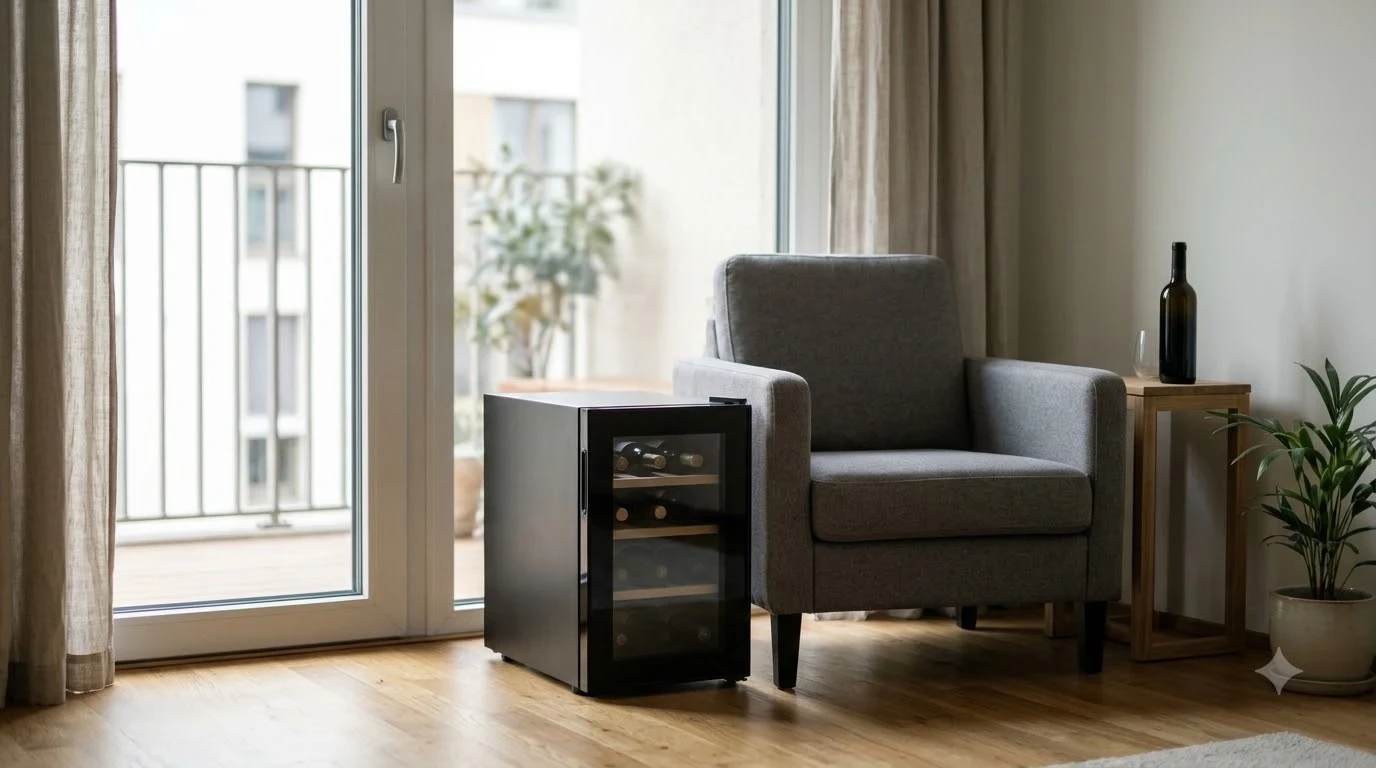
A wine fridge in living room works best when it combines quiet operation, suitable bottle capacity, attractive styling, and enough ventilation to maintain consistent wine temperatures. Choose a freestanding or properly built-in model according to your available space, and prioritize low operating noise if the appliance will sit near a sofa or television. A shaded, level position away from heaters and direct sunlight also helps the refrigerator operate efficiently while protecting your collection.
A living room can be a practical place for wine storage, particularly in homes where the kitchen has limited space or entertaining happens around a dining table and seating area. Unlike a refrigerator hidden behind kitchen cabinetry, a wine cooler in a shared living space becomes part of the room’s furniture and visual design. That makes appearance, door clearance, lighting, and operating noise just as important as temperature settings. The right choice should feel like a natural part of the room rather than an appliance squeezed into an inconvenient corner.
Who This Is For
A living-room wine refrigerator suits homeowners and apartment dwellers who want convenient access to their bottles without using kitchen or basement storage. It is particularly useful for people who entertain regularly, maintain a modest collection, or want a dedicated place for bottles they plan to serve over the coming weeks and months.
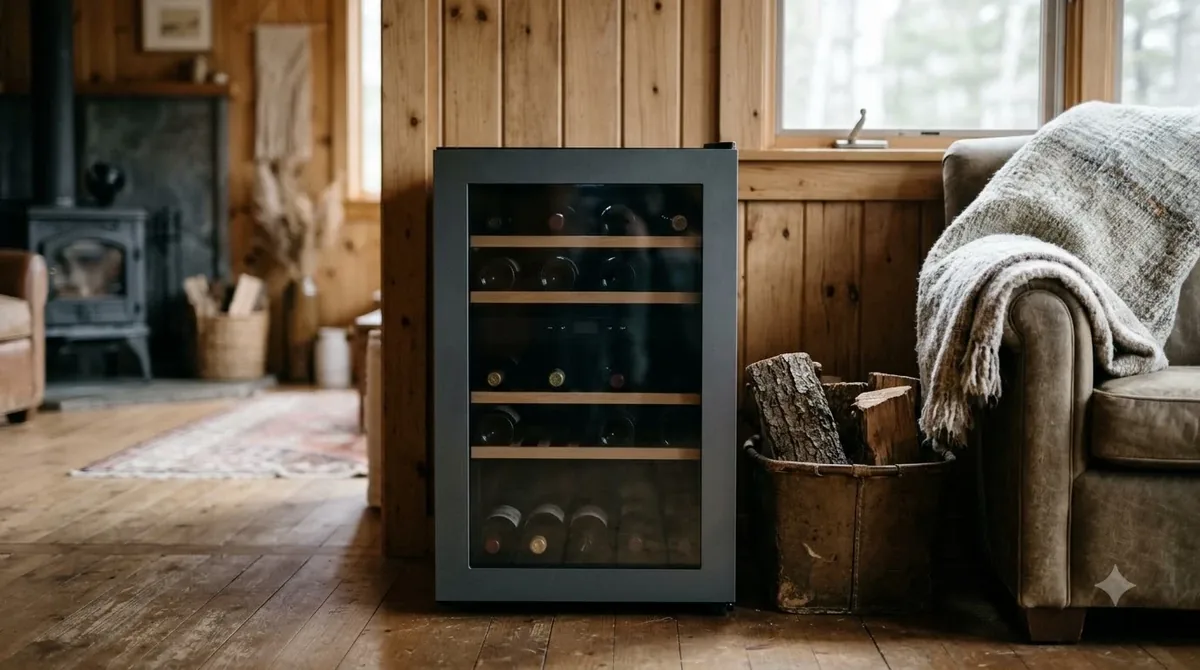
For a household that typically keeps 12 to 24 bottles, a compact freestanding cooler may be sufficient. A larger household with regular dinner parties or a growing collection might prefer capacity for 30 to 50 bottles. The important consideration is how much wine is actually stored, rather than how impressive the advertised maximum capacity looks.
A living-room installation also makes sense when the appliance needs to complement existing furniture. A black cabinet can coordinate with a television console, while a stainless-steel finish may suit contemporary furniture and metal accents. A glass door can display bottle labels, although the refrigerator should have appropriate light protection and should not sit where direct sunlight reaches it.
There are situations where another room makes more sense. Someone storing a large collection for extended aging may prefer a dedicated cellar or a temperature-controlled basement installation. A household with a small living room and limited walking space might find a compact apartment wine fridge easier to accommodate. Likewise, anyone planning a dedicated entertainment area can compare a bar wine fridge designed around serving convenience.
Think about how frequently the appliance will be used. If bottles are opened several times a week, easy shelf access and a door that opens comfortably matter. If the cooler mainly stores bottles for occasional gatherings, appearance, stable temperature, and unobtrusive operation deserve greater attention.
Key Factors to Compare
The best living-room wine fridge balances five practical considerations: capacity, noise, installation type, temperature control, and appearance. Comparing these features before purchasing helps prevent a common problem: choosing a refrigerator that looks attractive but is unsuitable for its intended location.
Start with the number of bottles you regularly keep. Standard wine bottles are commonly based on the 750 ml format, but sparkling bottles, Champagne bottles, and wider Burgundy bottles can occupy more room. Manufacturers often calculate capacity using tightly arranged standard bottles, so the usable capacity may be lower when the collection includes different shapes.
| Comparison factor | Practical target | Why it matters |
|---|---|---|
| Small collection | 12–18 bottles | Fits occasional household use |
| Regular collection | 20–30 bottles | Allows room for everyday favorites and entertaining |
| Larger collection | 40–50 bottles | Provides additional storage without requiring a cellar |
| Storage temperature | About 55°F | Supports consistent storage conditions |
| Light protection | UV-protected glass | Helps limit exposure to ultraviolet light |
| Installation | Freestanding or front-venting built-in | Determines required clearance |
| Operating noise | Compare published dB figures | Important near seating and entertainment areas |
Noise deserves particular attention in a living room. A compressor and cooling fan can produce humming, clicking, and vibration as the refrigerator cycles. These sounds may be barely noticeable in a kitchen but more apparent during a quiet movie, conversation, or evening spent reading. Compare the manufacturer’s published decibel rating between models of similar capacity, and consider the location of the compressor and fan.
Installation type is another major distinction. A freestanding cooler generally needs open space around its ventilation areas. A built-in model is designed to release heat through a front ventilation opening, allowing it to fit into a suitable cabinet opening. These categories are not interchangeable. Putting a rear-venting freestanding appliance inside an enclosed furniture unit can restrict airflow and interfere with cooling.
Temperature controls should match the collection. A single-zone model is suitable for storing mostly reds, mostly whites, or a mixed collection maintained at one storage temperature. A dual-zone refrigerator offers separate settings for households that want different temperatures for red and white wines or a dedicated serving area.
Finally, consider the door and interior. Reversible hinges can make installation easier, while sliding shelves improve access to bottles at the rear. LED lighting provides visibility without requiring a bright external lamp. A lock may also be useful in households where children can access the living room.
Tip: Measure the refrigerator’s full installation area, not just the cabinet width. Include the manufacturer’s required ventilation gaps, the door swing, and enough room to pull out shelves before deciding where it will stand.
Step-by-Step: Choosing and Positioning a Living-Room Wine Fridge
A successful installation begins with measuring the room and ends with checking that the refrigerator can maintain its selected temperature. Following a consistent process makes it easier to compare models and avoid costly placement mistakes.
- Measure the available floor space. Record the width, height, and depth of the intended position. Allow additional room for ventilation and door movement. A refrigerator that measures 20 inches wide may need a wider installation area once the manufacturer’s side-clearance requirements are included.
- Determine the actual bottle requirement. Count the bottles normally kept at home and add room for occasional purchases. A collection of 15 bottles might justify a 20-bottle-class refrigerator, while someone routinely storing 30 bottles should consider a larger capacity.
- Choose the installation format. Select a freestanding refrigerator for an open furniture arrangement or a front-venting built-in appliance for a suitable cabinet installation. Do not assume that a unit can be enclosed simply because its dimensions fit a furniture opening.
- Compare operating noise. Review published decibel information and check whether the refrigerator uses a compressor or thermoelectric cooling system. A quiet specification is especially important when the appliance will be within a few feet of a sofa or television.
- Select the temperature arrangement. Choose single-zone storage if the collection can remain at one consistent temperature. Consider dual-zone storage if the household regularly keeps both red and white wines ready for different serving conditions.
- Check the electrical position. Make sure an appropriate grounded outlet is accessible without trapping the power cord behind the appliance. Avoid using extension cords or adapters where the manufacturer’s instructions prohibit them.
- Prepare the floor and surrounding area. Choose a firm, level surface that can support the fully loaded refrigerator. Keep the unit away from direct sunlight, radiators, fireplaces, and other heat-producing equipment.
- Install and check the refrigerator. Follow the specific manual for leveling, clearance, and initial operation. Allow the unit to reach its selected temperature before loading the collection, and check that the door closes properly.
Do not skip the installation instructions simply because the refrigerator appears similar to another model. Clearance requirements can differ substantially. For example, the Midea FP-20RWC096LMNV-T1 manual specifies more than 30 cm of clearance above its particular unit and more than 10 cm at the sides and rear. Those figures are not universal requirements for every wine refrigerator.
Vinotemp also emphasizes placing a refrigerator on a flat, level surface and keeping its ventilation openings unobstructed. Its wine refrigerator buying guide provides additional guidance on storage conditions, temperature zones, and installation considerations.
Wine Fridge Types and Styles Explained
Living-room wine refrigerators generally fall into four useful categories: compact freestanding units, larger freestanding cabinets, built-in models, and dual-zone refrigerators. The right type depends on the room layout, collection size, and whether storage or serving convenience is the main priority.
Compact freestanding wine refrigerators
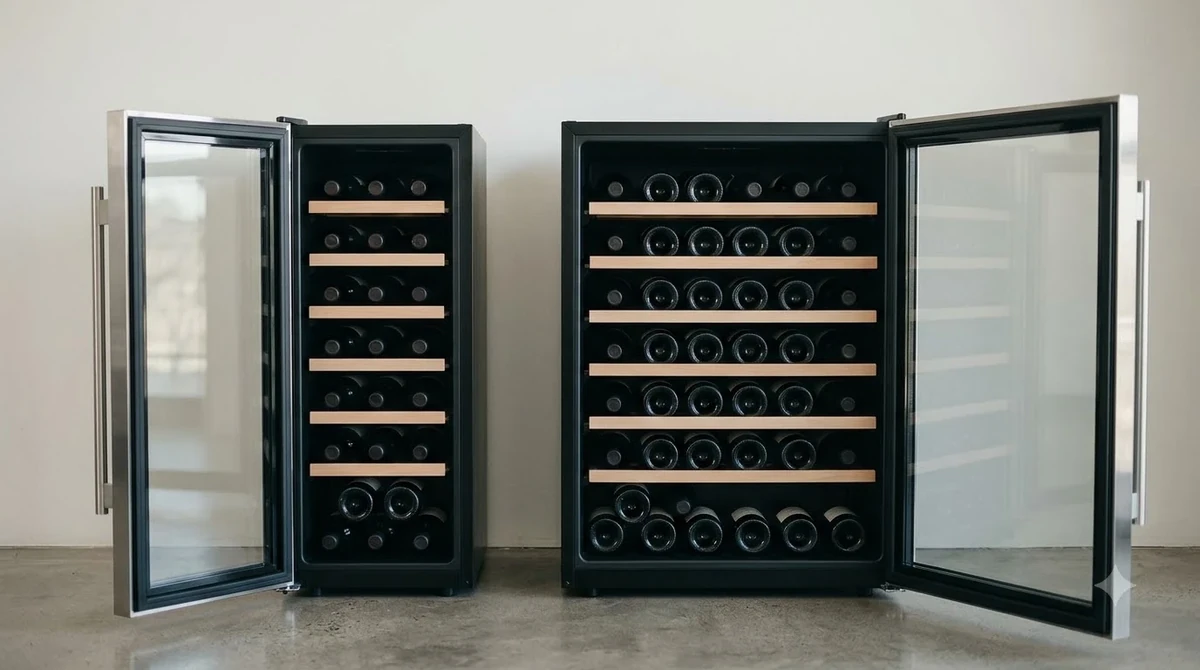
Compact models are suitable for smaller living rooms, apartments, and homes where the refrigerator needs to occupy a limited amount of floor space. A capacity in the 12-to-18-bottle range can accommodate a modest collection without making the appliance dominate the room.
These units are often easier to position beside a sideboard, console, or dining-room cabinet. However, a compact footprint does not remove ventilation requirements. Check the location of the exhaust vents and leave the clearance specified by the manufacturer.
Compact refrigerators can also be convenient for households that mainly purchase bottles for immediate consumption. They may not offer the shelf spacing or internal flexibility required for a collection containing numerous oversized bottles.
Medium and large freestanding cabinets
A medium-sized refrigerator holding approximately 20 to 30 bottles is a practical option for regular wine drinkers. It provides room for a rotating collection of reds, whites, rosé, and sparkling bottles without requiring a large dedicated storage area.
Larger freestanding cabinets with advertised capacities around 40 to 50 bottles suit homes where wine is a regular part of entertaining. These models may have more substantial doors, deeper shelves, and larger exterior dimensions. Their weight when fully loaded also makes floor stability particularly important.
Freestanding refrigerators should remain exposed to the airflow their manuals require. A decorative surround can be attractive, but it must not block the rear or side ventilation openings.
Built-in and under-counter models
Built-in wine refrigerators are designed for installation in a properly prepared cabinet or furniture opening. Many use front-facing ventilation, allowing the appliance to release heat through a grille near the bottom of the door.
This format can create a cleaner appearance in a living room with custom cabinetry. For example, a built-in cooler may fit into a purpose-designed entertainment wall or a cabinet beside a dining area. It can also keep the appliance’s sides hidden from view.
However, built-in installation requires accurate measurements. Cabinet depth, opening height, front ventilation, door clearance, and electrical access all need to match the manufacturer’s specifications. A freestanding appliance should not be substituted for a built-in model unless the manufacturer explicitly approves the installation.
Single-zone and dual-zone refrigerators
Single-zone refrigerators maintain one selected temperature throughout the main storage compartment. They are suitable for people who prioritize consistent storage rather than keeping several categories of wine at different serving temperatures.
Dual-zone refrigerators have separate temperature-controlled sections. A household might use one section for reds and another for whites or sparkling wines. This arrangement is particularly useful when bottles are frequently selected for immediate serving.
Remember that wine storage and wine serving are different purposes. A steady storage temperature around 55°F works for a mixed collection, while serving temperatures depend on wine style. Light whites and rosé generally serve around 45–50°F, full-bodied whites around 50–55°F, light reds around 55–60°F, and full-bodied reds around 60–65°F.
A dual-zone appliance can make serving more convenient, but it is not essential for every household. If most bottles are stored for future occasions rather than kept ready to pour, a simpler single-zone design may be sufficient.
Common Mistakes When Putting a Wine Fridge in a Living Room
The most common mistakes involve ventilation, sunlight, noise, and unsuitable furniture placement. A refrigerator can look perfectly positioned while still operating inefficiently because its surroundings interfere with heat release or airflow.
Enclosing a freestanding refrigerator
One frequent mistake is placing a freestanding wine cooler inside a closed wooden cabinet. The cabinet may make the appliance look integrated, but restricted airflow can cause additional heat buildup and longer cooling cycles.
Built-in and freestanding refrigerators use different ventilation arrangements. Before purchasing, identify where the selected model releases heat. A front-venting built-in appliance is generally the appropriate choice for an enclosed furniture opening, provided the cabinet follows its installation instructions.
Positioning the appliance beside a heater
A location next to a fireplace, radiator, heating vent, or sunny patio door may be convenient but creates an unfavorable operating environment. Miele specifically warns that heat-producing appliances and direct sunlight can increase energy consumption because the refrigerator has to work harder.
Choose a shaded wall away from concentrated heat. Even a glass door with UV protection does not make a position in direct sunlight ideal. Reducing unnecessary heat exposure helps the appliance maintain its selected temperature more consistently.
Ignoring operating noise
A refrigerator beside a sofa needs a different acoustic standard from one installed in a utility room. Compressor cycling, fan noise, and vibration can become noticeable when background noise is low.
Look at the stated noise rating before purchasing. Also consider whether the refrigerator will stand on a hard tile floor, hardwood, or another surface that could amplify vibration. A stable installation and properly adjusted feet can reduce unnecessary rattling.
Buying according to advertised bottle capacity alone
Advertised bottle capacity generally assumes a specific arrangement of standard bottles. Real collections often contain different shapes, including wide Pinot Noir bottles, sparkling wine bottles, and larger formats.
Check shelf spacing and internal dimensions rather than relying entirely on the maximum capacity figure. Removable or adjustable shelves can provide useful flexibility, particularly when the refrigerator stores a combination of wine styles.
Choosing appearance over everyday access
A dark glass door or attractive stainless-steel finish may look excellent in a showroom, but the refrigerator still needs to work in the actual room. A door that opens toward a sofa or blocks a walkway can become frustrating during regular use.
Measure the complete door-opening area and check whether the hinge can be reversed. Consider where guests will stand when selecting a bottle and whether the shelves can be extended without hitting nearby furniture.
Care and Storage Tips for a Living-Room Wine Fridge
Good maintenance helps a wine refrigerator remain quiet, efficient, and visually attractive. Consistent storage conditions, unobstructed ventilation, careful bottle arrangement, and occasional cleaning are more useful than constantly adjusting the temperature.
Maintain a stable storage temperature
For a mixed collection intended for storage, approximately 55°F is a useful target. Vinotemp identifies this temperature as desirable for long-term wine storage and emphasizes avoiding repeated temperature fluctuations.
Do not confuse the temperature displayed on the refrigerator with the room temperature surrounding it. A wine cooler must work harder when the living room becomes hot, particularly if the appliance sits near a window or heating equipment. Keeping the room and installation location reasonably stable supports more consistent operation.
Protect bottles from light
Living rooms often have large windows, decorative lamps, and bright overhead lighting. These features can create a more challenging environment for wine storage than a dark pantry or cellar.
Choose a refrigerator with appropriate UV protection in its door glass and position it away from direct sunlight. LED interior lighting is also a sensible choice because it provides visibility without relying on a bright, continuously illuminated display.
Arrange bottles carefully
For longer-term storage, cork-sealed bottles are generally kept on their sides so the wine remains in contact with the cork. This helps limit cork drying. Keep bottles from touching the refrigerator’s internal rear wall or blocking airflow openings.
Follow the refrigerator’s shelf-weight limits and avoid overloading its racks. If the collection includes oversized bottles, rearrange the adjustable shelves rather than forcing bottles into spaces that are too narrow.
Keep ventilation openings clean
Dust can collect around the grille, rear ventilation area, and other exposed surfaces. Clean accessible exterior areas periodically according to the manufacturer’s maintenance instructions. Make sure curtains, rugs, decorative objects, and furniture do not obstruct the airflow around the refrigerator.
Pay attention to vibration as well. If the appliance begins rattling, check that it remains level and that bottles or shelves are not touching in a way that creates additional noise. A refrigerator standing on an uneven surface may vibrate against nearby furniture.
Clean the interior and inspect the door seal
Remove bottles carefully before cleaning shelves and accessible interior surfaces. Use a soft cloth and an appropriate mild cleaning solution, following the appliance instructions. Avoid harsh chemicals that could leave unwanted odors inside the compartment.
Inspect the door gasket periodically for dirt, damage, or areas that prevent a complete seal. A door that does not close properly can allow warm air inside and make it more difficult for the refrigerator to maintain its set temperature.
If the appliance will be unused for an extended period, follow the manufacturer’s shutdown and cleaning instructions rather than simply leaving bottles inside a disconnected refrigerator.
Keep serving temperatures separate from storage temperatures
A storage refrigerator does not need to keep every wine at its ideal drinking temperature. A mixed collection can remain around 55°F, with individual bottles chilled or allowed to warm slightly before serving.
For reference, sparkling wines generally serve at 40–50°F, light whites and rosé at 45–50°F, full-bodied whites at 50–55°F, and light reds at 55–60°F. Full-bodied reds are generally served at 60–65°F. This distinction can help determine whether a single-zone storage cabinet or dual-zone serving-oriented refrigerator makes more sense.
For additional room-specific considerations, the By room wine storage guide can help compare a living-room installation with other household locations. A cooler basement may be another option for larger collections, particularly when a dedicated basement wine fridge provides better separation from everyday living areas.
Frequently Asked Questions
Can a wine fridge run continuously in a living room?
Yes. Wine refrigerators are designed to remain connected to power and cycle their cooling systems as needed. The compressor or cooling system does not necessarily run continuously at full power. Allowing the appliance to operate normally helps maintain a stable internal environment.
Does a wine fridge need a special electrical outlet?
Most household wine refrigerators use a standard household electrical connection, but the required voltage, amperage, and grounding depend on the model. Some larger installations may have additional electrical requirements. The appliance’s installation manual provides the correct electrical specifications and restrictions.
Can a wine fridge be placed on a carpeted living-room floor?
Some manufacturers discourage carpeted installations because carpet can interfere with stability, airflow, or protection from condensation and spills. A firm, level flooring surface is preferable. If carpet cannot be avoided, consult the manual about an appropriate stable protective platform and ventilation arrangement.
Why does a wine refrigerator make clicking sounds at night?
Clicking can occur when a cooling system switches on or off, while other normal sounds may include refrigerant movement and fan operation. A new or louder noise should be investigated if it continues, becomes irregular, or accompanies poor cooling. Checking the leveling feet and surrounding furniture can help identify avoidable vibration.
Should a wine fridge have a lock in a family living room?
A lock can be a useful feature when children or visitors have easy access to the appliance. It can also help prevent accidental door opening and unwanted handling of bottles. However, a lock does not replace appropriate supervision or safe installation, and the key or access mechanism should remain available to responsible adults.
A well-chosen wine fridge in living room should provide convenient bottle access without introducing unnecessary noise, heat, or visual clutter. Prioritize the correct installation format, adequate ventilation, appropriate capacity, and a stable storage temperature before deciding on finishes and decorative details. With careful positioning and regular maintenance, a wine refrigerator can become a useful and attractive part of the living space.
More in By Room & User
 Wine Fridge in Bedroom: Choose Quiet Storage That Fits Your SpaceUpdated Nov 20, 2026
 Wine Fridge In Dining Room: Choose the Right Size and StyleUpdated Nov 20, 2026
 Wine Fridge In Pantry: Choose the Right Size and SetupUpdated Nov 20, 2026
 Wine Fridge In Kitchen: Choose the Right Fit and PlacementUpdated Nov 20, 2026
 Wine Fridge In Garage: Choose a Cooler That Handles Temperature SwingsUpdated Nov 20, 2026
 Wine Fridge In Cabinet: How to Choose the Right Built-In FitUpdated Nov 20, 2026