

We may earn a commission when you buy through links on this page, at no extra cost to you. Learn more.
The oster wine opener is a convenient cordless electric corkscrew for opening traditional wine bottles with minimal manual effort, but its rechargeable battery and long-term reliability deserve careful consideration. The Oster Silver Electric Wine Opener combines push-button operation, a soft-grip handle, a charging base, and an included foil cutter. The manufacturer advertises up to 30 bottles per charge, although customer feedback raises concerns about declining battery performance and corkscrew jamming. It makes the most sense for households that value convenience over the simplicity and serviceability of a traditional manual opener.
An electric wine opener can make opening a bottle considerably easier, particularly during dinner parties or when several bottles need to be opened in succession. Oster’s silver model has a familiar countertop design, a rechargeable power system, and a straightforward operating mechanism. However, convenience is only part of the buying decision. Battery longevity, storage space, charging habits, and the possibility of a stuck cork all deserve attention before choosing this appliance.
Specs and Key Features
The Oster Silver Electric Wine Opener is designed around simple cordless operation rather than multiple complicated settings. Its combination of a rechargeable base, soft-grip housing, and separate foil cutter provides the essential equipment for opening conventional wine bottles without manually turning a corkscrew.
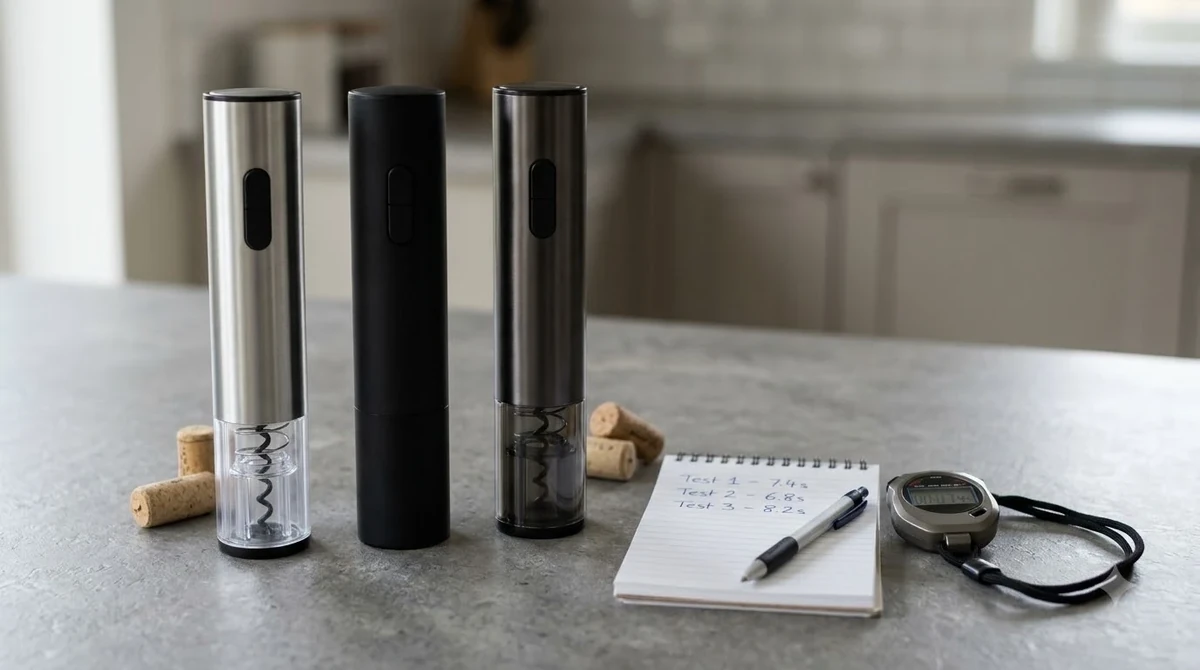
The specific model reviewed here is FPSTBW8207-S-AMZ. Oster lists a charging time of approximately 6-8 hours and advertises the ability to open up to 30 bottles from a full charge. Those figures make the opener suitable for occasional entertaining, although actual performance depends on battery condition, charging contact, and the corks being removed.
| Specification | Oster Silver Electric Wine Opener |
|---|---|
| Model | FPSTBW8207-S-AMZ |
| Operation | Cordless electric |
| Advertised capacity | Up to 30 bottles per charge |
| Charging time | Approximately 6-8 hours |
| Dimensions | 5.51 x 14.96 x 5.32 inches |
| Listed weight | 2.1 pounds |
| Listed wattage | 14.4 |
| Handle | Soft-grip design |
| Included accessories | Charging base and foil cutter |
| Warranty | One-year limited warranty |
| Intended use | Household use |
One important distinction is that Oster sells several electric wine opener configurations. The silver FPSTBW8207-S-AMZ should not be confused with the 4208 model, which includes a stainless-steel wine chiller, or the 4-in-1 wine kit, which includes additional wine accessories. Specifications and warranty terms can differ between these products.
The 8207’s physical dimensions also deserve consideration. Its approximately 15-inch height makes it taller than a compact manual corkscrew, so buyers should measure their available countertop or cabinet space before choosing a permanent storage location.
For a fuller specification reference, consult the official Oster Silver Electric Wine Opener product page. It provides the manufacturer’s stated features, included components, and warranty information.
What Owners Like
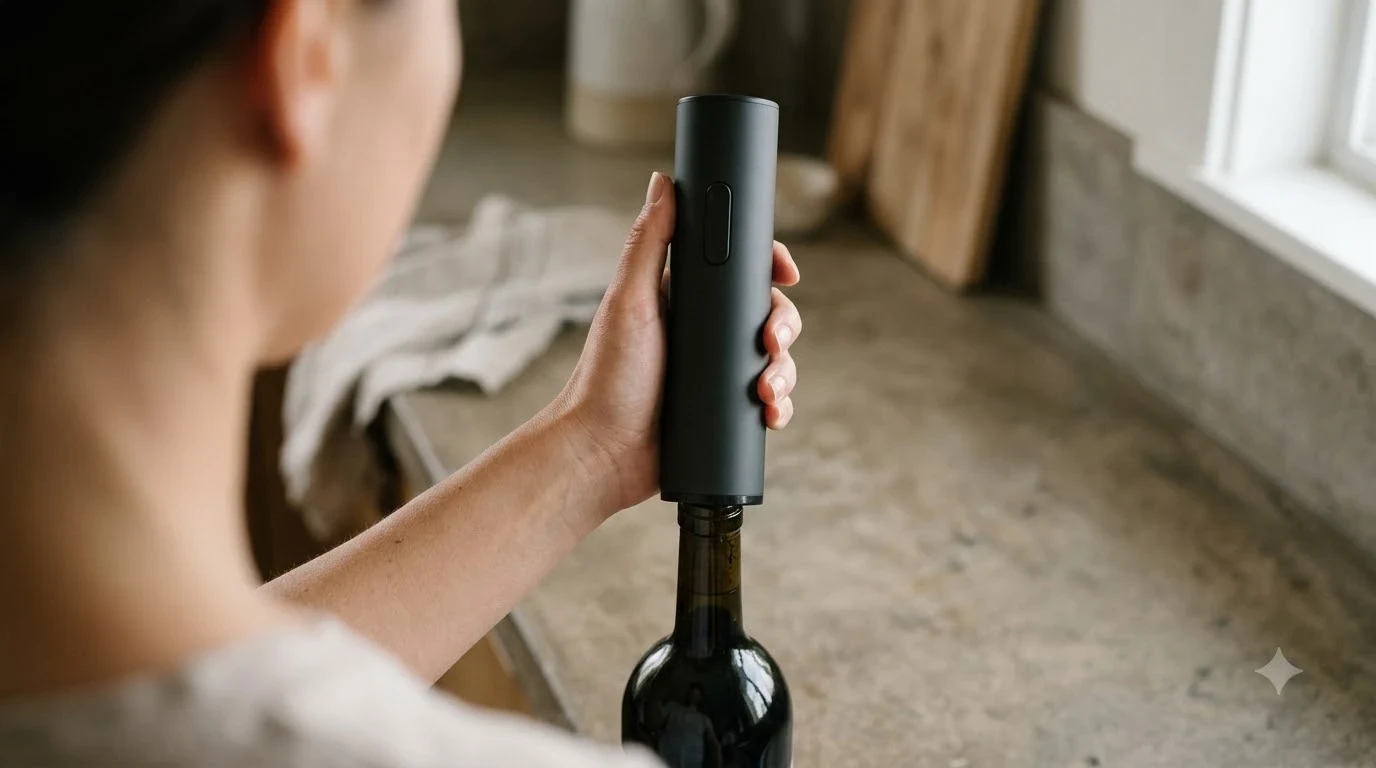
The strongest advantage of the Oster electric opener is its convenience: the motor does the turning and extraction, leaving the user to position the device and operate its switch. Owners also appreciate the cordless construction, soft grip, and compact set of included accessories.
Traditional corkscrews require the user to apply downward pressure, rotate the handle, and pull the cork from the bottle. That sequence is manageable for many people, but it can become inconvenient when opening several bottles or dealing with a particularly firm natural cork. An electric opener changes the process into a much simpler operation.
This feature is particularly attractive for people who have difficulty gripping small handles or applying consistent twisting pressure. The Oster’s soft-grip exterior provides a more comfortable surface to hold than a narrow metal corkscrew. The motor also reduces the amount of physical effort needed during extraction.
Another advantage is that the opener does not need to remain connected to a power outlet while removing a cork. Once charged, it can be moved around the kitchen, dining room, or entertaining area without dragging a cable across the counter. This is useful when a bottle is opened away from the location where the charging base normally sits.
Simple operation for entertaining
The two-direction control makes the basic opening sequence relatively easy to understand. One direction drives the corkscrew into the cork and extracts it. The opposite direction releases the removed cork from the mechanism.
That straightforward process is useful during a dinner party when attention is divided between preparing food, serving guests, and arranging glasses. Rather than struggling with a conventional corkscrew, the host can operate the opener with a button while keeping the bottle steady.
The included foil cutter is another practical benefit. Wine bottles commonly have a foil or capsule covering the neck, and removing it before uncorking gives the electric mechanism a clear working area. Having the cutter included means there is no immediate need to purchase a separate accessory.
Positive owner experiences
Customer feedback on the official Oster product page includes positive reports about long-term operation. One owner described using an Oster electric opener for years, noting that proper placement on the charging base was important to maintaining operation. That observation highlights an important practical detail: rechargeable appliances depend on consistent contact with their charging equipment.
Retailer feedback also identifies ease of use as a recurring positive feature. Lowe’s customer-review summary describes the opener as effective and convenient, particularly for people who prefer not to use the physical effort associated with manual cork extraction.
For buyers who prioritize a familiar design and straightforward controls, those advantages make the Oster a recognizable option. It is also a natural fit for a countertop entertaining area alongside wine glasses, decanters, and other bar accessories.
Common Complaints
Battery reliability is the biggest concern in owner feedback about the Oster electric wine opener. Customers report charging problems, reduced operating strength, and openers that stop functioning after a period of regular use.

Some reviews on Oster’s product page describe batteries losing their ability to power the corkscrew after approximately 12-18 months. Other customers report that the appliance initially worked well but later failed to charge correctly, even when the charging base appeared to receive power.
This matters because an electric opener is only useful when its battery can provide enough power to complete the extraction process. A partially charged or deteriorating battery may turn a convenient bottle-opening experience into a frustrating one, particularly when the cork is already engaged.
Corks getting stuck inside the mechanism
Another recurring complaint concerns corks becoming trapped inside the opener. In some customer reports, the corkscrew mechanism stops before completing its cycle, leaving the cork lodged in the housing. This can be especially inconvenient if the battery is also depleted.
Natural corks vary in density, age, moisture exposure, and structural condition. A dry, brittle cork can behave differently from a newer, more flexible one. Although no electric opener can eliminate every cork-related problem, proper alignment and allowing the motor to complete its intended movement can reduce unnecessary strain.
Customers have also described problems with corkscrew alignment and reduced extraction power. These experiences suggest that the device should be operated carefully rather than forced through resistance.
Battery replacement and product lifespan
Battery replacement is another important consideration. The manufacturer’s documentation describes the appliance and charging unit as containing no user-serviceable parts. Consequently, owners should not assume that replacing an internal battery will be a straightforward maintenance task.
This is a disadvantage compared with a manual corkscrew, which has no rechargeable battery or electronic charging components. A traditional opener may eventually wear out, but it does not become unusable simply because its battery no longer accepts a charge.
There are also mixed experiences concerning durability. Some owners report years of successful operation, while others describe problems within a much shorter period. That variation makes it difficult to predict the lifespan of an individual unit.
The practical conclusion is that the Oster’s advertised bottle capacity describes performance under suitable operating conditions, not a guarantee of long-term battery health. Buyers should consider the warranty and retain their purchase documentation in case a problem develops.
Who Should Buy and Who Should Skip
The Oster electric wine opener is best suited to households that open wine regularly and value push-button convenience. It is less appealing to buyers who want a mechanically simple accessory, easily replaceable components, or dependable operation without charging routines.
Who should consider buying it?
People who find manual corkscrews difficult to operate are among the clearest potential buyers. The motorized mechanism eliminates most of the twisting and pulling associated with a traditional opener. Its soft-grip exterior also gives users a comfortable surface to hold while positioning the device.
Frequent hosts may appreciate having an electric opener ready for dinner parties and gatherings. Opening several conventional bottles is simpler when the motor handles the extraction process. The included foil cutter also keeps the essential opening accessories together.
People who prefer countertop accessories may like the charging base and recognizable silver finish. The appliance can become part of a dedicated serving station, particularly when paired with wine glasses, bottle stoppers, and a wine preservation accessory.
A coordinated setup can also make sense for people arranging a bar cart. However, the charging base needs a suitable electrical connection, and the opener should have enough vertical clearance to be stored conveniently.
Who should skip it?
Buyers who prioritize longevity and repairability may prefer a manual corkscrew. A battery-powered appliance introduces another component that can eventually fail, and the Oster documentation does not describe a user-replaceable internal battery.
Occasional wine drinkers may not need an electric device at all. If a household opens one bottle every few weeks, a conventional waiter’s corkscrew can provide everything necessary without requiring a charging base or dedicated storage space.
Travelers and compact-kitchen owners should also consider the opener’s height. A smaller manual tool is easier to carry, store in a drawer, or place in a travel wine kit.
Finally, people who frequently encounter fragile or aged corks may prefer having a traditional two-prong opener or another suitable manual tool available. Older corks can crumble during extraction, and no motorized corkscrew guarantees a clean removal every time.
How It Compares to Alternatives
The Oster is a convenience-focused electric opener rather than an all-purpose wine tool. Its strongest competition comes from traditional manual corkscrews and other electric opener configurations, each of which addresses a different set of priorities.
Comparing the opening method, charging requirements, and included accessories gives buyers a more useful picture than comparing appearance alone. The right choice depends on how often wine is opened and whether convenience or long-term mechanical simplicity matters more.
Oster versus a manual corkscrew
A manual corkscrew is the simplest alternative. A waiter’s corkscrew combines a spiral, a hinged lever, and a small foil blade in a compact folding design. It does not need a charging base, electrical connection, or rechargeable battery.
The Oster is easier to operate for someone who struggles with manual pressure and twisting. A manual opener, however, is easier to transport and can remain useful for years without battery maintenance.
Manual models also provide more direct control over cork extraction. This can be helpful when working with delicate natural corks, although successful removal still depends on technique and the condition of the cork.
Oster versus a rechargeable wine opener kit
Oster also offers a 4-in-1 Wine Kit with a rechargeable bottle opener, wine pourer, vacuum stoppers, and foil cutter. That configuration is more appropriate for buyers who want several serving and preservation accessories in one purchase.
The basic silver FPSTBW8207-S-AMZ focuses on opening bottles and includes a charging base and foil cutter. It is therefore a simpler choice for someone who already owns wine stoppers and pourers.
For households that want both opening and preservation accessories, a wine opener and preserver set offers another category worth comparing. The important distinction is whether the extra accessories will actually be used rather than simply adding equipment to a drawer.
Oster versus other electric openers
Other electric wine openers can offer different charging arrangements, body materials, battery systems, and accessory packages. Some use removable batteries, while others rely on rechargeable internal batteries and dedicated stands.
Before choosing another model, compare the manufacturer’s stated bottle capacity, charging time, included accessories, and warranty. A product with a longer advertised battery capacity is not automatically more durable, so independent owner feedback remains useful.
It is also sensible to examine the availability of customer support and replacement components. A device that is easy to maintain may offer better long-term value than one with more accessories but no practical repair options.
For additional accessory comparisons, the Accessory Brands section provides a useful starting point for evaluating wine-opening equipment beyond a single model.
Using and Maintaining the Oster Wine Opener
Correct positioning and regular charging are important for getting consistent performance from the Oster. The manufacturer’s operating instructions emphasize upright alignment, careful handling of the corkscrew, and using the supplied charging equipment.
First-time charging
Before the first use, allow the opener to complete the recommended charging period. Oster lists approximately 6-8 hours for the FPSTBW8207-S-AMZ. The manual for the related 4207 and 4208 configurations also recommends an initial charge of at least eight hours.
Place the appliance securely on its charging base and make sure the charging connections are properly engaged. If the unit does not appear to charge, check its positioning and the power connection before assuming that the internal battery has failed.
Use only the supplied charging equipment. Substituting an unapproved power adapter can create an electrical or product-damage risk.
Opening a bottle correctly
- Remove the foil or capsule covering the bottle’s cork using the supplied foil cutter.
- Place the wine bottle upright on a stable, level surface.
- Position the opener directly over the cork, keeping the appliance as vertical as possible.
- Hold the opener securely and press the lower section of the control switch to begin extraction.
- Allow the mechanism to complete its operation rather than forcing it or trying to accelerate the motor.
- Lift the opener away from the bottle after the cork has been extracted.
- Press the opposite section of the switch to release the cork from the mechanism.
- Return the opener to its charging base when finished.
This procedure follows the general operating sequence described in Oster’s instruction manual. Proper alignment is especially important because holding the opener at an angle can interfere with the corkscrew’s ability to enter and extract the cork cleanly.
Tip: Keep a manual corkscrew nearby as a backup. If the Oster battery is weak or a cork becomes stuck, avoid forcing the mechanism or pulling aggressively on the corkscrew. Turn the appliance off, handle the sharp spiral carefully, and follow the manufacturer’s instructions for safely addressing a jam.
Cleaning and storage
Turn the appliance off and unplug the charging equipment before cleaning or handling attachments. Keep the motor housing and charging base away from water, and never immerse either component in liquid.
Wine residue and dust can accumulate around accessories during regular use. Clean the exterior carefully with an appropriate soft cloth, avoiding moisture around electrical connections and the corkscrew mechanism.
Store the foil cutter with the opener so that the accessories remain together. Choose a dry indoor location away from excessive heat, moisture, and direct exposure to harsh environmental conditions.
Do not attempt to open the motor housing or charging unit. Oster’s manual states that these components have no user-serviceable parts. If the opener develops an electrical or mechanical fault, consult the manufacturer’s customer-service information rather than attempting an internal repair.
Frequently Asked Questions
Can the Oster electric wine opener open bottles with synthetic corks?
It is designed for traditional wine bottles, and synthetic corks may vary in firmness and friction depending on their construction. A tightly fitting synthetic stopper can place different demands on the extraction mechanism than a softer natural cork. Keep the opener vertical and allow its normal operating cycle to finish.
Does the Oster wine opener work with screw-cap wine bottles?
No electric corkscrew is needed for a standard screw-cap bottle because the closure is designed to twist off by hand. The Oster is intended for bottles sealed with removable cork-style closures. Attempting to use its corkscrew mechanism on a screw cap will not provide the intended opening method.
Can the Oster opener remove a cork that has broken inside the bottle neck?
A partially broken cork may be difficult to remove with an ordinary electric opener because the remaining material might not provide a stable surface for the spiral. A specialized two-prong cork remover can be more appropriate for certain damaged or fragile corks. Avoid repeatedly driving the electric mechanism into loose cork fragments.
Does the charging base need to remain plugged in while opening wine?
No. The silver FPSTBW8207-S-AMZ is designed for cordless operation after charging. The base is used to recharge the appliance between uses rather than supplying continuous power during cork extraction.
Is the Oster wine opener suitable for commercial restaurant service?
Oster identifies the appliance as a household-use product rather than a commercial wine-service tool. Restaurants and busy hospitality operations generally need equipment designed for repeated professional use, with appropriate serviceability and dependable operation throughout demanding shifts. A dedicated commercial-grade manual or electric opener is a more suitable category to investigate.
The Oster Silver Electric Wine Opener offers an accessible way to remove conventional wine corks without the twisting and pulling required by manual tools. Its soft grip, cordless design, charging base, and included foil cutter make it convenient for household entertaining, but customer reports about battery deterioration and stuck corks deserve serious consideration. Choose it if push-button operation is your priority, and keep a dependable manual corkscrew available for occasions when the rechargeable mechanism cannot complete the job.
More in Wine Accessories
 Zwilling Wine Stopper Review: Preserve Open Bottles LongerUpdated Nov 21, 2026
 Wine Enthusiast Wine Preserver Review: Features, Benefits and LimitationsUpdated Nov 21, 2026
 Wine Enthusiast Wine Stopper: An Easier Way to Reseal Open BottlesUpdated Nov 21, 2026
 Vintorio Wine Opener: Two-Step Cork RemovalUpdated Nov 21, 2026
 Zwilling Wine Aerator Review: Aerate, Pour, and Seal With One ToolUpdated Nov 21, 2026
 Zazzol Wine Opener Review: Features, Comfort, and Buying AdviceUpdated Nov 21, 2026