

We may earn a commission when you buy through links on this page, at no extra cost to you. Learn more.
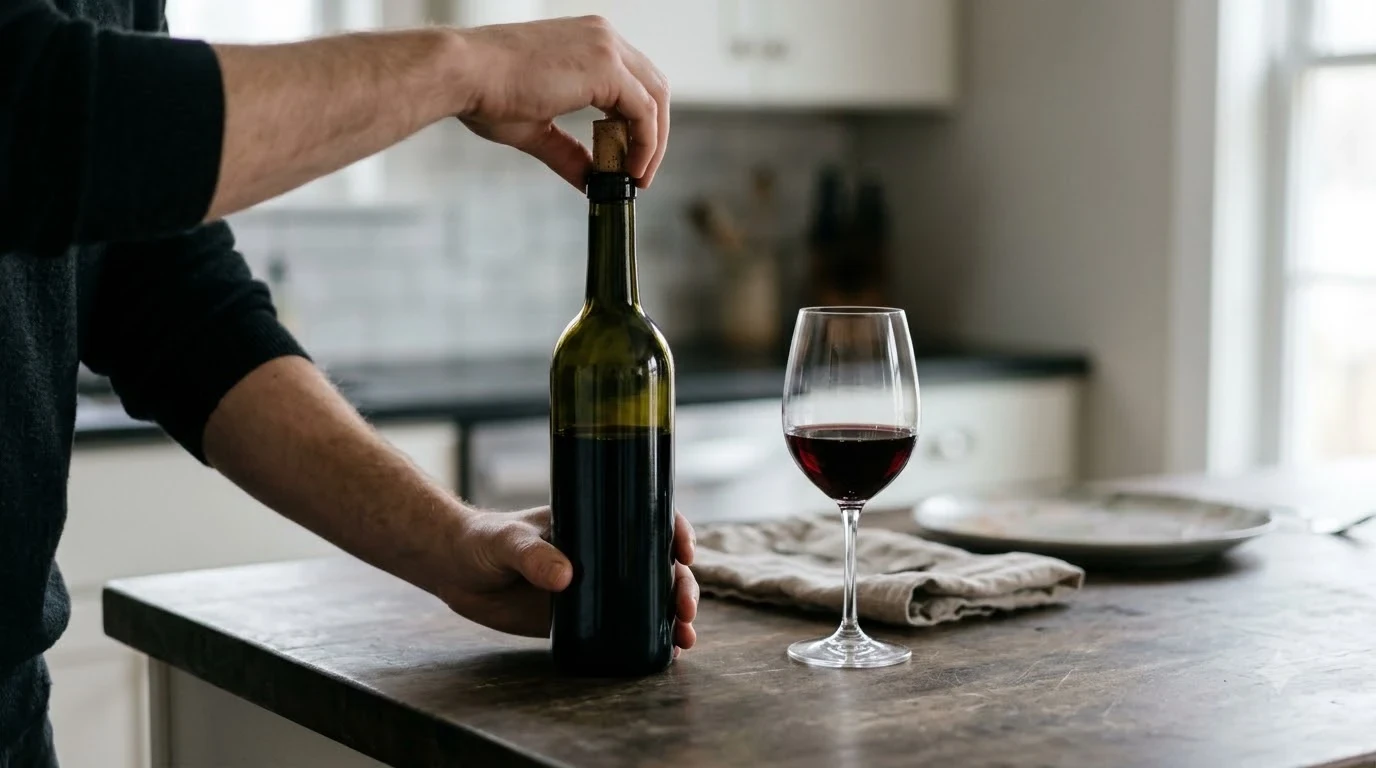
For anyone asking how to push a cork into a wine bottle, the safe method is to press a clean, blunt handle against a broken cork in still wine, then strain the wine before pouring. This is a practical last resort when a damaged cork cannot be pulled out cleanly. Use a stable bottle, apply controlled pressure, and avoid sharp or pointed tools. Never use this method on a pressurized sparkling-wine bottle.
A broken cork can turn a straightforward bottle opening into a small problem, especially when the remaining piece is wedged inside the neck or crumbles every time a corkscrew touches it. Pushing the cork into still wine can save the bottle, but it requires the right utensil and a plan for removing loose cork particles. The goal is to free the bottle opening without damaging the glass or making a mess of the wine.
When Pushing a Cork Into the Bottle Makes Sense
Pushing a cork inward is a last-resort solution for a still wine bottle when a broken or crumbly cork cannot be removed reliably. It is most useful when the remaining cork is lodged in the neck, is too fragile to pull, or has already broken into pieces during opening.

First, look at how much cork remains and how firmly it is lodged. If a substantial piece is still visible above the neck, pulling it out may be easier than pushing it in. A double-hinged waiter’s corkscrew can help lift a firm cork with controlled leverage, while an Ah-So opener can be useful for an older cork that is too fragile to pierce. Both approaches keep the cork in the neck rather than sending it into the wine.
The situation changes when the cork has split into soft pieces or the remaining portion is no longer accessible to a corkscrew. Repeated attempts to pull a crumbly cork can create even smaller fragments, leaving more material to strain out later. A slow, straight push may be more practical than repeatedly trying to extract a cork that is falling apart. A wooden spoon handle or another smooth, blunt utensil can move the cork below the bottle opening without cutting into it.
There is no need to panic if a cork drops into a bottle of ordinary still wine. Physical cork fragments are an inconvenience, not an automatic sign that the wine has spoiled. The practical task is to separate those pieces from the liquid before serving. Decanter’s guidance on handling a broken or crumbly wine cork also identifies pushing the broken piece inward and filtering the wine as useful solutions.
Prepare the Bottle and a Stable Work Area
Before applying pressure, prepare the bottle, the surface, and the utensil so the cork can move without the bottle slipping. A sink, a folded towel, and a clean receiving container provide a practical setup for this small repair.
Remove any remaining foil or capsule from the neck so you can see the cork clearly. Wipe away loose cork dust and inspect the glass around the opening. Look for a chipped rim, a visible crack, or a damaged neck. If the glass appears compromised, stop rather than forcing anything through it. A strainer can catch cork fragments, but it cannot make wine safe to serve if glass may have entered the bottle.
Place the bottle upright in a sink or on a low, stable work surface covered with a folded towel. The towel helps prevent slipping and catches any wine that spills when the cork drops. Keep the opening pointed away from your face and away from other people. Hold the bottle by its body with a steady hand rather than squeezing the neck. A firm, balanced position gives you more control than holding the bottle between your knees or bracing it against an unstable object.
Prepare the utensil before you begin. A clean wooden spoon handle, smooth wooden dowel, or sturdy blunt utensil is suitable if its end fits comfortably through the bottle opening. Wash and dry the utensil first, especially if it has been stored in a kitchen drawer. Avoid a knife, fork, screwdriver, skewer, or any sharp metal object. These tools can slip, scratch the glass, break off small pieces, or introduce unwanted material into the wine. A clean, smooth surface is more important than finding the longest or strongest object available.
How to Push the Cork Down Without Damaging the Bottle
The safest technique uses a straight, centered push with gradual pressure rather than a sudden jab. Keep the bottle upright, position the blunt end of the utensil against the middle of the cork, and allow the cork to move into the wine at a controlled pace.
Position the utensil
Set the blunt end directly against the exposed cork. Try to make contact near its center instead of pushing one edge downward. Off-center pressure can tilt the cork inside the neck, making it catch against the glass. If the cork is already broken and uneven, adjust the utensil so it contacts the firmest remaining section. Keep the tool aligned with the bottle opening rather than angling it against the rim.
Use one hand to steady the bottle and the other to control the utensil. Do not use the bottle’s glass lip as a lever or wedge the utensil between the cork and the glass. The cork needs to travel through the neck, not be scraped along the inside of it. A smooth handle that fits through the opening is easier to control than a broad object that catches on the rim.
Apply gradual pressure
Press downward slowly. The cork may resist at first because it is compressed inside the narrow neck. Maintain steady pressure and give it time to move rather than striking it with the palm of your hand or using a sudden burst of force. If the cork shifts slightly, pause and check that the utensil is still centered. A cork that moves unevenly can catch on one side, so patience matters more than strength.
As the cork passes through the neck, it may drop into the wine and cause a brief splash. This is one reason to work over a sink with a towel beneath the bottle. Keep your face away from the opening and do not lean over it to look inside while pressing. Once the cork has cleared the neck, stop pushing. There is no benefit to repeatedly stirring or pressing it farther into the wine.
If the cork does not move under moderate, controlled pressure, stop and reassess. It may be wedged at an angle, swollen, or breaking apart. Changing to another sharp implement or pressing harder is not a good solution. A damaged or unstable bottle should not be forced. You can also return to a cork-removal method if a firm portion remains accessible; the instructions for how to open a wine bottle with a broken cork can help when extraction is still practical.
Strain the Wine Before Serving
Once the cork has dropped into the bottle, the next step is to separate the wine from any floating pieces. A clean fine-mesh strainer, thin cheesecloth, or unbleached coffee filter can catch cork fragments as the wine passes into another container.
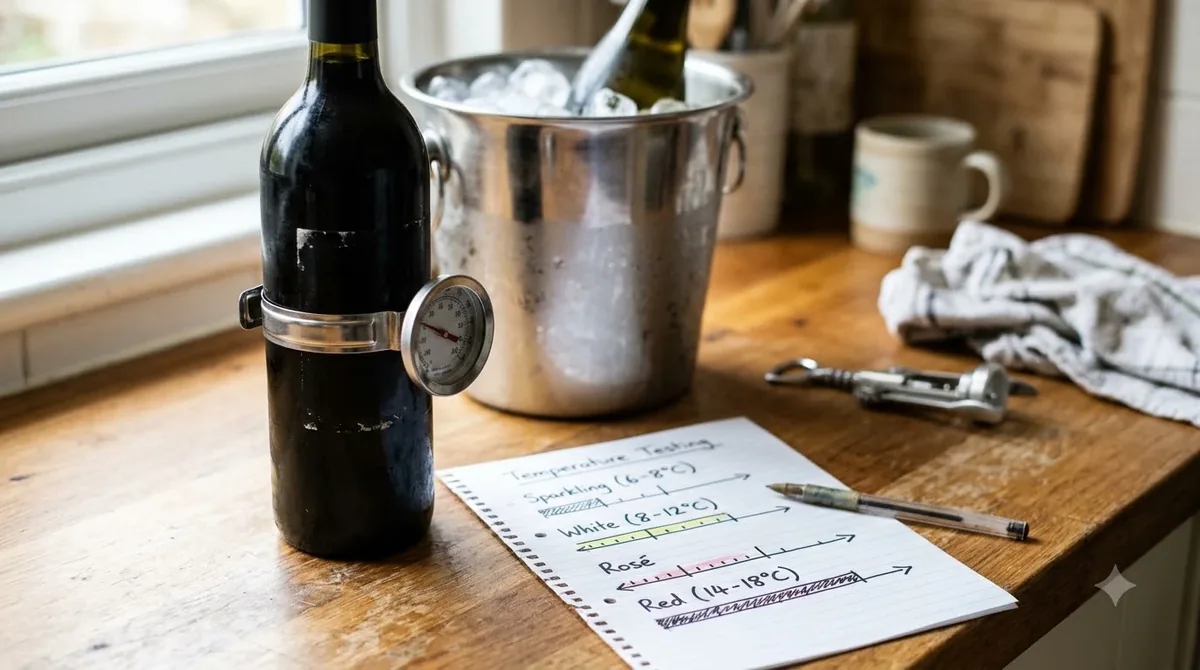
Set a clean funnel over a decanter, pitcher, or other food-safe container. Line it with a clean, thin cloth or use a fine-mesh sieve that has been washed and dried. Pour slowly so the cork pieces remain in the filter instead of slipping around its edges. Avoid filling the funnel too quickly. A slow pour gives the filtering material time to catch fragments and reduces the chance of wine running over the sides.
A paper coffee filter is useful when the cork has crumbled into very small particles. An unbleached filter is a good choice because WSET recommends it to avoid affecting the wine’s flavor. Place the filter securely in a funnel and allow the wine to pass through at its own pace. Coffee filters can drain more slowly than a mesh strainer, so do not press the cork pieces against the paper to speed things up. That pressure can tear the filter and send the fragments into the receiving container.
For an older or particularly delicate bottle, avoid unnecessary aeration. Decanter advises handling fragile wine gently because extra exposure to oxygen during filtration can speed oxidation and reduce delicate aromas. In that situation, pour only until the cork pieces have been caught, then stop. You can also filter directly into individual glasses when only a small amount of wine needs to be cleared. A young, sturdy everyday wine is generally less demanding, but slow pouring remains the simplest way to keep the fragments out of the glass.
| Situation | Recommended action | Useful tool or detail |
|---|---|---|
| Firm cork remains in the neck of still wine | Try to remove it before pushing | Double-hinged waiter’s corkscrew or Ah-So opener |
| Broken cork is crumbly or difficult to retrieve | Push it carefully into the bottle, then strain | Clean wooden spoon handle or blunt dowel |
| Cork is already floating in still wine | Leave it in the bottle and filter the wine | Fine-mesh sieve, cheesecloth, or unbleached coffee filter |
| Champagne or another pressurized sparkling wine | Do not use the push-in method | Keep the cork controlled and follow sparkling-wine opening precautions |
Tip: Pour through a clean filter into a separate decanter or pitcher instead of trying to scoop every cork fragment out of the bottle. Filtering the liquid is usually easier and more reliable than chasing small pieces around the neck.
Know Which Bottles Should Not Be Pushed
The push-in method is intended for still wine, not bottles containing pressurized sparkling wine. Champagne, Prosecco, and Cava require a different approach because pressure inside the bottle can force the cork outward unexpectedly.
The Comité Champagne reports that pressure inside a Champagne bottle is approximately 5 to 6 bar, or about three times the pressure of a car tire. That pressure is why opening a sparkling bottle requires firm control of the cork. For Champagne, the Comité recommends holding the cork securely, tilting the bottle between 30 and 45 degrees away from people, and rotating the bottle to release the cork gradually. For its detailed instructions, see the official Champagne opening guidance.
Do not attempt to solve a broken sparkling-wine cork by driving it into the bottle with a spoon handle or another utensil. A pressurized cork can move suddenly, and forcing it may cause wine to surge out. Keep the bottle pointed away from people and maintain control of the closure rather than putting your face or hands directly over the opening. If the cork is damaged and the pressure is not under control, stop improvising and seek help from someone experienced with sparkling-wine service.
There is another important reason to stop: damaged glass. A chipped or cracked bottle neck is not a cork problem that can be corrected by pushing the cork farther inside. Cork fragments can be strained from wine, but a filter cannot reliably remove tiny pieces of glass. If you suspect that glass has entered the bottle, do not serve the wine. The same caution applies when a utensil breaks, sheds material, or leaves you uncertain about what has fallen into the liquid.
Prevent Cork Breakage and Handle the Bottle Afterward
A careful opening technique can reduce the chance of needing to push a cork into the bottle in the first place. The right corkscrew, a steady hand, and a tool suited to the age of the wine are more useful than pulling harder when a cork begins to resist.
For most everyday still wines, a double-hinged waiter’s corkscrew provides controlled leverage. Its two-stage lever helps lift the cork in a straighter line and reduces sideways pressure against the neck. Insert the spiral near the center of the cork, turn it steadily, and use the lever in stages rather than trying to yank the cork out in one movement. Do not drive the spiral through the bottom of the cork, because piercing all the way through can push cork particles into the wine.
Older bottles need extra care because cork can become fragile with age. An Ah-So opener uses two narrow prongs that slide between the cork and the bottle, allowing the cork to be lifted without piercing it. This can be a better choice for a brittle closure that may break under the spiral of a conventional corkscrew. A wine towel can also improve your grip on the bottle while you work. Keep the bottle steady and make small adjustments rather than twisting forcefully or rushing the extraction.
If the cork has already been pushed inside, pour the wine through a filter into a clean container rather than trying to use the submerged cork as a replacement closure. If wine remains, transfer it to a suitable clean bottle or use a proper wine stopper, then refrigerate it. Still wine generally keeps for about 3 to 5 days in the refrigerator after opening, although its condition depends on the wine and how much air remains in the container. The cork that fell into the bottle is no longer a dependable seal.
A sound, intact cork can also be dried and saved for a craft project after serving. A collection of clean corks can become a useful display or household project, with instructions on how to make a cork board from wine corks. Once a wine bottle is empty and cleaned, it can also be reused as a decorative light with the steps in how to make wine bottle lights. For other practical bottle-opening and storage questions, the site’s Wine Q&A offers more wine basics.
Frequently Asked Questions
These five questions cover common points that can be confusing after a cork breaks, including the difference between cork debris and a wine fault, temporary recorking, and natural deposits in older wines.
Does cork floating in wine mean the wine is corked?
No. Floating cork pieces are physical fragments, while a wine described as corked has a fault usually associated with TCA, or trichloroanisole. Cork taint can produce musty aromas resembling damp cardboard and can mute the wine’s fruit character. The presence of a fragment by itself does not establish that the wine has this fault.
Can I put the original cork back into an opened wine bottle?
Yes, for temporary closure of a still-wine bottle, but the cork may no longer fit as it did before opening. The end that touched the wine becomes swollen, so the drier end is usually easier to insert. Wipe the cork and bottle mouth, twist gently, and leave a small portion of the cork visible rather than forcing it flush with the neck.
Can a corked wine be identified by its color?
Not reliably. TCA-related cork taint is generally identified through aroma and flavor rather than a visible color change. A wine may retain an apparently normal color while its fruit aromas are muted or its smell resembles damp newspaper or a musty basement.
Is sediment in an older red wine the same as cork fragments?
No. Mature red wines can develop natural sediment as tannins and color compounds combine and settle during bottle aging. Vintage Port is one example of a wine that may contain this type of deposit. Cork fragments are pieces of the closure, while wine sediment comes from components of the wine itself.
Can I return a bottle if the wine smells corked?
Many wine retailers will consider an exchange when a bottle has a clear cork-taint fault. Keep the bottle and as much of its contents as possible, rather than discarding the remaining wine immediately. A retailer may need the bottle and its contents to assess the problem.
A broken cork does not have to end the evening or waste a bottle of still wine. Use a clean blunt utensil, push slowly, and filter the wine before serving; stop if the bottle is pressurized or the glass is damaged. With a stable setup and the right technique, this small problem is usually manageable without sacrificing the wine.
More in Wine Basics
 Which Rose Is Best for Your Taste, Budget, and Food PairingsUpdated Nov 21, 2026
 Is Cheap Wine Bad? How to Find Bottles Worth DrinkingUpdated Nov 21, 2026
 What To Write On A Wine Gift Tag: Thoughtful Messages For Every OccasionUpdated Nov 21, 2026
 Which Wine Is Best For Weight Loss? Compare Lower-Calorie ChoicesUpdated Nov 21, 2026
 What Is The Best Wine For Mimosas? Choose Bubbly That Balances Orange JuiceUpdated Nov 20, 2026
 Which Prosecco Is Best for Your Taste and OccasionUpdated Nov 20, 2026