

We may earn a commission when you buy through links on this page, at no extra cost to you. Learn more.
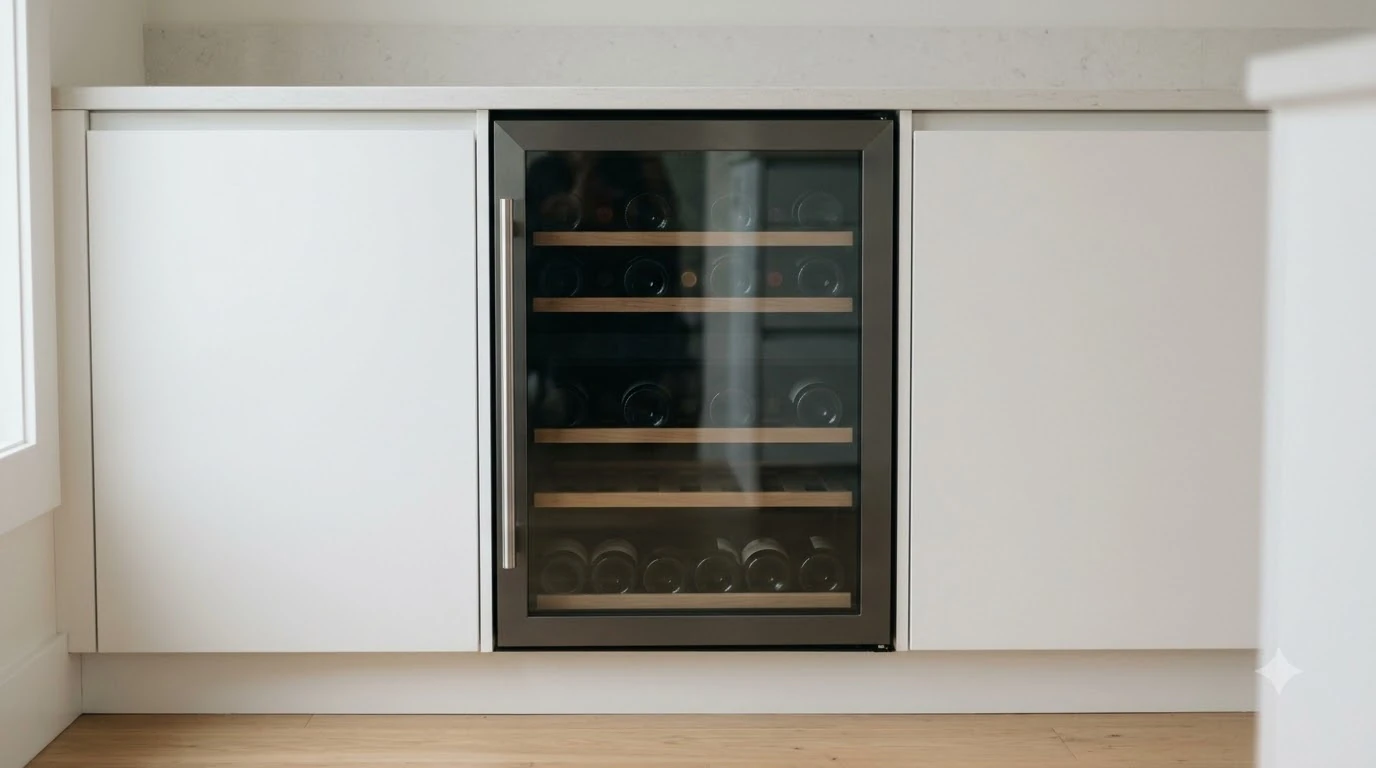
A vinotemp built in wine fridge is a strong option for homeowners who want integrated wine storage, front-venting installation, and flexible bottle capacity, particularly in kitchens and dedicated bar areas. The range includes compact single-zone refrigerators and larger dual-zone cabinets, with the Connoisseur Series 168 serving as an example of its high-capacity design. Its main advantages are adjustable storage temperatures, specialized bottle racks, and cabinetry-friendly ventilation, while installation dimensions, compressor noise, and warranty coverage deserve careful consideration before purchase.
Wine storage equipment should do more than keep bottles cold. It should maintain consistent conditions, protect bottles from unnecessary temperature changes, and fit naturally into the room where the collection is kept. Vinotemp offers several built-in configurations intended to meet those needs, including undercounter appliances and tall cabinets for larger collections. This review examines the brand’s built-in refrigerator approach through the features of the Connoisseur Series 168, explains the practical differences between its configurations, and identifies the ownership considerations that matter most before choosing a unit.
Specs and Key Features
Vinotemp’s built-in wine refrigerators combine front-venting cooling systems with integrated cabinetry designs, while individual models vary considerably in capacity and temperature control. The Connoisseur Series 168 is a useful example because it combines two storage zones, substantial bottle capacity, specialized shelving, and a tall cabinet format.

The EL-168WCST is designed for people who need more than a small undercounter refrigerator. Its two temperature compartments allow different wine styles to occupy separate environments, while the grooved shelves help keep bottles from shifting during ordinary use. A dual-pane glass door, stainless steel trim, black cabinet, and blue interior lighting give the appliance a presentation suitable for a kitchen, dining area, or dedicated wine room.
Its most important distinction is the relationship between the two temperature zones. Vinotemp specifies an upper range of 40–56°F and a lower range of 54–65°F. This provides flexibility for collections containing both lighter wines and fuller-bodied reds. However, the zones cannot be configured to exactly the same temperature, a limitation that matters for collectors who prefer one uniform storage setting throughout the cabinet.
| Specification | Connoisseur Series 168 |
|---|---|
| Model designation | EL-168WCST |
| Configuration | Dual-zone wine refrigerator |
| Approximate bottle capacity | 119–215 bottles |
| Upper temperature zone | 40–56°F |
| Lower temperature zone | 54–65°F |
| Width | 24 inches |
| Depth | 27 inches |
| Height | 73 3/5 inches |
| Empty weight | 256 pounds |
| Cooling system | Compressor |
| Installation | Built-in or freestanding |
| Door | Dual-pane glass |
| Interior lighting | Blue LED |
| Electrical supply | 115V AC, 60Hz |
| Warranty | 12 months parts and labor; 5 years compressor parts |
One particularly important specification is the stated capacity of approximately 119–215 bottles. That is a substantial range rather than a guaranteed fixed number. The final count depends on bottle shape, shelf arrangement, and whether bottles are stacked in the designated bulk-storage areas. Standard Bordeaux bottles are easier to arrange efficiently than wider Burgundy bottles, Champagne bottles, or unusual formats.
Vinotemp also identifies the Connoisseur 168 as suitable for an ambient temperature range of 41–100°F. This gives installation planners useful information about the surrounding room, although it should not be interpreted as permission to block ventilation or install the refrigerator in an unsuitable enclosed cabinet.
The manufacturer specifies a compressor cooling system, centralized digital temperature controls, a charcoal filter, and a door lock with key. These features serve different purposes: the compressor provides active refrigeration, the controls simplify temperature adjustments, the filter supports the cabinet’s air-management system, and the lock provides an additional layer of physical security.
Another important detail is the 256-pound empty weight. Moving a tall appliance of this size requires planning, especially in homes with narrow hallways, staircases, or tight kitchen access. Installation should account for the finished cabinet opening, door clearance, electrical access, and the refrigerator’s final position before delivery.
The manufacturer provides the full specifications and available resources on its Connoisseur Series 168 product page. This is the appropriate starting point for checking model-specific details rather than assuming every Vinotemp refrigerator shares the same dimensions or configuration.
What Owners Like
The strongest practical attractions of Vinotemp built-in refrigerators are their integrated appearance, flexible storage arrangements, and selection of capacities. These characteristics make the range appealing to homeowners who want their wine collection to become part of a kitchen or entertainment space rather than occupy a separate freestanding appliance.
Front ventilation is one of the most useful design features. A conventional freestanding refrigerator generally releases heat from its rear, making it unsuitable for installation inside a tightly fitted cabinet unless the manufacturer specifically permits that arrangement. Vinotemp’s front-venting built-in designs allow heat to escape through the designated front ventilation area, supporting undercounter and integrated installations.
This distinction is especially important during a kitchen renovation. A homeowner can plan the refrigerator around existing cabinetry instead of sacrificing an entire section of floor space to a freestanding appliance. The visual result can be cleaner, particularly when the door finish, surrounding cabinet materials, and handles are coordinated.
Flexible Bottle Organization
Vinotemp’s larger wine refrigerators offer storage arrangements intended for collections with different bottle shapes. The Connoisseur 168 includes grooved shelves with wooden lips, designed to hold bottles securely. The manufacturer also identifies bulk-storage areas for Champagne and Magnum formats.
That flexibility is useful because a real wine collection rarely consists entirely of identical Bordeaux bottles. A household might store California Cabernet Sauvignon, Oregon Pinot Noir, French Burgundy, Italian sparkling wine, and Champagne in the same appliance. These bottles do not always share identical dimensions, and a refrigerator that offers some flexibility can be easier to organize.
However, the stated maximum capacity should be treated as a favorable configuration rather than the number every owner should expect. Collectors who regularly purchase wider bottles should plan around a more conservative storage count. A cabinet that comfortably holds fewer bottles is more useful than one that reaches its advertised maximum only with an impractical arrangement.
Separate Temperature Environments
Dual-zone storage is another important attraction. A single-zone appliance maintains one general temperature throughout its storage compartment. A dual-zone refrigerator provides separate temperature controls for different sections, which can be useful when a collection includes both red and white wine.
For example, a household might use the upper compartment for Sauvignon Blanc, Riesling, and sparkling wines while keeping fuller-bodied reds in the lower compartment. Vinotemp’s Connoisseur 168 offers an upper range of 40–56°F and a lower range of 54–65°F. Those ranges provide meaningful flexibility for different storage and serving preferences.
Not every owner needs two zones, though. Someone who primarily stores bottles for long-term aging may prefer a consistent environment around 55°F rather than separate serving-oriented temperatures. The value of dual-zone functionality therefore depends on the collection’s composition and how frequently bottles are opened.
Appearance and Everyday Access
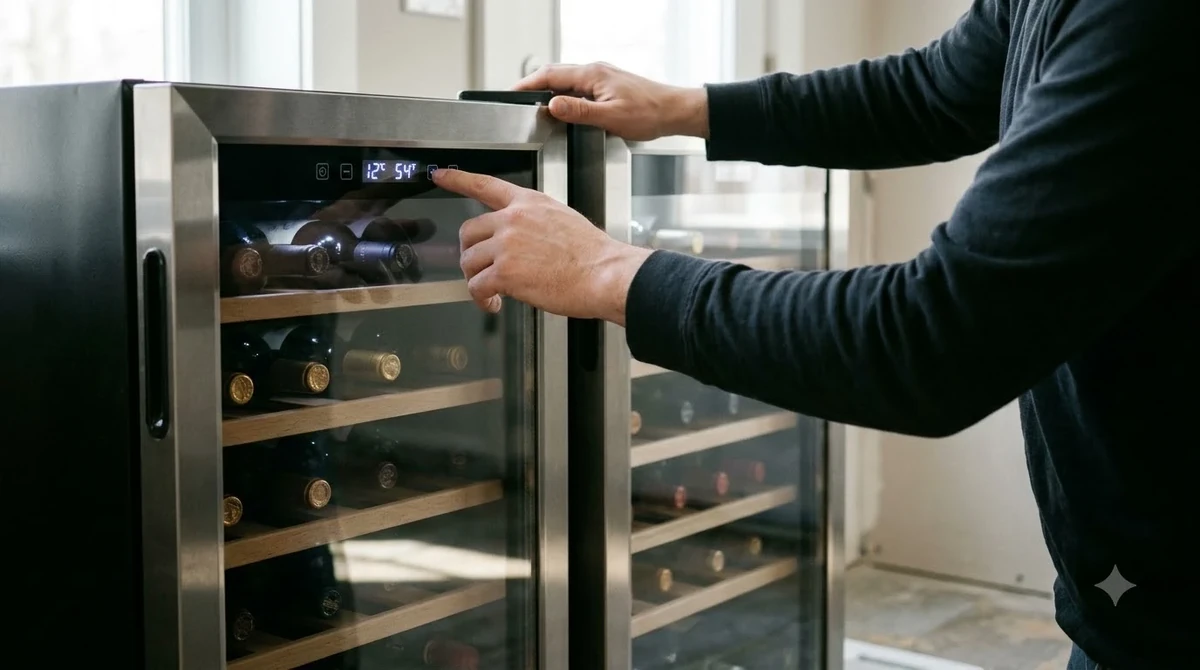
Glass doors and interior lighting make it easier to identify bottles without repeatedly removing shelves or rearranging the collection. The Connoisseur 168 combines a dual-pane glass door with stainless steel trim and blue LED lighting. Its centralized digital control panel also provides a straightforward way to monitor and adjust temperatures.
Security features may be useful in shared homes, entertainment areas, and commercial environments. The Connoisseur model includes a door lock and key, while the shelving design is intended to reduce bottle movement when accessing the collection.
There is also a practical advantage to having a dedicated wine refrigerator near the dining room. Bottles can be selected shortly before serving, making it easier to plan meals and gatherings. A chilled bottle of Sauvignon Blanc can be ready for seafood, while a fuller red can be prepared for a dinner featuring roast beef or chicken dishes.
For cocktail occasions, sparkling wine can also be stored separately from everyday drinking bottles. A chilled bottle is convenient for an Aperol Spritz recipe gathering, although the ideal serving temperature for sparkling wine is generally 40–50°F rather than the temperature used for long-term storage.
Common Complaints
The main potential drawbacks of a Vinotemp built-in wine refrigerator involve operating noise, installation demands, practical bottle capacity, and service considerations. These are not necessarily defects in every model, but they are important ownership factors that deserve attention before committing to a large appliance.
Compressor noise is an important consideration in open-plan homes. Vinotemp acknowledges that its refrigerators produce operating noise while the compressor and fans are running. It also explains that front-venting cabinets can be louder because of their cooling-system design and compressor size.
That distinction matters because a refrigerator installed in a kitchen may be heard from a nearby living or dining area. Noise that seems insignificant in a dedicated wine room can become more noticeable in a quiet apartment or an open-concept kitchen. Buyers who are particularly sensitive to appliance noise should ask for the exact decibel specification of the model being considered rather than assuming all units operate at the same sound level.
Installation Is More Demanding Than It Looks
A built-in refrigerator requires accurate measurements and appropriate ventilation. The Connoisseur 168 is 24 inches wide, 27 inches deep, and approximately 73.6 inches tall. These measurements should be considered alongside the manufacturer’s installation requirements, door movement, and the dimensions of the surrounding cabinetry.
Even a small measurement error can create difficulties. A refrigerator that is too deep may extend beyond the cabinet line, while insufficient space around the installation area can obstruct access to electrical connections or make future servicing difficult.
The front exhaust must remain unobstructed. Although a front-venting appliance is designed for built-in use, that does not mean it can be sealed inside an airtight enclosure. The ventilation grille is part of the cooling system and needs an appropriate path for releasing heat.
Actual Capacity May Be Lower Than Expected
The difference between the advertised maximum and practical capacity is another consideration. Vinotemp gives the Connoisseur 168 an approximate range of 119–215 bottles depending on how they are arranged. That is a substantial variation, and it illustrates why bottle-count claims should be interpreted carefully.
Collectors with large Champagne bottles, Burgundy bottles, or irregularly shaped bottles may find that their collection takes up more room than a standard-bottle estimate suggests. Stacking bottles can increase the count, but it may also make individual bottles less convenient to retrieve. Vinotemp specifically cautions against pulling out the shelves when bottles are stacked two or three high.
A refrigerator should not be filled so tightly that accessing one bottle requires disturbing several others. Leave enough room for practical organization and future purchases, particularly if the collection changes regularly.
Lighting and Control Preferences
Interior lighting improves visibility, but some homeowners may prefer a darker display or more control over illuminated panels. A separate Vinotemp 32-bottle model listed by Lowe’s received an owner comment praising its sliding racks while criticizing the fan noise and bright control lighting.
That review concerns a different model and should not be treated as evidence that the Connoisseur 168 has identical behavior. It does, however, illustrate why display brightness and operating sound are useful subjects to investigate before purchasing a refrigerator from the same brand.
Owners should also consider the location of the temperature display. A bright panel may be noticeable at night, especially if the refrigerator is installed in a kitchen that opens directly into a bedroom hallway or living room. Asking whether display brightness can be adjusted is a sensible part of the purchasing process.
Service and Warranty Considerations
Warranty coverage is another area where buyers should pay attention to the exact model documentation. Vinotemp specifies 12 months of parts-and-labor coverage and five years of compressor-parts coverage for the Connoisseur 168. The compressor-parts period should not be mistaken for five years of complete appliance coverage.
Before purchase, it is useful to clarify how labor, diagnostic visits, replacement components, and transportation are handled after the initial coverage period. A large built-in refrigerator may require professional access or removal from cabinetry for some repairs, so service logistics can affect the total ownership experience.
Keeping the original invoice, warranty registration information, and model identification details is also sensible. These records can make it easier to establish purchase information when contacting the manufacturer or an authorized service provider.
Who Should Buy and Who Should Skip
A Vinotemp built-in wine refrigerator makes the most sense for someone who has a suitable installation location, a clearly defined storage requirement, and a collection large enough to justify a dedicated appliance. Its appeal is strongest when integrated appearance and convenient bottle access matter as much as refrigeration itself.
Homeowners planning a kitchen renovation are among the most natural buyers. The refrigerator can be incorporated into the cabinetry layout from the beginning, allowing the installer to plan the ventilation opening, electrical connection, door swing, and surrounding finishes together. This is generally easier than trying to fit a tall refrigerator into cabinetry that was never designed for it.
Wine enthusiasts with mixed collections may also appreciate the dual-zone models. A household that frequently drinks Chardonnay, Riesling, Cabernet Sauvignon, and Pinot Noir can use separate compartments to organize bottles around different temperature preferences. The Connoisseur 168 provides the capacity and configuration for a collection that has outgrown a compact countertop or undercounter refrigerator.
Buy It If You Need Integrated Storage
The front-venting design is particularly attractive for kitchens, dining rooms, and home bars. It offers a practical alternative to leaving a freestanding refrigerator exposed in the room. The black cabinet and stainless steel trim of the Connoisseur 168 can also work with a range of contemporary appliance finishes.
Buyers who value organization may appreciate the specialized shelving and bulk-storage areas. The ability to accommodate larger Champagne and Magnum bottles makes the appliance more adaptable than a refrigerator designed exclusively around standard Bordeaux bottles.
It is also worth considering if the collection includes bottles intended for different occasions. Everyday whites, fuller reds, and sparkling wines can be arranged in a way that makes the collection easier to manage. A well-organized cabinet can reduce the need to move bottles around simply to find the one needed for dinner.
Skip It If Your Collection Is Small
A large refrigerator is not automatically a better investment for every wine drinker. Someone with 10–20 bottles may find a compact unit more appropriate, particularly if the available kitchen space is limited. Vinotemp offers smaller configurations, including a compact 28-bottle dual-zone refrigerator, which may be more suitable for modest collections.
A single-zone appliance may also be sufficient if the main objective is storing wine at a relatively consistent temperature. Dual-zone controls add flexibility, but they are not essential for a collection that consists mostly of one wine style or bottles intended for longer storage.
Skip It If Installation Conditions Are Unsuitable
Renters, homeowners with limited cabinetry, and people who cannot provide appropriate ventilation should consider another configuration. The tall Connoisseur 168 requires substantial floor space and careful access planning. Its empty weight of 256 pounds also makes it a poor choice for casual repositioning.
Noise-sensitive households should think carefully about placing a compressor refrigerator beside a quiet living area. The manufacturer’s acknowledgement that front-venting units can be louder makes the location particularly important.
Finally, buyers who expect extensive long-term labor coverage should compare the warranty carefully against other appliances. The Connoisseur 168’s five-year compressor-parts coverage does not provide five years of complete parts-and-labor protection.
How It Compares to Alternatives
Vinotemp’s built-in range includes different capacities and configurations, so choosing the right alternative depends on collection size, installation height, and temperature requirements. The Connoisseur 168 is intended for larger collections, while the compact and shorter configurations are more appropriate for households with limited storage needs.
The most useful comparison is between a tall dual-zone wine refrigerator, a compact dual-zone refrigerator, and a single-zone model. Each configuration solves a different storage problem, and the additional capacity of a larger cabinet is only valuable if the collection actually needs it.
Connoisseur 168 Versus Compact 28-Bottle Dual-Zone
The Connoisseur 168 is the more suitable choice for an established collection that requires substantial capacity. Its approximate 119–215-bottle range provides much more room than a compact refrigerator, and its bulk-storage areas accommodate larger bottle formats.
The compact 28-bottle dual-zone model is better suited to smaller kitchens and households that want separate temperature environments without committing to a tall wine cabinet. It may also be easier to incorporate beneath a counter, depending on the exact dimensions and cabinetry requirements of the selected model.
For someone who buys wine occasionally and usually keeps only a few bottles on hand, the smaller configuration is likely to be more practical. For someone who regularly purchases cases or maintains a varied collection, the larger refrigerator offers more room for organization.
Dual-Zone Versus Single-Zone Storage
The choice between one and two temperature zones should reflect the collection rather than the number of features advertised. A single-zone refrigerator provides one consistent environment, making it suitable for long-term storage when approximately 55°F is the desired target.
A dual-zone model provides separate compartments for different storage and serving preferences. This can be particularly helpful for households that frequently drink both red and white wine. The Connoisseur 168’s upper and lower temperature ranges provide this flexibility, although the zones cannot be set to the same temperature.
For a mixed collection, the difference can be useful. Light-bodied whites such as Sauvignon Blanc generally benefit from cooler serving temperatures, while full-bodied reds are typically served warmer. However, storage temperature and serving temperature are not identical concepts. A wine can be stored under consistent cellar conditions and brought to its preferred drinking temperature shortly before serving.
Built-In Versus Freestanding Installation
Built-in installation is the main reason to choose a front-venting refrigerator over a conventional freestanding appliance. A front-venting model is designed to release heat through the front grille, allowing it to operate in an appropriately prepared cabinetry opening.
Vinotemp identifies front exhaust on the Connoisseur 168 and permits either built-in or freestanding installation. That flexibility is useful, but the installation method should still follow the instructions for the specific appliance.
Conventional rear-exhaust refrigerators require clearance behind the appliance to release heat. Vinotemp’s general FAQ identifies a six-inch rear clearance for standard rear-exhaust cabinets, together with additional side and top ventilation space. Those requirements should not be confused with the installation instructions for a front-venting model.
For a built-in project, the most important step is confirming the exact opening dimensions and ventilation requirements before cabinetry is constructed. A qualified installer can also verify electrical access, door clearance, and the ability to remove the appliance for future service.
What to Prioritize When Comparing Models
Capacity should be the first consideration, but it should not be the only one. A refrigerator that stores 100 bottles comfortably may be more useful than a nominally larger model that requires awkward stacking and makes frequently accessed bottles difficult to reach.
Temperature flexibility comes next. A dual-zone appliance is useful for mixed collections, while a single-zone cabinet can be simpler for long-term storage. The next consideration is physical compatibility: height, width, depth, door swing, and ventilation must all work with the installation space.
Finally, compare service coverage and operating characteristics. A compressor refrigerator is an active mechanical appliance, and noise, maintenance access, and repair arrangements matter throughout its useful life. Looking at these details before purchase can prevent disappointment after the refrigerator becomes part of a finished kitchen.
For readers comparing other appliances in the same category, the wine refrigerator model reviews provide another starting point for evaluating different configurations and storage approaches.
Frequently Asked Questions
Can a Vinotemp built-in wine fridge be installed next to an oven?
Installation beside an oven is not automatically suitable because nearby appliances can create additional heat around the refrigerator. The Connoisseur 168 is rated for an ambient operating range of 41–100°F, but that rating does not replace the required installation clearances. A kitchen designer or appliance installer should assess the surrounding heat sources and ventilation before approving the location.
Does a Vinotemp wine refrigerator need a dedicated electrical circuit?
Vinotemp’s owner documentation for its Element single-zone refrigerator series recommends an individual grounded electrical outlet and specifies a 115V AC, 60Hz, 15A supply for those models. Electrical requirements can differ between appliances, so the exact manual for the selected refrigerator should determine the installation. An electrician can verify whether the existing kitchen circuit is appropriate.
Can large Burgundy bottles fit in a Vinotemp refrigerator?
Some Vinotemp configurations offer adjustable or specialized storage arrangements, but bottle compatibility varies by rack design. Wider Burgundy bottles can reduce the total number of bottles that fit compared with standard Bordeaux formats. Before purchasing, measure the widest bottles in the collection and ask whether the chosen model’s shelves accommodate them without removing necessary supports.
Does opening the door frequently affect wine refrigerator performance?
Frequent opening introduces warmer room air and can cause temporary changes inside the cabinet. The cooling system then has to work to restore the selected temperature. Keeping commonly accessed bottles organized near the front and avoiding unnecessarily long door openings can help reduce those fluctuations.
Can a Vinotemp wine refrigerator be moved after installation?
It can be relocated, but a large cabinet such as the 256-pound Connoisseur 168 requires appropriate lifting equipment and careful handling. The appliance should not be dragged across flooring, and its refrigerant lines and electrical cord must be protected. After transportation, follow the model’s instructions regarding upright settling time before reconnecting power.
A Vinotemp built-in wine fridge is worth considering when integrated installation, flexible storage, and a dedicated wine environment are priorities. The Connoisseur Series 168 is particularly suited to larger collections, while compact models make more sense for households with fewer bottles and limited cabinetry. Confirm the actual bottle capacity, ventilation requirements, dimensions, noise expectations, and warranty terms before making a final selection.
More in Model Reviews
 Magic Chef 44 Bottle Wine Cooler Review for Flexible StorageUpdated Nov 21, 2026
 Whynter 164 Bottle Wine Cooler Review: Capacity, Features, and FitUpdated Nov 21, 2026
 Insignia NS WC16BK6 Review: Compact 16-Bottle Wine StorageUpdated Nov 21, 2026
 Wine Enthusiast Electric Blue Omega Review: Opening, Pouring, and Preserving Made EasierUpdated Nov 21, 2026
 Koolatron 20 Bottle Wine Cooler Review: Features, Fit, and PerformanceUpdated Nov 21, 2026
 NewAir AWC 330E Review for Home Wine StorageUpdated Nov 21, 2026