

We may earn a commission when you buy through links on this page, at no extra cost to you. Learn more.
Touriga Nacional wine is a full-bodied, deeply pigmented red wine made from Portugal’s premier indigenous black grape variety, renowned for its concentrated dark fruit flavors, firm tannins, and signature floral aromas of violet and bergamot. Originally prized as the backbone of fortified Port blends, it has emerged as a standout dry table wine across Portugal’s Douro Valley and Dão regions, offering structure and aging potential comparable to Cabernet Sauvignon.
For decades, wine drinkers outside Portugal encountered this thick-skinned grape almost exclusively inside sweet, fortified bottles without ever seeing its name on the front label. Today, modern winemaking and clonal selection have brought dry single-varietal bottles and bold Iberian blends into American wine shops, giving fans of structured Wine by Type a distinctive alternative to mainstream international reds.
What Is Touriga Nacional Wine?
Touriga Nacional is a low-yielding, thick-skinned red wine grape native to northern Portugal that produces intensely colored, tannic wines with high aromatic lift. Viticulturists consider it the country’s flagship red cultivar, both as the structural anchor of vintage Port and as an increasingly celebrated dry red wine.
The grape’s defining physical traits explain its power in the glass. Touriga Nacional vines produce small, tight clusters of tiny berries with an unusually high skin-to-juice ratio. Because color compounds, flavor precursors, and tannins reside primarily in grape skins, pressing these small berries yields an almost opaque purple-ruby liquid packed with phenolic structure. As Wine Enthusiast notes in its overview of Portugal’s signature grape, the variety nearly vanished from commercial vineyards in the 1970s because its naturally meager yields and susceptibility to disease frustrated growers, before dedicated clonal research in the 1980s revived its standing.
Genetically, ampelographers have identified Touriga Nacional as a parent variety of Touriga Franca, another cornerstone grape of the Douro Valley. While Touriga Franca offers softer tannins and easier viticulture, Touriga Nacional provides the aromatic intensity, backbone, and longevity that winemakers rely on to anchor premium cuvées. Whether bottled on its own or blended with regional partners, it delivers a rare combination of heavyweight palate density and lifted, perfume-like aromatics.
Flavor Profile and Winemaking Styles
On the palate, Touriga Nacional wine balances ripe black fruit—such as blueberry, blackberry, and black plum—with unmistakable floral notes of violet, rose petal, and bergamot, supported by firm, grippy tannins. Depending on regional climate and winemaker choices, the grape appears in styles ranging from youthful, unoaked reds to age-worthy oak-matured reserves and fortified Ports.
Reviewers at Wine Folly highlight primary flavors of blueberry, violet, plum, mint, and wet slate, alongside subtle herbal nuances of rosemary, eucalyptus, and Mediterranean scrub. Unlike Cabernet Sauvignon, which leans toward cassis and cedar, or Syrah, which emphasizes black pepper and smoke, Touriga Nacional pairs dark fruit concentration with a bright, floral top note that persists from the first swirl through the finish. When matured in French or Portuguese oak barrels, secondary layers of bittersweet cocoa, vanilla, and toasted spice integrate into the wine’s sturdy tannic frame.
Winemakers craft Touriga Nacional across four main stylistic categories:
- Single-Varietal Dry Reds: Bottled as 100% Touriga Nacional, these wines showcase maximum color, violet perfume, and muscular tannins built for bottle aging.
- Portuguese Dry Red Blends: Winemakers frequently blend Touriga Nacional with Touriga Franca, Tinta Roriz (Tempranillo), and Castelão to soften its tannic grip and add bright red-fruit acidity.
- Fortified Port Wines: In the Douro Valley, fermentation is halted with neutral grape spirit (aguardente), preserving natural grape sweetness while Touriga Nacional supplies the structure for Ruby, Tawny, Late Bottled Vintage, and Vintage Ports.
- Rosé and Sparkling Expressions: Because the grape carries brisk natural acidity when harvested early, a smaller number of producers press the berries gently to craft aromatic dry rosés and traditional-method sparkling wines.
Where Touriga Nacional Grows
Northern Portugal’s Douro Valley and Dão regions serve as the historic heartland and benchmark growing zones for Touriga Nacional, though plantings have expanded across southern Portugal and into warm-climate vineyards in Australia, California, and Texas. Each terroir shapes the grape’s balance between plush weight and floral acidity.
Both the Douro and the Dão claim to be the grape’s ancestral birthplace, and tasting bottles from each region side by side reveals how soil and elevation transform the variety. In the steep, terraced vineyards of the Douro Valley, vines dig into dry, heat-retaining schist soils with minimal rainfall and no irrigation. These rugged conditions restrict berry size even further, yielding nearly opaque, full-bodied wines marked by blackberry, blueberry, roasted meat, and wet stone notes.
Roughly fifty miles south in the Dão, vineyards sit at higher elevations surrounded by pine and eucalyptus forests on sandy, decomposed granite soils. Higher annual rainfall and cooler nighttime temperatures slow ripening, producing Touriga Nacional wines that feel slightly lighter on their feet, with higher natural acidity, finer-grained tannins, and heightened aromas of violet, bergamot, and black cherry. Beyond northern Portugal, winemakers in the warmer plains of Alentejo blend it for plush, ripe fruit character, while producers in Australia and California’s Napa Valley have planted trial and commercial blocks to handle warm, dry growing seasons.
| Region | Dominant Soil Type | Climate & Elevation | Typical Wine Style |
|---|---|---|---|
| Douro Valley (Portugal) | Decomposing schist | Steep river valley, hot and dry | Full-bodied, nearly opaque, plush dark fruit, firm tannins |
| Dão (Portugal) | Sandy, decomposed granite | Higher elevation, cooler nights, wetter | Medium-to-full-bodied, higher acidity, pronounced violet lift |
| Alentejo (Portugal) | Granite, schist, and clay | Warm, sun-drenched rolling plains | Ripe, velvety, fruit-forward blends with softer tannins |
| Australia & California | Varied alluvial and clay loam | Warm Mediterranean climates | Rich, dark-fruited single varietals and Iberian-style blends |
How to Serve Touriga Nacional Wine
Serve dry Touriga Nacional wine slightly below room temperature at 60 to 68°F (15 to 20°C) in a large-bowled Bordeaux glass, and decant young bottles for at least one hour before pouring. Proper aeration softens the grape’s naturally assertive tannins and unlocks its signature floral aromatics.
Temperature control plays a crucial role in how this structured red tastes. If served too warm above 70°F, the wine’s alcohol—typically ranging between 13.5% and 14.5% ABV in dry styles—can feel heavy and mask delicate violet and herbal notes. Conversely, serving it straight from a cold refrigerator below 55°F clamps down on the bouquet and makes the thick-skinned tannins taste astringent. Aiming for cool cellar temperature around 60 to 65°F keeps the fruit vibrant and the palate balanced.
Glassware and aeration also make a noticeable difference. Choose a tall, wide-bowled red wine glass similar to what you would use for Cabernet Sauvignon or chianti grape Sangiovese, giving the aromatic compounds room to gather below the rim. For dry bottles under ten years old, pouring the wine into a wide-base decanter 60 to 90 minutes before dinner allows oxygen to smooth out youthful grip. Older bottles aged 15 years or more require gentler handling: stand the bottle upright for a day so sediment settles, then decant slowly just before serving without vigorous splashing.
Tip: If you do not have a decanter on hand, open your bottle of young Touriga Nacional two hours before dinner and pour a small splash into a glass to increase the surface area exposed to air inside the bottle neck.
Food Pairing with Touriga Nacional
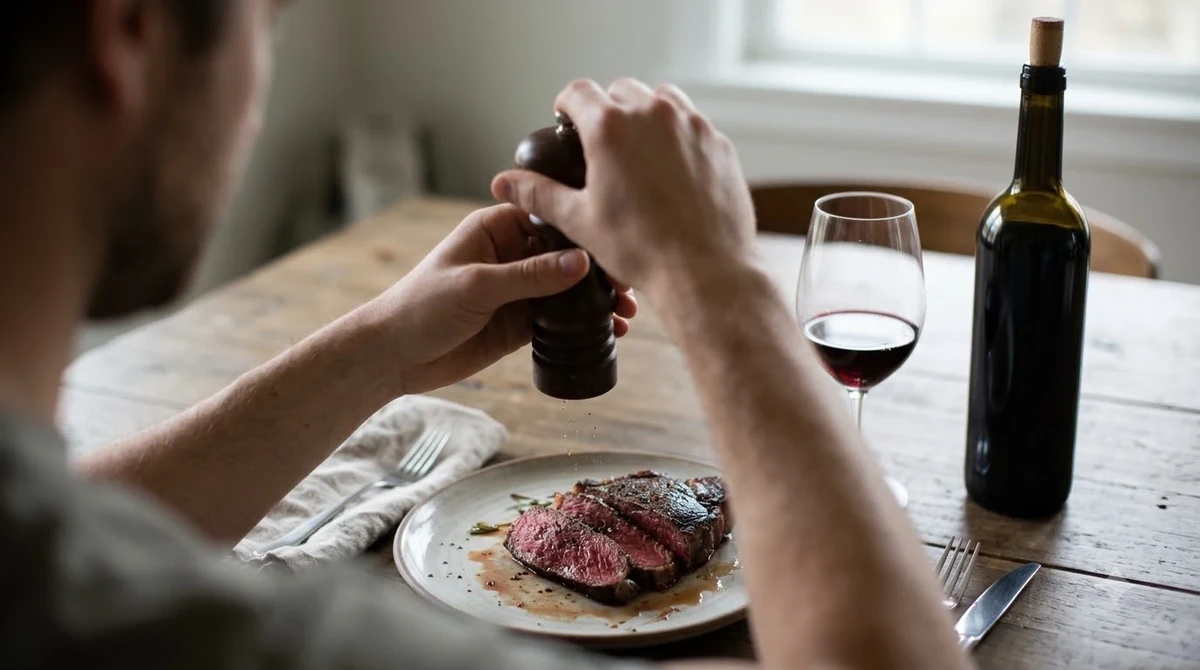
Touriga Nacional pairs best with rich, savory proteins and slow-cooked dishes whose fat and umami temper the wine’s firm tannins without overpowering its floral perfume. Dishes seasoned with rosemary, garlic, black pepper, or mild smoke echo the grape’s natural herbal undertones.
Because Touriga Nacional carries both substantial tannic grip and delicate violet-bergamot aromatics, successful pairings rely on balancing richness against seasoning intensity. Fatty cuts of meat bind to tannins on the palate, making the wine taste smoother and sweeter, whereas overly fiery chili heat or aggressive saltiness can strip away the floral finish. Braised lamb shanks, grilled ribeye steak with herb compound butter, and slow-roasted pork shoulder with fennel or rosemary are classic matches that mirror the wine’s rustic northern Portuguese roots.
Vegetarian and cheese pairings work equally well when built around earthy, creamy textures. Wild mushroom risotto, roasted eggplant with tahini or yogurt sauce, and lentil stews seasoned with bay leaf and thyme provide the savory weight needed to stand up to a full-bodied pour. On a cheese board, skip ultra-sharp, crumbly aged cheddars in favor of semi-soft cow’s and sheep’s milk cheeses like Fontina, Gruyère, Tomme, or creamy blue cheese served alongside toasted walnuts and fig jam.
How to Choose a Bottle of Touriga Nacional
Check the front and back labels to see whether the bottle is a single-varietal Touriga Nacional or a regional blend, and use the appellation—Douro, Dão, or Alentejo—to match the wine’s weight to your preferences. Understanding Portuguese label terminology makes shopping straightforward even if you are new to Iberian wines.
First, look at the grape listing. If “Touriga Nacional” appears alone on the front label, you are getting an unfiltered expression of the grape’s power, dense color, and floral intensity. If the front label simply reads “Douro Tinto” or “Dão Tinto,” turn the bottle around to read the back label: Touriga Nacional is often the lead variety blended with Touriga Franca and Tinta Roriz. Blends tend to be more approachable in their youth and offer everyday versatility, much like learning how blending shapes approachable white wines made from the colombard grape or Mediterranean catarratto grape.
Second, pay attention to classification terms and vintage age on Portuguese labels:
- DOC (Denominação de Origem Controlada): Indicates strict regional origin rules, such as Douro DOC or Dão DOC, ensuring authentic local grape varieties and traditional viticulture.
- Colheita vs. Reserva: “Colheita” simply denotes the harvest year for a standard vintage release, whereas “Reserva” signals higher minimum alcohol and stricter quality selection, often accompanied by oak aging.
- Drinking Windows: Entry-level Douro and Dão reds drink well within three to five years of vintage, while top single-varietal Reserva bottles easily evolve for ten to twenty years in a cool cellar.
Frequently Asked Questions
Is Touriga Nacional wine sweet or dry?
Touriga Nacional grapes are used to make both completely dry red table wines and sweet fortified Port wines. If a bottle is labeled as Douro DOC, Dão DOC, or simply Touriga Nacional without the word “Port” or “Porto,” it is fermented fully dry with rich dark fruit and firm tannins.
What familiar wine does Touriga Nacional taste like?
Dry Touriga Nacional is closest in body, tannin structure, and aging potential to Cabernet Sauvignon or Syrah. However, it stands apart from both by layering vivid floral aromas of violet and bergamot over concentrated blueberry, blackberry, and plum flavors.
How do you pronounce Touriga Nacional?
In Portuguese, Touriga Nacional is pronounced “toh-REE-gah nah-syoh-NAHL.” English speakers commonly say “tor-EE-gah nah-see-un-NALL,” which is widely understood in wine shops and restaurants.
Does Touriga Nacional wine need to be aged before drinking?
Everyday red blends containing Touriga Nacional are crafted to be enjoyed within three to five years of the vintage date after a brief decant. Single-varietal bottles and oak-aged Reserva releases from the Douro or Dão have enough tannin and acidity to improve in the cellar for ten to twenty years.
Whether you explore it in a plush Douro blend or an aromatic single-varietal bottling from the Dão, Touriga Nacional wine rewards anyone who enjoys structured, expressive reds. Give a young bottle an hour in a decanter alongside a hearty meal, and you will see why this native grape has earned its reputation as Portugal’s finest red variety.
More in Wine Types & Grapes
 Zinfandel Sugar Content: Dry Red vs. White Zinfandel GramsUpdated Nov 21, 2026
 Best Zinfandel Substitute Options for Sipping and CookingUpdated Nov 21, 2026
 Zweigelt Food Pairing: Best Dishes, Cheeses, and Serving TipsUpdated Nov 21, 2026
 Zinfandel Tannins Explained: How Structure Shapes Every BottleUpdated Nov 21, 2026
 Zinfandel Sweetness Level: Dry Red vs. Sweet White Zin ExplainedUpdated Nov 21, 2026
 Xinomavro Food Pairing: Best Dishes, Styles, and Serving TipsUpdated Nov 21, 2026