


We may earn a commission when you buy through links on this page, at no extra cost to you. Learn more.
The secura wine opener is a rechargeable electric corkscrew designed to remove ordinary wine corks with minimal twisting and pulling, making it a convenient choice for everyday wine drinkers and entertaining. Its stainless steel housing, charging stand, transparent lower compartment, and included foil cutter give it a practical combination of features. However, it has limitations with certain synthetic and undersized corks, requires advance charging, and is less suitable for delicate older bottles than a carefully operated manual corkscrew.
Opening a bottle should be a small part of enjoying wine, not a struggle before dinner begins. An electric corkscrew can make that step easier, particularly for households that open several bottles during the week or regularly entertain guests. Secura’s rechargeable model offers straightforward two-direction controls rather than a complicated operating system. Its performance depends on correct alignment, adequate battery power, and the type and condition of the cork. This review examines its specifications, everyday strengths, limitations, and the situations in which another opener might make more sense.
Specs and Key Features of the Secura Electric Wine Opener
The Secura SWO-3N combines a rechargeable electric mechanism with a stainless steel exterior and a separate charging stand. Its main selling point is straightforward operation: one control extracts the cork, while the opposite control releases it from the corkscrew.
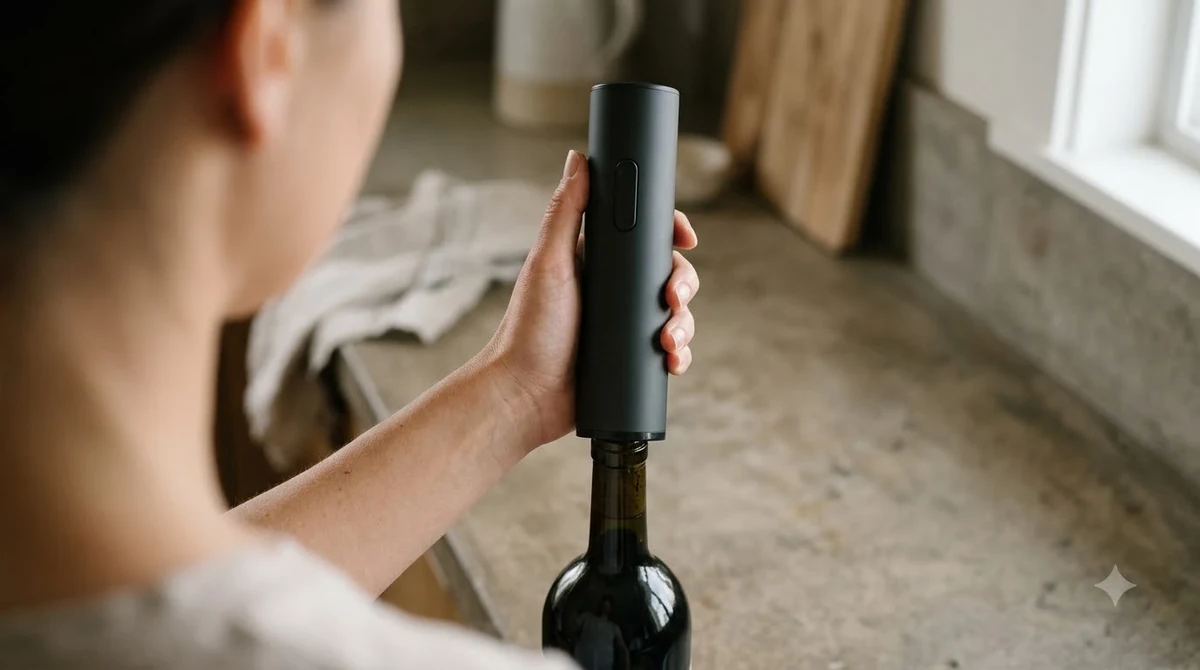
Secura identifies the stainless steel version as model SWO-3N, with product number B01261VEOG. The package includes the electric opener, a charging base, and a foil cutter. A transparent lower section allows users to observe the cork as the mechanism works, while the illuminated section also makes the appliance visually distinctive on a kitchen counter.
The manufacturer advertises up to 30 bottles per full charge. That figure is a useful capacity estimate rather than a guarantee for every household. Battery condition, charging habits, cork resistance, and operating conditions can influence actual performance. Shop TODAY gives a more conservative practical range of 20–30 bottles in its evaluation.
| Specification | Secura SWO-3N |
|---|---|
| Product number | B01261VEOG |
| Model | SWO-3N |
| Body material | Stainless steel |
| Power source | Rechargeable battery |
| Advertised capacity | Up to 30 bottles per charge |
| Initial charging time | At least 8 hours |
| Regular charging time | Approximately 6–8 hours |
| Charging arrangement | Charging stand and adapter |
| Included accessory | Foil cutter |
| Adapter input | 100–240V |
| Manufacturer warranty | 12 months |
These specifications are drawn from Secura’s product description and operating instructions. Shop TODAY reports dimensions of 11 x 4.92 inches and a weight of 1.8 pounds for the version it evaluated, useful measurements when considering counter or cabinet storage. Those measurements should not automatically be applied to every finish or package configuration.
The 100–240V input range is another practical feature, particularly for people who travel internationally or maintain homes in different countries. However, electrical compatibility does not eliminate the need to use the supplied charging equipment and an appropriate wall-plug adapter where necessary.
There is also a distinction between the advertised capacity and battery longevity. Up to 30 bottles per charge describes the approximate number of openings between charging sessions. It does not mean the rechargeable battery will maintain that capacity indefinitely. Like other battery-powered kitchen appliances, performance can decline with age and repeated charging cycles.
Secura lists a 12-month warranty and lifetime customer service on its product page. Buyers should retain their purchase documentation and confirm the applicable warranty terms for their particular retailer and product version.
What Owners and Independent Reviewers Like
The strongest argument for the Secura is convenience. It replaces the twisting, leverage, and manual cork extraction associated with traditional corkscrews with a simple motor-driven process that requires relatively little physical effort.
Liquor.com named the Secura its best overall electric wine opener in its comparison of electric models. Its evaluation highlighted the stainless steel appearance, easy controls, rechargeable charging base, and transparent lower section. The publication reported that removing a cork and releasing it from the mechanism took approximately 18 seconds in its evaluation.
That speed makes a difference during a dinner party. If several guests bring bottles or a host needs to open multiple wines for a tasting, the opener can reduce the repetitive physical work involved. Rather than repeatedly inserting a screw and pulling against the cork, the user positions the machine and lets its motor perform the extraction.
The transparent lower compartment is more useful than it might initially appear. It gives a visual indication of where the corkscrew is positioned and allows the user to watch the cork being extracted. This is particularly helpful for someone learning how to operate an electric corkscrew.
Shop TODAY also highlighted the included foil cutter and storage stand. Its evaluation found the foil cutter effective, requiring only a few turns around the bottle neck to separate the capsule. Having that accessory included means buyers do not need to purchase a separate cutting tool before using the opener.
The stainless steel exterior contributes to its appearance. Unlike a basic plastic kitchen gadget, the Secura has a finish that can fit comfortably beside a wine rack, wine refrigerator, or serving area. Its charging stand also provides a designated storage location instead of leaving the opener loose in a drawer.
Another advantage is the uncomplicated control arrangement. The two-direction switch avoids the need to learn several operating modes. The lower control drives the spiral into the cork and extracts it; the upper control reverses the spiral to release the cork afterward.
That straightforward arrangement makes the product accessible to guests who might not be familiar with traditional corkscrews. It can also be useful for people who find repetitive twisting or pulling uncomfortable. Liquor.com’s discussion of electric wine openers specifically identifies reduced physical effort and party convenience as reasons to consider this type of appliance.
For a closer look at the comparative evaluation and the alternatives considered, read Liquor.com’s electric wine opener review. Its comparison provides useful context for judging the Secura against other rechargeable and manual options.
For households that frequently serve conventional cork-finished wines, these advantages can outweigh the need to keep a rechargeable accessory on the counter. The most appealing feature is not an elaborate technical function. It is the reduction in effort during an otherwise ordinary part of serving wine.
Common Complaints and Performance Limitations
The Secura is convenient, but it is not equally reliable with every cork. Its manufacturer specifically acknowledges potential problems with a small percentage of synthetic, plastic, and undersized corks, and independent evaluations also identify occasional cork damage during extraction.
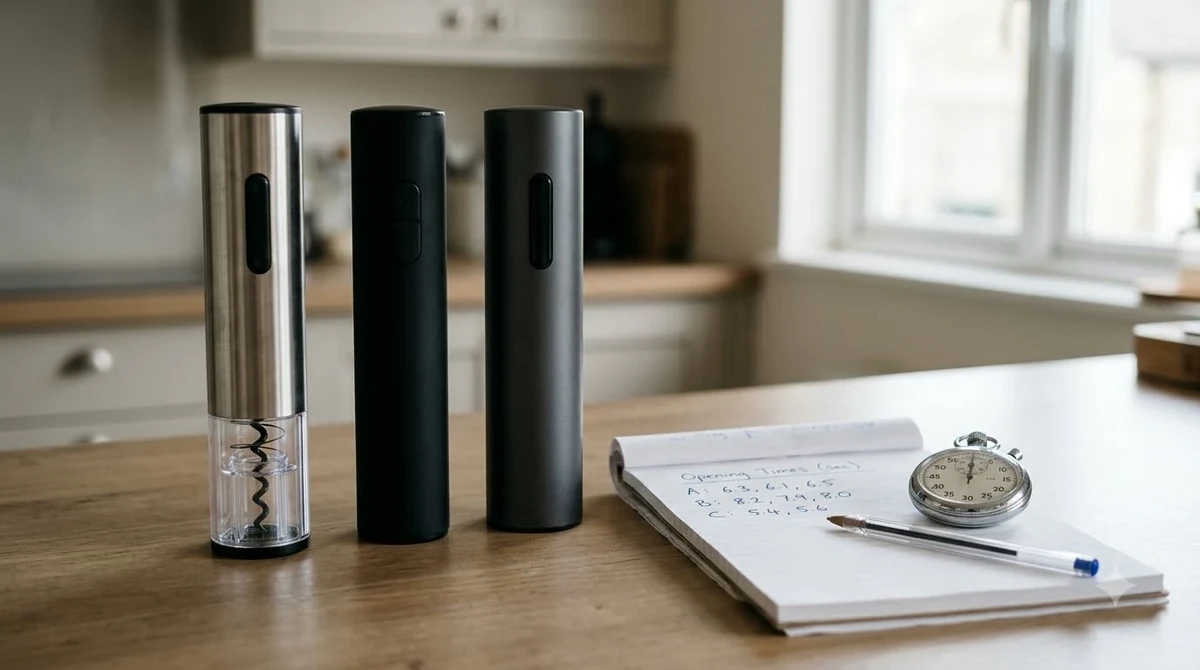
Liquor.com reported that the opener sometimes chewed up the cork slightly, even though it generally removed the stopper mostly intact. This is an important distinction. An electric corkscrew can remove a cork quickly without necessarily preserving its appearance or condition perfectly.
For a recently purchased bottle of everyday Cabernet Sauvignon, that may be a minor concern. For an older bottle with a fragile, dry cork, it can be more significant. Older natural corks can crumble during extraction, especially if they have become brittle through age or poor storage. A powered spiral is not necessarily the best tool for that situation.
A traditional two-prong opener or a carefully used waiter-style corkscrew offers more control when dealing with fragile stoppers. Liquor.com also cautions that electric openers can increase the possibility of cork breakage with older wines. Keeping a manual alternative available is sensible for anyone who regularly opens mature bottles.
Battery dependence is another limitation. The opener cannot perform its intended job if its rechargeable battery is depleted. Its initial charge takes at least eight hours, while subsequent full charging sessions generally require six to eight hours. That makes advance preparation important before a large dinner or celebration.
The advertised capacity of 30 bottles should also be treated as an approximate maximum. A household that opens bottles infrequently may find that the opener sits unused for long periods. Battery maintenance becomes more important in that situation than it would for someone who uses the appliance several times each week.
Another consideration is operating noise. Shop TODAY characterized the sound level as moderate, with an evaluation score of 3 out of 5 for volume. It is therefore not the right purchase for someone whose primary requirement is an exceptionally quiet electric opener.
There is also the question of physical storage. The stainless steel construction and charging base make the Secura more substantial than a simple manual corkscrew. It needs a stable counter location or suitable cabinet space, preferably somewhere near an electrical outlet.
Finally, the rechargeable battery and motor introduce components that can eventually require servicing or replacement. The manufacturer’s manual states that the opener contains no user-serviceable parts and warns against opening the appliance. This means it should be treated as a complete electrical appliance rather than a tool that owners can easily repair themselves.
These limitations do not make the Secura a poor purchase. They simply define its best role: opening ordinary bottles conveniently rather than serving as a universal cork-removal solution.
Who Should Buy the Secura Wine Opener and Who Should Skip It
The Secura is best suited to people who value convenience, open wine regularly, and prefer an electric mechanism to a traditional hand-operated corkscrew. Its rechargeable design and included accessories make it particularly practical for a home serving area.
Good candidates include:
- Frequent wine drinkers: Households opening several bottles each week can benefit from the rechargeable mechanism and its advertised capacity of up to 30 bottles per charge.
- Dinner-party hosts: The electric extraction process helps reduce repetitive effort when opening several bottles during a gathering.
- People with limited hand strength: The motor-driven design reduces the twisting and pulling needed with a conventional corkscrew.
- Gift buyers: The stainless steel finish, charging stand, and foil cutter create a useful appliance package for someone setting up a home wine station.
- People who appreciate countertop accessories: The stand and illuminated transparent section give the appliance a visible place beside other serving equipment.
For these users, the main advantage is consistency of operation. Once the battery is charged and the user understands the two-direction switch, opening an ordinary cork-finished bottle becomes a short sequence of straightforward steps.
However, some buyers should consider another option:
- Collectors of mature wines: A manual opener is often preferable when handling older bottles with fragile natural corks.
- People who rarely drink wine: A manual corkscrew does not need charging and is easier to store when used only occasionally.
- Travelers and campers: A compact waiter-style opener is more convenient when access to a charging outlet is uncertain.
- Users who want a quiet appliance: The Secura has received a moderate noise assessment rather than a particularly quiet rating.
- People who frequently open difficult synthetic corks: Secura itself acknowledges that some synthetic and undersized stoppers may need manual assistance.
There is also a difference between buying an opener for convenience and buying a complete wine-serving kit. The Secura package focuses on cork extraction. It does not replace accessories such as vacuum stoppers, bottle pourers, or preservation equipment.
Someone building a more complete serving setup might prefer a wine opener and preserver set instead. That approach can make more sense for a household that regularly saves unfinished bottles and wants several accessories in one purchase.
For an occasional wine drinker who mainly needs a dependable tool in a drawer, a simple manual opener is likely to offer better long-term practicality. The Secura makes more sense when its electric convenience will be used regularly enough to justify the charging routine and counter space.
How the Secura Compares to Alternative Wine Openers
The Secura occupies the practical middle ground between a basic manual corkscrew and a more elaborate electric wine opener. It emphasizes straightforward controls, a rechargeable stand, and an attractive stainless steel exterior rather than advanced automation or a large accessory collection.
Liquor.com’s comparison provides useful context through several named alternatives. Its evaluation identifies the Oster Electric Wine Opener as a budget-oriented choice, the Peugeot Elis Electric Corkscrew as a premium option, and the Cuisinart Electric Wine Opener as another rechargeable alternative.
The Oster offers a similar charging-base arrangement and foil cutter. Liquor.com reports a capacity of up to 30 bottles per charge for that model as well. Its aluminum and plastic construction gives it a different appearance from the Secura’s stainless steel housing.
The Peugeot Elis is a more premium alternative. Liquor.com highlights its quiet operation, streamlined design, and capacity of approximately 40 bottles per charge. Its higher-end positioning makes it more attractive to someone prioritizing quieter operation and a refined design over keeping the purchase simple.
The Cuisinart rechargeable model is another alternative for shoppers comparing cordless electric options. Its position in Liquor.com’s selection makes it worth considering, particularly for someone who wants to compare the physical design and operating controls of several electric openers before choosing.
Manual corkscrews remain a different category. A waiter-style opener requires more technique but does not depend on a battery or charging stand. It is also compact enough to store in a drawer, kitchen utensil organizer, or serving kit.
For a compact manual alternative that can be carried conveniently, a wine bottle opener keychain provides a different kind of convenience. It is designed for portability rather than repeated electric extraction, so it should not be expected to offer the same operating experience as the Secura.
The right comparison therefore depends on what the buyer values most. The Secura is attractive for regular home use, Oster offers a comparable electric approach, Peugeot targets quieter premium operation, and a manual corkscrew remains useful for travel and delicate corks.
There is no reason to assume that the most expensive or most automated option is automatically the best purchase. A household opening two ordinary bottles a week may have different requirements from a wine collector opening mature Bordeaux or Burgundy.
How to Use, Charge, and Maintain the Secura
Correct positioning and regular charging are central to the Secura’s performance. The manufacturer’s instructions are simple, but following them helps avoid incomplete extraction, unnecessary strain on the motor, and preventable damage to the cork.
1. Charge the opener before its first use
Secura recommends an initial charge of at least eight hours. Connect the supplied adapter to the charging stand and place the opener firmly in position. The charging indicator should illuminate when the electrical connection is properly engaged.
For later charging sessions, allow approximately six to eight hours for a full recharge. Since the manufacturer advertises up to 30 openings per full charge, the appliance should normally be able to handle an ordinary household’s routine without needing to recharge after every bottle.
2. Remove the foil capsule
Use the included foil cutter to remove the capsule covering the top of the bottle. Position the cutter around the bottle neck and rotate it to separate the foil cleanly.
Removing the capsule first gives the corkscrew direct access to the stopper. It also prevents foil from interfering with the opening process or getting caught around the mechanism.
3. Position the opener vertically
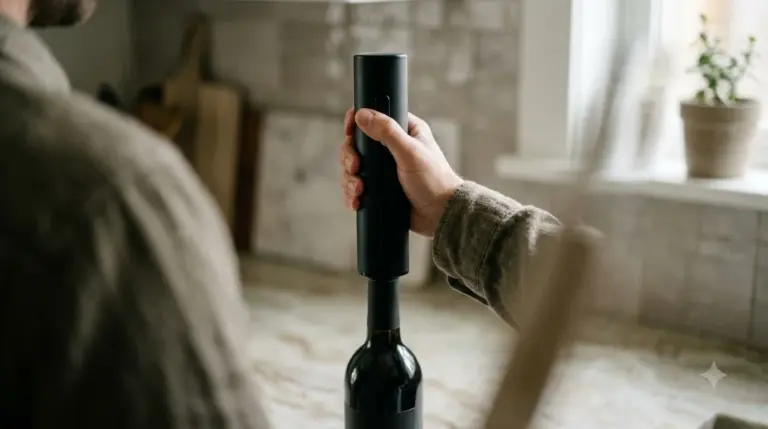
Place the Secura directly over the bottle neck. Keep the appliance as upright as possible and hold the bottle securely with your other hand.
Alignment is particularly important because the manufacturer’s instructions warn that an opener held at an angle may not extract the cork properly. Avoid pushing the appliance downward with excessive force.
4. Extract the cork
Press the lower portion of the switch. The spiral rotates clockwise, enters the cork, and gradually pulls it out of the bottle.
Allow the mechanism to operate at its natural speed. Secura specifically warns against forcing the appliance or attempting to accelerate the process manually.
5. Release the cork from the mechanism
Lift the opener away from the bottle once the cork has been extracted. Press the upper portion of the switch to reverse the spiral. The mechanism rotates counterclockwise and releases the cork.
This second step is important because removing the opener from the bottle does not automatically eject the cork from the internal spiral. Releasing it before opening another bottle keeps the mechanism ready for its next use.
6. Clean and return the opener to its stand
Wipe the exterior with a damp cloth or sponge and dry it afterward. Never immerse the opener in water or place it in a dishwasher. The corkscrew spiral is sharp, so avoid touching or adjusting the mechanism directly.
Tip: Before a dinner party, charge the Secura fully and test its controls with an ordinary cork-finished bottle. A full charge takes approximately 6–8 hours, so checking the appliance shortly before guests arrive may be too late if the battery is depleted.
When the opener is not being used, return it to its charging stand as directed by the manufacturer. This also gives it a consistent storage location and helps keep the appliance ready for its next use.
For longer periods without regular use, follow the battery-maintenance guidance in the instructions supplied with the particular model. Avoid attempting to open the housing or charging base to repair an internal electrical component. Secura states that these parts contain no user-serviceable components.
A sensible maintenance routine is straightforward: keep the exterior clean, avoid moisture around the electrical connections, use the supplied charging equipment, and inspect the appliance before operating it. These habits are more useful than trying to force a struggling cork through the mechanism.
Frequently Asked Questions
Can the Secura wine opener be used with champagne bottles?
No electric corkscrew should be used to extract a champagne or sparkling wine stopper. These bottles contain pressure that can cause the cork to move suddenly. Remove the wire cage carefully while keeping a hand over the cork, then twist the bottle rather than pulling the stopper with an electric appliance.
Does the Secura opener need a special replacement battery?
The SWO-3N manual identifies a rechargeable nickel-metal hydride battery. It does not provide a routine consumer battery-replacement procedure, and Secura states that the appliance has no user-serviceable parts. Contact the manufacturer’s customer service before attempting any battery-related repair.
Can the Secura opener be packed in checked luggage?
Airline and aviation rules for rechargeable battery-powered appliances can depend on battery specifications and the airline. Check the battery capacity and the applicable airline requirements before packing it. Keeping the appliance protected from accidental activation is also sensible during transport.
Does the Secura opener work with screw-cap wine bottles?
No. Screw-cap bottles do not have a cork for the electric spiral to extract. Simply twist off the cap by hand. The Secura is intended for bottles closed with compatible cork-style stoppers rather than every type of wine closure.
What should you do if the Secura opener stops halfway through removing a cork?
Stop rather than repeatedly forcing the motor. Secura’s instructions identify low battery power as a possible reason for incomplete extraction and recommend using the upper switch to release the cork from the mechanism. Recharge the appliance before trying again, and seek customer service assistance if the problem continues.
The Secura electric wine opener is a practical choice for people who regularly open conventional cork-finished wines and appreciate a simple, rechargeable tool. Its stainless steel body, transparent compartment, charging stand, and included foil cutter make it a convenient addition to a home serving station, although battery dependence and occasional cork compatibility problems deserve consideration. Keep a manual corkscrew available for older bottles and difficult stoppers, and the Secura can serve as a useful everyday companion beside a well-organized bar cart. For additional equipment ideas, explore the site’s Accessory Brands section.
More in Wine Accessories
 Vinglace Wine Tumbler Review: A Glass-Lined Choice for Better SippingUpdated Nov 20, 2026
 ZWILLING Electric Wine Opener Review: Features and DrawbacksUpdated Nov 20, 2026
 Vinturi Electric Wine Opener Review for Easy UncorkingUpdated Nov 20, 2026
 Vinabon Wine Aerator Review for Easier, Cleaner Wine ServingUpdated Nov 20, 2026
 Vacu Vin Electric Wine Opener Review: Easy Cork Removal for Home Wine LoversUpdated Nov 20, 2026
 Rabbit Wine Accessories for Easier Home Wine ServiceUpdated Nov 20, 2026