

We may earn a commission when you buy through links on this page, at no extra cost to you. Learn more.
The hamilton beach electric wine opener is a convenient cordless corkscrew for everyday home wine service, particularly if you regularly open bottles sealed with natural corks. Model 76610 includes a rechargeable charging base, a removable foil cutter, and straightforward up/down controls. Its advertised capacity reaches approximately 30 bottles per full charge, although independent testing identified weaker performance with synthetic corks and some ergonomic shortcomings.
The Hamilton Beach Cordless Electric Wine Opener is designed to replace the twisting and pulling associated with a traditional corkscrew. Rather than relying on wrist strength to extract a cork, users position the device over the bottle and operate its electric mechanism with a button. That simplicity makes it appealing for casual wine drinkers, dinner parties, and households that open bottles regularly. However, its performance deserves a closer look before choosing it over another electric opener or a traditional waiter’s corkscrew. The following review examines the 76610’s specifications, owner feedback, practical limitations, and suitability for different wine-drinking habits.
Specs and Key Features
The Hamilton Beach 76610 combines a rechargeable motor, a two-direction control switch, and a compact charging station. Its advertised capacity of approximately 30 bottles per charge and included foil cutter make it a straightforward countertop accessory rather than a complicated wine-serving system.
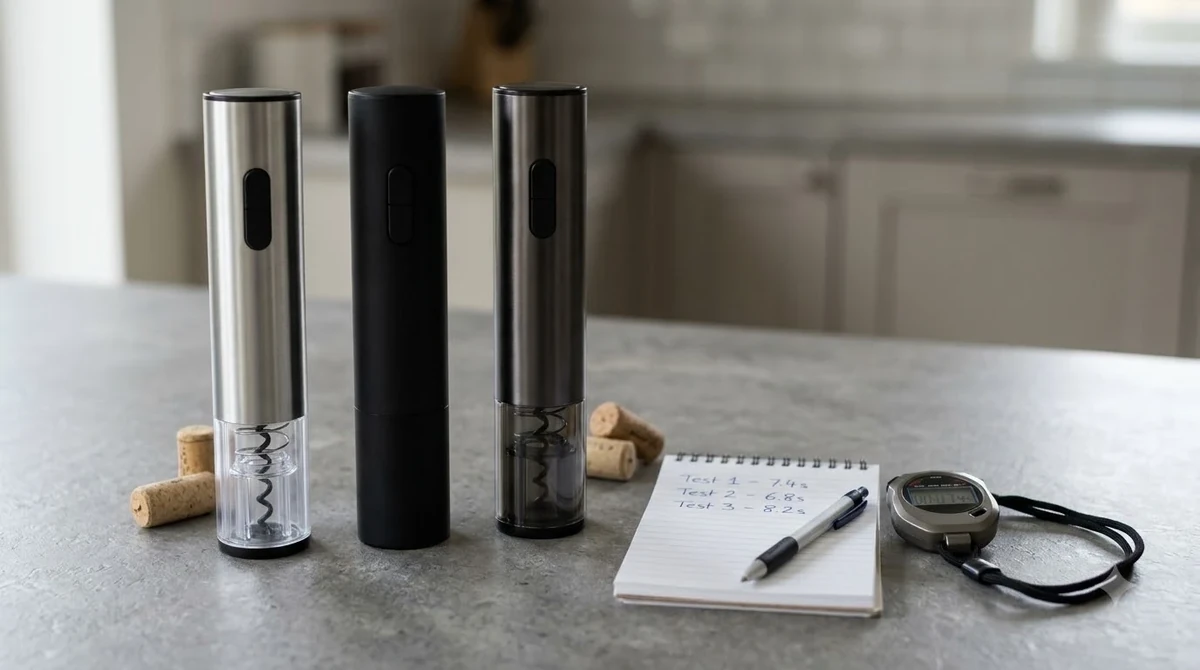
The manufacturer describes the unit as cordless and portable, with a nonslip grip intended to make handling easier. The charging base also provides a designated storage location for the foil cutter, reducing the number of separate accessories that need to be kept in a kitchen drawer. Its dimensions are relatively compact for an electric appliance, although the charging station requires additional vertical clearance.
| Specification | Hamilton Beach 76610 |
|---|---|
| Product type | Cordless electric wine opener |
| Model number | 76610 |
| Power | Rechargeable battery |
| Advertised capacity | Up to 30 bottles per full charge |
| Controls | Up/down switch |
| Included accessory | Foil cutter |
| Charging equipment | Charging base and cord |
| Charging indicator | Red during charging; green when complete |
| First charging period | At least 8 hours |
| Manufacturer dimensions | 11 x 4.25 x 4 inches |
| Weight | 11.1 ounces, according to America’s Test Kitchen |
| Height on charging stand | 10.75 inches, according to America’s Test Kitchen |
| Cork compatibility | Natural and synthetic corks |
These specifications reveal the product’s priorities. It is built around convenience, simple operation, and rechargeable storage rather than advanced controls or additional wine accessories. There is no need to purchase separate batteries, and the charging indicator provides a straightforward way to monitor charging progress.
One distinction deserves attention: the manufacturer’s 11-inch height and America’s Test Kitchen’s 10-inch measurement refer to different product descriptions and measurement conditions. America’s Test Kitchen separately lists 10.75 inches when the opener is on its charging stand. The practical takeaway is to allow approximately 11 inches of vertical clearance rather than assuming the appliance will fit beneath every low kitchen shelf.
Another important consideration is the difference between advertised capacity and guaranteed performance. Hamilton Beach states that a fully charged unit can open up to 30 bottles. That figure is a manufacturer specification, not a promise that every battery will maintain the same output with every cork type, bottle condition, or usage pattern.
The product is also no longer available through Hamilton Beach’s official product listing. That matters if you are considering a used unit, remaining retail inventory, or a replacement accessory. Before purchasing, establish whether the particular seller can provide a compatible charging cord, foil cutter, and support information.
For the official feature list and current product-status information, consult the Hamilton Beach 76610 product page.
What Owners Like
The strongest appeal of the Hamilton Beach opener is its uncomplicated operation. Owners appreciate being able to remove a cork with a downward button press rather than twisting a manual corkscrew through the cork and pulling it out by hand.
Walmart’s customer feedback highlights ease of use as an important positive theme. Its product listing includes comments from customers who appreciate the simple opening procedure and the ability to leave the appliance on a countertop for convenient access. One reviewer described how the electric mechanism eliminated the difficulty they had experienced with traditional cork removal.
The two-button arrangement is particularly practical because each control has a distinct purpose. The lower arrow extracts the cork from the bottle, while the upper arrow reverses the mechanism to release the cork from the opener. Once users understand that sequence, opening a bottle becomes a repeatable process that requires little explanation.
Convenience without disposable batteries
The rechargeable design is another advantage. Battery-operated accessories that depend on replaceable cells can become inconvenient when batteries run out unexpectedly. The Hamilton Beach charging base provides a permanent location for the opener, allowing users to recharge it between occasions instead of keeping spare batteries nearby.
The charging indicator also helps. A red light signals that charging is taking place, while a green light indicates completion. This is a relatively simple system, but it removes uncertainty about whether the device has finished charging.
A useful accessory package
The included foil cutter makes the package more practical than an electric motor alone. Wine bottles sealed with foil require that covering to be removed before the corkscrew can engage properly. Having the cutter supplied with the appliance means there is no immediate need to find a separate tool.
Its storage location on the back of the charging base is particularly useful. Small accessories are easy to misplace, especially in kitchens where wine tools share space with bottle stoppers, pourers, and glassware.
The compact footprint is another positive point for households that do not have a dedicated bar. The appliance can occupy a small countertop area, and its charging base keeps the opener upright between uses.
Lightweight handling
America’s Test Kitchen recorded a weight of 11.1 ounces for the Hamilton Beach 76610. That is a relatively light construction compared with heavier electric wine openers. A lighter body can make it easier to lift, position, and store, particularly when opening several bottles during a meal.
Its cordless construction also eliminates the need to position a bottle beside an electrical outlet. Users can move the appliance from the kitchen counter to a dining area without dragging a power cable behind it. The battery still needs to be charged beforehand, but everyday operation does not depend on an outlet being nearby.
For someone who opens wine occasionally and prefers simple equipment, those advantages are meaningful. The device does not need an app, complicated settings, or an extensive accessory collection. Its basic purpose is to remove a cork and return to its charging station.
Common Complaints
The most significant concern with the Hamilton Beach 76610 is its performance with synthetic corks. Independent testing found that it was more effective with natural corks, while synthetic versions were slower and more difficult to remove.

America’s Test Kitchen evaluated multiple electric wine openers and identified the Hamilton Beach model as not recommended in its comparison. Testers appreciated its relatively light weight and simple controls, but reported that synthetic cork removal was less effective than with stronger-performing alternatives.
This distinction is important because synthetic corks are common in contemporary wine packaging. A household that mainly buys traditional wines sealed with natural cork may experience fewer problems than someone whose collection includes many bottles with synthetic closures.
Grip placement and handling
The other notable criticism concerns the silicone grip pads. Although Hamilton Beach describes the handle as ergonomic and nonslip, America’s Test Kitchen found that the finger-placement areas were awkwardly positioned. Instead of naturally accommodating the hand, the grip could force fingers into uncomfortable positions.
This is a useful reminder that an ergonomic label does not guarantee a comfortable experience for every hand size. The opener is relatively light, but grip shape and button placement can matter more than weight when positioning a motorized corkscrew vertically over a bottle.
Users should also recognize that electric operation does not eliminate the need for stability. The bottle needs to remain steady while the opener is aligned with the neck. A poorly aligned mechanism can make cork removal more difficult, regardless of whether the motor is functioning properly.
Battery aging and charging expectations
Rechargeable batteries are convenient, but they introduce a long-term consideration that traditional manual corkscrews do not have. Battery capacity can decline with age and repeated charging cycles. A device that once opened many bottles between charges may eventually require more frequent charging.
Hamilton Beach’s advertised capacity of up to 30 bottles should therefore be treated as a performance target for a fully charged unit, not a lifetime guarantee. An older opener may not deliver the same capacity as a new one.
Owner feedback across retailer listings also raises practical questions about long-term charging reliability. Some consumers focus on battery life and the convenience of charging-base storage, while others report difficulty maintaining dependable operation over extended ownership. These comments should not be treated as controlled durability measurements, but they reinforce the importance of checking the condition of a used device.
Availability and replacement parts
Availability is another drawback. Hamilton Beach’s official listing identifies the 76610 as no longer available. That does not mean every existing unit is unusable, but it does make replacement planning more important.
The manufacturer’s product page lists a foil cutter and charging cord among the associated parts and accessories. Buyers considering older inventory should confirm that the specific unit includes its charging equipment and that replacement accessories remain obtainable before committing to a purchase.
Overall, the complaints do not make the opener unsuitable for every household. They do, however, suggest that people who frequently open synthetic-cork bottles or need a particularly comfortable grip should compare alternatives rather than selecting the Hamilton Beach model solely because it is rechargeable.
Who Should Buy and Who Should Skip
The Hamilton Beach 76610 is most appropriate for occasional wine drinkers who value cordless convenience, straightforward controls, and a small countertop charging station. Its strongest use case is opening naturally corked bottles at home without requiring a traditional twisting motion.
For someone who opens one bottle for dinner, entertains a few guests, or keeps a small wine collection, the product’s operating method is easy to understand. The up/down switch separates cork extraction from cork release, while the foil cutter handles the initial preparation step.
Good candidates for this opener
Consider the Hamilton Beach model if your priorities include the following:
- Occasional home wine service: The electric mechanism simplifies opening a bottle for dinner without requiring a waiter-style corkscrew.
- Natural-cork bottles: Independent testing found more successful performance with natural corks than with synthetic alternatives.
- Countertop convenience: The charging base provides an upright storage location and keeps the foil cutter close to the appliance.
- Cord-free operation: The opener can be carried between the kitchen and dining area without remaining connected to an outlet.
- Simple controls: The separate upper and lower arrows make the opening and release procedures easy to learn.
It can also make sense as a gift for someone who enjoys wine but dislikes operating a traditional corkscrew. A person who regularly hosts small dinners may appreciate having the opener ready on its base instead of searching through a kitchen drawer for a manual tool.
Who should look elsewhere
The Hamilton Beach 76610 is less compelling for households that primarily buy synthetic-cork wines. America’s Test Kitchen specifically identified difficulties with that closure type, so frequent synthetic-cork use is a reason to consider another electric mechanism.
It may also be a poor match for buyers who prioritize long-term repairability. Rechargeable appliances eventually face battery wear, and the discontinued status of this particular model makes replacement-part availability an important consideration.
People who open many bottles in quick succession should pay attention to grip comfort and stability. The independent criticism of the silicone finger pads suggests that the handle may not feel natural to every user. Anyone who has difficulty maintaining a secure grip should compare the physical shape of different openers before buying.
Finally, collectors who frequently encounter older corks or fragile natural corks may prefer a different opening method altogether. An electric worm is designed to penetrate and extract a cork mechanically, but it does not eliminate the possibility of cork breakage. A careful two-pronged opener may be more appropriate for particularly delicate closures.
Tip: If you are purchasing a pre-owned Hamilton Beach 76610, ask the seller to demonstrate both directions of operation and confirm that the charging indicator changes from red to green. Check the foil cutter, charging cord, base, and battery performance before relying on the opener for a gathering.
How It Compares to Alternatives
The Hamilton Beach 76610 occupies the straightforward manual-start category of electric wine openers. Its main distinction is the combination of a lightweight body, simple controls, and an advertised capacity of up to 30 bottles per full charge, rather than advanced automation or a large accessory package.
America’s Test Kitchen compared it with several other electric openers, including models from Secura, Cuisinart, Ozeri, and Rabbit. Its findings provide a useful basis for understanding where the Hamilton Beach model fits and which features deserve more attention when choosing a replacement.
Hamilton Beach versus Secura
America’s Test Kitchen selected the Secura Electric Wine Opener as its winner. Testers appreciated its transparent window, comfortable handling, and ability to open both natural and synthetic corks effectively. They also reported that it opened more than 30 bottles consecutively without losing charge during their evaluation.
By comparison, the Hamilton Beach model was lighter at 11.1 ounces, but its synthetic-cork performance and grip arrangement were less impressive. The Secura is the stronger reference point for buyers who want an electric opener with more consistent results across different closure types.
Hamilton Beach versus Cuisinart
America’s Test Kitchen identified the Cuisinart Cordless Wine Opener and Vacuum Sealer as a runner-up in its comparison. Testers liked its ability to handle natural and synthetic corks, along with its relatively quiet and stable operation.
The Cuisinart package also includes a foil cutter and a dedicated storage location for that accessory. Its disadvantages include a somewhat top-heavy feel and greater height, which may complicate storage in smaller kitchen cabinets.
The Cuisinart CWO-25 is another option mentioned in the same comparison. It performed well with natural corks but struggled more with synthetic versions. This illustrates why buyers should not assume that every electric wine opener will deliver the same results simply because it uses a motorized corkscrew.
Hamilton Beach versus a manual corkscrew
A traditional waiter’s corkscrew has an important advantage: it does not depend on a rechargeable battery. It is compact, inexpensive to store, and can remain useful for years with basic care. It also gives the user direct control over the angle and depth of cork penetration.
The trade-off is that manual extraction requires more coordination and physical effort. The Hamilton Beach opener automates the twisting and pulling action, making it appealing to people who prefer a button-operated device.
America’s Test Kitchen also points out that electric wine openers are not completely free of physical effort. Some models wobble during operation and still require users to maintain a secure grip. Therefore, an electric design should not automatically be considered easier for every person.
Choosing the right alternative
For households that frequently open synthetic-cork wines, the Secura or the tested Cuisinart cordless option deserves closer consideration. For buyers who prioritize a lightweight body and uncomplicated controls, the Hamilton Beach remains an understandable design, provided its closure limitations are acceptable.
Other wine accessories can complement whichever opener you select. An electric wine chiller serves a different purpose by helping prepare wine for serving, while beach wine glasses are relevant for outdoor entertaining. These additions do not improve cork extraction, but they can make a home wine setup more practical.
Care, Charging, and Everyday Use
Correct positioning and charging habits are essential to getting dependable performance from the Hamilton Beach opener. The manufacturer’s instructions emphasize an upright opening position, a steady bottle, and regular placement on the charging base when the device is not being used.
Initial charging
Before the first use, Hamilton Beach instructs owners to charge the appliance for at least 8 hours. Connect the charging cord to the base, plug it into the electrical outlet, and position the opener on the charging station according to the instructions.
The charging indicator illuminates red during charging and turns green when the battery is fully charged. Subsequent charging periods should take less time than the initial charge, according to the manual.
Opening a bottle correctly
- Prepare the bottle. Place the wine bottle upright on a stable surface and remove the foil with the supplied cutter. Rotate the cutter around the top of the bottle to separate the foil cleanly.
- Position the opener. Hold the bottle securely with one hand and position the opener vertically over the cork with the other hand.
- Check alignment. Make sure the opener sits firmly on the bottle neck and that its directional arrows face toward you.
- Extract the cork. Press and hold the lower arrow until the mechanism stops and the cork has been removed from the bottle.
- Lift the opener. Remove the appliance vertically from the bottle without twisting it unnecessarily.
- Release the cork. Press and hold the upper arrow to reverse the mechanism and release the cork from the opener.
- Return the unit to storage. Place the opener on its charging base when it is not being used.
This procedure follows the manufacturer’s recommended operating sequence. Keeping the appliance straight over the cork is particularly important because angled positioning can interfere with proper extraction.
Cleaning and storage
The instruction manual specifically warns against immersing the opener, charging base, cord, or charging port in water. These components contain electrical connections and should never be treated like dishwasher-safe kitchen utensils.
For ordinary exterior maintenance, disconnect the power supply and use a lightly damp cloth to clean accessible surfaces. Dry the exterior before returning the opener to its charging station. Keep the charging port free from moisture and avoid allowing wine residue to accumulate around the mechanism.
Store the foil cutter in its designated compartment on the base. This helps keep the accessory available and reduces the likelihood of misplacing it between uses.
It is also sensible to keep the charging station away from sinks, hot appliances, and areas where it may be knocked off the counter. A dry, level countertop is a more suitable location for an electrical wine accessory.
For owners who want to complete a broader home wine setup, wine accessory brands provide another useful starting point for comparing serving and storage equipment. A simple opener, appropriate glassware, and reliable bottle storage can cover most everyday requirements without requiring an elaborate bar arrangement.
Frequently Asked Questions
Can the Hamilton Beach 76610 open bottles with screw caps?
No. This appliance is designed specifically for natural and synthetic cork closures, not screw caps. Bottles with threaded metal or plastic caps should be opened using the appropriate manual twisting method instead.
Does the Hamilton Beach opener have a transparent viewing window?
The 76610 product documentation does not identify a transparent viewing window as one of its features. Buyers who want to watch the corkscrew mechanism operate should compare models that explicitly advertise a clear inspection window.
Can the charging base be used with another electric wine opener?
The manufacturer’s instructions specify using only the charger supplied with this appliance and warn against using its charger with other products. Do not assume that another opener with a similar-looking charging connection is electrically compatible.
What should you do if a cork breaks during extraction?
Stop operating the motor if the cork begins breaking apart or the mechanism becomes stuck. Remove loose cork material carefully and avoid repeatedly running the motor against an obstruction. A two-pronged cork extractor may be a more appropriate tool for recovering a fragile remaining cork.
Is the Hamilton Beach 76610 suitable for commercial wine service?
The manufacturer identifies this appliance as intended for household use only. Its advertised capacity of up to 30 bottles per charge does not establish suitability for restaurant or commercial service, where equipment may need more frequent operation and professional servicing.
The Hamilton Beach 76610 remains an easy-to-understand electric wine opener with useful cordless operation, a charging base, and a convenient foil cutter. Its strongest performance case is occasional household use with natural corks, while synthetic-cork limitations, grip concerns, and discontinued availability deserve careful consideration. If those compromises fit your requirements, it can still be a practical wine accessory; otherwise, comparing newer electric openers or choosing a reliable manual corkscrew is the more sensible approach.
More in Wine Accessories
 Hamilton Beach Wine Opener Review: Specs, Pros, and Real LimitsUpdated Nov 21, 2026
 Circle Joy Wine Aerator Review for Faster, Easier PouringUpdated Nov 21, 2026
 Ivation Wine Chiller Review for Practical Home Wine StorageUpdated Nov 21, 2026
 Houdini Wine Opener Not Working? Fix Common Problems and Restore Smooth Cork RemovalUpdated Nov 21, 2026
 Crenova Wine Opener Review: Easy Cork Removal and Useful ExtrasUpdated Nov 21, 2026
 Cuisinart Wine Aerator Review: Faster, Easier Wine ServingUpdated Nov 21, 2026