

We may earn a commission when you buy through links on this page, at no extra cost to you. Learn more.
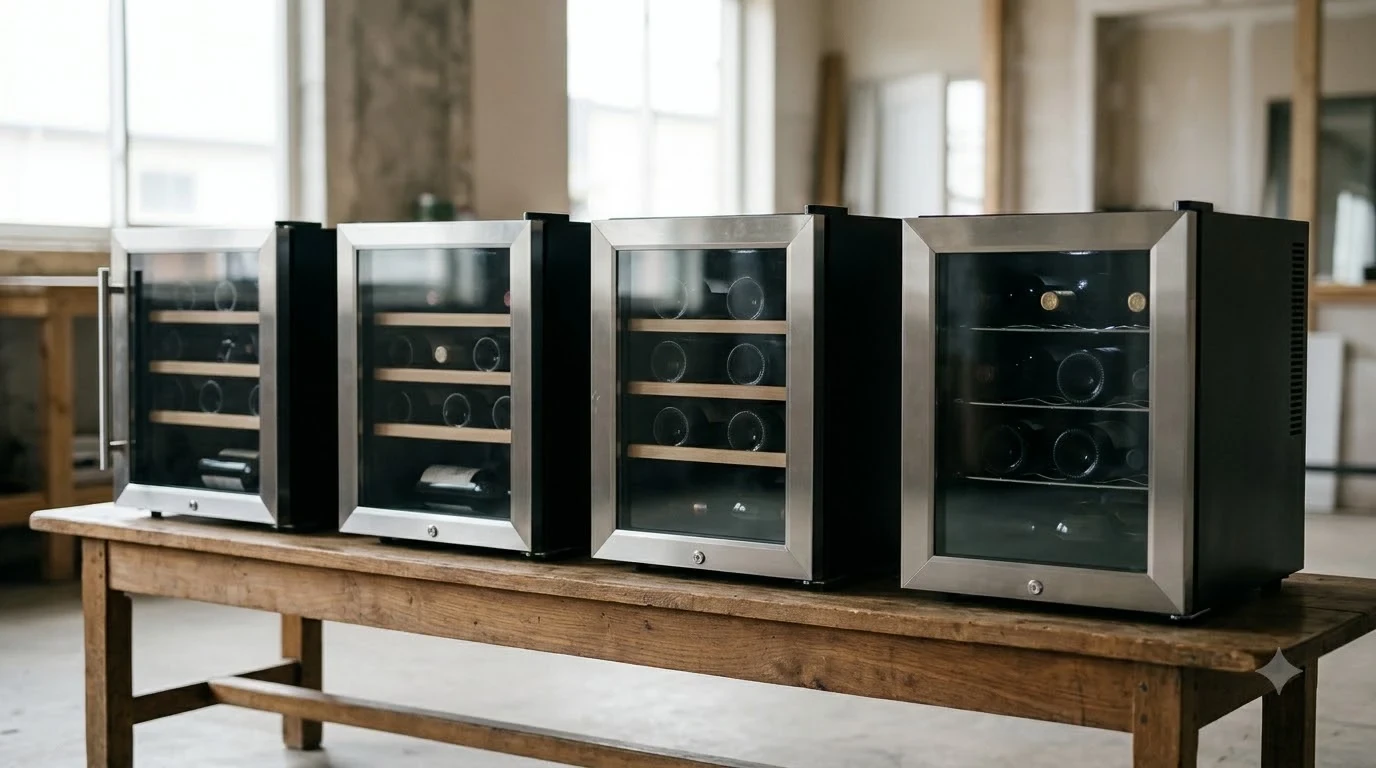
The cuisinart countertop wine cooler is a convenient choice for storing up to eight bottles in a compact space, with adjustable digital temperature controls and quiet thermoelectric cooling. The Cuisinart Private Reserve CWC-800CEN offers a 39°F to 68°F advertised temperature range, three chrome racks, and interior lighting. Its biggest limitation is temperature performance in warm rooms: the manufacturer explains that ambient conditions can prevent the cooler from reaching its lowest advertised setting.
The Cuisinart Private Reserve 8-Bottle Wine Cellar is designed for wine drinkers who want dedicated storage without giving up the floor space required by a conventional wine refrigerator. Its compact dimensions make it an appealing option for apartments, small kitchens, home bars, and dining areas. However, its eight-bottle capacity, thermoelectric cooling system, and relatively narrow rack spacing make it important to understand exactly what this appliance can handle before purchasing.
Specs and Key Features: CWC-800CEN Capacity and Design
The CWC-800CEN combines an eight-bottle storage compartment with electronic temperature adjustment and a glass-front design. Its strongest features are its small footprint, simple controls, and ability to keep a modest collection separate from everyday refrigerator storage.
Cuisinart’s official product specifications identify this appliance as the Private Reserve 8-Bottle Wine Cellar. The manufacturer lists three contoured chrome racks, a triple-pane viewing window, adjustable feet, and a black exterior with stainless steel trim. The touchscreen-style controls provide access to the temperature settings and interior light.
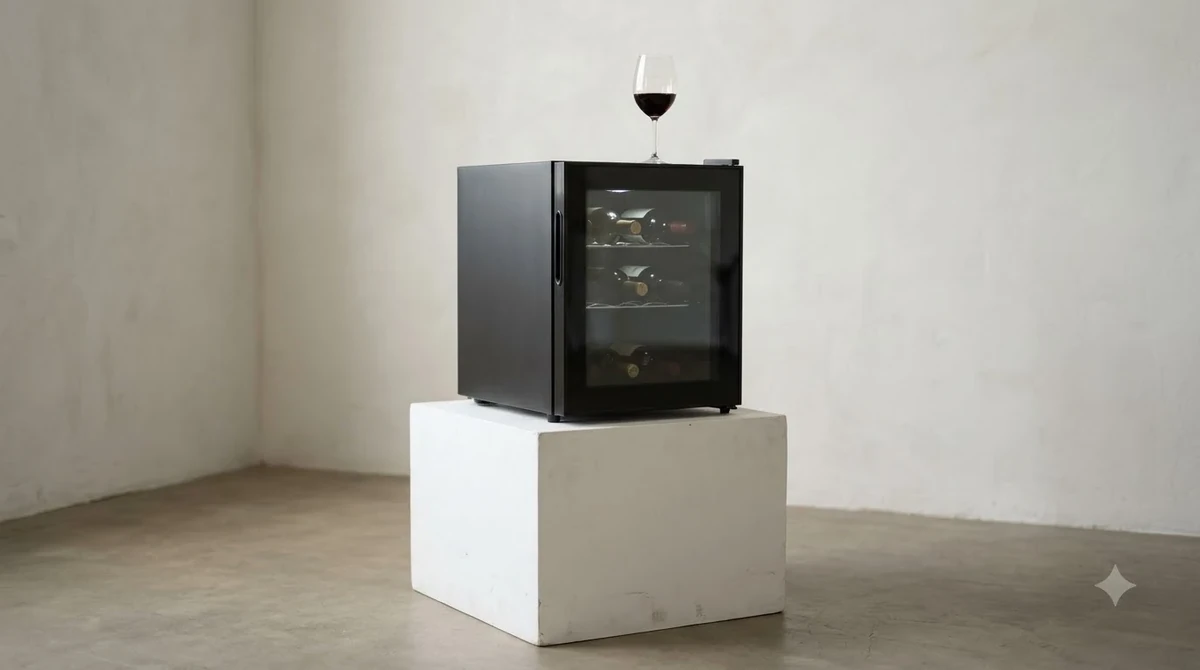
The physical dimensions are particularly important for anyone considering countertop placement. At 17.5 inches wide and 17.25 inches high, the appliance occupies considerably less space than many freestanding wine refrigerators. Its listed depth is 10.5 inches, making it relatively shallow for a dedicated wine storage appliance. Nevertheless, the installation requirements add to the actual space needed.
| Specification | Cuisinart CWC-800CEN |
|---|---|
| Product name | Private Reserve 8-Bottle Wine Cellar |
| Model number | CWC-800CEN |
| Capacity | 8 bottles |
| Cooling technology | Thermoelectric |
| Advertised temperature range | 39°F–68°F |
| Default temperature | 55°F |
| Temperature adjustment | 1°F increments |
| Interior racks | 3 contoured chrome racks |
| Compatible bottle sizes | 750 ml and 1500 ml, according to Cuisinart |
| Exterior finish | Black with stainless steel trim |
| Viewing window | Triple-pane glass |
| Dimensions | 10.5 × 17.5 × 17.25 inches |
| Listed weight | 24 pounds |
| Installation | Freestanding |
| Warranty | Limited three-year warranty |
The eight-bottle capacity is best understood as a practical limit rather than a promise that every combination of wine bottles will fit equally well. Standard Bordeaux-style bottles are generally easier to arrange than wider Burgundy bottles, sparkling wine bottles, or unusually shaped specialty bottles. Although Cuisinart lists compatibility with 750 ml and 1500 ml bottles, bottle dimensions and rack spacing still affect how much can be stored comfortably.
The triple-pane viewing window and interior illumination give the unit a display-oriented appearance. These features are useful in an open kitchen or home bar, where the cooler is visible rather than hidden in a utility room. The adjustable feet also help stabilize the cabinet on a level surface, reducing the chance of vibration caused by an uneven countertop.
Another useful distinction is that this is a single-compartment cooler. It has one temperature setting for the entire collection, not separate red and white wine zones. You can change the setting depending on what you are storing, but you cannot independently maintain two different serving temperatures at the same time.
What Owners Like About the Compact Design and Operation
Customer feedback generally emphasizes convenience, manageable dimensions, straightforward temperature adjustment, and relatively quiet operation. Those characteristics make the CWC-800CEN attractive for households that want a small dedicated wine refrigerator rather than a large collection-storage appliance.
Best Buy customer reviews describe the appliance as compact and easy to use. Owners mention the digital controls, attractive interior lighting, and useful eight-bottle capacity. Some also appreciate having a dedicated place for wine instead of moving bottles between a kitchen refrigerator and a countertop before serving.
One recurring advantage is the combination of red and white wine storage in a single small appliance. For example, a household might keep Chardonnay and Sauvignon Blanc chilled while using a slightly warmer setting for Pinot Noir or Merlot. The temperature can be adjusted according to the collection’s immediate needs.
The ability to store an opened bottle is another practical benefit reported by a Best Buy customer. A bottle with a vacuum stopper may fit inside the cabinet, allowing the owner to keep unfinished wine at a controlled temperature instead of returning it to a crowded food refrigerator. Actual fit depends on the bottle’s height and closure.
Why thermoelectric cooling appeals to small households
The Cuisinart uses thermoelectric cooling rather than a conventional compressor-based refrigeration system. The manufacturer describes this design as an energy-conscious, quieter approach for the compact wine cellar. This is attractive when the appliance sits in a kitchen, dining area, or small living space where operating noise can be more noticeable.
Thermoelectric technology also suits a relatively small storage compartment. The appliance is not intended to replace a full-size wine refrigerator for a large collection. Instead, its purpose is to provide a dedicated temperature-controlled environment for a handful of bottles.
Owners frequently mention that the unit does not produce disruptive noise during ordinary use. However, quiet operation should not be confused with complete silence. A cooling fan can cycle on and off, and the frequency of operation depends partly on the room temperature and how often the door is opened.
Appearance and everyday convenience
The black finish and stainless steel detailing make the appliance reasonably easy to coordinate with common kitchen finishes. Its glass viewing window provides visibility without requiring the door to be opened every time someone wants to see which bottles are available.
The LED display is another useful feature because it allows owners to see the selected temperature without relying on a mechanical dial. Temperature adjustments are made electronically in one-degree increments, providing more control than basic wine cabinets with only a few preset settings.
For people who usually keep fewer than eight bottles available, this combination of appearance and straightforward operation is likely to be more important than advanced features such as dual zones, Wi-Fi connectivity, or inventory management.
Common Complaints: Temperature Limitations and Bottle Fit
The most important drawback is the difference between the advertised temperature range and the temperature the appliance can actually achieve in a warm room. Bottle compatibility is another consideration because the compact rack arrangement may not accommodate every bottle shape without rearranging the storage space.

The temperature issue deserves particular attention. Cuisinart lists a minimum setting of 39°F, but its manual explains that thermoelectric cooling depends on surrounding air temperature. According to the CWC-800CEN manual, when the room is 77°F, the lowest achievable internal temperature is approximately 50°F to 52°F. At an ambient temperature of 66°F, the cabinet can reach approximately 39°F to 41°F.
This distinction matters in kitchens that experience considerable heat from cooking appliances, direct sunlight, or warm summer conditions. Someone expecting to maintain sparkling wine at a consistently cold serving temperature may find the appliance less suitable in a warm room. The digital display shows the selected setting, but the selected number does not guarantee that the cabinet will reach that exact temperature.
For red wine storage, the limitation may be less significant. Many lighter reds benefit from temperatures around 55°F to 60°F, while fuller reds are generally served around 60°F to 65°F. However, white wine and sparkling wine usually require colder conditions, making room temperature a more important purchasing consideration.
Rack spacing and bottle shape
Customer complaints also mention tight spacing between the chrome racks. Several Best Buy reviewers describe difficulties accommodating bottles that are wider than standard wine bottles. One reviewer reported removing a rack to make additional room for a wider bottle.
This does not mean the cooler cannot accommodate anything other than conventional Bordeaux bottles. Cuisinart explicitly identifies 750 ml and 1500 ml bottle compatibility. However, the dimensions of a particular bottle can matter as much as its stated volume.
For example, a broad Burgundy bottle, sparkling wine bottle, or Champagne bottle may require more horizontal space than a standard 750 ml Bordeaux bottle. The result can be fewer usable storage positions or the need to rearrange the racks. Owners who frequently purchase bottles from different regions should consider this limitation before assuming that all eight positions will remain usable.
Other operational considerations
Some reviewers mention the cooling fan cycling on and off. This is not automatically evidence of a fault. Cooling equipment must operate periodically to maintain its internal environment, and thermoelectric systems can become more active when room temperatures rise.
Another consideration is the single temperature zone. The cooler cannot simultaneously hold Champagne at 45°F and Cabernet Sauvignon at 63°F. Owners must select one compromise temperature or rotate the setting according to the wines they plan to serve.
Finally, the eight-bottle capacity leaves little room for collection growth. A household that regularly purchases several bottles at a time may quickly run out of available positions. The CWC-800CEN is a small wine-storage solution, not a substitute for a larger cellar.
Tip: Before purchasing, measure the width and height of your largest wine bottles. Also measure the available installation area and allow at least 2 inches of ventilation clearance around the sides and rear. In warm kitchens, pay particular attention to the cooler’s actual operating temperature rather than relying exclusively on its digital setting.
Who Should Buy the Cuisinart CWC-800CEN and Who Should Skip It?
The Cuisinart is most appropriate for casual wine drinkers who want a small, attractive appliance for a limited selection of bottles. It is less appropriate for collectors who need dependable low temperatures, substantial capacity, or separate storage zones for different wine styles.
For a household with four to eight regularly consumed bottles, the compact format can be convenient. Instead of dedicating a large section of a kitchen refrigerator to wine, owners can maintain a separate collection in a purpose-built cabinet.
The product is particularly appealing for people who enjoy alternating between red and white wines. A single adjustable temperature can serve as a practical compromise for temporary storage, particularly when the wine is moved to an appropriate serving temperature before drinking.
Good candidates for this wine cooler
- Apartment residents: The compact 17.5-inch width and 17.25-inch height make it easier to accommodate than a large freestanding wine refrigerator.
- Casual wine drinkers: An eight-bottle capacity is sufficient for a modest collection that changes regularly.
- Home bar owners: The glass door, interior lighting, and black finish create a display-friendly storage area.
- Red wine enthusiasts: A collection of Pinot Noir, Merlot, or Cabernet Sauvignon can benefit from dedicated temperature-controlled storage when the surrounding room is suitable.
- People seeking simpler controls: The electronic display and one-degree adjustments avoid the guesswork associated with basic mechanical controls.
Who should consider another appliance?
Wine collectors with more than eight bottles should consider a larger refrigerator. The limited storage space is particularly inconvenient for anyone who buys wine by the case or keeps multiple bottles of the same vintage.
People living in consistently warm environments should also be cautious. If the room regularly reaches 77°F or higher, the manual’s temperature performance figures indicate that the cooler may struggle to maintain the cold conditions required for white wine and sparkling wine.
Buyers who frequently store Champagne, traditional-method sparkling wine, or broad Burgundy bottles should investigate rack dimensions carefully. A larger refrigerator with more flexible shelving may be a better investment for a collection containing varied bottle shapes.
Finally, anyone looking for separate red and white compartments should skip this single-zone model. A dual-zone refrigerator is a more suitable choice when both categories need different storage temperatures at the same time.
How It Compares to Larger Wine Refrigerator Alternatives
The Cuisinart occupies the compact end of the wine refrigerator category. Its main advantages are its small footprint, simple operation, and eight-bottle capacity, while larger refrigerators offer more storage positions and potentially more specialized temperature management.
Choosing between these appliance types depends on collection size, bottle variety, installation space, and the temperature requirements of the wines being stored. The CWC-800CEN is not automatically the better choice simply because it is smaller.
Compact countertop versus larger freestanding refrigerators
A larger freestanding wine refrigerator is generally more suitable for people who keep 20, 30, or more bottles at home. Additional shelf space makes it easier to organize different producers, vintages, and wine styles without constantly rearranging bottles.
However, a larger unit requires more floor space and may be less convenient in a small apartment. It can also represent unnecessary capacity for someone who usually buys only a few bottles at a time.
The Cuisinart’s compact dimensions are a clear advantage in this situation. Its listed 24-pound weight also makes it more manageable to position than many larger wine refrigerators, although the appliance must still be moved upright and installed on a stable surface.
Single-zone versus dual-zone storage
The CWC-800CEN uses one temperature setting for all eight bottles. This is convenient if the collection is relatively consistent, but it is restrictive when storing several wine styles that benefit from substantially different temperatures.
A dual-zone refrigerator has two independently controlled storage areas. One compartment can be configured for white wine while the other is set for red wine. This arrangement is particularly useful for households that regularly serve Chardonnay, Riesling, Pinot Noir, and Cabernet Sauvignon.
However, dual-zone designs typically require more installation space. Buyers should compare the capacity of each compartment rather than considering only the total bottle count.
How to evaluate the broader market
For shoppers who are not committed to the Cuisinart brand, a comparison of the best rated wine cooler options can help identify appliances with larger capacities, alternative cooling systems, or more flexible shelf arrangements. Readers comparing individual appliance evaluations can also explore our wine cooler model reviews for additional product-specific buying considerations.
When comparing alternatives, prioritize the following characteristics:
- Actual cooling performance: Look for information about the minimum achievable temperature at realistic room temperatures.
- Capacity: Choose a refrigerator with enough usable space for your collection rather than relying solely on the manufacturer’s maximum bottle count.
- Temperature zones: Determine whether one shared temperature is sufficient or whether independently controlled compartments are necessary.
- Bottle compatibility: Examine shelf spacing and compatibility with Champagne, Burgundy, and other wider bottles.
- Ventilation: Check installation clearances and whether the design is intended for freestanding or built-in use.
- Warranty: Compare coverage periods and the availability of replacement parts and authorized service.
The Cuisinart makes the most sense when convenience and compact dimensions are more important than maximum capacity. A larger compressor-based refrigerator may be preferable for a serious collection, especially if the appliance will operate in a warm room or store a variety of bottle shapes.
Frequently Asked Questions
Can the Cuisinart CWC-800CEN be used for wine other than standard 750 ml bottles?
Yes. Cuisinart identifies compatibility with both 750 ml and 1500 ml bottles. However, larger bottle formats can reduce the number of bottles that fit comfortably at once. Bottle height, shoulder shape, and diameter can affect rack placement even when two bottles have the same stated volume.
Does the Cuisinart wine cooler have a removable air filter?
Yes. The CWC-800CEN manual identifies a removable air filter designed to help keep dust and dirt away from the fan and motor. The manufacturer recommends cleaning this filter every three months using warm, soapy water. It should be completely dry before being reinstalled.
Does the Cuisinart CWC-800CEN remember its temperature after a power interruption?
The operating instructions advise unplugging the appliance during a power interruption and reconnecting it after electricity returns. They do not provide a clear guarantee of temperature-setting memory following every interruption. Owners should check the display and allow the cabinet to stabilize before relying on its storage temperature again.
Can the Cuisinart wine cellar be placed inside a closed kitchen cabinet?
No. The manufacturer’s manual specifies freestanding installation and warns against placing the appliance inside an appliance garage or fully enclosed cabinet. The cooling system requires ventilation, so an enclosed location can interfere with heat removal and temperature performance.
Should the Cuisinart wine cooler remain upright during transportation?
Yes. The operating instructions specifically recommend keeping the wine cellar upright when moving it. The manual also instructs owners to remove all bottles before transportation and to empty and clean the appliance before long periods of absence.
The Cuisinart Private Reserve CWC-800CEN is a practical compact wine cellar for households that value convenient access, straightforward controls, and storage for up to eight bottles. Its most significant limitations are temperature performance in warm rooms, restricted capacity, and tight rack spacing for some bottle shapes. If those limitations match your storage environment and collection, it is a sensible small-format option; otherwise, a larger wine refrigerator with stronger temperature flexibility is the better direction.
More in Model Reviews
 Magic Chef 44 Bottle Wine Cooler Review for Flexible StorageUpdated Nov 21, 2026
 Whynter 164 Bottle Wine Cooler Review: Capacity, Features, and FitUpdated Nov 21, 2026
 Insignia NS WC16BK6 Review: Compact 16-Bottle Wine StorageUpdated Nov 21, 2026
 Wine Enthusiast Electric Blue Omega Review: Opening, Pouring, and Preserving Made EasierUpdated Nov 21, 2026
 Koolatron 20 Bottle Wine Cooler Review: Features, Fit, and PerformanceUpdated Nov 21, 2026
 NewAir AWC 330E Review for Home Wine StorageUpdated Nov 21, 2026