

We may earn a commission when you buy through links on this page, at no extra cost to you. Learn more.
The best diy wine rack depends on your available square footage, collection size, and woodworking comfort level, with modular stackable wood kits offering the easiest, most reliable build for growing collections. Wall-mounted peg and dowel systems work best when floor space is tight, while floor-to-ceiling grid racking maximizes capacity inside a closet or pantry. For budget-minded weekend builders, repurposed wooden crates or PVC pipe honeycombs deliver fast, sturdy horizontal storage without advanced joinery.
Building your own bottle storage lets you tailor dimensions to an awkward pantry alcove, match existing kitchen cabinetry, and expand capacity one tier at a time. Whether you assemble a pre-cut hardwood kit with a rubber mallet or rip pine boards on a miter saw, the right design keeps corks wet, supports heavy glass safely, and turns stray bottles into an organized display.
Quick Comparison
Each do-it-yourself wine rack style balances build complexity, bottle capacity, and spatial footprint differently.
| Rack Type | Best For | Skill & Tool Level | Bottle Orientation | Expansion Flexibility |
|---|---|---|---|---|
| Modular Stackable Wood Kits | Growing collections & beginners | Low (mallet or basic screwdriver) | Cork-forward horizontal | High (add tiers upward) |
| Wall-Mounted Peg & Dowel Racks | Small apartments & blank walls | Moderate (stud finder, drill, level) | Label-forward horizontal | Moderate (add columns) |
| Floor-to-Ceiling Grid & Bin Racking | Closet & cellar conversions | High (saw, brad nailer, anchoring) | Cork-forward & bulk bin | Low (built-in fixed frame) |
| Countertop X-Cube & Lattice Boxes | Kitchen counters & under-cabinet nooks | Moderate (miter saw, wood glue) | Diagonal & horizontal | Low (standalone unit) |
| Upcycled Crate & Pipe Honeycombs | Renters & weekend budget builds | Low (minimal cutting, brackets) | Cork-forward horizontal | High (modular stacking) |
Best for Growing Collections: Modular Stackable Wood Kits
Interlocking wooden rack kits give you the satisfaction of custom-fitted bottle storage without needing a workshop full of power tools, expanding vertically as your cellar grows.
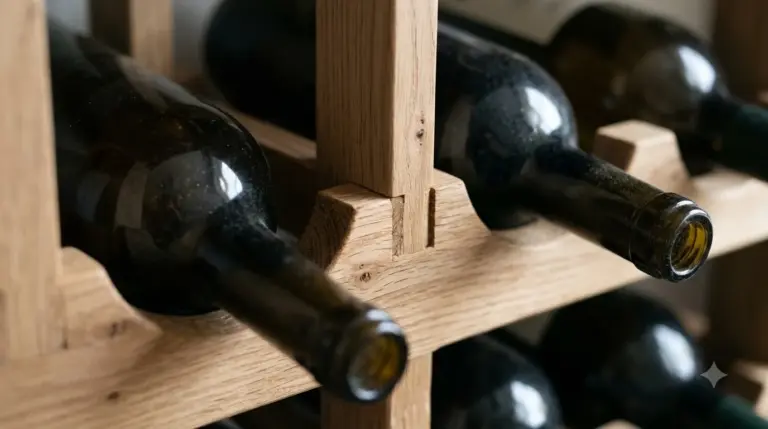
Why it stands out: Pre-notched hardwood rails and dowels snap or screw together in minutes, creating rigid horizontal cradles that protect natural corks from drying out. Industry specialists at Wine Enthusiast highlight stackable half-height and full-height wood rack kits for beginners because individual rails support standard Bordeaux, Pinot Noir, and Champagne diameters cleanly. Unfinished pine, redwood, or mahogany pieces also take stain or clear sealant easily, allowing you to match dining room furniture before locking the tiers together.
Keep in mind: Individual bottle slots rarely accommodate oversized magnums or squat sparkling bottles unless the rails feature wide spacing. Best for: Collectors who want a scalable, furniture-grade wine rack that starts small on a dining room floor and builds upward over several years.

- Capacity
- 72 bottles, 8 tiers
- Material
- Bamboo
- Size
- 33.5 x 9.8 x 40.4 in
- Assembly
- No tools, about 5 minutes
Collectors adding bottles every few months can build this shelf out tier by tier. Eight stackable levels hold nine bottles each, and side plates close the gaps for a steadier frame. The bamboo is unfinished, which leaves room to stain, paint, or varnish it to suit a room. Setup takes about five minutes with no tools, and the openings fit standard 750ml bottles.
Pros & ConsView
- Eight modular tiers hold 72 bottles
- Side plates add support and stability
- Assembles in about five minutes, no tools
- Floor-standing frame is tall at 40 inches
- Bottles must be removed before repositioning
Best for Small Spaces: Wall-Mounted Peg and Dowel Racks
Wall-mounted peg and dowel systems lift bottles off crowded floors and countertops, turning a narrow strip of drywall into a sleek, label-forward wine display.
Why it stands out: By anchoring a solid hardwood backer board directly into wall studs and inserting steel or wooden dowels at precise intervals, you cradle each bottle horizontally along its neck and base. Storing bottles label-forward makes reading vintages effortless without pulling bottles out and disturbing sediment, while open spacing promotes steady air circulation around the glass. If you want inspiration for layout proportions before drilling, browsing a dedicated wall mounted wine rack guide clarifies how far apart rods should sit for secure balance.
Keep in mind: Wine is heavy—a full standard bottle weighs roughly three pounds—so hollow-wall anchors alone will fail under load; every vertical rail or backer panel must hit structural wood studs or masonry. Best for: Apartment dwellers, narrow hallways, and entertainers who want visual access to everyday bottles without sacrificing floor space.

- Capacity
- 6 bottles plus glasses
- Material
- Metal pipes, engineered wood
- Lighting
- LED, 21 colors and modes
- Size
- 31.5 x 11 x 28.7 in
For a small room that needs more than a bottle holder, this wall unit combines bottle storage, a shelf, and a stemware holder in one frame. A guardrail helps keep items in place. An LED strip offers 21 colors and 21 modes through a remote. It ships with an illustrated manual and installation tools, though the wall should be checked for stable mounting first.
Pros & ConsView
- Combines bottles, shelf, and glass holder
- LED strip adds 21 colors and modes
- Manual and installation tools included
- Holds only six bottles
- Needs a wall that can bear the load
Best for Closet and Pantry Conversions: Floor-to-Ceiling Grid and Bin Racking
Custom floor-to-ceiling grid and diamond-bin framing transforms an underutilized hall closet, pantry alcove, or basement corner into high-density cellar storage.
Why it stands out: Combining individual horizontal bottle columns at eye level with open diamond or square bins near the floor lets you organize single-bottle treasures alongside bulk purchases. Diamond bins excel when you buy in volume and need to know how many bottles in a case of wine will fit neatly into a single triangular cubby without sorting each bottle individually. Using moisture-resistant woods like redwood, cedar, or mahogany prevents warping in cool, damp environments while supporting hundreds of pounds of glass.
Keep in mind: Tall framing systems require L-brackets anchored into top wall plates or ceiling joists to eliminate forward tipping, and accurate measurements around baseboards are mandatory before cutting lumber. Best for: Serious home collectors converting a dark interior closet into a dedicated storage room.

- Capacity
- 150 bottles
- Tiers
- 15
- Size
- 38 W x 60 H x 9 D in
- Mount
- Freestanding or wall
Built for cellars, basements and home bars, this 15-tier rack stores up to 150 bottles horizontally, ten per shelf, on scalloped wave-shaped rows. It stands 60 inches tall and 38 inches wide in a smooth black metal finish, and it can be placed on the floor or mounted to the wall. Step-by-step instructions and hardware are included.
Pros & ConsView
- Holds 150 bottles across 15 tiers
- Horizontal storage keeps wine fresh longer
- Instructions and hardware included
- Needs 38 by 9 inches of floor and 60 inches of height
- Assembly required, unlike tabletop racks
Best for Kitchen Countertops: X-Cube and Lattice Boxes
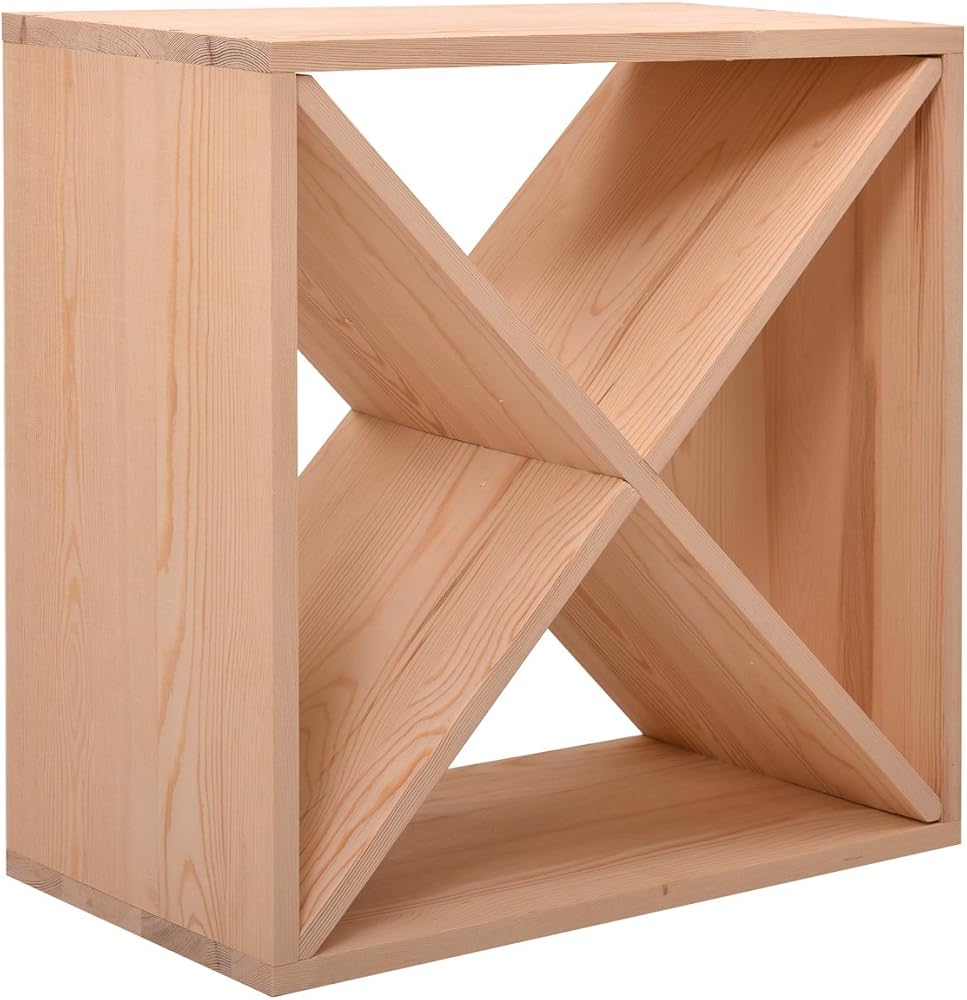
Compact wooden X-cube and lattice boxes fit neatly beneath upper kitchen cabinets or inside open shelving cubbies, keeping a week’s worth of dinner bottles within arm’s reach.
Why it stands out: A simple outer box divided by two intersecting diagonal boards creates four triangular compartments that hold twelve to sixteen bottles in a tidy footprint. Reviewers at leading wine publications frequently recommend cube and grid configurations because their low center of gravity resists tipping on smooth stone countertops, and the flat top surface doubles as a serving tray for glassware or a corkscrew. Building one requires only straight 45-degree miter cuts, wood glue, and finish nails.
Keep in mind: Kitchen counters sit near ovens, dishwashers, and sunny windows, so countertop racks should only hold bottles you plan to open within a few weeks rather than age long-term. Best for: Home cooks and casual drinkers looking for an approachable weekend woodworking project with clean geometric lines.
- Capacity
- 24 bottles, 4 cubes
- Material
- Fir wood
- Size
- 19.7 x 10.2 x 19.7 in
- Finish
- Natural, paintable
A counter or pantry corner is the right home for this compact wooden cube. Its four compartments each hold six bottles, and the footprint is under 20 inches in every direction. Extra units can be stacked if the collection outgrows it. The sustainable fir has a natural finish that accepts paint, and the manual numbers every part for a straightforward build.
Pros & ConsView
- Four compartments store six bottles each
- Compact 19.7 inch cube fits counters
- Extra units stack for added capacity
- Requires assembly from a manual
- Natural wood needs painting to change color
Best for Renters and Budget Builders: Upcycled Crate and Pipe Honeycombs
Repurposed wooden wine crates and cut-to-length PVC or metal pipes offer zero-commitment horizontal storage that disassembles effortlessly when you move.
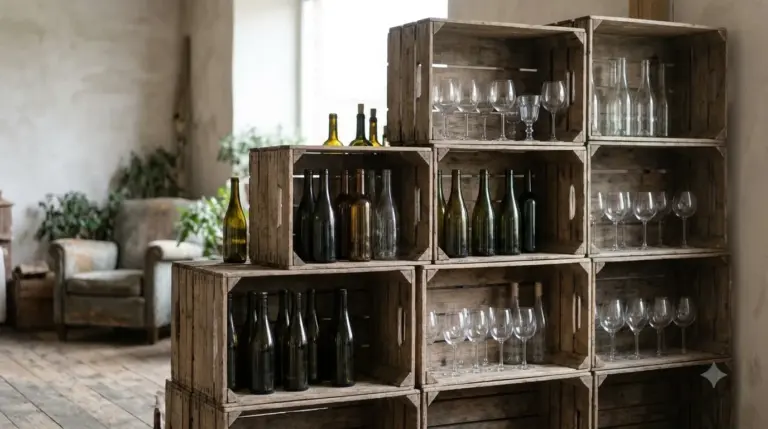
Why it stands out: Stacking sturdy wooden shipping crates on their sides and adding simple plywood X-dividers inside each box creates instant cubbies with built-in rustic character. Alternatively, slicing four-inch-diameter PVC pipe into twelve-inch sleeves and bonding them into a honeycomb pyramid produces lightweight, waterproof cradles sized specifically for standard 750ml bottles. Both approaches require minimal tools, cost a fraction of custom millwork, and tuck neatly inside a coat closet or sideboard.
Keep in mind: Stacked crates taller than two rows must be screwed together and tethered to a wall so they cannot shift when you pull a bottle from a lower bin. Best for: Renters, students, and DIY newcomers seeking functional, reconfigurable Racks & Storage in a single afternoon.

- Capacity
- 16 bottles, 4 tiers
- Material
- Natural bamboo
- Size
- 17 x 9.2 x 16.4 in
- Assembly
- Tools included, ~15 min
Renters and budget builders get a simple option here, with no wall holes needed. Made from natural bamboo, this four-tier rack holds 16 bottles on a counter or pantry shelf. Tools come enclosed, and putting it together takes roughly 15 minutes. The polished finish suits a retro or modern kitchen, and the small footprint makes it easy to move when you relocate.
Pros & ConsView
- Sits on a counter, no wall drilling
- Natural bamboo with a polished finish
- Tools are enclosed for assembly
- Holds only 16 bottles
- Assembly takes about 15 minutes
How to Choose
Before buying lumber or ordering hardware, measure your exact installation spot and account for standard bottle dimensions. Most 750ml Bordeaux bottles measure roughly three inches in diameter and twelve inches long, whereas wider Burgundy, Pinot Noir, and sparkling bottles require at least three-and-a-half inches of center-to-center spacing so labels do not tear when bottles slide in and out.
Material selection matters just as much as spacing. Softwoods like construction-grade pine are inexpensive and easy to cut, though unfinished pine can dent under heavy glass and may warp in humid basements. Rot-resistant hardwoods such as redwood, Spanish cedar, and mahogany handle ambient moisture gracefully without off-gassing strong odors that penetrate natural corks. If you plan to stain or paint your project, allow the finish to cure completely for several days so volatile fumes dissipate before loading your bottles.
Placement ultimately determines how well your wine ages inside the rack. According to storage guidelines published by Wine Folly, wine stays freshest in dark, vibration-free environments kept between 55 and 59 degrees Fahrenheit with 55 to 75 percent relative humidity, because warm rooms accelerate aging dramatically. Keep your finished rack away from refrigerators, laundry appliances, heating vents, and direct sunlight.
Tip: Leave a half-inch gap between the back of your wine rack and the wall so air can circulate behind the bottles, preventing trapped moisture and label mildew.
Frequently Asked Questions
Do DIY wine racks need to store bottles completely flat or at a slight tilt?
Any horizontal or gently angled position that keeps the wine in continuous contact with the inside of the cork works well. Keeping the cork wet prevents it from drying out, shrinking, and letting oxygen seep into the bottle, whereas screw-cap bottles can safely rest upright or sideways.
What is the best wood to use when building a wine rack from scratch?
Redwood, mahogany, and kiln-dried cedar are top choices because they resist moisture, splintering, and warping without requiring heavy chemical sealants. Poplar and oak also work nicely for indoor dining room racks if you want a smooth, paintable or stainable furniture finish.
How deep should a homemade wine rack be?
A depth of 12 to 13.5 inches supports a standard 750ml bottle safely so the body rests on the rails while only the neck protrudes slightly for easy gripping. Deeper racks make reaching back-row bottles awkward, while shallower shelves risk tipping heavier Champagne bottles forward.
How much weight does a full wine rack need to support?
Each filled 750ml glass bottle weighs approximately 2.7 to 3.3 pounds, meaning a modest 36-bottle rack carries over 100 pounds of static load. Always use wood glue alongside mechanical fasteners like wood screws or brad nails, and anchor tall floor units directly into wall studs.
Choosing the right DIY wine rack comes down to matching the build style to the coolest, darkest spot in your home and leaving room for your collection to expand. Once you lock in proper bottle spacing and solid wall anchoring, a well-built rack keeps every vintage organized, accessible, and ready to pour.
More in Racks & Storage
 Best Wine Barrel Racks for Distinctive Bottle StorageUpdated Nov 20, 2026
 Best Wine Storage Tower: Sizing, Protection and Room LayoutUpdated Nov 18, 2026
 Best Pyramid Wine Rack: Materials, Sizes and Where It FitsUpdated Nov 18, 2026
 Best Kitchen Cabinet Wine Rack Insert for Built-In Bottle StorageUpdated Nov 18, 2026
 Best 16 Bottle Wine Rack Options for Kitchens, Bars and CellarsUpdated Nov 18, 2026
 Best 48 Bottle Wine Rack Options for Cellars, Kitchens, and Tight SpacesUpdated Nov 18, 2026