

We may earn a commission when you buy through links on this page, at no extra cost to you. Learn more.
The best wine racks store bottles horizontally so natural corks stay moist, while matching your available floor, wall, or cabinet footprint. Compact countertop and under-cabinet designs work best for everyday six-to-twelve-bottle rotations in small kitchens, whereas stackable modular units grow effortlessly alongside an expanding collection. For larger inventories or display-worthy dining rooms, freestanding floor towers and wall-mounted label-forward systems maximize capacity without cluttering walkways.
Leaving cork-finished bottles upright on a pantry shelf allows the stopper to dry out, shrink, and let damaging oxygen seep into the wine. Properly built wine racks solve that problem immediately while keeping labels visible and bottle shapes supported. Because every home layout and bottle count demands a different footprint, choosing the right structural style matters far more than chasing decorative trends.
Quick Comparison
Each rack style balances capacity, installation effort, and bottle accessibility differently depending on where you plan to keep your wine.
| Rack Type | Typical Capacity | Installation | Best Location | Key Advantage |
|---|---|---|---|---|
| Countertop Racks | 6 to 18 bottles | None (ready out of the box) | Kitchen counters, sideboards, bar carts | Zero hardware required and effortless to relocate |
| Stackable Modular Racks | 24 to 100+ bottles | Tool-free interlocking pins or dowels | Closets, pantries, basements | Expands vertically or horizontally as your collection grows |
| Wall-Mounted Racks | 6 to 36+ bottles | Stud anchors and wall screws | Dining rooms, narrow hallways, kitchen walls | Frees up floor space and displays labels outward |
| Freestanding Floor Racks | 36 to 120+ bottles | Basic assembly plus anti-tip wall strap | Basements, dining corners, dedicated wine rooms | High-density storage in a single unified frame |
| Cabinet and Under-Shelf Racks | 4 to 12 bottles | Slide-on brackets or light wood screws | Upper kitchen cabinets, pantry shelves, hutches | Uses dead vertical air space above existing shelves |
Best for Small Kitchens and Everyday Rotation: Countertop Wine Racks
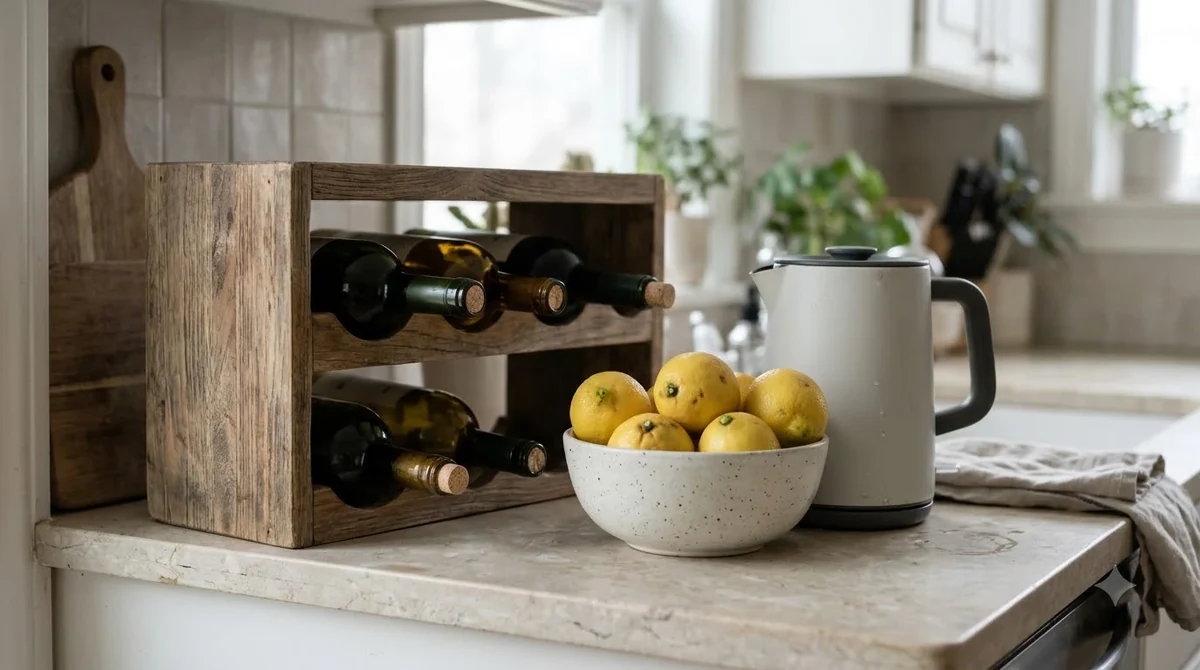
Countertop wine racks are compact, self-supporting frames built to hold between six and eighteen bottles on a kitchen counter, buffet, or bar cart. They give casual drinkers immediate grab-and-go access without requiring tools, wall anchors, or dedicated floor space.
Why it stands out: Ready to use straight out of the box, a countertop unit keeps your current weeknight lineup organized and tilted slightly downward or completely flat so corks remain saturated. Open wire, geometric metal, and slatted hardwood frames allow air to circulate freely around the glass while keeping individual bottles from clinking against one another. Because the footprint rarely exceeds the width of a standard cutting board, you can slide the entire rack out of the way when prepping dinner or hosting guests.
Keep in mind and best for: Placement is critical with any kitchen-based storage, as reviewers at Wine Enthusiast warn against setting racks next to heat-generating appliances like ovens, stoves, dishwashers, or refrigerator exhaust vents. Direct sunlight through a kitchen window will also accelerate premature aging. Choose a countertop style if you drink through a single case every few weeks, rent an apartment where drilling holes is off-limits, or want a neat staging station near your dining table.

- Capacity
- 14 bottles
- Material
- Iron, powder coated
- Size
- 17.2 x 11.6 x 5.5 in
- Assembly
- None required
A geometric black iron rack that doubles as a statement piece on a counter or inside a cabinet. It holds 14 bottles, with 11 slots for standard bottles and 3 on top for oversized ones. The powder-coated finish is rust resistant, and no assembly is required. At 17.2 by 11.6 by 5.5 inches, it stays modest in size.
Pros & ConsView
- Holds 14 bottles, three of them oversized
- Rust-resistant powder-coated finish
- No assembly required
- Open rack with no locking feature
- Countertop size, not for a large cellar
Best for Growing Collections: Stackable Modular Wine Racks
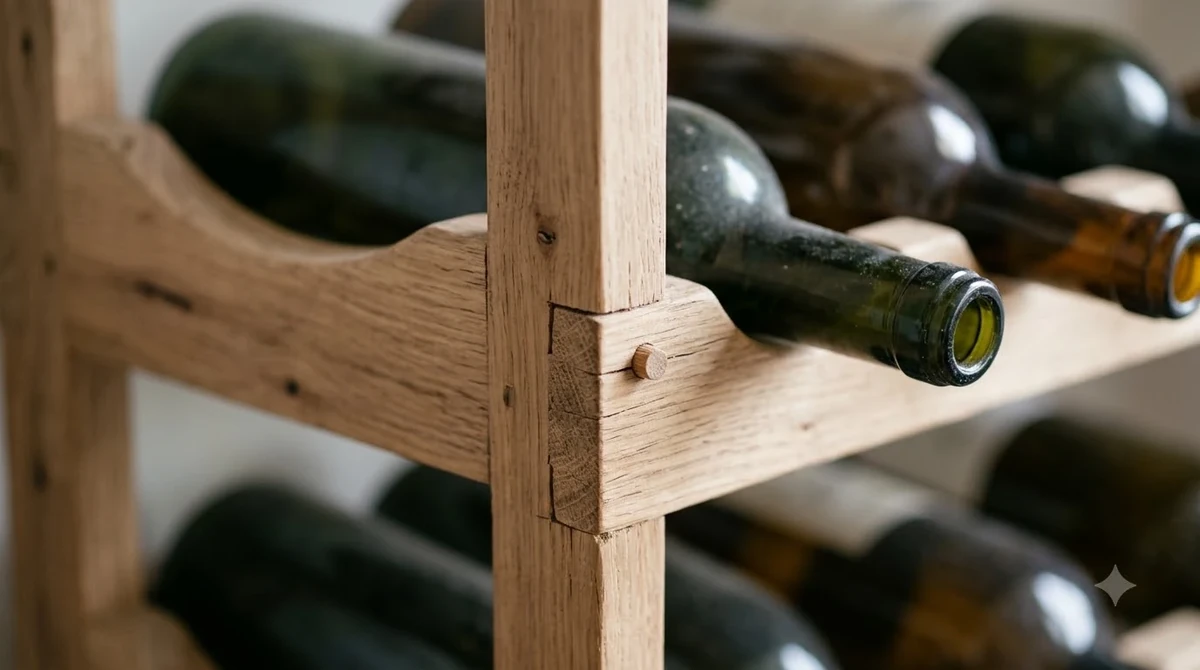
Stackable modular wine racks consist of interlocking wood or heavy-gauge metal tiers that snap or dowel together without permanent joinery. You can start with a low two-tier base and add extra columns or vertical rows whenever new shipments arrive.
Why it stands out: Buying storage for fifty bottles when you only own twelve wastes space, yet outgrowing a fixed frame forces you to buy an entirely new unit. Modular systems eliminate that guesswork by letting you configure the grid to fit awkward closet alcoves, stair landings, or basement walls. Many hardwood modular kits feature chamfered rails that cradle standard 750-milliliter Bordeaux bottles alongside wider Burgundy and Champagne shoulders without pinching labels.
Keep in mind and best for: Once a modular grid rises above waist height, lateral wobble becomes a real hazard unless you secure the upper tier to a wall stud. Always check the slot diameter before purchasing additional tiers, since narrow slots designed strictly for slim Riesling or Bordeaux glass may jam on wider sparkling bottles. This category is ideal for collectors who steadily buy by the case—if you are planning capacity around the twelve bottles in a case of wine, modular tiers make it simple to add exact twelve-bottle increments over time.

- Capacity
- 72 bottles, 8 tiers
- Material
- Bamboo
- Size
- 33.5 x 9.8 x 40.4 in
- Assembly
- No tools, about 5 minutes
Collectors adding bottles every few months can build this shelf out tier by tier. Eight stackable levels hold nine bottles each, and side plates close the gaps for a steadier frame. The bamboo is unfinished, which leaves room to stain, paint, or varnish it to suit a room. Setup takes about five minutes with no tools, and the openings fit standard 750ml bottles.
Pros & ConsView
- Eight modular tiers hold 72 bottles
- Side plates add support and stability
- Assembles in about five minutes, no tools
- Floor-standing frame is tall at 40 inches
- Bottles must be removed before repositioning
Best for Dining Rooms and Visual Display: Wall-Mounted Wine Racks
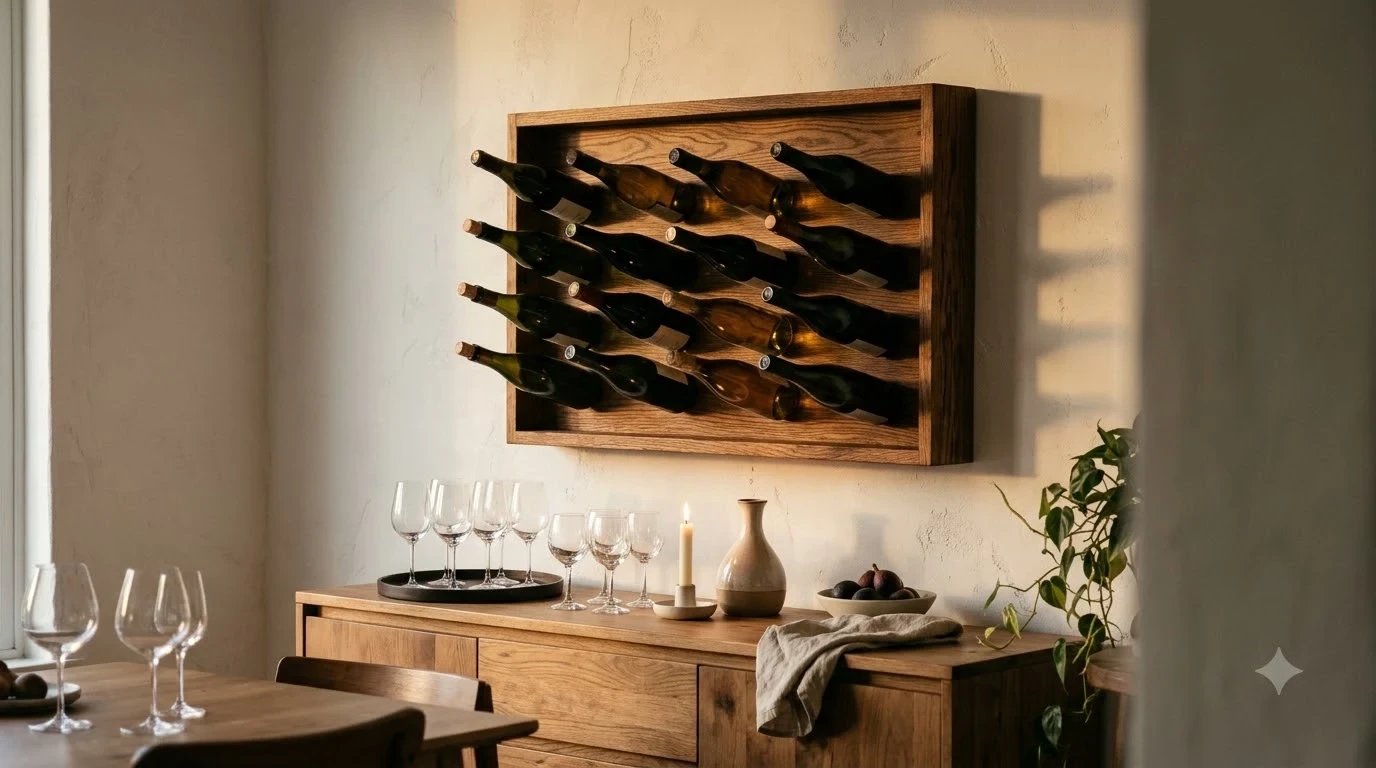
Wall-mounted wine racks bolt directly into wall studs or heavy-duty masonry anchors, suspending bottles horizontally in either cork-forward or label-forward orientations. They turn blank dining room or hallway walls into functional architectural displays while leaving every inch of floor space clear.
Why it stands out: Label-forward metal pegs and cradle rails let you read every vintage at a glance without pulling bottles out and disturbing sediment. According to experts interviewed by Wine Enthusiast, open metal racks also encourage superior airflow around bottles compared to enclosed cabinetry. Because wall units mount above floor level, they keep fragile glass safely out of reach of toddlers, pets, and vacuum cleaners.
Keep in mind and best for: A full 750-milliliter bottle weighs roughly two-and-a-half to three pounds, meaning a twenty-four-bottle wall rack puts more than seventy pounds of dead weight on your drywall. Skipping studs or relying on light plastic drywall plugs invites catastrophic failure, so precise stud-finder alignment is non-negotiable. Wall-mounted racks are best for homeowners with narrow dining areas, open-concept living spaces, or basement tasting walls where vertical real estate is far more abundant than floor area.

- Capacity
- 36 bottles
- Units
- 12 modules, 3 bottles each
- Material
- Black metal
- Mounting
- Screw-mounted
Growing collections need a layout that can keep expanding, and this grid is built that way. Twelve modules each hold three bottles, so you can run them in a block or spread them out as stock increases. Reinforced welding carries full bottles, and the vertical design keeps labels and corks visible. It fits kitchens, bars, and wine rooms, and it is screw-mounted for stability.
Pros & ConsView
- Adds up to 36 bottles on one wall
- Modules can be rearranged as stock grows
- Reinforced welding supports full bottles
- Many modules take time to position
- Screw mounting means permanent wall holes
Best for High-Capacity Cellaring: Freestanding Floor Wine Racks
Freestanding floor wine racks are tall, stationary towers or wide grid-and-bin cabinets capable of housing anywhere from three dozen to well over a hundred bottles in one footprint. Built from thick hardwood such as mahogany or redwood, or reinforced steel frames, they serve as the backbone of dedicated pantries and home cellars.
Why it stands out: When a collection passes the forty-bottle mark, consolidated floor units offer the highest storage density per square foot. Combination bin-and-column designs pair individual bottle cubbies at eye level with open diamond or square bins near the bottom for bulk stacking identical vintages. That layout makes it effortless to follow the organization advice highlighted by Wine Folly, keeping everyday “drink now” bottles at comfortable chest height while tucking age-worthy reds onto lower or higher shelves away from casual reach.
Keep in mind and best for: Heavy wood towers require flat, level flooring—plush carpet can cause a tall rack to lean forward as weight increases on the upper shelves. Even on hardwood or concrete, anchoring the top frame to the wall with an anti-tip bracket protects against accidental bumps. Choose a freestanding floor rack when you have a cool basement corner, walk-in pantry, or spare closet dedicated to long-term bottle organization.

- Capacity
- 24 bottles
- Material
- FSC-certified bamboo
- Layout
- 6 tiers, 4 bottles each
- Size
- 15.9"W x 9.44"D x 32.28"H
This tall bamboo console gives a hosting setup real presence without taking much floor. Six tiers hold four bottles each, tilted slightly so corks stay moist, and the FSC-certified bamboo is described as moisture-proof and sturdy. Clear instructions and tools are included, with a setup time of about 15 minutes. At roughly 32 inches tall, it stands upright without taking much floor space.
Pros & ConsView
- Tilted tiers keep corks moist
- FSC-certified bamboo build
- Tools and instructions are included
- Needs about 32 inches of vertical space
- Bamboo, not hardwood, if you want true wood
Best for Tight Pantry and Cupboard Spaces: Cabinet and Under-Shelf Wine Racks
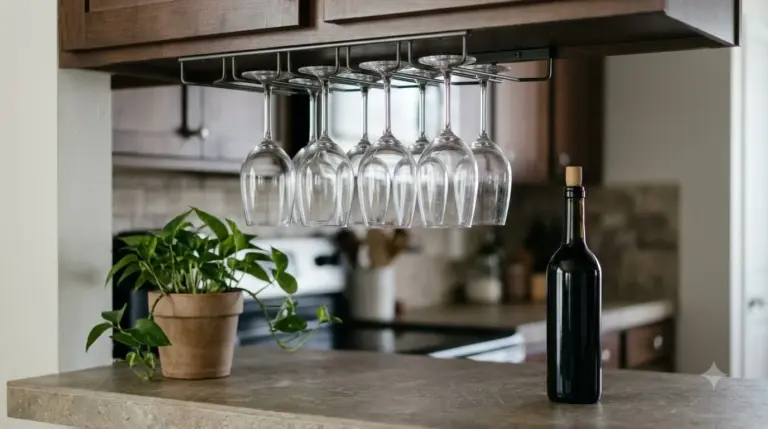
Cabinet and under-shelf wine racks attach beneath existing wooden shelves or sit flush inside kitchen cupboards and credenzas to hold four to twelve bottles. By suspending bottles in the unused vertical gap above plates or glassware, they create wine storage without claiming counter or floor territory.
Why it stands out: Most upper kitchen cabinets and pantry shelves leave several inches of wasted headroom above stacked dishes or dry goods. Slide-on wire cradles hook directly over a standard three-quarter-inch shelf board with zero screws, while screw-in wood or metal rails convert a standard hutch into a dedicated wine cubby. Keeping bottles tucked behind closed cabinet doors also shields labels and wine from ambient kitchen light and ultraviolet rays.
Keep in mind and best for: Measure both the interior depth of your cupboard and the clearance below the shelf before ordering, because a standard wine bottle measures roughly twelve inches long and will prevent cabinet doors from closing if the shelf is too shallow. Avoid mounting under-shelf cradles inside cabinets located directly above a stove or built-in microwave, where rising heat spikes daily temperatures. These space-savers suit apartment dwellers, small-kitchen cooks, and anyone retrofitting an existing sideboard or pantry.

- Material
- Iron, matte black finish
- Capacity
- 3 to 4 glasses per rack
- Pack
- 2 racks
- Size
- 10.2" x 4" each
Two short racks instead of one long one, which lets you split glasses between separate cabinets or keep a small bar corner tidy. Each rack holds three to four glasses with a base from 0.9 to 3.8 inches and mounts under a shelf with the supplied screws. The painted iron resists rust, and the slim footprint takes little cabinet room.
Pros & ConsView
- Two racks can go in different cabinets
- Fits glass bases from 0.9 to 3.8 inches
- Mounting hardware included
- Each rack holds only three to four glasses
- Painted iron instead of stainless steel
How to Choose
Before selecting a frame style, match the rack’s physical specifications to the bottles you actually buy and the room where they will live:
- Slot diameter and bottle shape: Standard Bordeaux bottles measure under three inches wide, whereas Pinot Noir, Chardonnay, and sparkling wine bottles often reach three-and-a-half inches across. Look for cubbies or cradles with at least a 3.5-inch opening if you drink sparkling wines or wide-shouldered reds.
- Label-forward vs. cork-forward orientation: Cork-forward racks pack more bottles into a narrower width, while label-forward cradles let you identify bottles immediately without sliding them out and scuffing paper labels.
- Material durability: Unfinished or properly sealed hardwoods like mahogany, redwood, and bamboo resist warping in humid basements. Powder-coated steel and wrought iron deliver slim profiles and high weight ratings without sagging under heavy loads.
- Room environment: A rack organizes bottles, but it does not regulate temperature. Place your unit in the coolest, darkest spot available—away from sunlit windows, exterior walls, and kitchen heat sources.
Tip: If you plan to cellar fine wines for several years in a home that regularly warms above 70°F, pair passive racking for short-term bottles with temperature-controlled wine fridges for long-term aging.
Frequently Asked Questions
Do all wine bottles need to be stored horizontally on a wine rack?
Bottles sealed with natural or agglomerated corks should rest horizontally so the liquid stays in continuous contact with the stopper. Keeping the cork moist prevents it from drying out, shrinking, and letting oxygen spoil the wine. Bottles closed with screw caps or glass stoppers do not rely on liquid contact to maintain their seal and can safely stand upright if needed.
What size bottles fit in standard wine racks?
Most standard racks are engineered around the classic 750-milliliter Bordeaux bottle—the familiar twenty-five ounces in a bottle of wine found on everyday dinner tables. Wider 750-milliliter Burgundy, Rhône, and Champagne bottles frequently require slots at least 3.5 inches wide to avoid jamming or tearing labels. Large-format magnums (1.5 liters) typically need dedicated top shelves, wide diamond bins, or adjustable cradles.
Which wood is best for a wine rack?
Mahogany, redwood, and cedar are top choices because they naturally resist moisture, warping, and fungal growth in cool, slightly humid storage areas. Bamboo and heavy oak also perform well in dry living spaces when properly sanded so rough edges do not scratch glass or tear paper labels. Avoid soft, untreated pine if the rack will sit in a damp basement where humidity fluctuates.
How much weight does a full wine rack need to support?
A full 750-milliliter bottle of wine weighs roughly 2.6 to 3 pounds depending on glass thickness, which means even a modest twenty-four-bottle rack must safely carry around sixty-five to seventy pounds. Larger one-hundred-bottle floor units easily exceed 275 pounds when fully loaded. Always check structural joints, place racks on level flooring, and anchor tall or wall-mounted frames directly into wall studs.
Selecting the right wine storage comes down to matching the frame’s capacity and footprint to the quietest, coolest spot in your home. Start with an honest count of how many bottles you keep on hand—plus a little room for gifts or seasonal shipments—and choose a sturdy horizontal design that makes grabbing tonight’s bottle effortless.
More in Racks & Storage
 Best Wine Barrel Racks for Distinctive Bottle StorageUpdated Nov 20, 2026
 Best Wine Storage Tower: Sizing, Protection and Room LayoutUpdated Nov 18, 2026
 Best Pyramid Wine Rack: Materials, Sizes and Where It FitsUpdated Nov 18, 2026
 Best Kitchen Cabinet Wine Rack Insert for Built-In Bottle StorageUpdated Nov 18, 2026
 Best 16 Bottle Wine Rack Options for Kitchens, Bars and CellarsUpdated Nov 18, 2026
 Best 48 Bottle Wine Rack Options for Cellars, Kitchens, and Tight SpacesUpdated Nov 18, 2026