


We may earn a commission when you buy through links on this page, at no extra cost to you. Learn more.
The best countertop wine rack for most kitchens is a low-profile horizontal wood or powder-coated metal cradle holding 6 to 12 bottles, keeping natural corks moist while tucking cleanly beneath upper cabinets. If your counter runs deep but narrow, vertical stackable cubes or slim geometric wire stands maximize height without eating into prep space. Households that entertain frequently benefit from combination tabletop racks with built-in stemware hooks, while collectors with wider Burgundy or Champagne bottles need wide-slot modular grids.
Keeping a week or two of dinner bottles within arm’s reach saves constant trips to a basement closet or pantry, yet leaving bottles upright on open granite invites dry corks, accidental knocks, and clutter. Choosing the right style comes down to matching your available counter clearance, typical bottle shapes, and daily pouring habits to a frame that stays rock-solid when half empty.
Quick Comparison
Each countertop rack style solves a distinct spatial or entertaining bottleneck, trading off bottle capacity against footprint and bottle-shape flexibility.
| Rack Style | Typical Capacity | Best Counter Spot | Fits Wide Bottles | Footprint Profile |
|---|---|---|---|---|
| Low-Profile Horizontal Cradle | 6 to 12 bottles | Under upper cabinets | Moderate (check slot width) | Wide, low height |
| Slim Geometric Wire Stand | 5 to 9 bottles | Narrow galley counters | Limited to standard Bordeaux | Compact, vertical |
| Stackable Modular Wood Grid | 8 to 24 bottles | Deep islands or sideboards | Yes, with wider lattice openings | Expandable cube |
| Tabletop Rack with Stemware Holder | 4 to 8 bottles + 4 to 6 glasses | Home bars or dining buffets | Moderate | Tall, all-in-one |
| Sculptural Single-Row Wave Rack | 3 to 6 bottles | Open display ledges | Yes, open cradles fit magnums/sparkling | Shallow, linear |
Best for Tight Under-Cabinet Clearance: Low-Profile Horizontal Wood Cradles
A two-tier wooden cradle sits under 10 inches tall, sliding effortlessly beneath standard 18-inch upper kitchen cabinets while keeping 6 to 12 bottles tilted slightly downward. Warm acacia, bamboo, or walnut slats cushion glass against stone countertops without scratching.
Why it stands out: Horizontal storage is not just an aesthetic choice for bottles sealed with natural bark. As enology specialists at Wine Folly explain, natural cork regulates tiny amounts of oxygen transfer and relies on contact with the liquid inside to stay elastic and sealed. Low wooden cradles hold bottles dead-still on their sides, preventing vibrations from disturbing sediment while fitting right beneath upper cabinetry where taller frames cannot go.
Keep in mind and best for: Many rigid scalloped wood slats are milled specifically for 750 mL Bordeaux cylinders, meaning wider Pinot Noir, Rhône, or sparkling bottles may wedge tightly or sit crooked on the top row. Check that the cradle has silicone feet so it does not slide across polished quartz when you pull a bottle out one-handed. This style is best for everyday cooks who want a quiet, stable, furniture-grade rack tucked against the backsplash.

- Capacity
- 4 bottles per rack
- Stacking
- Up to 3 tiers
- Material
- Steel
- Assembly
- None required
Modular storage for collections that grow slowly. Each unit holds four bottles, and up to three tiers can stack for expanded capacity. Wave-shaped recessed holders stop bottles from rolling, tipping or slipping, and the smooth steel build arrives ready to use with no assembly. It sits on a tabletop and wipes clean with a dry cloth.
Pros & ConsView
- Stacks up to three tiers
- Wave holders prevent rolling and slipping
- No assembly required
- Each unit holds only four bottles
- Tabletop design, not for floor storage
Best for Narrow Galley Counters: Slim Geometric Wire Stands
Honeycomb and triangle-truss metal racks build upward rather than outward, footprinting barely the width of two dinner plates while holding 5 to 9 bottles. Powder-coated steel or iron frames add modern visual lightness so a small kitchen never feels boxed in.
Why it stands out: When counter depth is scarce, vertical geometry reclaims unused airspace without requiring wall anchors or hardware—a major perk for renters who cannot drill into tile backsplashes for a wall mounted wine rack. Welded steel intersections distribute weight evenly down to the counter, keeping the frame rigid even when you load only the top slots first. Open wire construction also lets ambient air circulate freely around every bottle.
Keep in mind and best for: Geometric metal loops usually have fixed internal diameters around 3.25 to 3.5 inches, which grips standard Cabernet and Sauvignon Blanc bottles securely but leaves almost no wiggle room for bulbous Champagne or Alsace flutes. Lighter wire frames can also tip slightly if bumped from the side when nearly empty. Pick this design for compact apartments, coffee-bar corners, and minimalist kitchens stocked mostly with standard 750 mL bottles.

- Capacity
- 14 bottles
- Material
- Iron, powder coated
- Size
- 17.2 x 11.6 x 5.5 in
- Assembly
- None required
A geometric black iron rack that doubles as a statement piece on a counter or inside a cabinet. It holds 14 bottles, with 11 slots for standard bottles and 3 on top for oversized ones. The powder-coated finish is rust resistant, and no assembly is required. At 17.2 by 11.6 by 5.5 inches, it stays modest in size.
Pros & ConsView
- Holds 14 bottles, three of them oversized
- Rust-resistant powder-coated finish
- No assembly required
- Open rack with no locking feature
- Countertop size, not for a large cellar
Best for Growing Collections and Wide Bottles: Stackable Modular Wood Grids
Interlocking wooden cube and lattice systems let you start with an eight-bottle countertop footprint and snap on extra tiers as your weekend rotation grows. Generous square or diamond openings accommodate chunky Burgundy, Champagne, and even heavier-shouldered bottles without scraping labels.
Why it stands out: Industry buyers and sommeliers interviewed by Wine Enthusiast emphasize choosing racks sized to accept wider Champagne-format 750 mL bottles rather than narrow Bordeaux-only slots. Modular wood grids solve that sizing headache while offering expansion capacity that approaches how many bottles in a case of wine without forcing you to buy a full floor cabinet upfront. Unfinished or lightly oiled hardwood also resists warping in humid kitchens.
Keep in mind and best for: Stacked modular frames grow tall quickly—often exceeding 16 inches once you add a third row—which can crowd low upper cabinets or block under-cabinet task lighting. Assemble the dowels or notched joints firmly on a flat surface so the structure stays square under full weight. This option fits buyers with deep kitchen islands, butler’s pantries, or wide sideboards who drink plenty of Pinot Noir, Chardonnay, and sparkling wine.

- Capacity
- 12 bottles
- Material
- Ash wood, natural
- Design
- Modular, stackable
- Weight
- 7 lb
Modular and stackable, this ash wood rack grows with a collection, and its interlocking units can be shaped into different arrangements for a cabinet or counter. It holds 12 bottles, weighs 7 pounds and is crafted in Vermont from heavy-duty hardwood. The natural finish suits kitchen corners, bars and home tasting rooms, and the units can be reconfigured whenever your storage needs change over time.
Pros & ConsView
- Interlocking units expand to fit your space
- Heavy-duty ash hardwood construction
- Holds 12 bottles, made in Vermont
- Heavier at 7 pounds than metal racks
- Interlocking pieces take planning to arrange
Best for Home Bars and Entertaining: Tabletop Racks with Stemware Holders
Combination countertop racks pair a 4- to 8-bottle horizontal cradle at the base with overhead wire tracks that suspend four to six stemmed glasses upside down. Everything needed to pour a glass stays consolidated in a single footprint.
Why it stands out: Grouping bottles, stemware, and often a small top tray for a corkscrew and foil cutter turns an empty stretch of dining buffet or bar cart into a self-contained pouring station. Hanging sturdy everyday glasses by the foot keeps rims off dusty shelves and frees up valuable interior cabinet space for plates and bowls. Heavy weighted bases ensure the unit stays planted while you slide stems in and out of the tracks.
Keep in mind and best for: Overhead glass hooks push total height to 15 to 20 inches, making these racks too tall for most standard kitchen counters beneath wall cabinets. Ultra-delicate, hand-blown crystal stems with thin bases can also chip if knocked against metal tracks, so reserve hanging hooks for durable everyday glassware. Choose this style for open bar tops, dining room sideboards, and hosts who want grab-and-go entertaining convenience.
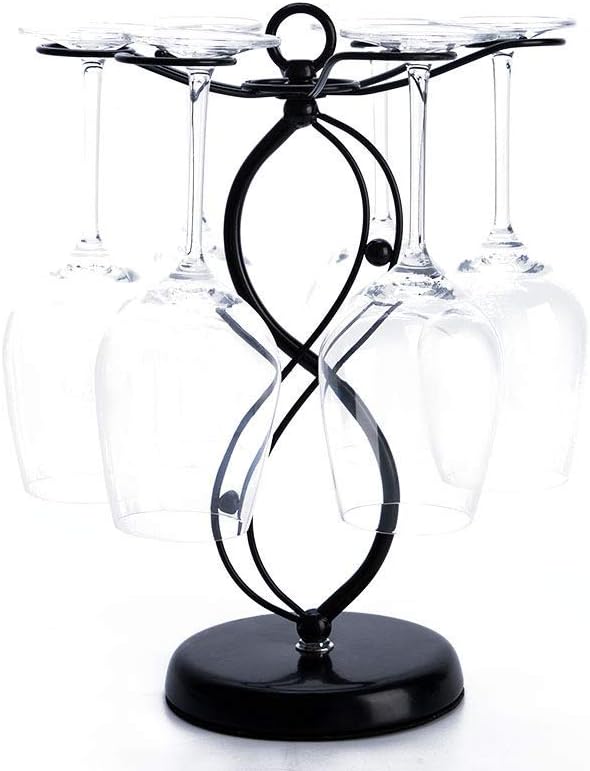
- Hooks
- 6
- Material
- Black painted metal
- Height
- 13.39 in
- Max Glass
- Up to 11 in stemware
This is a glass holder rather than a bottle rack, so it suits a home bar that needs stemware kept within reach. Six spiral hooks hold stemware up to 11 inches tall, from red and white wine glasses to champagne and cocktail glasses. The black painted metal frame has a glossy finish and stands freely on a counter.
Pros & ConsView
- Six hooks keep stemware within reach
- Fits glasses up to 11 inches tall
- Freestanding, no mounting needed
- Holds glasses only, not wine bottles
- Six-glass capacity is limited for big parties
Best for Small Rotations and Display: Sculptural Single-Row Wave Racks
Single-row wave, arched marble, or bent-wood racks hold just 3 to 6 bottles in shallow, open-top cradles that double as centerpiece decor. Because the upper half of every bottle remains exposed, oversized formats and decorative labels stay completely unobstructed.
Why it stands out: Open-top saddles eliminate slot-diameter restrictions entirely, cradling standard Bordeaux, wide-hipped Rhône bottles, and even 1.5-liter magnums with equal ease. Their slim depth—often under 7 inches—lets them sit comfortably along narrow pass-through ledges, kitchen peninsulas, or console tables where deeper racks overhang the edge. When you only keep a few bottles on hand for weekend dinners, a compact sculptural piece avoids the look of half-empty storage.
Keep in mind and best for: Because bottles rest in open grooves rather than enclosed sleeves, heavy bumps on a busy prep counter can dislodge a bottle if the grooves are too shallow. They also offer the lowest bottle-per-inch density of any countertop style. This category is best for casual wine drinkers who buy three or four bottles at a time and want an attractive, easy-access display piece.

- Capacity
- 8 bottles
- Material
- Acacia wood
- Max Diameter
- 3.15 in
- Layout
- 2 sizes, 3 wine styles
A good display piece for a small rotation of bottles, this acacia wood rack doubles as a water bottle organizer. It can be arranged three ways for wine and adjusted to two sizes for taller or shorter bottles, and it sits on a counter or in a cabinet. Bottles must stay under 3.15 inches in diameter, so check wider ones first.
Pros & ConsView
- Two-in-one wine and water bottle rack
- Adjustable in two sizes, three wine layouts
- Natural acacia wood finish
- Bottle diameter limited to 3.15 inches
- Two tiers hold only eight bottles
How to Choose
Start by measuring the vertical clearance between your countertop and the bottom lip of your upper cabinets, plus any under-cabinet light bars. Standard kitchen counters sit 18 inches below upper cabinetry; aiming for a rack under 12 inches tall ensures you can pull bottles straight out from the top row without angling them awkwardly against wood trim.
Next, check slot geometry against what you actually drink. If your rotation leans toward Cabernet Sauvignon and Merlot, standard 3.4-inch openings work fine, whereas Pinot Noir, Champagne, and Oregon Chardonnay require openings at least 3.75 inches wide or open-saddle waves. Look for rubberized feet or felt pads on metal and stone frames so shifting bottles never scuffs granite, marble, or butcher block, and explore broader Racks & Storage setups if your collection regularly tops two cases.
Placement matters just as much as frame geometry. Keep your rack away from the oven, dishwasher steam vents, sunny windowsills, and the warm top of a refrigerator, since temperature swings and ultraviolet light flatten aromas fast even over a few weeks.
Tip: Before ordering any multi-tier rack, measure the tallest bottle in your fridge or pantry—usually a Riesling or Pinot Noir—and add two inches of clearance so necks do not jut into adjacent walkways or cabinet doors.
Frequently Asked Questions
Should wine bottles be stored horizontally on a countertop rack?
Yes, bottles sealed with natural cork should rest horizontally so wine stays in contact with the cork and keeps it from drying out and shrinking. Bottles with screw caps or synthetic stoppers can safely sit upright or tilted, though horizontal racks still save counter space and keep bottles from tipping.
How many bottles should a countertop wine rack hold?
A capacity of 6 to 12 bottles hits the sweet spot for most kitchens, holding one to two weeks of casual drinking without dominating prep space. If you regularly buy mixed cases or host large dinners, moving up to a freestanding floor wine rack keeps counters clear.
Is it safe to keep a wine rack on the kitchen counter near appliances?
A kitchen counter works well for short-term storage over a few weeks as long as the rack sits away from heat-generating appliances. Avoid placing racks beside ranges, toaster ovens, dishwashers, or direct window sunlight, because rapid warmth and UV rays dull fresh fruit flavors prematurely.
What material is best for a countertop wine rack?
Hardwoods like bamboo, acacia, and walnut absorb minor vibrations and will not scratch stone counters, making them ideal for everyday use. Powder-coated steel and iron offer slimmer profiles and higher weight-to-size rigidity, provided the base includes silicone or felt pads to protect your countertop finish.
The right countertop frame turns loose bottles beside the stove into an organized, low-maintenance rotation that protects corks and frees up prep space. Match your rack’s height to your cabinet clearance, verify slot width for your favorite bottle shapes, and tuck it into the coolest, shadiest corner of your kitchen.
More in Racks & Storage
 Best Wine Barrel Racks for Distinctive Bottle StorageUpdated Nov 20, 2026
 Best Wine Storage Tower: Sizing, Protection and Room LayoutUpdated Nov 18, 2026
 Best Pyramid Wine Rack: Materials, Sizes and Where It FitsUpdated Nov 18, 2026
 Best Kitchen Cabinet Wine Rack Insert for Built-In Bottle StorageUpdated Nov 18, 2026
 Best 16 Bottle Wine Rack Options for Kitchens, Bars and CellarsUpdated Nov 18, 2026
 Best 48 Bottle Wine Rack Options for Cellars, Kitchens, and Tight SpacesUpdated Nov 18, 2026