

We may earn a commission when you buy through links on this page, at no extra cost to you. Learn more.
White wine sugar content ranges from under 1 g/L in the driest styles to more than 45 g/L in sweet dessert wines. Most dry white wines hold only a few grams of residual sugar per liter, and the exact figure depends on how far the fermentation was allowed to run. The EU table wine definition calls a wine dry at up to 4 g/L of sugar, or up to 9 g/L when the acidity is high enough to balance the sweetness.
This guide explains what residual sugar means, how white wines are grouped by sweetness, and why two bottles of white wine can taste very different even when the grape is the same. It also covers how to judge sweetness when the label gives no number.
What residual sugar means in white wine
Residual sugar is the sugar left in a wine after fermentation stops. During fermentation, yeast converts grape sugars into alcohol and carbon dioxide. Winemakers can let that process finish completely, leaving very little sugar behind, or they can stop it early by chilling the wine, filtering out the yeast, or adding alcohol, which keeps more sugar in the bottle.
Sugar in wine is measured in grams per liter, abbreviated g/L. The Wikipedia summary of wine sweetness notes that the OIV definition of dry counts the glucose and fructose left in the wine, which are the two natural sugars present in grape juice. Because the figure is only a few grams in a dry wine, a single glass usually holds a small amount compared with a soft drink.
Sugar levels by white wine style
White wine sweetness is usually sorted into a few broad categories. Each one has a grams-per-liter range set by wine law in the EU and by the OIV, the international wine organization. The categories below use the EU table wine figures, which are the most widely quoted.
| Style | Residual sugar (g/L) | What it tastes like |
|---|---|---|
| Dry | Up to 4 g/L, or up to 9 g/L when balanced by acidity | Crisp, savory, little or no sweetness on the palate |
| Medium dry | Up to 12 g/L | Gently rounded, with a hint of fruit sweetness |
| Medium or semi-sweet | Up to 45 g/L | Clearly sweet, often balanced by bright acidity |
| Sweet | More than 45 g/L | Dessert style, rich and syrupy |
The range from dry to sweet is wide. A dry white wine at 4 g/L and a sweet white at 50 g/L differ by more than ten times in sugar, which is why the same grape can make wines that taste nothing alike.
Why dry white wines still contain some sugar
Almost no white wine is completely free of sugar. The Wikipedia page on sweetness notes that it is rare to find wines with less than 1 g/L, even among the driest styles. Trace sugar comes from grape juice that fermentation did not fully convert, and it is normal for a bone-dry white to carry a small amount.
Acidity plays a large role in how that sugar is perceived. A wine with high acidity can carry a few extra grams of sugar and still taste crisp, while a low-acid wine with the same sugar can taste soft or sweet. Sweetness is therefore a balance between sugar and acid rather than a single number.

How grape variety and winemaking affect sugar
Grape variety sets the starting point, but winemaking decides the final sugar. Most Chardonnay and Sauvignon Blanc are made in a dry style, meaning the fermentation is allowed to finish. Some Riesling, Moscato and Gewürztraminer producers stop fermentation early to keep more natural sweetness, and many sweet wines are made from grapes harvested late when their sugar is concentrated.
Oak, malolactic fermentation and lees contact change how sugar tastes without changing the number on a lab report. Buttery or creamy notes can make a dry Chardonnay seem fuller, and fruit-forward aromas can make a dry white seem slightly sweet. Tasting a wine alongside its style description helps separate these effects from true residual sugar.
Reading labels and tech sheets
Many bottles do not print grams of sugar on the label. Words such as dry, semi-sweet and sweet are not always tied to a fixed number, so the wording alone can be unreliable. Producer tech sheets, which are often posted on winery websites, sometimes list residual sugar in g/L, and these are the most direct source for a specific bottle.
When no figure is available, look at the producer’s description. Phrases such as “bone dry,” “crisp and dry” or “off-dry” usually indicate the style, and a note about dessert pairing signals a sweet wine. Retailers and wine guides also tend to describe sweetness on a scale, which gives a rough sense of where a bottle sits.
Importers and distributors sometimes publish fuller product sheets than the front label allows. These sheets may include alcohol percentage, residual sugar and the style of oak treatment. If a bottle does not state its sugar and the label wording is vague, comparing it with a similar wine from the same region and vintage can give a useful estimate, since producers in the same area often make wines within a similar range.
Sugar and food pairing
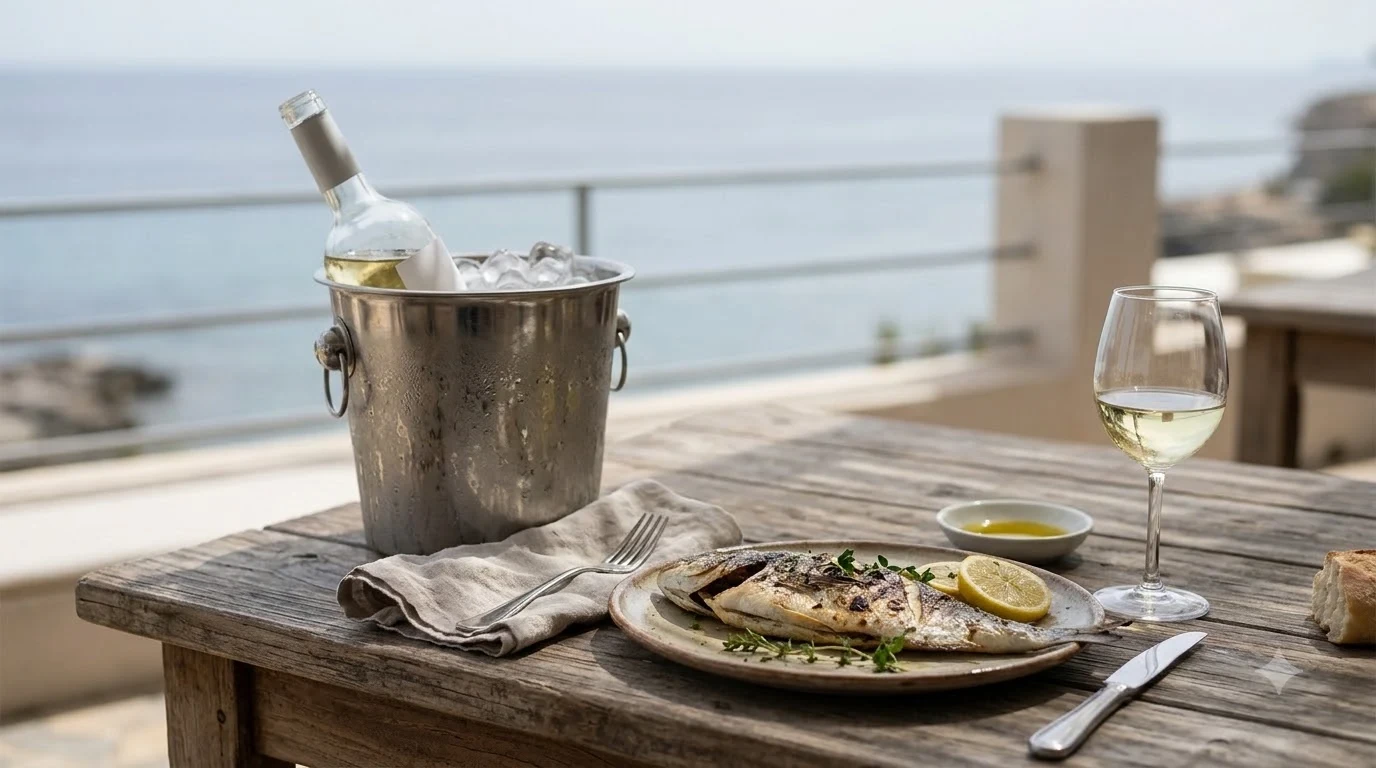
Sweetness changes how a white wine works with food. A dry white with lively acidity suits seafood, salads and light poultry, because its acid cuts through rich or fatty textures. A slightly sweet white, such as an off-dry Riesling, often works well with spicy dishes, since a touch of sugar softens heat. Sweet whites generally pair with desserts, fruit-based sweets or soft blue cheeses.
A common mistake is to serve a dry white with a sweet dessert. The wine will taste thin or sour by comparison. Matching the sweetness of the wine to the sweetness of the food avoids that effect.
The same principle applies to sweet food and salty food. A sweeter white can work well with salty cheeses, cured meats or pork with fruit glaze, because the sugar in the wine balances salt and rich fat. In each case the goal is a wine that is at least as sweet as the dish, so the wine does not seem sour or flat next to it.
Serving temperature also changes how sweetness reads. A well-chilled white tastes crisper and can seem drier, while a white served closer to cellar temperature shows more of its fruit and sugar. Many sommeliers suggest taking a dessert white out of the fridge a few minutes before pouring so its aromas and sweetness come through.
Tip: If a dry white tastes sweeter than expected, check the alcohol level and the acidity on the producer’s notes. High alcohol can make a wine feel rounder, and low acidity can make a small amount of sugar more noticeable.
Frequently Asked Questions
What is the sugar content of a typical dry white wine?
Under the EU table wine definition, a dry wine has up to 4 g/L of residual sugar, or up to 9 g/L when the acidity is high enough to balance it. Many dry whites sit near the low end of that range.
Does dry white wine have any sugar at all?
Yes, in most cases. It is rare for a white wine to fall below 1 g/L, so even very dry styles usually contain a trace amount of natural grape sugar.
Which white wines are usually the sweetest?
Dessert wines made from late-harvest or botrytized grapes sit in the sweet category, above 45 g/L. Some sweet Moscato and late-harvest Riesling styles fall in this range as well.
How can I tell how sweet a white wine is without a sugar number?
Read the producer’s tasting notes and check the style words on the label. Terms such as dry, off-dry and dessert give a clear signal, and the grape and region help too, since some regions favor drier styles.
White wine sugar content is easier to judge once you know the categories and the role of acidity. For more on how sugar works across other styles, see sauvignon blanc sugar content or pinot noir sugar content, and browse the full Wine by Type guide to compare grapes side by side.
More in Wine Types & Grapes
 Zinfandel Sugar Content: Dry Red vs. White Zinfandel GramsUpdated Nov 21, 2026
 Best Zinfandel Substitute Options for Sipping and CookingUpdated Nov 21, 2026
 Zweigelt Food Pairing: Best Dishes, Cheeses, and Serving TipsUpdated Nov 21, 2026
 Zinfandel Tannins Explained: How Structure Shapes Every BottleUpdated Nov 21, 2026
 Zinfandel Sweetness Level: Dry Red vs. Sweet White Zin ExplainedUpdated Nov 21, 2026
 Xinomavro Food Pairing: Best Dishes, Styles, and Serving TipsUpdated Nov 21, 2026