

We may earn a commission when you buy through links on this page, at no extra cost to you. Learn more.
The best 46 bottle dual zone wine cooler for most kitchens is a front-venting built-in compressor unit with adjustable beechwood shelves, allowing you to flush-mount the cabinet under a standard 24-inch counter while keeping reds and whites at separate serving temperatures. Collectors living in quiet open-concept spaces should prioritize low-decibel inverter compressor models rated around 38 to 40 dB, while households with eclectic bottle shapes need wide-spaced or removable racks to fit wider Burgundy and Champagne bottles without losing capacity.
A 46-bottle capacity hits a practical middle ground in home wine storage, holding nearly four full cases in a footprint that matches a standard 24-inch dishwasher cutout. Because dual-zone cabinets divide the interior into two independently regulated compartments—typically chilling whites and sparkling wines at 40 to 50 degrees F in the upper section while holding reds at 55 to 65 degrees F below—you can pull any bottle ready for the glass without waiting for it to warm up or chill down.
Quick Comparison
Different 46-bottle dual-zone designs trade off ventilation clearance, acoustic output, and shelf geometry depending on where and how you plan to store your collection.
| Cooler Type | Best Placement | Noise Level | Bottle Flexibility | Standout Advantage |
|---|---|---|---|---|
| Front-Venting Built-In Compressor | Undercounter kitchen cabinetry | Moderate (40–43 dB) | Standard Bordeaux focus | Zero side clearance required |
| Ultra-Quiet Inverter Compressor | Dining rooms and living areas | Very low (38–40 dB) | Moderate to high | Minimal vibration and steady temps |
| Wide-Spaced Mixed-Bottle Rack | Kitchens or home bars | Moderate (40–42 dB) | High (fits Pinot and Champagne) | Prevents label scraping on wide bottles |
| Freestanding Rear-Venting Cabinet | Open floor spaces and pantries | Moderate (41–44 dB) | Standard to moderate | Simple plug-and-play setup |
| Lockable UV-Shielded Display Unit | High-traffic entertaining spaces | Moderate (40–43 dB) | Standard Bordeaux focus | Security lock and tinted UV glass |
Best for Undercounter Kitchens: Front-Venting Built-In Compressor Coolers
Front-venting built-in coolers exhaust warm air through a slotted toe-kick grille at the base of the door, making them the only safe choice for tight undercounter cutouts.
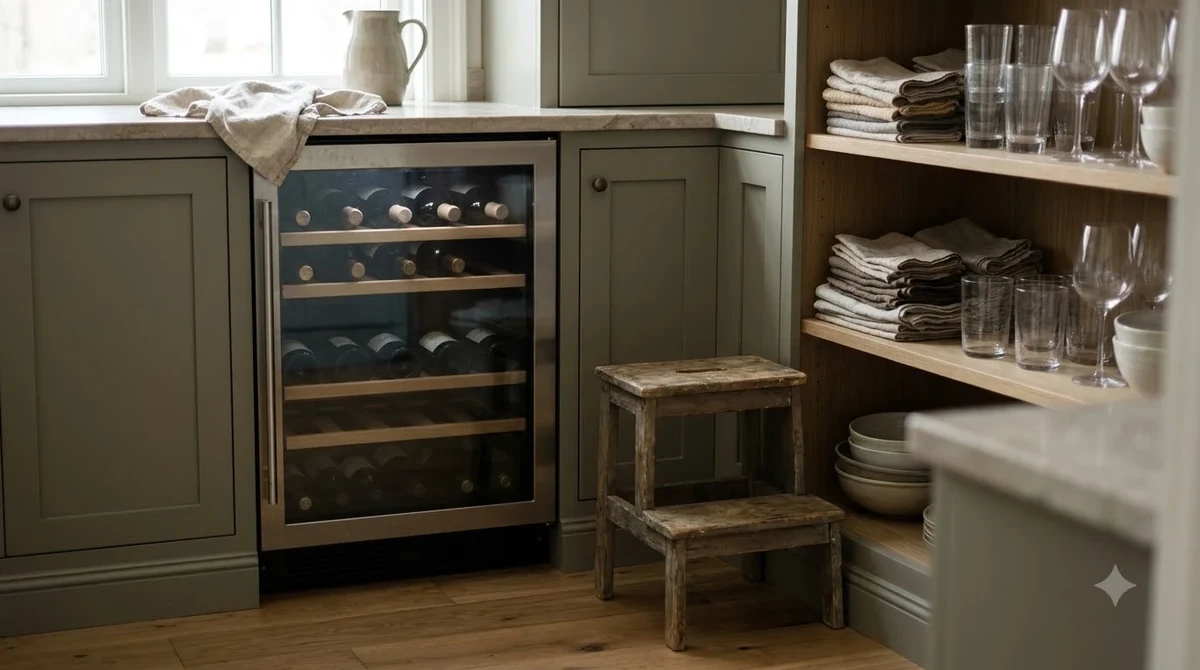
Why it stands out: As Wine Enthusiast notes in its wine refrigerator buying guide, built-in units are engineered specifically for enclosed cabinetry and require virtually no side or rear breathing room. Most 46-bottle built-in cabinets measure roughly 23.4 to 24 inches wide and 33 to 34 inches tall, sliding neatly into a standard base cabinet opening. Leveling legs allow you to raise the chassis flush against the underside of your countertop while keeping the front exhaust louvers completely unobstructed.
Keep in mind and best for: Never block the lower front intake with a custom baseboard, as restricting airflow overworks the compressor and can void manufacturer warranties. Also account for an extra 1.5 to 2 inches of depth if the cabinet uses a protruding bar handle rather than a recessed pocket grip. This style is best for homeowners remodeling a kitchen or wet bar who want a clean, integrated appliance line.
Best for Quiet Living Spaces: Low-Decibel Inverter Compressor Coolers
Variable-speed inverter compressors ramp cooling power up and down gradually rather than clicking on and off at full blast, cutting operating noise below 40 decibels.
Why it stands out: Traditional single-speed compressors produce an audible hum every time the thermostat cycles, which can become distracting in open-concept living rooms, dining areas, or home offices. Inverter models maintain tighter thermal stability—often within a single degree—while running at a whisper-quiet 38 to 40 dB and generating far less mechanical vibration. Dampened compressor mounts and wooden slats absorb micro-vibrations so sediment stays undisturbed at the bottom of aging bottles.
Keep in mind and best for: Even the quietest compressor coolers rely on internal circulation fans to distribute chilled air evenly across both compartments, so you will still hear a faint air-movement murmur in a dead-silent room. Make sure the floor beneath the cabinet is completely level before loading it with glass, since an uneven stance amplifies rattle. Choose this category if your wine fridge sits near a television, dining table, or reading nook.
Best for Pinot Noir and Sparkling Wine: Wide-Spaced Mixed-Bottle Coolers
Coolers outfitted with adjustable or wide-spaced telescoping shelves let you store sloped-shoulder Burgundy, Pinot Noir, and heavy Champagne bottles without forcing the racks.
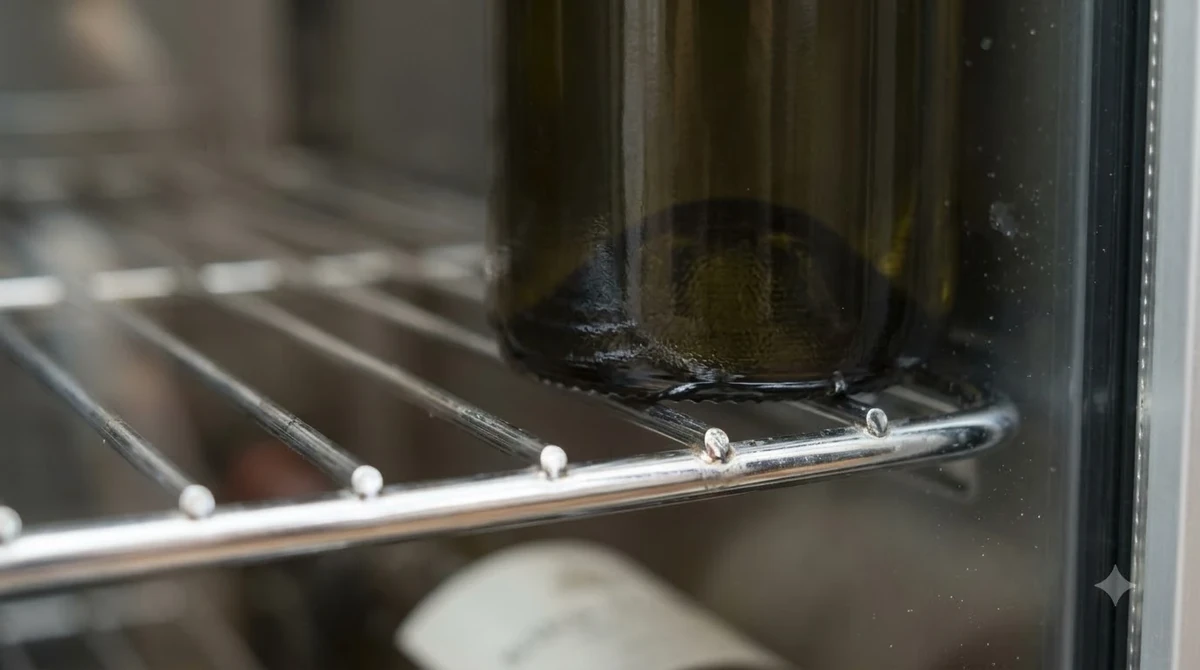
Why it stands out: Almost every manufacturer calculates a 46-bottle rating using narrow, straight-sided 750 mL Bordeaux bottles stacked neck-to-base. When you try to slide wider Pinot Noir, Rhône, or sparkling bottles onto tightly spaced standard racks, labels tear and shelves bind. Cabinets built with removable beechwood shelves or extra vertical clearance—around 3.75 to 4 inches between tiers—let you reconfigure the interior to fit wider diameters cleanly on full-extension ball-bearing glides.
Keep in mind and best for: Loading bulky Champagne or oversized Napa Cabernet bottles into any 46-bottle cabinet will reduce your true usable capacity to roughly 34 to 40 bottles. Check whether the upper chill zone reaches 40 degrees F or lower if you plan to keep sparkling wine ready to pop on short notice. This layout is best for drinkers whose collections lean toward Oregon Pinot Noir, Chardonnay, Prosecco, and Champagne.
Best for Open Floor Plans: Freestanding Rear-Venting Wine Coolers
Freestanding 46-bottle coolers dissipate heat through coils on the back and sides of the cabinet, offering straightforward installation anywhere near a grounded wall outlet.
Why it stands out: When you do not need to slide a unit under a counter, a freestanding design gives you clean finished side panels and simple plug-and-play placement in a pantry, basement, or dining room corner. Many freestanding models feature reversible door hinges, allowing you to swap the swing direction to match nearby walls or traffic flow. Because heat escapes freely from the exterior walls, the cooling system experiences less thermal stress during warm summer months as long as ambient room temperatures stay below 90 degrees F.
Keep in mind and best for: Freestanding units require 2 to 5 inches of open clearance on the sides, back, and top so warm air can escape; pushing one tight into a cabinet niche will overheat the compressor. They also lack the finished front toe-kick trim found on built-in models. Pick a freestanding unit if you rent your home, plan to move the cooler later, or have an open wall space waiting for dedicated wine storage.
Best for Bright Rooms and Entertaining: Lockable UV-Shielded Display Coolers
Models equipped with double- or triple-pane Low-E UV-blocking glass, soft interior LED lighting, and an integrated door lock protect bottles in sunlit rooms and busy entertaining spaces.
Why it stands out: Ultraviolet rays accelerate chemical reactions that flatten aromatics and prematurely age wine, making tinted or argon-filled insulated glass essential near windows. Interior white or blue LEDs illuminate bottle labels without generating the heat of incandescent bulbs, and a physical key lock at the bottom of the door keeps prized vintages secure during parties or in homes with curious kids.
Keep in mind and best for: Leaving display lighting switched on continuously can slightly nudge internal air temperatures upward, so look for cabinets with a theater-style auto-dimming feature or an independent light switch. Keep the cabinet out of direct afternoon sunbeams even with UV-coated glass. This style suits hosts who display their wine in a sunlit dining room, finished basement bar, or family gathering space.
How to Choose
Start by measuring your available space and comparing capacity against how fast you buy wine. If 46 bottles feels tight for a growing cellar, browse our guide organized By bottle count to compare larger cabinets. On the other hand, if you only keep a few cases on hand in a narrow 15-inch gap, a 32 bottle dual zone wine cooler may fit better, while casual drinkers who only chill a weekend lineup can get by with a countertop 4 bottle wine cooler.
Next, check the exact temperature range of each zone. As Wine Folly explains, long-term wine storage works best around 55 to 59 degrees F with 55 to 75 percent humidity, whereas serving temperatures differ sharply by style. Look for an upper zone capable of reaching 40 to 50 degrees F for crisp whites and sparkling wines, paired with a lower zone adjustable between 50 and 65 degrees F for reds. Also verify whether the physical divider between zones is fixed or if a slight temperature differential rule applies—many dual-zone units require the upper zone to be set at least 4 degrees F colder than the lower zone.
Finally, inspect shelf construction and door details. Unfinished beechwood or cedar slats resist high humidity without warping and cushion bottles better than bare wire racks, while telescopic glides let you read back-row labels without pulling heavy shelves halfway out of their tracks.
Tip: Before ordering, confirm which way the door hinges open and whether the cabinet includes a reversible hinge kit. Many sliding shelves cannot extend fully unless the glass door opens past 90 degrees, which becomes a major headache if the handle bumps against an adjacent wall or cabinet pull.
Frequently Asked Questions
How many cases of wine fit in a 46-bottle dual-zone cooler?
A 46-bottle cooler holds just under four standard 12-bottle cases, which equals roughly 230 five-ounce pours if you are calculating how many glasses in a bottle of wine for an upcoming dinner party. However, that count assumes uniform 750 mL Bordeaux bottles. Mixing in wider Pinot Noir, Syrah, or Champagne bottles typically brings real-world capacity closer to 35 to 40 bottles.
Can I set both zones in a dual-zone wine cooler to the same temperature?
On some dual-zone models, you can set both compartments to 55 degrees F for uniform long-term aging, while other units require the upper zone to remain at least 4 degrees F cooler than the lower zone. Check the thermostat specifications before buying if you want the option to convert the entire cabinet into a single-temperature cellar.
Why are dual-zone 46-bottle wine coolers cooled by compressors instead of thermoelectric chips?
Thermoelectric cooling plates struggle to maintain wide temperature splits or drop below 50 degrees F in warm kitchens, making them impractical for 46-bottle cabinets. Compressor systems deliver reliable cooling down to 40 degrees F regardless of summer room heat and recover quickly after you open the door.
Can a freestanding 46-bottle wine cooler be installed under a kitchen counter?
No, placing a rear-venting freestanding cooler inside an enclosed undercounter cabinet traps heat around the condenser coils and causes premature compressor failure. Only install a cooler under a counter if the manufacturer explicitly rates it for built-in, front-venting installation.
Choosing the right 46-bottle dual-zone cabinet comes down to matching ventilation style to your floor plan and shelf spacing to the bottles you actually drink. Once you dial in both zones for your favorite whites and reds, every bottle stays protected from heat and light and ready to pour at a moment’s notice.
More in By Bottle Count
 Best 52 Bottle Wine Fridge Options for Every Kitchen and CollectionUpdated Nov 18, 2026
 Best 15 Bottle Wine Fridge Options for Quiet Storage and Ready-to-Pour ServingUpdated Nov 18, 2026
 Best 34 Bottle Wine Cooler Types for Kitchens, Bars, and Home CellarsUpdated Nov 18, 2026
 Best 166 Bottle Wine Cooler Types for Serious Collectors and HostsUpdated Nov 18, 2026
 Best 54 Bottle Wine Fridge Types for Undercounter and Home CellarsUpdated Nov 18, 2026
 Best 28 Bottle Wine Fridge for Two Cases and Entertaining StockUpdated Nov 18, 2026