

We may earn a commission when you buy through links on this page, at no extra cost to you. Learn more.
The best 34 bottle wine cooler for your home depends on whether you want a front-venting built-in unit for kitchen cabinetry or a freestanding single-zone compressor cabinet for steady cellar storage. Most buyers in this mid-size capacity range do well with a dual-zone compressor fridge if they keep both crisp whites and reds ready to pour, while collectors aging bottles at a steady 55°F save shelf space with a single-zone model. If your collection leans toward wider Pinot Noir, Champagne, or Napa Cabernet bottles, prioritize units with adjustable wood shelving so you do not lose a third of your advertised capacity.
A 34-bottle wine refrigerator hits a practical middle ground for everyday drinkers and growing collectors alike. It holds nearly three full cases of standard 750ml Bordeaux bottles without demanding the floor footprint or electrical draw of a full-height cellar cabinet. Whether you are outgrowing a compact 16 bottle wine cooler or adding dedicated kitchen storage beside your main refrigerator, choosing the right configuration comes down to ventilation, temperature zones, and shelf geometry.
Quick Comparison
Different 34-bottle wine cooler designs solve distinct placement, serving, and bottle-shape challenges across kitchens, dining rooms, and home bars.
| Cooler Type | Best Placement | Temperature Range | Cooling System | Ideal Bottle Mix |
|---|---|---|---|---|
| Built-In Undercounter Dual-Zone | Flush under kitchen or bar counters (front-venting) | 41°F–54°F upper; 54°F–65°F lower | Compressor with fan circulation | Mixed reds, whites, and sparkling ready to serve |
| Freestanding Single-Zone Compressor | Open kitchen corner, dining room, or basement | 41°F–65°F uniform cabinet | Compressor | Long-term aging or single-style collections |
| Dual-Door Side-by-Side Split | 24-inch wide bar niche or freestanding | 37°F–64°F independent left and right | Compressor with dual evaporators | Frequent hosts pouring reds and chilled whites simultaneously |
| Adjustable-Shelf Wide-Bottle | Freestanding or undercounter | 41°F–64°F single or dual zone | Low-vibration compressor | Burgundy, Champagne, Rhône, and broader 750ml bottles |
| Slim-Footprint Compact Freestanding | Apartments, pantries, or tight alcoves | 41°F–64°F single zone | Compressor | Standard Bordeaux bottles in small floor spaces |
Best for Built-In Undercounter Kitchens
Front-venting built-in 34-bottle coolers slide flush beneath standard 34-inch to 36-inch countertops without overheating inside tight cabinetry.
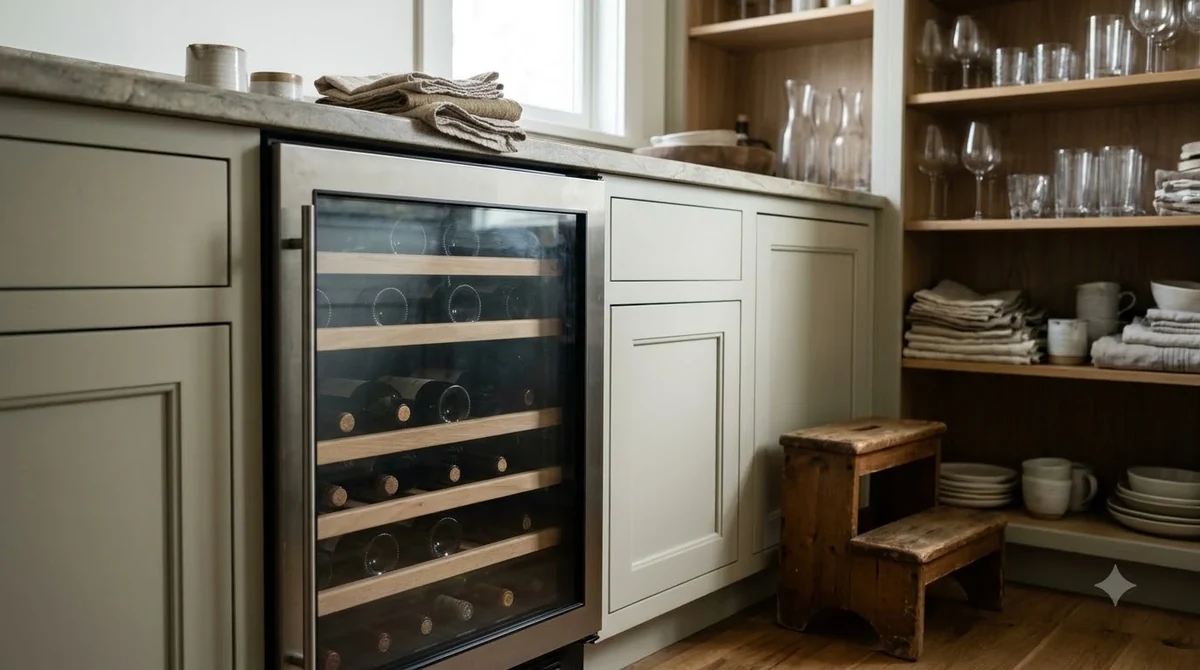
Why it stands out: Standard freestanding appliances exhaust warm air through their back and side panels, which causes compressor burnout if boxed into wood cabinets. Built-in 34-bottle models route airflow through a slotted kickplate grille at the bottom front, allowing zero-clearance installation next to dishwashers or base cabinets. Most undercounter designs in this size measure roughly 24 inches wide by 34 inches tall, matching standard North American kitchen base dimensions while offering dual temperature zones and reversible doors.
Keep in mind and best for: Because front-venting hardware and heavier insulation occupy cabinet depth, built-in units often require 22 to 23 inches of depth plus handle clearance. Reviewers at Wine Enthusiast note that placing any wine fridge near high-heat appliances like ovens or ranges forces the compressor to cycle harder, so pick a cabinet bay away from direct stove heat. This style is best for homeowners renovating a kitchen island, butler’s pantry, or wet bar who want integrated cabinetry aesthetics.
Best for Long-Term Cellaring and Single-Style Collections
A freestanding single-zone compressor cooler maintains one uniform climate throughout the entire cabinet, making it the most reliable option for aging bottles past a year.
Why it stands out: Without a thermal divider wall splitting the interior in half, single-zone cabinets dedicate more internal cubic footage to actual bottle racks and airflow channels. According to Wine Folly, the ideal long-term wine storage window sits between 55°F and 59°F with 55 to 75 percent humidity, and compressor-driven coolers hold that target far more steadily than thermoelectric models. Double-paned, UV-tinted tempered glass doors and activated charcoal filters further guard cork-sealed bottles against light strike and kitchen odors.
Keep in mind and best for: Single-zone coolers require you to chill crisp whites or sparkling wines in your kitchen refrigerator for 30 to 45 minutes before dinner if you keep the cabinet set at 55°F. You also need two to four inches of breathing room around the back and sides for proper heat dissipation. This configuration is best for collectors building a cellar of age-worthy reds or enthusiasts who want maximum rack simplicity and consistent temperatures.
Best for Entertaining With Reds and Whites Ready to Pour
Dual-zone 34-bottle coolers split the interior into two independently controlled compartments so white, rosé, and sparkling wines stay chilled while reds rest at cellar temperature.
Why it stands out: Instead of constantly shuffling bottles between a warm pantry and a kitchen fridge before guests arrive, dual-zone cabinets hold an upper or left compartment at 41°F to 50°F and a lower or right compartment at 55°F to 65°F. Many 24-inch-wide 34-bottle models use a side-by-side French-door layout with two separate glass doors, which prevents warm room air from spilling into your red wine section every time you reach for a chilled Sauvignon Blanc. Digital touch panels outside the glass let you verify both zones at a glance.
Keep in mind and best for: The internal partition and second evaporator fan trim actual bottle capacity slightly compared to an open single-zone box, and dual-fan systems can generate a subtle hum around 40 to 42 decibels. If you only keep a few open bottles chilled on a counter, a tiny 4 bottle wine cooler handles immediate table service, whereas a 34-bottle dual-zone unit anchors full dinner parties. This type is best for frequent hosts who pour diverse wine styles every week.
Best for Wide Burgundy, Champagne, and Napa Bottles
Adjustable-shelf 34-bottle coolers feature removable beechwood or coated wire racks with wider vertical spacing to accommodate broader bottle shoulders without scraping labels.
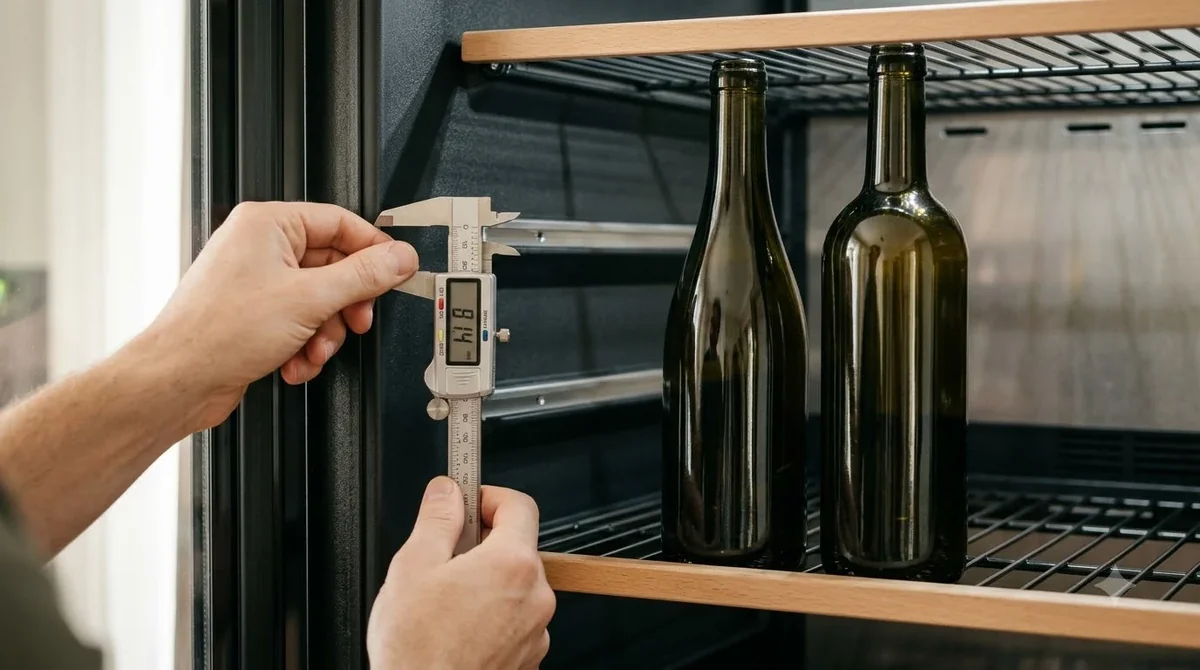
Why it stands out: Manufacturers calculate advertised capacity—including the 34-bottle benchmark—using slender 750ml Bordeaux cylinders. In real-world use, wider Pinot Noir, Syrah, Turley-style Zinfandel, and Champagne bottles wedged onto tight fixed rails either tear paper labels or force you to skip every other slot. Models built with sliding beechwood shelves on telescopic tracks allow you to lift out one rack to create extra vertical clearance for magnums or broader sparklers while dampening micro-vibrations from the compressor.
Keep in mind and best for: Removing a rack to fit thicker Champagne bottles reduces your practical headcount from 34 bottles down to roughly 24 to 28 bottles, so check total interior cubic feet—ideally 3.4 to 5.3 cubic feet—before buying. If you are comparing capacity tiers across your collection, our guide to wine coolers By bottle count breaks down how real-world capacity scales across different bottle shapes. This type is best for drinkers whose racks lean heavily toward California Pinot Noir, Oregon Chardonnay, or grower Champagne.
Best for Apartments and Tight Floor Footprints
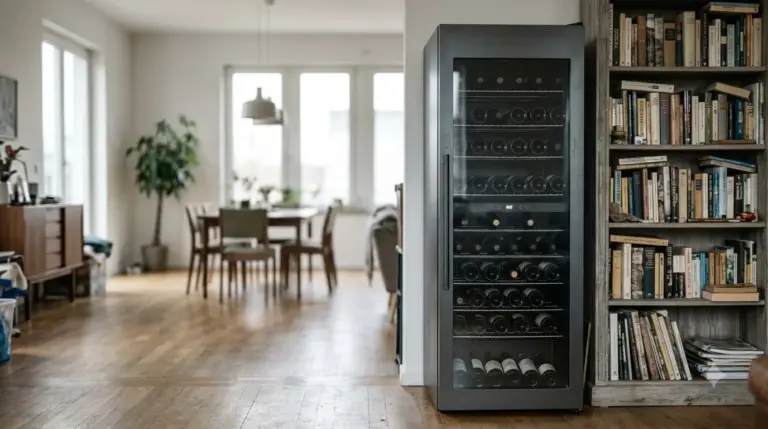
Compact freestanding 34-bottle coolers pack nearly three cases of wine into a narrow 17-inch to 19-inch wide cabinet that tucks beside a dining sideboard or inside a walk-in pantry.
Why it stands out: While standard undercounter coolers span 23.5 to 24 inches wide, space-saving freestanding towers trim width down to roughly 17.3 to 18.9 inches by stacking five or six deeper shelves inside a 33-inch-tall frame. Despite their slimmer footprint, modern compressor models in this class still deliver digital thermostats down to 41°F, soft interior LED lighting that emits zero heat, and adjustable leveling feet for older hardwood floors. Recessed door handles keep the front profile clean so nobody snags a pocket walking past in a tight hallway.
Keep in mind and best for: Compact narrow-body cabinets rely on rear and side ventilation, meaning they cannot be sealed inside tight cabinetry, and their narrower shelves usually require alternating neck-to-base bottle orientation to reach the full 34-bottle count. They also operate as single-zone units rather than split climate zones. This type is best for apartment dwellers, condo owners, and renters who want serious storage capacity without sacrificing wide wall space.
How to Choose
Evaluating four mechanical and layout specs before ordering ensures your 34-bottle wine cooler fits your space and protects your bottles for years.
- Ventilation and installation clearance: Choose a front-venting built-in unit if the cabinet will sit under a counter or inside millwork. Choose a freestanding unit only if you can leave at least two inches of open air space behind and beside the cabinet.
- Compressor vs. thermoelectric cooling: At the 34-bottle size, compressor cooling is strongly preferred because thermoelectric units struggle to hold steady temperatures in rooms warmer than 72°F and cannot reliably chill sparkling wines down to 41°F.
- Noise rating for living spaces: Look for decibel ratings at or below 40 to 42 dBA if the cooler will sit in an open-concept kitchen, dining room, or home office rather than a basement or utility room.
- Door glazing and security: Double-paned UV-resistant tempered glass prevents condensation on humid summer days and blocks ultraviolet light, while a built-in door lock or child control lock prevents accidental temperature changes.
Tip: Let a newly delivered compressor wine cooler stand upright unplugged for at least 12 to 24 hours before powering it on so the refrigerant oil settles back into the compressor after shipping.
Frequently Asked Questions
How many cases of wine does a 34 bottle wine cooler actually hold?
A 34-bottle wine cooler holds just under three standard 12-bottle cases of 750ml Bordeaux-style wine bottles. If your collection includes wider Burgundy, Rhône, or Champagne bottles, expect real-world capacity to land between 24 and 28 bottles unless you remove a shelf.
What are the typical dimensions of a 34 bottle wine cooler?
Most 34-bottle wine coolers measure between 33 and 34.3 inches tall and 21 to 23 inches deep, allowing them to fit comfortably beneath standard kitchen counters. Width varies by layout, with compact freestanding models measuring around 17.5 to 19 inches wide and built-in or dual-door models spanning 23.5 to 24 inches wide.
Should I buy a single-zone or dual-zone 34 bottle wine cooler?
Buy a single-zone model if you plan to store and age all your wines at a steady 55°F or primarily drink red wine. Choose a dual-zone model if you regularly entertain and want white and sparkling wines chilled at 41°F to 50°F while keeping reds ready at 55°F to 65°F, which comes in handy when calculating how many glasses in a bottle of wine you need chilled for a dinner party.
Can I put a freestanding 34 bottle wine cooler under a counter?
No, freestanding wine coolers vent heat through their back and side walls and will overheat or fail prematurely if enclosed under a counter. If you want an undercounter installation, verify that the specification sheet explicitly lists built-in capability with a front-facing exhaust grille.
Matching your 34-bottle wine cooler to your cabinet layout and bottle shapes keeps every vintage protected from heat swings, UV light, and vibration. Focus first on whether you need front-venting built-in hardware or open-air freestanding placement, then select single-zone stability or dual-zone serving flexibility based on how you pour each week.
More in By Bottle Count
 Best 52 Bottle Wine Fridge Options for Every Kitchen and CollectionUpdated Nov 18, 2026
 Best 15 Bottle Wine Fridge Options for Quiet Storage and Ready-to-Pour ServingUpdated Nov 18, 2026
 Best 166 Bottle Wine Cooler Types for Serious Collectors and HostsUpdated Nov 18, 2026
 Best 54 Bottle Wine Fridge Types for Undercounter and Home CellarsUpdated Nov 18, 2026
 Best 46 Bottle Dual Zone Wine Cooler for Built-In Kitchens and Home BarsUpdated Nov 19, 2026
 Best 28 Bottle Wine Fridge for Two Cases and Entertaining StockUpdated Nov 18, 2026