
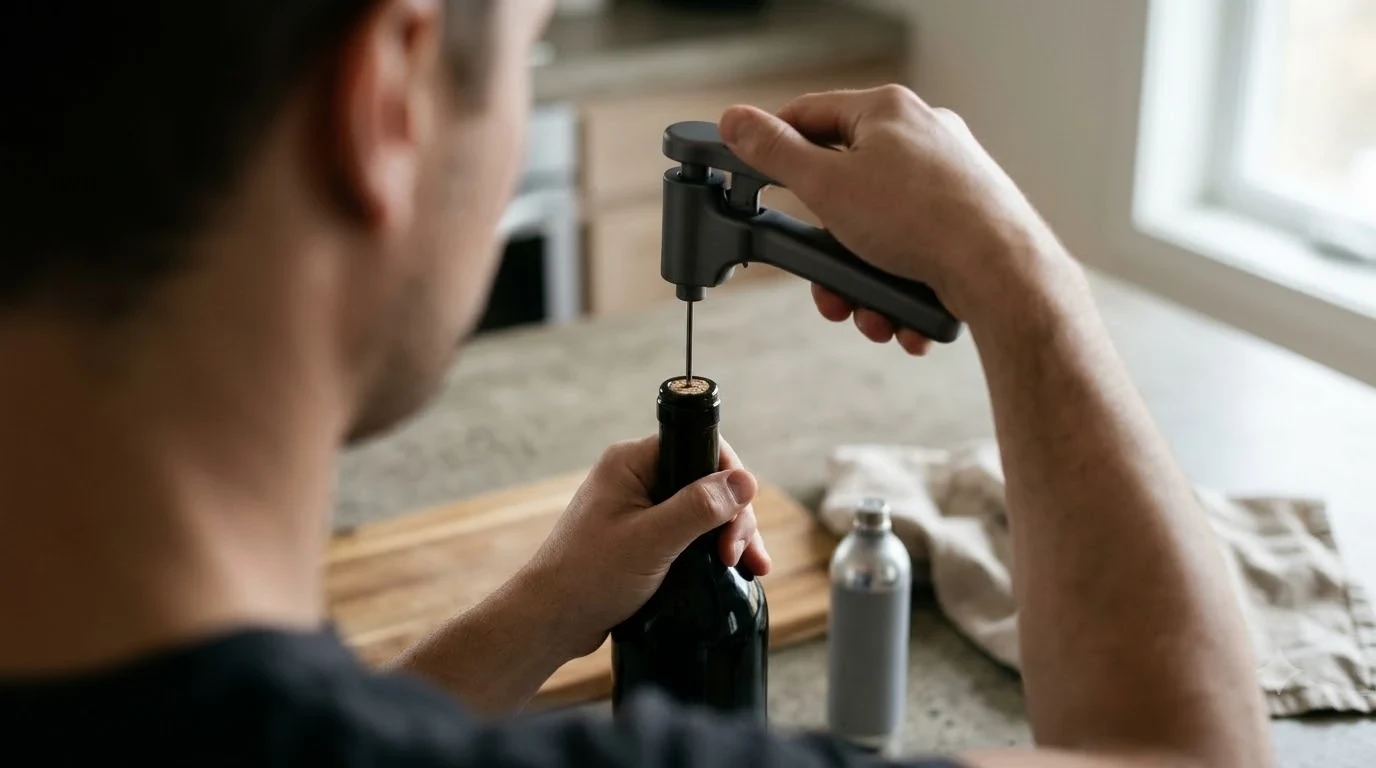

We may earn a commission when you buy through links on this page, at no extra cost to you. Learn more.
The wine enthusiast wine preserver is a rechargeable automatic vacuum system designed to help keep opened bottles fresh for up to seven days. It removes air from an opened bottle through a compatible silicone stopper, then signals when the sealing process is complete. With four included stoppers, date indicators and a compact design, it is a convenient option for households that regularly save unfinished wine. Its main limitation is that vacuum preservation is not the same as replacing oxygen with inert gas, and the manufacturer’s freshness claim should be treated as an upper limit rather than a guarantee.
Not every bottle gets finished on the night it is opened. You might want one glass of Cabernet Sauvignon with dinner, a small pour of Chardonnay while cooking, or a second glass of Pinot Noir the following evening. Without a suitable closure, oxygen gradually changes the wine’s aromas, flavors and overall character. Wine Enthusiast’s automatic vacuum preserver addresses this problem with a rechargeable device that works with reusable silicone stoppers. This review examines its specifications, operating principles, practical advantages, potential drawbacks and the situations in which a different preservation method may be more suitable.
Specs and Key Features
The Wine Enthusiast Automatic Vacuum Wine Saver and Preserver combines an automatic air-removal mechanism with reusable bottle stoppers. Its most notable features are the four included silicone closures, rechargeable battery and manufacturer-stated preservation period of up to seven days.
The product is designed around a straightforward process: insert a stopper into an opened bottle, position the device over the stopper and press down. The unit automatically removes air and stops when the cycle is complete, communicating the result with an audible beep. This reduces the amount of manual work compared with a traditional hand-operated vacuum pump.
Its physical dimensions are relatively compact, measuring 1.8 inches long, 1.8 inches wide and 5.6 inches high. That makes it easier to store in a kitchen drawer, wine cabinet or bar area than a larger preservation appliance. The rechargeable lithium-ion battery takes approximately two hours to reach a full charge, according to the manufacturer’s specifications.
| Specification | Manufacturer-listed details |
|---|---|
| Product | Automatic Vacuum Wine Saver and Preserver |
| Item number | 496 10 |
| Preservation claim | Up to 7 days |
| Included stoppers | 4 silicone stoppers |
| Date indicators | Integrated into stopper rings |
| Battery type | Rechargeable lithium-ion |
| Full charging time | Approximately 2 hours |
| Length | 1.8 inches |
| Width | 1.8 inches |
| Height | 5.6 inches |
| Included accessories | Charging cable and 4 silicone stoppers |
| Operation | Automatic vacuum sealing |
One particularly useful detail is the date-setting ring on each stopper. Rather than relying on memory, users can mark the date the bottle was sealed. This is helpful when several bottles are open simultaneously, especially when different wines are being saved for different meals.
The four-stopper arrangement also makes the product more versatile than a single reusable closure. A household can keep several bottles sealed while using the same powered device to remove air from each one. However, the preserver itself is still a single-bottle-at-a-time tool, not a multi-bottle dispensing refrigerator.
There is an important distinction between the listed specifications and the actual performance of the wine. The seven-day figure is Wine Enthusiast’s stated product claim. It does not mean every red, white or rosé will taste identical to its original condition after a full week. Wine style, remaining volume, storage temperature and the effectiveness of the seal all influence the result.
What Owners and Wine Drinkers May Like
The strongest selling point is convenience: the automatic mechanism removes much of the repetitive pumping associated with manual vacuum systems. The four reusable stoppers and date indicators also make the product practical for people who frequently have more than one unfinished bottle.
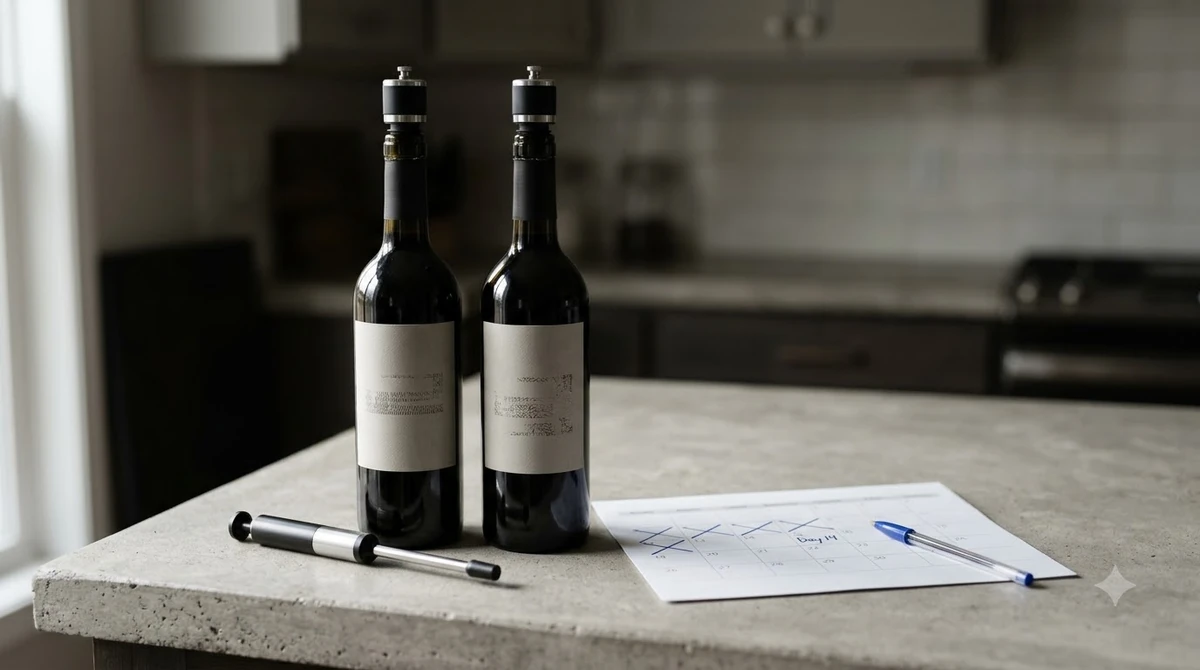
Traditional preservation methods can involve several steps. A user inserts a stopper, attaches a pump and repeatedly operates it until the desired vacuum is reached. With the Wine Enthusiast automatic model, the process is more direct. The user positions the device, applies downward pressure and waits for the audible completion signal.
This approach may appeal to people who do not want another complicated piece of equipment in the kitchen. It is also useful for households where several people share wine and need a straightforward way to close bottles after dinner. For a dedicated entertaining area, the compact device can sit alongside glasses, corkscrews and serving tools on a bar cart.
Four stoppers offer useful flexibility
Having four silicone stoppers is a meaningful advantage for everyday use. Imagine opening a Sauvignon Blanc on Friday, a Merlot on Saturday and a Chardonnay for Sunday lunch. Separate stoppers allow all three bottles to be sealed without having to remove and reuse the same closure repeatedly.
The date rings add another practical benefit. A bottle that has been open for two days should generally receive priority over one that was sealed only a few hours earlier. Recording the sealing date makes this easier to manage, particularly for people who enjoy comparing several wines over a weekend.
Automatic operation reduces repetitive work
Some users prefer an automatic appliance because it offers a more consistent routine. There is no need to count manual pump strokes or repeatedly check whether a hand pump has reached its stopping point. The automatic unit provides an audible signal when its cycle finishes.
The two-hour charging specification is also reasonable for a device that is intended for occasional use between bottles rather than continuous commercial service. Its small footprint means it can remain near the wine glasses, corkscrew and bottle stoppers without taking up much counter space.
Useful for everyday still wines
The automatic vacuum format makes the most sense for ordinary still wines that are likely to be finished within a few days. For example, a bottle of Merlot opened with a weekday meal may provide another enjoyable glass the following evening when properly sealed and refrigerated.
It can also help people who like to rotate between different grape varieties. Rather than committing to one bottle until it is empty, they can keep a few options available for different dishes. That flexibility is particularly useful for households that enjoy lighter Pinot Noir with poultry, Cabernet Sauvignon with grilled beef and Chardonnay with seafood.
Nevertheless, the device should be viewed as a convenience accessory rather than a way to eliminate wine oxidation completely. Its value lies in reducing exposure and slowing deterioration, not in stopping every chemical change that occurs after opening.
Common Complaints and Limitations
The most important limitation is that vacuum preservation has a different mechanism from argon or nitrogen preservation. The automatic system removes some of the air from the bottle, but it does not replace the remaining oxygen with an inert protective gas.
That distinction matters because different preservation systems are designed for different needs. Vacuum pumps are convenient for casual home use, while gas-based systems can be more appropriate for people who want to keep valuable bottles available over a longer period. Neither approach should be interpreted as making opened wine permanently stable.
The seven-day claim needs realistic expectations
Wine Enthusiast advertises preservation for up to one week. This is useful as a general performance target, but wine quality does not follow a universal seven-day timetable. A delicate Pinot Noir may lose some of its fresh fruit character sooner than a structured Cabernet Sauvignon, while an aromatic white wine can become noticeably less expressive as it oxidizes.
The amount of wine remaining also matters. A bottle with only one glass left contains a larger volume of air above the wine than a bottle that is still mostly full. Consequently, the same sealing procedure may produce different results depending on how much wine remains.
For everyday use, a sensible approach is to enjoy most opened still wines within three to five days, refrigerating the remaining wine even if it has been vacuum-sealed. The advertised seven-day period should not replace attention to aroma, flavor and overall condition.
It requires charging
The automatic mechanism is convenient, but it introduces a dependency that manual pumps do not have. The rechargeable battery needs to be charged before use, and a depleted device may not be available when an unexpected bottle needs sealing.
The stated full charging time is approximately two hours. This is not a major inconvenience for someone who keeps the device charged, but people who prefer equipment that is always ready without electrical charging may prefer a traditional hand pump and stopper.
Vacuum sealing is not suitable for every wine
Sparkling wine is an important exception. Champagne, Cava and Prosecco depend on dissolved carbon dioxide for their characteristic bubbles. A vacuum system designed for still wine is not the appropriate way to preserve that carbonation.
A dedicated sparkling-wine stopper is a better choice because it is designed to maintain pressure inside the bottle. Sparkling wines should generally be served at 40 to 50 degrees Fahrenheit, and a suitable Champagne closure helps retain their effervescence between pours.
Another limitation concerns premium bottles intended for extended enjoyment. If a collector regularly opens expensive Burgundy, aged Bordeaux or other valuable wines, an inert-gas preservation system may be a more suitable investment. A simple vacuum device cannot provide the same functionality as a system that replaces oxygen with argon.
More components require basic maintenance
The device includes several reusable components, and the stoppers need to remain clean and properly seated to create an effective seal. Wine residue around a stopper can interfere with the closure, while a damaged or poorly positioned stopper may allow air to enter the bottle.
Users should also remember that the automatic preserver and its stoppers are separate parts. Keeping the stoppers together in a designated drawer or container helps prevent them from becoming misplaced. The product listing does not provide a detailed dishwasher-cleaning specification, so gentle cleaning of the removable silicone parts is a sensible precaution.
Who Should Buy and Who Should Skip
The Wine Enthusiast automatic preserver is best suited to casual and regular wine drinkers who want a convenient way to close unfinished bottles. It is less appropriate for sparkling wine enthusiasts, collectors seeking long-term preservation or people who rarely leave wine unfinished.
For a household that opens a bottle of wine two or three times a week, four reusable stoppers can be genuinely useful. They make it possible to keep several still wines available without needing a separate powered device for each bottle.
Who should consider buying it?
- Weeknight wine drinkers: People who enjoy one or two glasses with dinner rather than finishing a full 750 ml bottle at once.
- Couples and small households: Two people may prefer to open different wines on different evenings and save the remaining portions.
- Casual wine enthusiasts: People who regularly switch between Cabernet Sauvignon, Merlot, Chardonnay and Pinot Noir may appreciate having four stoppers.
- Home entertainers: Hosts who open several still wines for guests can use the date rings to keep track of when bottles were sealed.
- People who value convenience: The automatic operation is useful for anyone who finds manual vacuum pumping repetitive.
- Organized home bar owners: The compact 5.6-inch-tall unit can fit into a relatively small storage area.
Who should skip it?
- People who finish every bottle: If an opened bottle is always consumed in one sitting, a preservation appliance offers little practical benefit.
- Sparkling wine drinkers: A dedicated Champagne stopper is more appropriate for protecting carbonation.
- Collectors of expensive wines: People who want to preserve individual pours from premium bottles over extended periods should investigate argon-based systems.
- Minimalist households: A simple reusable stopper may be sufficient for someone who only saves wine overnight.
- Travel-focused users: Those who need a completely manual solution may prefer a compact hand pump that does not rely on battery charge.
It is also important to consider the kind of wine being opened. A young, fruit-forward Merlot or Sauvignon Blanc is a reasonable candidate for short-term vacuum preservation. A particularly delicate older wine may be more sensitive to oxygen exposure and should not be expected to retain its original character simply because a vacuum stopper is attached.
For someone building a practical collection of wine accessories, the preserver can complement a corkscrew, foil cutter and serving accessories. The site’s Accessory Brands section is another useful starting point for comparing equipment that supports opening, serving and storing wine. A dedicated wine opener and preserver set may be worth considering if opening and resealing bottles are both frequent activities.
How It Compares to Alternative Wine Preservation Methods
The automatic Wine Enthusiast preserver occupies the convenience-focused end of the preservation category. Manual pumps, ordinary stoppers and inert-gas systems all address oxygen exposure, but they differ in operation, cost structure, complexity and intended storage period.
Wine Enthusiast’s own preservation buying guide separates basic vacuum pumps from more involved systems designed to serve and preserve several bottles. Its wine preservation buying guide provides a useful overview of vacuum, nitrogen and argon approaches.
| Preservation method | How it works | Best use | Main limitation |
|---|---|---|---|
| Wine Enthusiast automatic vacuum | Automatically removes air through a stopper | Regular home use and multiple still-wine bottles | Requires charging |
| Manual vacuum pump | Uses a hand-operated pump to remove air | Occasional preservation | Requires manual operation |
| Ordinary wine stopper | Closes the bottle opening | Short-term storage and overnight use | Does not actively remove air |
| Argon preservation system | Uses inert gas to reduce oxygen contact | Premium still wines and longer preservation needs | More specialized equipment |
| Sparkling wine stopper | Creates a pressure-resistant closure | Champagne, Cava and Prosecco | Does not replace a still-wine preservation system |
Automatic versus manual vacuum pumps
The most direct comparison is with a traditional manual vacuum pump. Both approaches use a stopper to close the bottle and reduce the amount of air remaining inside. The main difference is how the vacuum is created.
A manual pump is simple and does not require a battery. It is a sensible option for someone who opens wine occasionally and wants an inexpensive, uncomplicated accessory. However, operating it requires repeated pumping, and the user must rely on the pump’s mechanism or stopping signal to determine when the process is complete.
The Wine Enthusiast automatic model is more convenient for regular use because it performs the vacuum operation automatically. Its four silicone stoppers and date rings also make it useful for people who frequently have multiple open bottles. The trade-off is that the automatic unit needs charging and introduces another electronic component to maintain.
Vacuum versus argon preservation
Argon systems work differently. Instead of relying primarily on air removal, they introduce an inert gas into the bottle to reduce the amount of oxygen in contact with the remaining wine. This approach is especially attractive to collectors and people who want to enjoy expensive bottles over a longer period.
Wine Enthusiast’s preservation recommendations distinguish these systems from conventional vacuum stoppers. The latter are generally more appropriate for everyday household use, while gas-based systems offer another approach for special bottles and more demanding preservation needs.
For example, someone who regularly pours a glass of everyday Cabernet Sauvignon and stores the rest until the following evening may be perfectly comfortable with a vacuum preserver. Someone who wants to enjoy a premium bottle across several weeks may prefer an argon-based alternative.
Vacuum preservation versus ordinary refrigeration
Refrigeration is an important part of wine preservation, regardless of the closure being used. Lower temperatures slow many of the chemical reactions associated with wine deterioration. A sealed bottle stored in the refrigerator is generally a better option than leaving it open on a warm kitchen counter.
However, refrigeration alone does not remove the air already present inside the bottle. A vacuum stopper combines a physical closure with air removal, making it a useful additional step. For most casual wine drinkers, the combination of proper sealing and refrigeration is more practical than investing in a complex preservation appliance.
How to Use and Maintain the Wine Enthusiast Preserver
Correct positioning and a clean stopper are essential for reliable operation. The basic process is straightforward, but users should take a moment to ensure the stopper fits securely before activating the automatic mechanism.
- Prepare the bottle. Place the opened bottle on a stable, level surface. Remove any loose cork fragments or residue around the neck.
- Choose a silicone stopper. Take one of the four included stoppers and inspect it for visible damage or wine residue.
- Insert the stopper. Position the stopper securely in the bottle opening so that it forms a tight closure.
- Position the preserver. Place the automatic device over the stopper, keeping it properly aligned with the bottle neck.
- Activate the vacuum cycle. Apply the downward pressure described in the product instructions. The automatic mechanism begins removing air.
- Wait for the completion signal. Allow the device to finish its cycle and indicate completion with an audible beep before removing it.
- Mark the sealing date. Adjust the date ring on the silicone stopper so that the opening or preservation date is easy to identify.
- Refrigerate the bottle. Store the sealed still wine in the refrigerator to slow further deterioration.
Do not rush the sealing process or pull the device away while it is operating. A proper connection between the appliance and stopper is important because a loose fit can compromise the vacuum cycle. If the device does not appear to seal correctly, check the stopper position before repeating the process.
Tip: Refrigerate opened still wine even after vacuum sealing. Keep the bottle upright, mark the sealing date and try to finish ordinary red, white and rosé wines within three to five days. The manufacturer’s seven-day claim is an upper preservation target, not a promise that every bottle will remain unchanged for that long.
Cleaning the reusable stoppers
After pouring the remaining wine, remove the stopper carefully and rinse away any wine residue. Allow the removable parts to dry before returning them to storage. Avoid using abrasive cleaning materials that could damage the silicone or affect the sealing surface.
Inspect the stoppers periodically. A stopper that has become distorted, cracked or difficult to insert may no longer create a reliable seal. Keeping the sealing surface clean is especially important because even small amounts of residue can interfere with a tight fit.
Keeping the rechargeable unit ready
The product’s listed full charging time is approximately two hours. Charging the device after a period of regular use helps ensure it is ready when another bottle needs sealing.
Store the appliance in a dry location away from excessive heat and moisture. A drawer near the wine accessories is practical, provided the device and charging cable are not exposed to spills. The four stoppers can be stored together so that they remain easy to find.
Storing different wine styles
Not every wine should be treated identically after opening. Light-bodied whites, aromatic whites and rosé generally benefit from refrigeration. Even full-bodied reds can be refrigerated after opening; allow a serving to warm slightly before drinking if it has become too cold.
For reference, light whites and rosé are commonly served at 45 to 50 degrees Fahrenheit, while full-bodied whites are generally served at 50 to 55 degrees. Light reds are often best at 55 to 60 degrees, and full-bodied reds at 60 to 65 degrees.
These serving temperatures are not storage instructions. The refrigerator is useful for slowing deterioration, while the wine can be brought closer to its preferred serving temperature before the next pour.
Frequently Asked Questions
Does the Wine Enthusiast automatic preserver work with screw-cap bottles?
The system is designed to seal a bottle opening with its silicone stopper rather than requiring the original cork. A compatible stopper must form a secure fit around the bottle opening. Screw-cap bottles can have different neck and opening dimensions, so physical compatibility should be confirmed before relying on the device.
Does vacuum preservation change the flavor of wine?
Vacuum preservation is intended to slow oxidation, not add flavor or improve the wine. Removing some of the air may help retain existing aromas, but it does not reverse changes that have already occurred. Some delicate wines can also lose aromatic expression after opening, even when properly sealed.
Can the preserver be used with half bottles?
The manufacturer’s listed product information describes the device as a wine-bottle preserver but does not establish compatibility with every half-bottle format. Bottle openings and neck shapes can differ between formats. The stopper needs to fit securely for the vacuum mechanism to operate as intended.
Can vacuum-sealed wine be used for cooking several days later?
Wine that remains in good condition can be used in sauces, braises and marinades according to the recipe. However, vacuum sealing does not make spoiled or badly deteriorated wine suitable for cooking. A wine that has developed an unpleasant vinegar-like aroma or other obvious faults should not be treated as though the preservation device has restored it.
Does the automatic preserver work during a power outage?
The product uses a rechargeable lithium-ion battery rather than requiring a permanently connected power supply during each sealing cycle. This means a charged unit can be used without being plugged in at the moment of operation. Its availability still depends on having sufficient battery charge, so refrigeration and a suitable stopper remain useful backup measures.
The Wine Enthusiast Automatic Vacuum Wine Saver and Preserver is a practical choice for people who regularly open still wine but rarely finish every bottle in one evening. Its automatic operation, four silicone stoppers and date-setting rings make everyday preservation more convenient, although the seven-day claim should be approached with realistic expectations. For casual wine drinkers, it offers a useful middle ground between a basic stopper and a more specialized gas-based preservation system. Choose it for convenience and short-term storage, but consider a dedicated sparkling closure or argon system if your wine collection requires a different level of preservation.
More in Wine Accessories
 Zwilling Wine Stopper Review: Preserve Open Bottles LongerUpdated Nov 21, 2026
 Wine Enthusiast Wine Stopper: An Easier Way to Reseal Open BottlesUpdated Nov 21, 2026
 Vintorio Wine Opener: Two-Step Cork RemovalUpdated Nov 21, 2026
 Zwilling Wine Aerator Review: Aerate, Pour, and Seal With One ToolUpdated Nov 21, 2026
 Zazzol Wine Opener Review: Features, Comfort, and Buying AdviceUpdated Nov 21, 2026
 Secura Wine Opener Not Working: Fix Charging and Stuck-Cork ProblemsUpdated Nov 21, 2026