


We may earn a commission when you buy through links on this page, at no extra cost to you. Learn more.
If you searched “secura wine opener not working,” start with a complete charge and correct alignment before assuming the motor has failed. Secura’s instructions call for about 6–8 hours to recharge the opener, a firm connection to the charging base, and a straight position over the cork. If the cork is stuck inside the opener, the upper “Up” part of the switch reverses the spiral and releases it; do not force the mechanism or open the housing.
Secura’s rechargeable electric opener is a simple two-direction corkscrew rather than a complicated appliance, but its battery, charging contacts, switch, and cork position all have to work together. The troubleshooting below applies to the SWO-3N and KP1-36N2 instructions; confirm the model printed on your own unit before following model-specific support steps. A failed opening can point to a depleted battery, a tilted opener, an unsuitable cork, or an electrical fault.
Specs and Key Features
The Secura electric wine opener combines a rechargeable motor, a single Up/Down switch, a charging base, and a separate foil cutter. Its most useful troubleshooting numbers are a recommended 8-hour first charge, a 6–8-hour regular recharge, and a manufacturer estimate of approximately 30 bottles per full charge.
| Feature | Documented detail | Why it matters |
|---|---|---|
| Models covered in Secura instructions | SWO-3N and KP1-36N2 | Match the manual and support request to the model printed on the opener. |
| Battery type | Ni-MH, specified in the KP1-36N2 manual | Battery condition affects motor strength and how reliably a cork comes out. |
| First charge | At least 8 hours | Give a new or long-stored unit a complete initial charge. |
| Typical full recharge | Approximately 6–8 hours | A short top-up may not restore enough power for a difficult cork. |
| Rated capacity | Approximately 30 bottles per full charge | This is the maker’s estimate, not a promise for an older battery or every cork type. |
| Controls | One switch with Down and Up functions | Down extracts the cork; Up reverses the spiral to eject it. |
| Included accessories | Charging stand, adapter, and foil cutter | Use the supplied power equipment and remove foil before opening. |
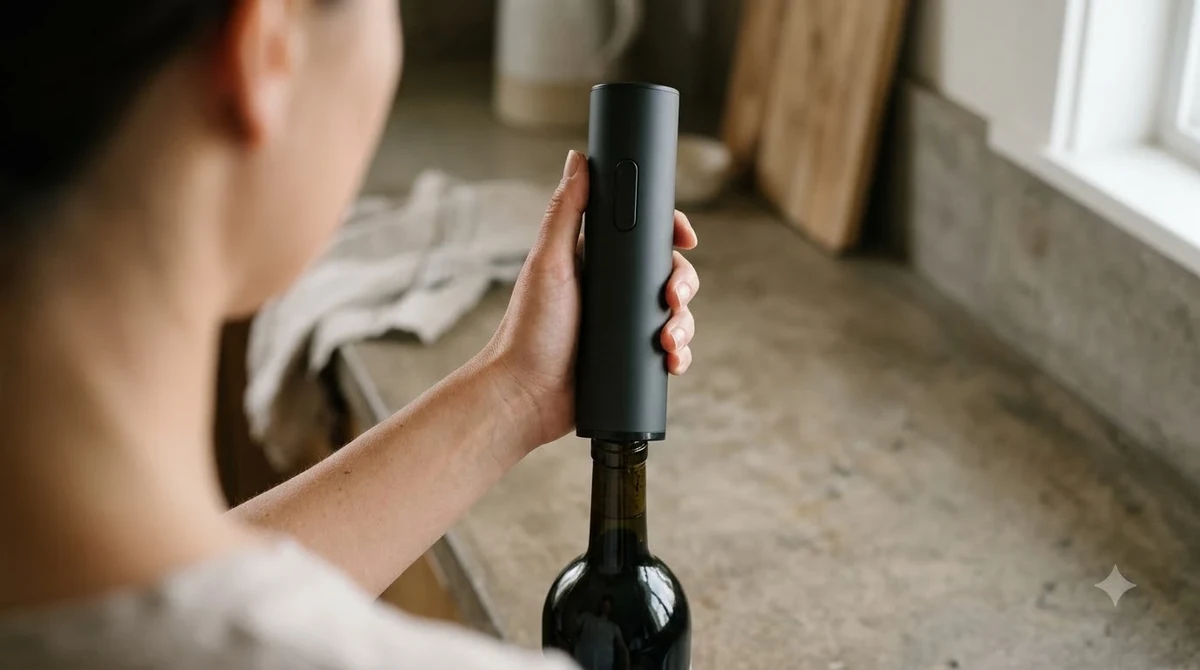
The operating sequence is deliberately basic. Remove the foil with the included cutter, center the opener over the bottle neck, hold the bottle still, and press Down. The corkscrew turns clockwise as it enters the cork and draws it into the body. Once the opener stops, lift it away from the bottle and press Up; the spiral turns counterclockwise to push the cork free. The Up control is not a second extraction speed or a reset button. It is the reverse direction used to eject the cork after opening.
These details explain why a Secura can appear dead even when its motor is not permanently damaged. A weak battery can lack the power to complete extraction, while a tilted opener can send the spiral off-center. The approximately 30-bottle estimate can also fall with battery age, long storage, or difficult corks. The official Secura SWO-3N user instructions are the best reference for the basic charging and switch sequence.
What Owners Like
Owner feedback tends to praise the ease of removing an ordinary cork with one button, the stainless-steel appearance, and the convenience of keeping the opener upright in its charging stand. The same design can be especially useful for someone who finds a traditional corkscrew difficult to grip or turn.
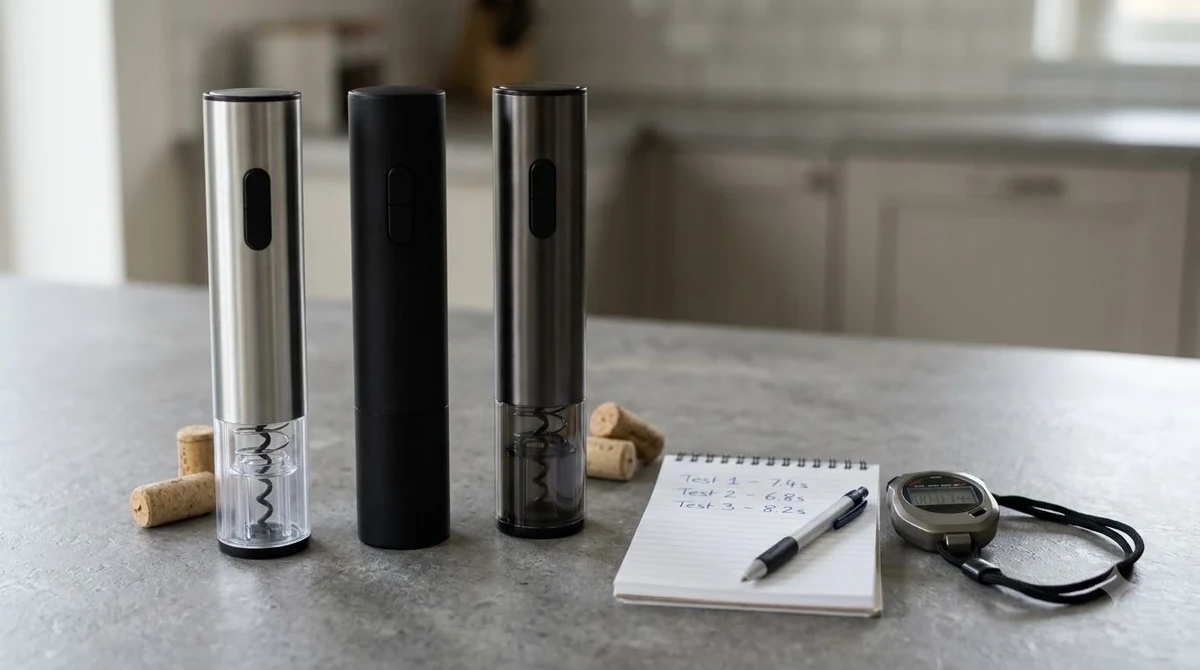
BestViewsReviews’ analysis of customer-review themes describes operation as easy for many owners and records positive comments about smooth cork removal, the visible lower section, and the unit’s appearance on a kitchen counter. Some reviewers also value the quieter motor compared with other electric openers they have owned. These are recurring impressions rather than a guarantee that every unit will perform identically; the site also records comments from owners who encountered weak power or frequent charging.
The two-direction switch is easy to learn: Down draws the cork out, then Up releases it. There is no lever arm to position or handle to twist through the cork. The separate foil cutter is useful, and the charging stand gives the opener a regular home. On a counter or bar cart, the unit can remain visible and ready between uses.
That convenience has limits. It is an electric countertop accessory with a battery and a dedicated base, not a compact manual corkscrew for a picnic bag. People who open only an occasional bottle may prefer a small manual tool as their primary opener and keep the Secura for guests or for situations where powered cork removal is more comfortable. A compact wine bottle opener keychain is a different kind of backup: it is portable, but it does not provide the same powered assistance.
Common Complaints and Fixes
The most useful way to diagnose a Secura that will not operate is to match the symptom to the likely cause. A blank or weak unit points first to charging; a motor that stops halfway may be low on power; a cork that remains in the bottle can indicate poor alignment or a cork type the mechanism struggles with.
Tip: Before opening another bottle, give the Secura one uninterrupted 6–8-hour charge and confirm that the LED illuminates while the opener is fully seated. That single check rules out many low-power and poor-contact problems.
Work through these checks in order, stopping if the switch, cord, adapter, or housing appears damaged:
- Check the power path. Plug the supplied adapter into the charging stand and a working wall outlet. Set the opener firmly into the stand so its charging connection is fully engaged. The manual says the LED illuminates when the unit is correctly connected for charging; if there is no light, reseat the opener and inspect the adapter connection rather than assuming the battery is charging.
- Allow a full charge. Leave the opener on the correctly connected stand for about 6–8 hours. For first use, Secura recommends at least 8 hours. A brief few-minute charge is not a substitute for a complete cycle, especially when the battery has been sitting unused.
- Prepare the bottle. Cut away the foil with the supplied cutter and expose the cork. Hold the bottle firmly on a stable surface. Center the opener directly above the cork and keep it as vertical as possible; do not start it at an angle or try to push it down faster than the motor runs.
- Use the correct direction. Press the lower Down section to extract the cork. When the motor stops and the opener is clear of the bottle, press the upper Up section to reverse the spiral and release the cork. If the cork remains inside the opener, continue using the Up control rather than pulling at the sharp spiral with your fingers.
- Change tools for a difficult cork. Secura specifically notes that a small percentage of plastic or synthetic corks and undersized corks may cause problems. A fully charged opener that still cannot extract that cork should be set aside; use an appropriate manual corkscrew rather than forcing the motor.
Secura’s KP1-36N2 instructions specifically say a low battery can stop extraction halfway. Press Up to release the cork, then recharge before another bottle. Do not keep repeating Down on a depleted battery; Secura warns against using the opener when the battery is low.
When the cork is stuck
If the cork has left the bottle but remains attached to the spiral, use Up to rotate the spiral in reverse. If it remains partly inside the bottle, use a manual corkscrew to finish the job. Keep fingers and utensils away from the sharp spiral; never wedge a knife into the mechanism or dismantle the opener.
When charging does not restore power
If the LED responds and a full charge does not restore normal operation, the problem may be battery wear or an internal fault. Owner-review summaries include both reports of weak power and reports of normal operation. Repeated stalling on ordinary corks is a reason to contact Secura, not to keep running the motor. The manual says the opener and stand have no user-serviceable parts.
Who Should Buy and Who Should Skip
The Secura is most appealing to people who want powered cork removal for standard still-wine bottles and prefer a simple switch to a twisting manual corkscrew. It is less suitable for anyone who needs a repairable, pocket-sized tool or expects an electric opener to handle every cork without exception.
Consider it if a one-switch operation is more comfortable than applying repeated wrist force, if the charging base can stay on a kitchen counter, and if most of the bottles you open use ordinary natural corks. The manufacturer’s estimate of approximately 30 bottles on a full charge can be enough for a small dinner gathering, but the battery must be charged ahead of time. Returning the opener to its stand after use is part of the manufacturer’s recommended routine, and a full charge is especially important before opening several bottles in succession.
Skip it as your only corkscrew if you regularly open bottles with long, dense synthetic corks, if you want a tool that works without charging, or if you need something that can be repaired at home. A manual waiter’s corkscrew is a sensible backup because it is not dependent on a rechargeable battery. If you want a gift or a coordinated accessory set with a stopper as well as an opener, a wine opener and preserver set may suit that purpose better than buying the Secura alone. The Secura package is focused on the opener, charging stand, adapter, and foil cutter.
Consider how often the opener will be used. A rechargeable appliance left unused for months can be inconvenient if its battery is depleted. Secura recommends returning the unit to its stand after use; for extended storage, confirm battery-care instructions for the exact model. A compact manual opener is usually more practical for a drawer or travel.
How It Compares to Alternatives
The Secura’s main alternative is not another electric model so much as a manual corkscrew that cannot run out of charge. Electric openers reduce repetitive twisting, while manual waiter’s corkscrews are smaller and work without a charging stand; each solves a different problem.
Food & Wine’s evaluation of 16 electric wine openers explains why alignment and controlled pressure matter across the category. Its guide says electric models are generally held vertically over the bottle and operated with a button, while the other hand steadies the bottle; it also warns that excessive downward force can damage an opener. That advice is consistent with Secura’s own warning not to force or speed up its mechanism. Food & Wine’s tested selection includes the Oster Cordless Electric Wine Opener, but it did not present a head-to-head test of the Secura against Oster, so its findings should not be treated as a direct ranking of the two.
Compared with a manual waiter’s corkscrew, the Secura is convenient for repeated openings when charged, but larger and dependent on its base. Its separate stand and foil cutter need more counter space than an opener with a built-in cutter or USB charging. The stand keeps the unit upright; a manual tool can be stored almost anywhere and used immediately.
For frequent use, the Secura’s stainless-steel housing, separate cutter, and two-direction switch are useful features. For a household opening one bottle every few months, a manual tool may be less fussy. The choice depends on whether powered convenience outweighs charging and storage needs; keep a manual backup regardless.
Frequently Asked Questions
These quick answers cover the remaining questions about charging, battery care, cork compatibility, and support. A complete recharge takes approximately 6–8 hours, and the product’s manufacturer warranty is limited to 1 year under the conditions in the manual.
Does the LED show when the battery is fully charged?
Secura describes the illuminated LED as an indication that the opener is properly engaged with the charging connection. The manual does not describe a multi-color charge gauge or a numerical battery display, so the light is not a percentage reading. Allow the recommended charging period to elapse rather than judging battery capacity from the light alone.
Can I replace the battery myself?
The KP1-36N2 manual identifies a Ni-MH battery but does not provide a consumer removal or replacement procedure. Under the SWO-3N warranty, the manufacturer may choose to repair the product or replace it with a new or refurbished unit. Contact Secura before attempting to open the housing.
Are the SWO-3N and KP1-36N2 the same model?
They are separate model designations in Secura’s documentation, even though their manuals show the same basic Down-to-extract and Up-to-eject control sequence. That shared operation does not establish that their charging stands, adapters, or internal parts are interchangeable. Use the model number on your own opener when requesting support.
What does the one-year warranty cover?
The SWO-3N manual describes a one-year limited warranty for the original purchaser when the product was bought directly from Secura or an authorized reseller and proof of purchase is available. It also says the manufacturer may inspect the unit before accepting a claim and that shipping costs for inspection and warranty service are the purchaser’s responsibility. Terms can differ by model, so refer to the warranty supplied with your opener.
Can I wash the Secura opener under running water?
No. The manual directs owners to wipe the housing with a damp cloth or sponge and then dry it. It specifically says not to immerse the opener in water or put it in a dishwasher, and the sharp corkscrew spiral should be handled carefully during cleaning.
A Secura that will not open a bottle is not automatically defective: charge it fully, seat it correctly, center it over the cork, and use Down and Up for their intended jobs. If it still struggles with an ordinary cork after those checks, stop using it and contact Secura with the model number and purchase information rather than trying to repair the sealed mechanism yourself.
More in Wine Accessories
 Coravin Vs Vacu Vin: Choose the Right Wine Saver for Your BottlesUpdated Nov 21, 2026
 Zwilling Wine Stopper Review: Preserve Open Bottles LongerUpdated Nov 21, 2026
 Wine Enthusiast Wine Preserver Review: Features, Benefits and LimitationsUpdated Nov 21, 2026
 Wine Enthusiast Wine Stopper: An Easier Way to Reseal Open BottlesUpdated Nov 21, 2026
 Vintorio Wine Opener: Two-Step Cork RemovalUpdated Nov 21, 2026
 Zwilling Wine Aerator Review: Aerate, Pour, and Seal With One ToolUpdated Nov 21, 2026