


We may earn a commission when you buy through links on this page, at no extra cost to you. Learn more.
A coravin wine opener review shows that Coravin is an excellent choice for pouring individual glasses without removing a natural cork, making it especially useful for wine enthusiasts who want to preserve bottles across multiple occasions. Unlike a conventional corkscrew, the Coravin Timeless system uses a thin needle and argon gas to dispense wine while leaving the cork in place. Its preservation technology is impressive, but ongoing capsule costs, needle care, and closure compatibility are important considerations before buying.
Opening a bottle of wine traditionally means committing to drinking it within the next several days. That can be inconvenient when you want a single glass of Cabernet Sauvignon on Tuesday, a little Pinot Noir on Friday, or a taste of an expensive Bordeaux without finishing the bottle. Coravin offers a different approach: access the wine without pulling its cork. This review examines the Timeless Three+ system, including its operation, included accessories, practical advantages, limitations, and the types of wine drinkers most likely to appreciate it.
Specs and Key Features
The Coravin Timeless Three+ is a wine preservation and dispensing system rather than a traditional wine opener. Its central feature is a precision needle that passes through a natural cork, allowing wine to flow into a glass while argon gas helps protect the remaining contents from oxygen exposure.
The Three+ is designed for people who want to enjoy wine in smaller quantities without removing the original closure. Its molded black body houses the dispensing mechanism, while the included accessories make it possible to access compatible screw-cap bottles and aerate wine during pouring.
According to the manufacturer, the package includes two Pure Argon capsules, two Timeless screw caps, an aerator, a needle-clearing tool, and a protective bottle sleeve. This provides a useful starting collection rather than requiring buyers to source several essential accessories separately.
| Feature | Coravin Timeless Three+ |
|---|---|
| Product category | Wine preservation and dispensing system |
| Primary closure | Natural cork |
| Gas type | 100% pure argon |
| Included capsules | 2 |
| Typical capsule capacity | Up to 15 glasses |
| Glass serving used for capacity estimate | 150 ml |
| Included screw caps | 2 |
| Aerator | 1 |
| Needle type | Standard needle |
| Body finish | Matte black |
| Additional accessories | Needle-clearing tool and bottle sleeve |
| Screw-cap compatibility | Requires Timeless Screw Cap accessory |
One particularly useful specification is capsule capacity. Coravin estimates that a Timeless argon capsule can provide up to 15 pours of 150 ml each. That equals approximately 2.25 liters of wine, although actual performance depends on pouring technique, gas consumption, and the condition of the equipment.
The included aerator is another meaningful feature. Instead of requiring a separate decanter for every bottle, it disperses wine into smaller droplets as it enters the glass. Coravin describes the resulting aeration as comparable to approximately 90 minutes of decanting for the Timeless Three+ accessory.
These features make the Three+ more sophisticated than a basic corkscrew or bottle stopper. However, buyers should understand that its main purpose is controlled wine access and preservation, not simply removing corks more conveniently.
How the Coravin Wine Preservation System Works
Coravin’s main advantage comes from dispensing wine without removing the natural cork. A hollow needle creates a temporary passage through the closure, and pressurized argon gas helps move wine into the glass while limiting the amount of oxygen entering the bottle.
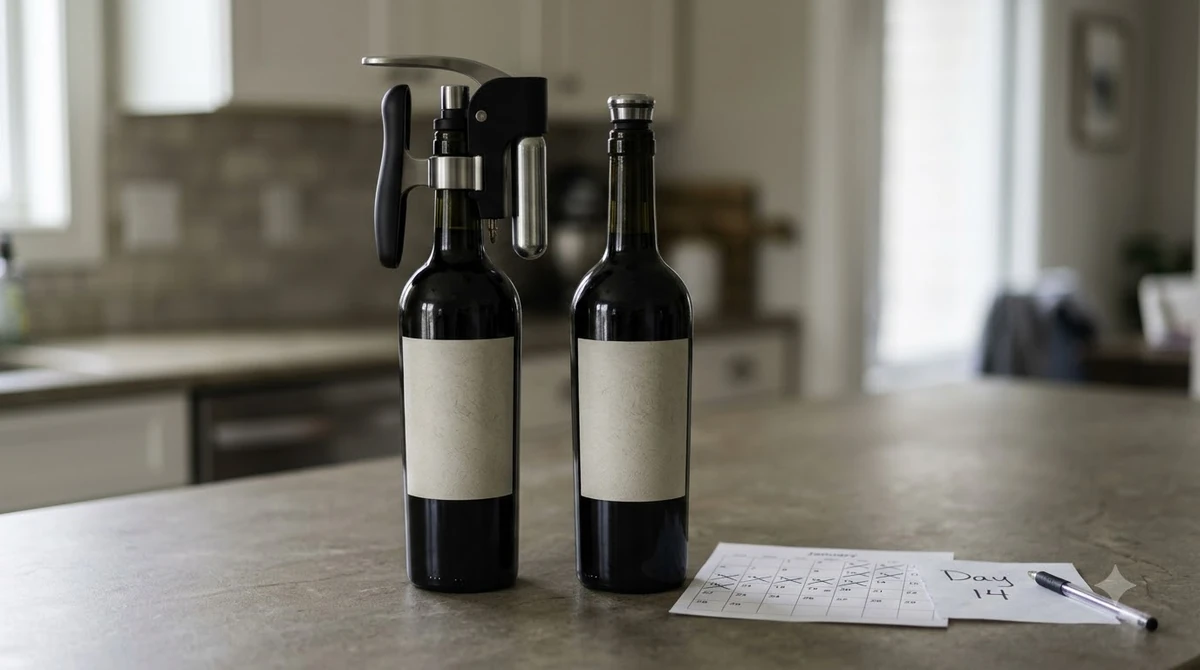
Argon is an inert gas, meaning it does not readily react with wine. It is also used in winemaking environments to help protect wine from oxidation. The Coravin system uses this property to replace the volume of wine removed from the bottle with protective gas.
When the needle is withdrawn, a healthy natural cork can close around the small puncture. This allows the remaining wine to stay inside its original bottle with the closure still in place. The system therefore differs significantly from a vacuum stopper, which can only operate after the bottle has already been opened.
The three main operating stages
- Insert the needle: Position the Coravin over the bottle neck and press down in one smooth movement. The device’s clamps secure the bottle neck while the needle passes through the cork.
- Dispense the wine: Tilt the bottle approximately 45 degrees, keeping the needle tip submerged. Press and release the trigger briefly to introduce argon and allow wine to flow through the dispensing tube.
- Remove the device: Return the bottle upright to stop the flow. Lift the Coravin away in a steady movement and allow the natural cork time to reseal.
Short trigger presses are important because holding the trigger unnecessarily can waste argon. Coravin also recommends returning the bottle upright before removing the system rather than attempting to pull it away while wine is still flowing.
The process becomes more familiar with practice, although it involves more steps than using a traditional waiter’s corkscrew. Someone opening one bottle for a dinner party might prefer a conventional opener, while someone taking a small glass from several bottles over multiple weeks can appreciate the extra procedure.
How long does the remaining wine last?
Coravin’s Timeless technology is designed to preserve wine for extended periods because the original natural cork remains in place. The manufacturer describes the possibility of keeping wine for years, provided the equipment is used correctly and the cork continues to seal properly.
That claim should not be interpreted as a guarantee that every bottle will remain unchanged indefinitely. Cork condition, storage temperature, bottle age, and the quality of the initial seal all influence preservation. An older bottle with a dry or damaged cork deserves more caution than a recently purchased wine with a healthy closure.
The distinction between the Timeless system and conventional preservation products is important. A vacuum stopper or ordinary wine stopper works after opening, while Coravin is intended to avoid removing the original closure in the first place.
For additional technical details, Coravin’s explanation of its wine preservation technology describes the needle, argon replacement process, capsule capacity, and operating procedure.
What Owners Like About Coravin
The biggest attraction of Coravin is flexibility: wine drinkers can pour a small amount from a bottle without feeling obligated to finish it within a few days. This is particularly useful for expensive bottles, comparative tastings, and households where different people prefer different wines.
The practical value becomes clearer when considering how people actually drink wine. A person might want a glass of Chardonnay with seafood one evening and a glass of Cabernet Sauvignon with steak another evening. Traditionally, enjoying both wines requires opening two bottles and managing the remaining contents afterward.
With a compatible Timeless system, both bottles can remain closed between individual pours. This gives collectors and curious wine drinkers more freedom to explore different regions, producers, grape varieties, and vintages without opening an entire bottle each time.
Greater flexibility for wine tasting
Coravin is particularly attractive for anyone who regularly compares wines. Imagine tasting three different Pinot Noir bottles from Oregon, Burgundy, and New Zealand during the same week. Instead of opening all three bottles and trying to finish them quickly, a user can take a measured glass from each and return the bottles to appropriate storage.
This flexibility is useful when studying differences in acidity, body, fruit character, oak influence, and tannin. It also allows someone to revisit a particular wine alongside different meals without needing to open another bottle.
The Spruce Eats highlights this advantage in its assessment of the Coravin Timeless system, explaining how it can help wine enthusiasts sample different bottles without committing to finishing each one. Its review also identifies the system’s portability and relatively compact design as practical benefits.
For households with a growing wine collection, this can be more meaningful than the novelty of the technology. It changes how bottles are accessed, especially when the collection includes wines that are not intended for immediate consumption.
Useful for different serving preferences
Not everyone wants the same serving size. One person may prefer a small tasting pour, while another wants a more traditional 5-ounce glass. Coravin allows users to control how much wine they dispense instead of automatically committing to a conventional bottle-opening routine.
This is particularly convenient for people who enjoy richer wines. A full-bodied Cabernet Sauvignon, Syrah, or Merlot can be appreciated in a smaller serving without leaving an opened bottle waiting for another occasion.
It also offers practical flexibility for pairing experiments. Someone preparing grilled lamb on one evening and mushroom risotto on another can revisit a bottle of red wine to see how its flavors work with both meals.
Convenient accessories in the Three+ package
The included accessories help make the Three+ more versatile than a basic dispensing device. The aerator provides an additional way to prepare wine, while the two screw caps extend compatibility to certain screw-cap bottles.
The protective sleeve is another sensible inclusion. Wine bottles are made of glass, and a damaged or chipped bottle can present a breakage risk. The sleeve provides an additional layer of protection when using the system, although it does not make damaged bottles safe to use.
Wine Enthusiast’s Coravin frequently asked questions and usage guide also discusses needle options, closure compatibility, aeration, and the practical considerations involved in maintaining the equipment.
Common Complaints and Limitations
Coravin is an impressive preservation system, but it is not an ideal replacement for every wine opener. Its ongoing consumable requirements, delicate needle, operating procedure, and restrictions on bottle closures can make it less appealing for casual drinkers who simply want to open and serve wine.
The first limitation is the recurring need for argon capsules. Unlike a traditional corkscrew, which can operate for years without consumable refills, a Coravin system depends on pressurized gas. The supplied capsules eventually run out and must be replaced with compatible products.
Replacement capsules add ongoing expense
Coravin’s estimated capacity of up to 15 glasses per Timeless capsule is useful, but it assumes efficient operation. Excessive trigger presses, unnecessary gas release, and loose connections can reduce the actual number of pours.
For someone who uses the device regularly, replacement capsules become a normal part of ownership. Buyers should consider how often they expect to use the system and whether they are comfortable maintaining a supply of compatible capsules.
This matters especially for people who only open one bottle occasionally. If wine is normally consumed within three or four days after opening, a regular stopper and refrigerator may be perfectly adequate.
The needle requires careful handling
The needle is essential to the Timeless system, but it is also a relatively delicate component. It must pass through the cork without bending or sustaining damage, and its coating can wear with repeated use.
Coravin recommends checking the needle when insertion or removal becomes difficult. A worn coating or damaged tip can interfere with normal operation, making replacement necessary. The needle-clearing tool included with the Three+ is useful for maintaining an unobstructed wine passage.
Owners should avoid treating the needle like a conventional metal corkscrew. Forcing the system into an unsuitable closure or attempting to manipulate a bent needle can create unnecessary problems.
Not every bottle closure is compatible
Closure compatibility is arguably the most important limitation to understand before purchasing. The Timeless system is designed around natural cork, which can naturally close around the needle after removal.
Synthetic corks are different. Their material does not provide the same self-sealing behavior, so wine accessed through a synthetic closure can be exposed to oxygen during storage. Coravin advises against using the Timeless system with these closures.
Glass closures are also unsuitable because they can permanently damage the needle. Screw-cap bottles require the appropriate Timeless Screw Cap accessory rather than direct needle insertion into the metal closure.
Another consideration is the condition of older corks. A cork that is already brittle, dry, or deteriorating may not reseal reliably. This makes the system less predictable for certain mature bottles, even when the wine itself is valuable.
The pouring process takes practice
A conventional corkscrew is usually faster for opening an entire bottle. Coravin requires positioning the device, inserting the needle, controlling gas release, tilting the bottle, and removing the system afterward.
Its dispensing speed is also different from simply pouring from an open bottle. Coravin lists typical pour times of approximately 25 to 29 seconds for its standard needle in its general operating information. That may seem slow when serving several guests simultaneously.
These limitations do not necessarily make the system poorly designed. They reflect its different purpose. Coravin prioritizes access to individual glasses and preservation rather than speed during large gatherings.
Who Should Buy Coravin and Who Should Skip It
Coravin makes the most sense for wine enthusiasts who regularly want small servings from several bottles and value preserving the remaining wine. It is less compelling for households that typically finish a bottle during one dinner or rely on conventional wine-opening routines.
The most important purchasing question is not whether the technology works. It is whether the ability to access wine without removing the cork will solve a recurring problem in your household.
Good reasons to choose Coravin
Wine collectors: People with collections containing mature Bordeaux, Burgundy, Napa Cabernet Sauvignon, or other cellar-worthy wines may appreciate the ability to sample individual bottles without immediately opening them. It can make exploration easier when a collection includes wines intended for different occasions.
Frequent wine tasters: Anyone comparing several producers or grape varieties can benefit from accessing smaller quantities. For example, tasting Sauvignon Blanc from Marlborough alongside Sancerre can become easier when both bottles can be revisited without conventional opening.
People who drink wine occasionally: A person who enjoys a single glass once or twice a week may find a preservation system more convenient than repeatedly opening bottles and worrying about leftover wine.
Wine educators and enthusiasts: People who regularly organize comparative tastings can use Coravin to make multiple bottles available without committing to finishing every bottle during one session.
Reasons to consider another option
People who usually finish bottles: If a bottle is typically shared among several people at dinner, a conventional corkscrew is simpler. There is little advantage to preserving wine that is already going to be consumed.
Budget-conscious occasional drinkers: The system requires an initial equipment purchase and recurring capsule replacements. A simple opener and stopper may be more practical for people who rarely have leftover wine.
Drinkers who mostly buy synthetic-cork wines: The Timeless system is not designed for synthetic closures. If those wines represent most of a household’s purchases, another preservation system may offer better compatibility.
People who frequently host large groups: Coravin is intended for controlled, individual dispensing. When serving multiple guests from several bottles, a conventional corkscrew and ordinary pouring setup will usually be faster.
For people building a practical home wine setup, a conventional wine opener and preserver set can provide a simpler alternative for bottles that will be finished within several days. A wine bottle opener keychain is also useful as a compact backup for picnics, travel, or occasional gatherings.
How It Compares to Alternative Wine Openers
Coravin occupies a different category from traditional wine openers because its main job is to dispense and preserve wine rather than remove a closure. Comparing it with ordinary corkscrews, vacuum stoppers, and other preservation devices helps clarify which approach makes the most sense.
Coravin versus a waiter’s corkscrew
A waiter’s corkscrew is a straightforward tool for removing natural cork. It is compact, inexpensive to maintain, and useful in restaurants, homes, and travel situations. Once the cork is removed, however, the bottle has been opened and the remaining wine is exposed to air.
Coravin takes longer to operate but allows users to access wine without pulling the cork. For someone opening a bottle of everyday Merlot to share with dinner guests, a waiter’s corkscrew is generally more convenient. For someone who wants one glass of an expensive Napa Cabernet and intends to revisit the bottle weeks later, Coravin offers a different advantage.
Coravin versus vacuum stoppers
Vacuum stoppers are designed for bottles that have already been opened. They work by removing some air from the bottle and creating a tighter closure to slow oxidation.
They are relatively simple to use, but they cannot provide the same unopened-cork access offered by the Timeless system. The remaining wine is still in a bottle whose original closure has been removed.
For people who regularly finish opened bottles within three to five days, a conventional stopper may provide sufficient convenience. Coravin is more appropriate when the goal is to keep multiple bottles available for longer periods.
Coravin versus the Pivot preservation system
Coravin’s Pivot system uses a different approach from the Timeless range. Instead of inserting a needle through the original cork, Pivot replaces the bottle’s closure with a dedicated stopper and uses argon gas when dispensing wine.
This makes Pivot particularly useful for bottles with closures that are unsuitable for Timeless, including synthetic corks and glass closures. Coravin describes Pivot as a system that can preserve wine for up to four weeks after the bottle is opened.
The difference is important for buyers who regularly purchase wines with mixed closure types. Timeless is designed around preserving natural cork bottles without removing their closures, while Pivot offers a more flexible approach once the bottle has been opened.
Neither system is automatically the right choice for everyone. The better option depends on whether preserving the original cork is essential or whether replacing the closure is an acceptable trade-off.
For people organizing their wine accessories, a dedicated bar cart can also make it easier to keep a Coravin, conventional corkscrew, wine glasses, and serving accessories together. Those comparing different equipment categories can explore additional options in the site’s Accessory Brands section.
Frequently Asked Questions
Is Coravin a wine opener or a wine preserver?
Coravin is primarily a wine preservation and dispensing system rather than a conventional opener. Its Timeless technology accesses wine through a natural cork without removing the closure. It does not replace the function of a traditional corkscrew when you want to remove the cork completely.
Can Coravin be used on sparkling wine?
The Timeless system is designed for still wine and should not be used to access Champagne or other sparkling wines. Coravin makes a separate Sparkling system that uses carbon dioxide rather than the argon system used for still wines. The dedicated equipment is designed to maintain carbonation in an appropriately sealed sparkling bottle.
Can Coravin work with large wine bottles?
Wine Enthusiast explains that standard Coravin systems are designed for bottle formats ranging from splits to standard magnums. Larger formats, including double magnums, are not recommended for normal use. Buyers with unusually shaped or oversized bottles should consider equipment compatibility before attempting to dispense wine.
Can an old cork become unsuitable for Coravin?
Yes. Cork elasticity can deteriorate as a bottle ages, particularly when the closure becomes dry or fragile. A damaged cork may not reseal reliably after needle removal, even if the bottle originally used natural cork. The condition of the closure matters as much as its material.
Does Coravin require special cleaning after every bottle?
Coravin recommends keeping the needle and dispensing path clear using its designated cleaning procedure. Its needle-clearing tool is included with the Timeless Three+ package. Users should also avoid allowing wine residue to accumulate around the needle and follow the manufacturer’s instructions when cleaning the device.
The Coravin Timeless Three+ is a specialized accessory that offers genuine advantages for people who want to enjoy individual glasses without removing a natural cork. Its argon technology, included aerator, and screw-cap accessories make it a versatile option for compatible still wines, although ongoing capsule requirements and closure restrictions deserve consideration. For frequent tasters and wine collectors, it can be a worthwhile addition; for everyday bottle opening, a conventional corkscrew remains the simpler choice.
More in Wine Accessories
 Coravin Vs Vacu Vin: Choose the Right Wine Saver for Your BottlesUpdated Nov 21, 2026
 Zwilling Wine Stopper Review: Preserve Open Bottles LongerUpdated Nov 21, 2026
 Wine Enthusiast Wine Preserver Review: Features, Benefits and LimitationsUpdated Nov 21, 2026
 Wine Enthusiast Wine Stopper: An Easier Way to Reseal Open BottlesUpdated Nov 21, 2026
 Vintorio Wine Opener: Two-Step Cork RemovalUpdated Nov 21, 2026
 Zwilling Wine Aerator Review: Aerate, Pour, and Seal With One ToolUpdated Nov 21, 2026