

We may earn a commission when you buy through links on this page, at no extra cost to you. Learn more.
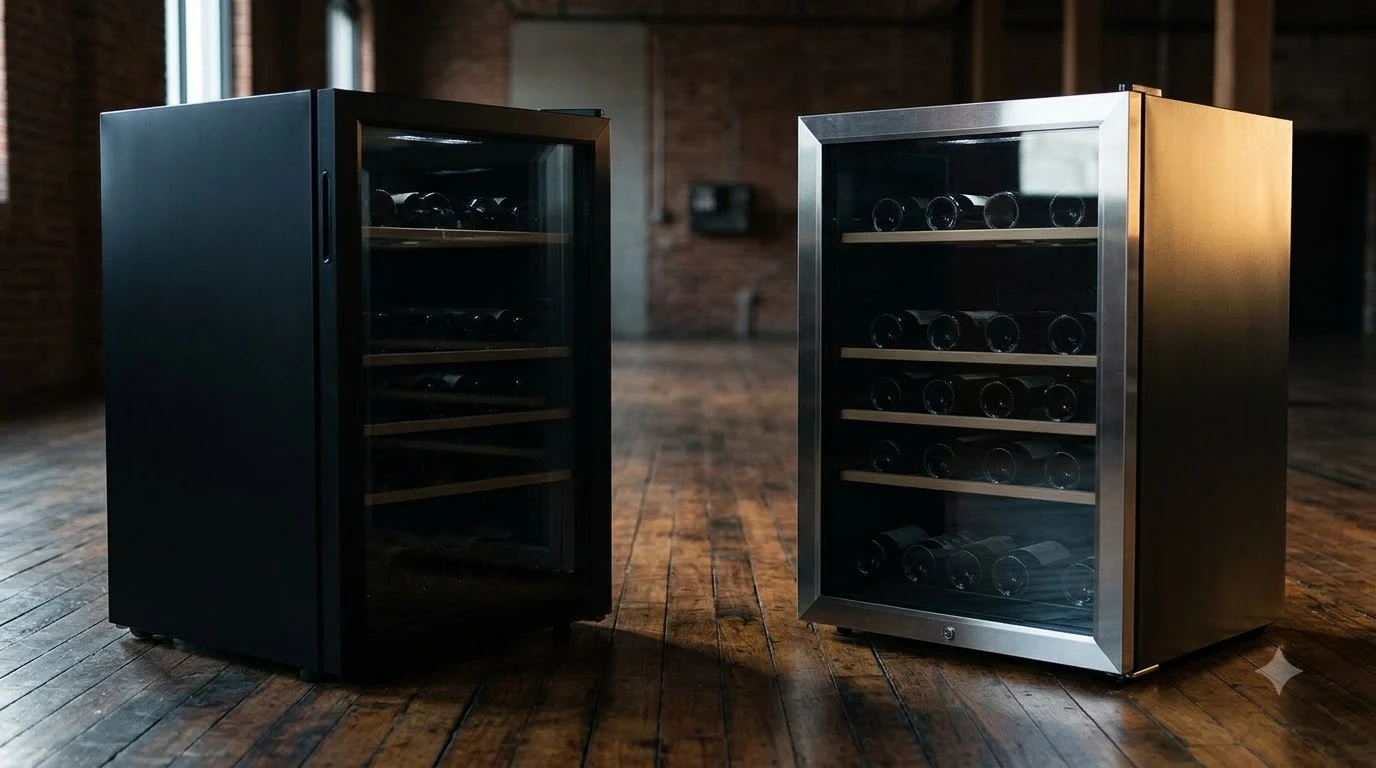
EdgeStar vs Whynter wine coolers: Whynter is a particularly strong choice for buyers who prioritize quiet compressor cooling and built-in installation, while EdgeStar offers a broad selection of capacities and configurations for different home layouts. Both brands offer dual-zone wine refrigerators, reversible doors, and options for storing red and white wines separately. The right choice depends on the exact model, available cabinet space, temperature requirements, and the features that matter most to your collection.
Choosing between EdgeStar and Whynter is easier when comparing specific models rather than assuming every refrigerator from either brand performs identically. Their product ranges include compact wine coolers, undercounter appliances, freestanding refrigerators, and larger-capacity storage units. This comparison uses the EdgeStar CWR462DZ and Whynter BWR-462DZ as representative 46-bottle dual-zone models, while also considering the wider selections offered by both brands. Readers comparing other appliance categories can also explore our Versus product comparisons for a similar model-by-model approach.
| Comparison | EdgeStar CWR462DZ | Whynter BWR-462DZ |
|---|---|---|
| Advertised capacity | 46 bottles | 46 bottles |
| Cooling configuration | Dual zone | Dual-zone compressor |
| Upper temperature range | 40°F–54°F | 40°F–55°F |
| Lower temperature range | 54°F–65°F | 50°F–65°F |
| Dimensions (H × W × D) | 33.5 × 23.5 × 22.5 inches | 32.5 × 23.5 × 22.5 inches |
| Maximum listed power | 120 watts | 100 watts |
| Electrical supply | 115V / 60Hz | 115V / 60Hz |
| Refrigerant | R600a | R600a |
| Reversible door | Yes | Yes |
| Warranty | One year parts and labor | One-year limited warranty |
Temperature Control and Cooling Performance
Both brands provide dual-zone storage, but their temperature ranges are not identical. Whynter offers a slightly wider upper-zone range on the BWR-462DZ, while EdgeStar’s CWR462DZ provides a straightforward division between cooler upper storage and warmer lower storage.

The EdgeStar CWR462DZ has an upper-zone range of 40°F to 54°F and a lower-zone range of 54°F to 65°F. This arrangement accommodates a collection containing sparkling wine, white wine, rosé, and red wine. The shared boundary at 54°F means the refrigerator is designed around two complementary storage environments rather than two completely independent temperature ranges.
Whynter’s BWR-462DZ provides an upper range of 40°F to 55°F and a lower range of 50°F to 65°F. The overlapping temperature ranges give owners more flexibility when assigning wines to different compartments. For example, a collector can maintain sparkling wine or crisp white wine in the upper section while keeping fuller-bodied whites or reds in the lower section.
Both models use compressor-based cooling. Compressor systems are generally suitable for larger refrigerators and environments where more substantial cooling capacity is needed. They are also less dependent on a small difference between room temperature and the selected cabinet temperature than many thermoelectric designs.
Matching storage temperatures to wine styles
Temperature selection matters because different wine styles benefit from different serving conditions. Sparkling wines are generally served at 40°F to 50°F, light whites and rosé at 45°F to 50°F, full-bodied whites at 50°F to 55°F, light reds at 55°F to 60°F, and fuller-bodied reds at 60°F to 65°F.
Neither refrigerator needs to reproduce every serving temperature perfectly to be useful. A wine cooler primarily provides controlled storage, and bottles can receive a final adjustment before serving. For example, a Chardonnay stored around 52°F can be brought slightly cooler if preferred, while a Cabernet Sauvignon stored around 62°F can be served without extensive warming.
The choice also depends on whether the collection contains mostly one wine category or several. Someone storing primarily Sauvignon Blanc and Riesling may prefer a consistently cool environment. A household that regularly purchases Pinot Noir, Merlot, sparkling wine, and Chardonnay has a stronger reason to consider dual-zone storage.
For broader wine storage guidance, the distinction between long-term storage and serving temperature is important. Keeping wine at a suitable, relatively consistent temperature is more useful than repeatedly changing settings to match the serving temperature of individual bottles.
For additional product information, consult the Whynter BWR-462DZ specifications, which identify the temperature ranges, cooling system, and installation configuration.
Storage Capacity and Cabinet Dimensions
Both representative models advertise space for 46 standard wine bottles, making them comparable choices for medium-sized collections. Their external dimensions are also close, although Whynter’s refrigerator is approximately one inch shorter than the EdgeStar model.
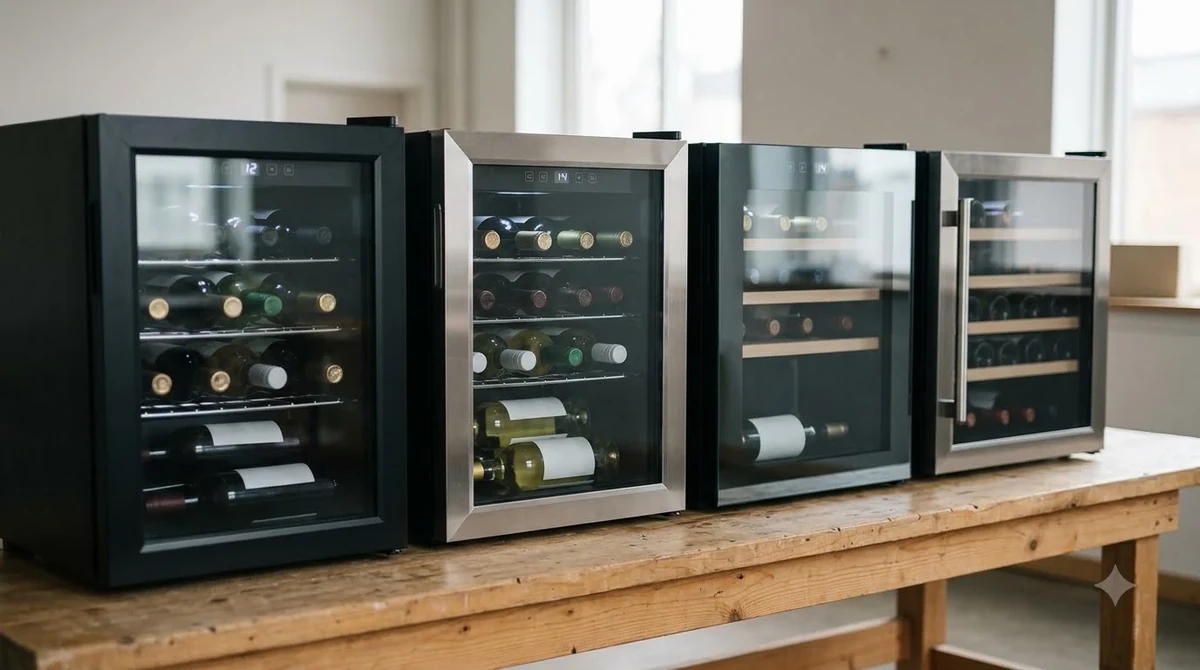
The EdgeStar CWR462DZ measures 33.5 inches high, 23.5 inches wide, and 22.5 inches deep without the handle. Its advertised capacity is based on 46 standard 750 ml bottles. The dimensions make it a potential option for an undercounter installation where the available opening matches the manufacturer’s installation requirements.
Whynter’s BWR-462DZ measures 32.5 inches high, 23.5 inches wide, and 22.5 inches deep without the handle. Its 46-bottle capacity is divided into 16 bottles in the upper compartment and 30 in the lower compartment. The slightly shorter cabinet can matter in kitchens where countertop height and opening clearance are important considerations.
Advertised capacity versus practical capacity
A stated 46-bottle capacity should not be interpreted as a guarantee that every combination of 46 bottles will fit. Wine refrigerator manufacturers generally calculate capacity using standard Bordeaux-style bottles. Actual storage depends on bottle shape, diameter, shoulder width, and shelf spacing.
Champagne bottles, wide Pinot Noir bottles, and certain specialty wine bottles can occupy considerably more room than standard Bordeaux bottles. A collection with many sparkling wines may therefore require more shelf space than the advertised capacity suggests.
Consider the following practical examples:
- Standard Bordeaux bottles: These are the reference format used for advertised capacity and generally make the most efficient use of shelving.
- Champagne bottles: Their wider bodies can reduce the number of bottles accommodated on a shelf.
- Pinot Noir bottles: Some producers use wider or more rounded bottle designs that require additional clearance.
- Mixed collections: Different bottle shapes can make a nominal 46-bottle refrigerator feel considerably smaller.
Whynter specifies five removable slide-out roller wood-faced shelves for the BWR-462DZ. Removable shelving provides some flexibility for organizing bottles, although removing shelves also changes how the available storage space is used. Buyers should examine the shelf arrangement and internal measurements before assuming oversized bottles will fit comfortably.
EdgeStar’s capacity should be evaluated in the same way. Its 46-bottle specification provides a useful starting point, but a household with many large-format bottles should prioritize internal shelf measurements rather than relying exclusively on the advertised total.
For a collection that is expected to grow beyond 46 bottles, both brands offer larger alternatives. EdgeStar’s published range includes models advertised for 141 and 142 bottles, while Whynter’s product range includes a 92-bottle dual-zone refrigerator. These larger appliances require more careful planning for floor space, electrical access, and ventilation.
Installation Flexibility and Kitchen Fit
Installation requirements can determine which brand is more suitable before cooling performance becomes a consideration. Front-venting wine refrigerators are generally appropriate for built-in installation, whereas rear-venting freestanding appliances need adequate clearance and should not be enclosed inside cabinetry.
The EdgeStar CWR462DZ is described as a built-in wine cooler with freestanding installation flexibility. Its owner manual provides specific clearance requirements, including approximately 1 to 2 inches behind the appliance and 1/4 inch at the top and sides. It also emphasizes maintaining sufficient access for ventilation and servicing.
Whynter’s BWR-462DZ is explicitly listed for both built-in and freestanding use. Its front-venting design supports undercounter placement, while the same appliance can also operate independently in a suitable location. This configuration makes it attractive to homeowners who want an appliance that can work in different room layouts.
Built-in installation considerations
A built-in refrigerator needs more than the correct width and height. The ventilation system, door movement, cabinet opening, electrical outlet, and service access must all be considered before installation.
The two representative models have the same stated width and depth without their handles, but their heights differ by one inch. That small difference can become important when the available opening is close to the appliance’s stated dimensions.
Before choosing either refrigerator, measure the complete installation opening rather than the cabinet door or visible countertop space. Include the handle, hinge movement, toe-kick area, and any trim that could interfere with ventilation.
Door direction is another practical consideration. Both models have reversible doors, allowing the opening direction to be adjusted to suit the surrounding kitchen. This can make access easier when a refrigerator is positioned beside a dishwasher, kitchen island, or wall.
Whynter’s product guidance also makes an important distinction: built-in models with front ventilation can generally be used freestanding, but freestanding models that release heat through the rear should not be enclosed as built-in appliances. That distinction is useful when comparing models from either brand, particularly if the refrigerator may be relocated later.
Tip: Measure the refrigerator opening in three places: near the floor, at the middle, and near the countertop. Check the appliance’s full depth with the handle installed, then confirm the manufacturer’s ventilation and servicing requirements before ordering or building cabinetry.
Features, Shelving, and Everyday Convenience
EdgeStar and Whynter both offer useful features for organizing and protecting a home wine collection. The most meaningful differences are found in individual models rather than in a universal advantage for either brand.
The EdgeStar CWR462DZ includes a temperature-memory function, an internal fan, and a carbon filter. The memory function restores the previous temperature setting after a power interruption. The carbon filter is intended to reduce the effect of surrounding odors, while internal air circulation helps distribute cooled air throughout the cabinet.
The manual also describes a door-ajar alarm and temperature-related warning features. These functions can be useful when the refrigerator is installed in a busy kitchen where the door may occasionally be left open. A warning provides an opportunity to close the door before the cabinet experiences a prolonged temperature disturbance.
Whynter’s BWR-462DZ offers a different combination of convenience features. Its published specifications include a security lock and key, malfunction alarm, temperature memory, Sabbath mode, and reversible door. The soft white LED interior lighting includes separate function and showcase modes.
Shelf design and bottle access
Whynter uses five removable slide-out roller wood-faced shelves in the BWR-462DZ. This arrangement makes it easier to access bottles without having to move every bottle in front of the one being selected. The wood-faced construction also gives the interior a traditional wine-cellar appearance.
EdgeStar’s shelving should be evaluated according to the exact model being considered. Its wider range includes different refrigerator designs, so shelf materials, pull-out mechanisms, and internal layouts should not be assumed to be identical across every product.
For frequent entertaining, sliding shelves can be especially convenient. A household that regularly serves several different wines may appreciate being able to locate and retrieve a bottle without disturbing the surrounding collection.
Door protection and lighting
Glass doors are useful for viewing a collection without opening the refrigerator. However, wine is sensitive to excessive light exposure, so a refrigerator’s glass construction and protective features deserve attention. Whynter specifies double-pane glass on the BWR-462DZ, while EdgeStar’s CWR462DZ uses a stainless steel door design with a glass viewing area.
Interior lighting also affects how easily bottles can be identified. LED lighting provides visibility without requiring a conventional high-heat bulb. Whynter’s soft white lighting is suitable for locating bottles, while its showcase mode provides an additional display option.
Locks may be useful in households where children have access to the kitchen or where a collection contains bottles that should not be moved casually. Whynter lists a security lock for the BWR-462DZ. Buyers considering EdgeStar should confirm the presence of a lock on the specific model rather than assuming every wine cooler includes one.
Noise Levels, Power Consumption, and Maintenance
Noise and energy use are important for refrigerators installed near living areas, dining spaces, and home entertainment rooms. Whynter publishes a below-38-dB noise specification for the BWR-462DZ, while EdgeStar’s CWR462DZ documentation provides a 120-watt input-power specification without an equivalent numerical noise rating.
Whynter lists maximum power consumption of 100 watts and a current rating of 0.8 amps for the BWR-462DZ. EdgeStar lists 120 watts and 1.5 amps for the CWR462DZ. These figures provide a useful comparison of the stated electrical specifications, but they should not be interpreted as direct measurements of annual electricity consumption.
Actual energy use depends on operating conditions, room temperature, door-opening frequency, ventilation, thermostat settings, and compressor cycling. A refrigerator does not necessarily draw its maximum listed power continuously throughout the day.
Understanding operating noise
Whynter’s published noise figure gives buyers a specific reference when planning an installation near a dining table or living room. A rating below 38 dB indicates that the manufacturer positions this model as a relatively quiet appliance.
EdgeStar’s CWR462DZ documentation does not provide a comparable numerical sound rating in the specifications reviewed here. Its compressor, internal fan, and refrigerant circulation can produce normal operating sounds. The manual explains that rattling may come from refrigerant movement, water lines, or items placed on top of the refrigerator.
Neither brand should be selected on the assumption that every model will operate at the same sound level. EdgeStar’s published range includes a thermoelectric 52-bottle model, while other models use different cooling arrangements. Whynter also sells thermoelectric and compressor refrigerators. The cooling technology and model-specific sound rating therefore deserve more attention than the brand name alone.
Routine maintenance
Proper ventilation is one of the simplest ways to support consistent operation. A refrigerator installed too close to a heat source or without sufficient clearance may struggle to maintain its target temperature. Both brands’ installation instructions emphasize suitable surroundings and airflow.
The EdgeStar CWR462DZ manual recommends an ambient operating environment above 50°F and below 95°F. It also explains that the appliance should remain level and that the door gasket should be kept clean to support proper sealing.
For the carbon filter, EdgeStar’s manual recommends replacement every three to six months depending on exposure to odors. A kitchen installation may require more frequent replacement than a refrigerator located in a dedicated wine room.
Whynter owners should also keep the ventilation area clear, maintain the door seal, and follow the specific cleaning and service instructions supplied with their refrigerator. Sliding shelves should be handled carefully, especially when heavily loaded.
For either brand, avoid using abrasive cleaners on the cabinet or door. Disconnect power before performing interior cleaning, and allow the appliance to return to its operating temperature before loading a full collection after extended maintenance.
Warranty Coverage and Customer Support
Warranty terms deserve attention because wine refrigerators are appliances that may operate continuously for years. The representative EdgeStar and Whynter models both carry one-year limited warranty coverage, although the specific coverage wording and service conditions should be compared before purchase.
EdgeStar’s CWR462DZ owner manual describes a full one-year parts-and-labor warranty for qualifying residential use. It covers defects in materials and workmanship under the conditions specified in the documentation. The manual also explains that service is handled through authorized repair arrangements and that the warranty applies to the original purchaser under its stated conditions.
Whynter lists a one-year limited warranty for the BWR-462DZ. Its product information also provides access to the model’s owner manual and support resources. Buyers should review the applicable warranty terms, including exclusions, service procedures, and any requirements involving product registration or proof of purchase.
What buyers should confirm
Warranty length alone does not tell the entire story. Installation labor, transportation, cosmetic damage, commercial use, and improper operation may be excluded from coverage. These details can affect the practical value of a warranty even when two products advertise the same coverage period.
Before completing a purchase, confirm the following:
- Parts coverage: Determine which components are covered and whether replacement parts are included.
- Labor coverage: Confirm whether diagnostic work and authorized repairs are covered during the warranty period.
- Service location: Find out whether the appliance must be shipped to an authorized facility or can receive local service.
- Installation exclusions: Review whether damage caused by incorrect ventilation, electrical connections, or installation is excluded.
- Documentation: Keep the receipt, model number, serial number, and original installation information.
The EdgeStar CWR462DZ manual specifically advises owners to record the model and serial numbers from the appliance’s rating label. This information can help identify the correct product when contacting customer service.
Whynter also provides model-specific manuals and product support resources. Checking these resources before purchase is particularly useful when an appliance will be installed inside custom cabinetry or used as part of a larger kitchen renovation.
Which Should You Pick: EdgeStar or Whynter?
Whynter is a strong choice for buyers who want a clearly specified dual-zone compressor refrigerator with published noise information and useful built-in features. EdgeStar is worth considering for shoppers who want to explore a broad selection of capacities, installation configurations, and cooling technologies.
Choose Whynter if quiet operation matters
The BWR-462DZ has a published noise rating below 38 dB, which gives buyers a useful point of comparison when the refrigerator will sit near a dining or living area. Its 100-watt maximum power specification, five removable roller shelves, lock, and malfunction alarm add practical value.
Its 40°F–55°F upper zone and 50°F–65°F lower zone also provide flexibility for collections containing several wine styles. The front-venting design is particularly useful for homeowners planning an undercounter installation.
Choose EdgeStar if product variety matters
EdgeStar’s published selection covers several capacity categories, from compact 12-bottle appliances to large 141- and 142-bottle configurations. Buyers who are still deciding between a compact bar refrigerator, a medium-sized kitchen appliance, and a larger collection unit have multiple configurations to investigate.
The CWR462DZ offers a useful 46-bottle reference point, with temperature memory, an internal fan, and a carbon filter. Its 40°F–54°F upper zone and 54°F–65°F lower zone suit households that prefer a clearly divided dual-zone arrangement.
Choose according to your installation
For an undercounter kitchen, compare the precise opening dimensions and front-venting requirements before selecting either brand. Whynter’s BWR-462DZ is explicitly designed for built-in or freestanding use. EdgeStar’s CWR462DZ also supports built-in and freestanding installation, subject to the clearance instructions in its manual.
For a freestanding wine refrigerator, prioritize room layout, available floor space, door clearance, and the ability to access the appliance for maintenance. A model with a larger capacity is not automatically better if it occupies more space than the collection requires.
Final buying recommendation
For a direct comparison between the two 46-bottle models, Whynter has the more detailed published noise specification and a useful combination of alarms, shelving, and security features. EdgeStar remains a competitive alternative with a similar advertised capacity and a different temperature-zone arrangement.
Neither brand is automatically the right choice for every wine enthusiast. Compare the precise model specifications, installation instructions, and warranty conditions before deciding. For help choosing a suitable wine refrigerator capacity, explore our wine refrigerator reviews for additional model comparisons and buying considerations.
Frequently Asked Questions
Can a wine refrigerator also store opened wine bottles?
Yes. Both types of wine refrigerator can provide a convenient place for opened bottles when the bottles are properly resealed. Use a suitable stopper or closure to reduce oxygen exposure, and keep the bottles upright when practical to minimize leakage.
Should wine bottles be stored horizontally in these refrigerators?
Traditional cork-sealed bottles are commonly stored horizontally so the wine remains in contact with the cork. Screw-cap bottles do not require this arrangement, although horizontal storage can still make better use of shelf space. Bottle orientation should also account for the refrigerator’s shelf design.
Can a wine refrigerator be used for beverages other than wine?
Some wine refrigerators can accommodate canned drinks or other bottled beverages, but their shelf spacing and temperature controls are designed primarily for wine. Check the appliance’s intended use and shelf dimensions before loading non-wine containers. A dedicated beverage refrigerator may provide more convenient storage for cans and taller drink bottles.
How long should a new wine refrigerator run before loading bottles?
Allow the appliance to stabilize and reach its selected operating temperature before adding the collection. EdgeStar’s CWR462DZ manual specifically recommends allowing at least 24 hours for the selected temperature to be reached before storing wine. Transportation and setup instructions may differ between models.
Does a wine refrigerator replace a dedicated wine cellar?
A wine refrigerator can provide convenient temperature-controlled storage for a household collection, but it is not necessarily equivalent to a dedicated cellar designed for long-term aging. A cellar may offer more extensive control over humidity, insulation, capacity, and environmental stability. The appropriate solution depends on collection size and how long the bottles are intended to be stored.
EdgeStar and Whynter both offer worthwhile wine storage options, but their differences become clearer when individual models are compared. Whynter makes a compelling case for buyers prioritizing published noise specifications and built-in convenience, while EdgeStar offers a varied selection for different storage needs. Choose the refrigerator that fits your collection, installation space, and preferred temperature arrangement rather than relying on brand reputation alone.
More in Versus
 Edgestar Vs Kalamera: Choose the Right Wine CoolerUpdated Nov 21, 2026
 Frigidaire Vs Magic Chef: Compare Wine Cooler Features and FitUpdated Nov 21, 2026
 Newair Vs Whynter: Choose the Right 46-Bottle Wine CoolerUpdated Nov 21, 2026
 Kalamera Vs Newair: Choose the Right Wine Cooler for Your HomeUpdated Nov 21, 2026
 Danby Vs Vinotemp: Choose the Right Wine Cooler for Your SpaceUpdated Nov 21, 2026
 Dual Zone vs Single Zone Wine Fridge: Choose the Right Storage SetupUpdated Nov 21, 2026