

We may earn a commission when you buy through links on this page, at no extra cost to you. Learn more.
Frigidaire vs Magic Chef comes down to temperature control, storage capacity, and installation flexibility: Frigidaire is generally the stronger choice for wine enthusiasts who want electronic controls and separate temperature zones, while Magic Chef offers practical options for smaller collections and straightforward storage. Both brands sell freestanding wine refrigerators, and some Magic Chef models also accommodate built-in installation. The right choice depends less on the brand name than on the specifications, bottle arrangement, and temperature features of the particular model.
Choosing a wine refrigerator involves more than finding a cabinet that holds the advertised number of bottles. Temperature stability, shelf spacing, door clearance, and the difference between single-zone and dual-zone cooling all affect how conveniently a collection can be stored. Frigidaire and Magic Chef approach these requirements differently across their product ranges, so comparing representative models helps identify which features matter most before purchasing.
| Comparison | Frigidaire | Magic Chef |
|---|---|---|
| Representative model | FRWE4626AS | MCWC30SV |
| Advertised capacity | 46 bottles | 30 bottles |
| Temperature control | Electronic digital controls | Mechanical thermostat dial |
| Temperature zones | Two | One on MCWC30SV |
| Temperature range | 41°F–64°F | No numerical range specified in the MCWC30SV manual |
| Width | Approximately 21 7/16 inches | 18.9 inches |
| Installation | Freestanding | Freestanding on MCWC30SV |
| Door | Reversible | Reversible |
| Lighting | LED | Interior light |
| Warranty | 1 year parts and labor | 1 year parts and labor; 5 years compressor parts |
This comparison uses the Frigidaire FRWE4626AS and Magic Chef MCWC30SV as representative examples, not as identical-capacity competitors. Individual models differ considerably, including Magic Chef’s larger 50-bottle options and Frigidaire’s other two-zone configurations. Specifications should therefore be compared model by model rather than assumed to apply to every refrigerator sold under either brand.
Storage Capacity and Physical Dimensions
Frigidaire offers a useful advantage for larger collections, while Magic Chef has compact options that can fit more easily into limited spaces. The difference between a 30-bottle cabinet and a 46-bottle cabinet can influence both purchasing decisions and everyday organization.
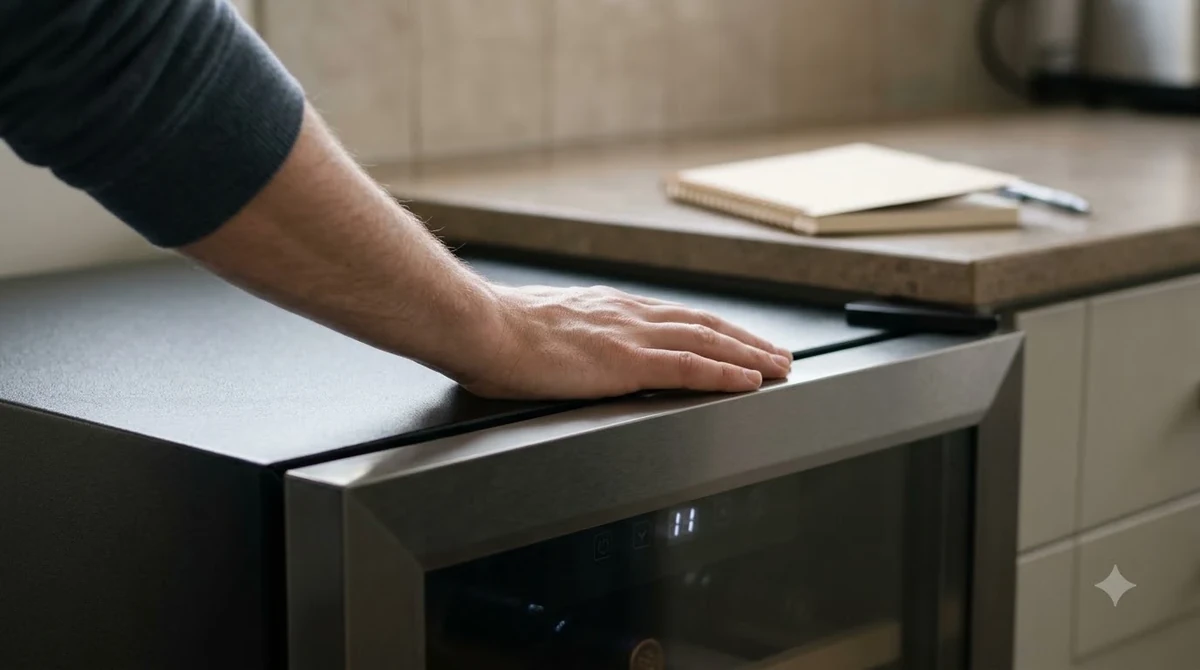
The Frigidaire FRWE4626AS is rated for up to 46 wine bottles, making it a reasonable choice for households that regularly keep several varieties available. Its approximately 21 7/16-inch width and 33 1/4-inch height without the hinge make it a relatively compact cabinet for its stated capacity. The interior uses wooden shelves, and its two-zone arrangement gives the collection more flexibility than a basic single-temperature refrigerator.
The Magic Chef MCWC30SV takes a different approach. Its stated capacity is 30 bottles, and its dimensions are 18.9 inches wide, 33.1 inches high, and 20.5 inches deep. That narrower profile can be useful in an apartment, dining room, or small home bar where every inch of floor space matters. It also provides a more modest storage commitment for someone who buys wine regularly but does not maintain a large reserve.
Capacity figures deserve careful attention because manufacturers generally calculate bottle counts using standard 750 ml wine bottles. A collection containing sparkling wine, Champagne, Burgundy bottles, or unusually shaped bottles may not fit in the same arrangement. Wider bottles need more horizontal room, while taller bottles can interfere with shelf spacing.
Magic Chef also has larger options. Its MCWC50DST, for example, is listed as a 50-bottle cooler with dimensions of 23.4 inches wide, 34.4 inches high, and 24.4 inches deep. This shows why it would be misleading to describe the entire Magic Chef range as small or limited-capacity. A larger Magic Chef model can exceed the advertised capacity of the representative Frigidaire refrigerator.
For practical planning, leave some unused space rather than assuming every advertised bottle position will be useful. A collection of 25 standard bottles may fit comfortably in a 30-bottle cabinet, while a collection of 30 bottles with several wide Champagne bottles may require more room than the nominal count suggests.
Temperature Control and Dual-Zone Performance
Frigidaire has an advantage in the representative comparison because its FRWE4626AS provides electronic temperature controls and two temperature zones. The Magic Chef MCWC30SV uses a mechanical thermostat, making it a simpler option for owners who do not need separate settings for different wine styles.
The Frigidaire FRWE4626AS has a stated adjustable range of 41°F to 64°F. Its electronic controls allow users to select a temperature rather than relying on a numbered mechanical dial. Two temperature zones are particularly useful for households that keep both red and white wine ready for serving. Whites and sparkling wines generally need cooler conditions, while many reds are better served at warmer temperatures.
The distinction is important because a single-zone cooler maintains one general temperature throughout its storage compartment. That can be perfectly suitable for a collection consisting mainly of one wine style or for long-term storage at a consistent temperature. However, it is less convenient for a household that wants chilled Sauvignon Blanc alongside bottles of Cabernet Sauvignon.
The Magic Chef MCWC30SV manual describes a thermostat with seven numbered cooling positions. Position 1 is the warmest and position 7 is the coldest. The manual recommends position 2 for red wines and position 6 for white wines. These recommendations provide a basic starting point, but they are not equivalent to a digital temperature display or two independently controlled zones.
A mechanical dial can also require more observation. Changing a setting does not immediately change the temperature of every bottle, and the manual recommends allowing several hours for temperatures to stabilize between adjustments. Owners should use an independent refrigerator thermometer if they need to understand the actual temperature inside a cabinet controlled by numbered settings.
Tip: For serving, use approximately 45°F to 50°F for light whites and rosé, 50°F to 55°F for fuller-bodied whites, 55°F to 60°F for lighter reds, and 60°F to 65°F for fuller-bodied reds. Storage and serving temperatures are different considerations, so choose a refrigerator based on the storage conditions your collection requires.
Frigidaire’s older FFWC3822QS specifications provide another useful example of its dual-zone approach. That model lists an upper zone of 41°F to 54°F and a lower zone of 55°F to 64°F. These ranges illustrate the benefit of having dedicated cooler and warmer sections, although the exact temperature settings vary between Frigidaire models.
For buyers who want to keep Prosecco ready for an Aperol spritz recipe while storing reds separately, two temperature zones can make daily use more convenient. The same advantage applies to a Hugo spritz recipe, which uses chilled sparkling wine. A single-zone cabinet can still store these bottles, but it cannot independently maintain different temperatures in separate compartments.
Shelving, Door Design, and Everyday Convenience
Both brands offer glass-door designs and reversible-door options on representative models, but their shelf arrangements and controls vary. The best choice depends on how often bottles are removed, how many large-format wines are stored, and whether convenient access matters more than maximum advertised capacity.
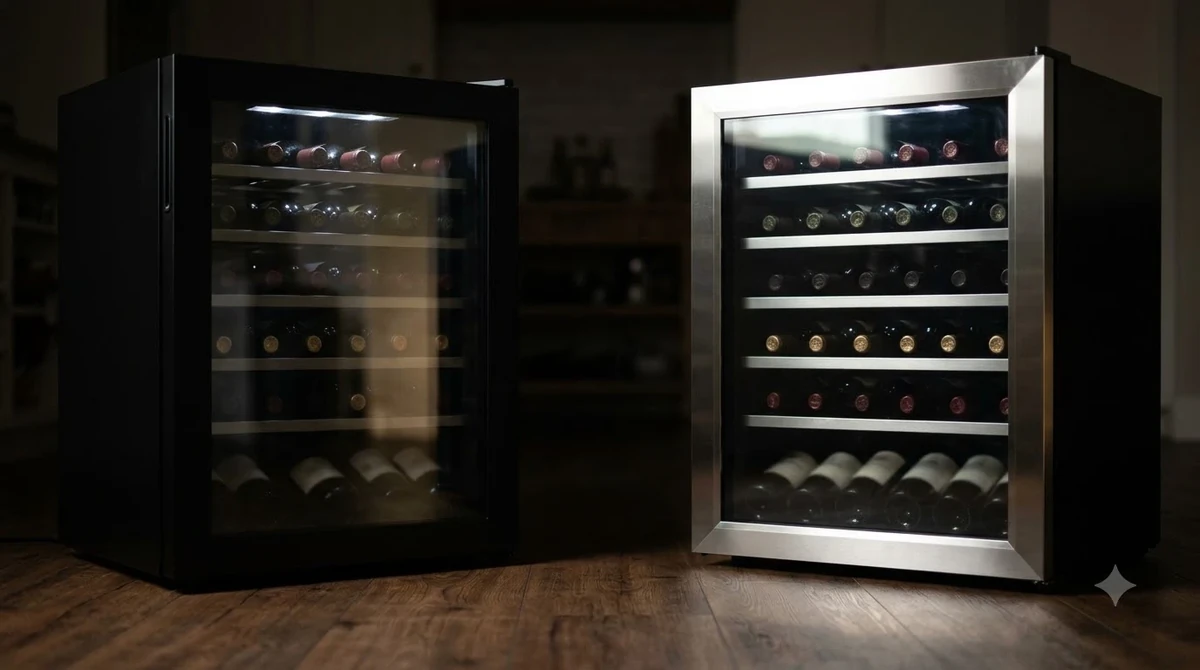
The Frigidaire FRWE4626AS uses natural stained wood shelving and a tinted glass door. The wooden shelves give the interior a traditional wine-cellar appearance, while the LED lighting makes it easier to identify bottles. Its Low-E glass door is designed to help limit heat and ultraviolet exposure, which is useful for a refrigerator intended to display a wine collection.
Frigidaire’s FFWC3822QS specifications list five slide-out wine racks. This is a useful distinction because a shelf that slides outward can make bottle identification and retrieval easier than a fixed rack. However, the specifications for that older model should not automatically be applied to every newer Frigidaire cabinet. Buyers should verify the shelf mechanism of the exact model under consideration.
The Magic Chef MCWC30SV manual identifies wine racks, a tempered glass door, and an interior light. Its simpler arrangement is designed to keep the bottles organized without adding complicated electronic features. The manual also describes automatic defrosting, which reduces the need for manual ice removal during ordinary operation.
Magic Chef’s larger MCWC50DST has sculpted chrome shelves, showing that shelf construction differs across the range. Chrome racks can be practical for regular storage, while wooden shelving may appeal more to buyers who prefer the appearance of a traditional wine cabinet. Neither material automatically guarantees better bottle access; spacing, shelf movement, and weight support are more important.
Door reversibility is another useful feature. Both the Frigidaire FRWE4626AS and Magic Chef MCWC30SV have reversible doors, allowing the opening direction to be changed to suit the room. This can help when the refrigerator sits beside a wall, cabinet, or kitchen island. However, reversing a door requires attention to hinge placement and alignment rather than simply turning the appliance around.
Before buying, measure the bottles that occupy the most space in the collection. Burgundy and Pinot Noir bottles can have wider bodies than many Bordeaux-style bottles, while sparkling wine bottles can be particularly difficult to fit in tightly spaced racks. If large bottles are common, flexible shelving and removable racks deserve more attention than the headline capacity number.
Installation Requirements and Energy Use
Installation is one of the most important differences between individual wine cooler models because a freestanding cabinet cannot automatically be treated as a built-in appliance. Frigidaire’s representative model is designed for freestanding use, while Magic Chef offers both freestanding and built-in models in its wider range.
The Magic Chef MCWC30SV manual explicitly states that the appliance is freestanding only and should not be recessed or installed inside cabinetry. It requires five inches of clearance at the back and sides for ventilation. Installing it inside a tight cabinet opening could restrict airflow and interfere with cooling performance.
This distinction matters because Magic Chef also sells models such as the MCWC50DST that are listed for built-in or freestanding installation. That flexibility belongs to the specific model, not automatically to every Magic Chef wine cooler. A buyer planning an under-counter installation must choose a model specifically designed and approved for that purpose.
The Frigidaire FRWE4626AS is likewise a freestanding wine cooler. Its dimensions should be checked against the intended location, including the space needed for the door to open. A cabinet that fits between two kitchen units may still be inconvenient if its door cannot swing far enough to allow the shelves and bottles to be accessed.
Energy use is another comparison point. Frigidaire lists annual consumption of 151 kWh for the FRWE4626AS and identifies it as ENERGY STAR certified. This provides a published reference for estimating electricity consumption. Actual consumption can differ depending on room temperature, ventilation, door openings, and the way the refrigerator is loaded.
For an installation decision, compare the appliance’s full dimensions rather than relying only on its width and height. Include the door handle, hinge movement, electrical outlet, ventilation clearance, and any surrounding cabinet doors. A few inches of extra space can make the difference between a convenient installation and a refrigerator that is difficult to use.
The Magic Chef MCWC30SV manual also specifies an ambient operating range of 55°F to 77°F. It warns that temperatures outside this range can hinder appliance performance. A hot garage, an unheated room, or a location beside an oven may therefore be unsuitable even if the refrigerator physically fits.
Warranty Coverage, Maintenance, and Long-Term Ownership
Both brands provide basic warranty coverage on representative wine coolers, but the details are not identical. Magic Chef’s MCWC30SV manual specifies additional compressor-parts coverage, while Frigidaire lists one year of parts and labor coverage for its FRWE4626AS.
The Magic Chef MCWC30SV warranty covers parts and labor for one year and compressor parts for five years. The longer compressor coverage is a useful feature to consider because the compressor is a major component of a conventional refrigeration system. However, the extended period covers compressor parts rather than all labor and transportation expenses.
Frigidaire lists one year of parts and labor coverage for the FRWE4626AS. Its published product information also provides access to the owner’s guide, product specifications, replacement parts, and certified service information. These support resources matter when an appliance needs troubleshooting or a replacement component.
Warranty comparisons should focus on the actual coverage rather than the number of years alone. A five-year compressor-parts warranty does not mean the complete refrigerator is covered for five years. Buyers should also consider whether service is available in their location, what proof of purchase is required, and which expenses remain their responsibility.
Routine maintenance is relatively straightforward for both types of appliance. Keep the door gasket clean, remove dust from accessible ventilation areas, avoid blocking interior airflow, and wipe up spills promptly. A clean gasket helps the door close properly, reducing the amount of warm air that enters the cabinet.
The Magic Chef MCWC30SV manual recommends cleaning its interior with a solution of approximately two tablespoons of baking soda per quart of water. It also advises keeping the appliance away from direct sunlight and heat-producing equipment. These are practical steps for preserving normal cooling operation.
Frigidaire’s instructions for its newer wine cooler range similarly emphasize proper ventilation and avoiding overloaded shelves or blocked air vents. Overloading can interfere with air circulation and cause the compressor to run longer. Organizing bottles so that frequently used items are accessible can also reduce unnecessary door openings.
For either brand, a wine cooler should not be expected to replace a dedicated long-term wine cellar in every situation. A domestic appliance can provide convenient temperature-controlled storage, but owners should consider room conditions, vibration, light exposure, and the stability of the selected temperature. Collectors storing valuable bottles for many years may prefer equipment specifically designed for cellar conditions.
Which Brand Should You Choose?
Frigidaire is the stronger starting point for buyers who prioritize electronic temperature control, two-zone storage, and clearly specified features. Magic Chef makes sense for buyers who want straightforward operation, compact choices, or a larger model with a suitable built-in installation rating.
Choose Frigidaire if the collection regularly includes reds, whites, and sparkling wines that benefit from separate storage temperatures. The FRWE4626AS provides a 46-bottle capacity, a 41°F to 64°F adjustment range, electronic controls, and two temperature zones. Its LED lighting, reversible door, and Low-E glass add practical convenience for a visible home wine display.
Frigidaire is also a reasonable choice if energy information is important. The FRWE4626AS has published annual consumption of 151 kWh and ENERGY STAR certification. That gives buyers a concrete specification to compare against other appliances rather than relying only on general claims about energy efficiency.
Choose a smaller Magic Chef model if the collection is modest and the installation space is narrow. The MCWC30SV has a 30-bottle capacity and a width of 18.9 inches. Its mechanical thermostat is simple to operate, and its reversible door provides flexibility when arranging the appliance in a small room.
Magic Chef may also be the better choice if the goal is a larger built-in or freestanding wine refrigerator. Its MCWC50DST is rated for 50 bottles and offers both installation options. This makes it important to compare the particular Magic Chef model rather than assuming that the brand only specializes in compact cabinets.
Neither brand should be selected on capacity alone. A nominal 50-bottle refrigerator may be less useful than a 46-bottle cabinet if the former has poor shelf spacing for the bottles in a collection. Likewise, a dual-zone refrigerator offers little benefit to someone who stores only one type of wine and wants a single consistent temperature.
Consider the room before making the final decision. Measure the available floor space, confirm ventilation requirements, and account for the door opening. Then compare the temperature range with the wines that will actually be stored. If the refrigerator will hold mostly Sauvignon Blanc, Chardonnay, and sparkling wine, cooler storage flexibility may be more important than the number of bottles it can accommodate.
For households that enjoy cooking as well as wine, a convenient wine refrigerator can also make it easier to keep bottles ready for entertaining. A chilled white wine can accompany lighter dishes, while a suitable red can be served alongside richer meals such as those featured in a chicken Marsala recipe. The appliance should make the collection easier to organize rather than encourage buying more bottles than the available storage can handle.
For another appliance comparison, the Frigidaire FRWE4626AS official product specifications provide a useful reference for checking the advertised capacity, temperature settings, energy consumption, and design features against competing models.
The overall decision is straightforward: Frigidaire is a compelling choice for buyers who value separate temperature zones and electronic settings, while Magic Chef offers a broader range of simple and larger-format storage possibilities. Comparing exact model specifications, rather than relying on brand reputation alone, is the most reliable way to find a wine cooler that fits the home and collection.
Frequently Asked Questions
Do Frigidaire and Magic Chef wine coolers use the same type of compressor?
Cooling technology varies by model, so the brand name alone does not establish whether two refrigerators use identical compressor systems. For example, Magic Chef’s six-bottle MCWC6B is specified as a thermoelectric cooler, while its larger models use different refrigeration configurations. Check the technical specifications for the exact model before comparing cooling technology.
Can a wine cooler be used to chill regular food and drinks?
A dedicated wine cooler is designed around wine-bottle storage rather than general refrigerator organization. Some Magic Chef wine and beverage centers include interchangeable shelves for cans and bottles, but that does not mean every wine-only model is suitable for food storage. A dedicated beverage refrigerator is generally a more practical choice for mixed household drinks.
Should a wine cooler remain plugged in during a short vacation?
The Magic Chef MCWC30SV manual recommends leaving the appliance operating during vacations shorter than three weeks. For an extended absence lasting several months, it recommends removing the contents, unplugging the refrigerator, cleaning and drying the interior, and leaving the door slightly open. Follow the instructions for the particular model because vacation procedures can differ.
How long should a wine cooler run before bottles are loaded?
The Magic Chef MCWC30SV manual recommends allowing the refrigerator to cool for approximately three to four hours after plugging it in before adding bottles. It also recommends allowing several hours for the temperature to stabilize after thermostat adjustments. A fully loaded refrigerator can take additional time to reach its intended operating conditions.
Does removing wine cooler shelves affect the advertised bottle capacity?
Yes. Removing shelves can create additional vertical space for unusually shaped bottles, but it generally reduces the number of individual storage positions available. A bottle arrangement that works for standard 750 ml bottles may not work for magnums or larger sparkling wine bottles. Plan capacity around the actual bottle sizes in the collection rather than the advertised maximum alone.
Frigidaire and Magic Chef both offer useful wine storage options, but their strengths depend on the model selected. Compare temperature zones, shelf dimensions, installation requirements, energy information, and warranty terms before deciding. A refrigerator that accommodates the collection comfortably and maintains suitable storage conditions is a better investment than one chosen solely for its advertised bottle count.
More in Versus
 Edgestar Vs Kalamera: Choose the Right Wine CoolerUpdated Nov 21, 2026
 EdgeStar Vs Whynter Wine Coolers for Smarter StorageUpdated Nov 21, 2026
 Newair Vs Whynter: Choose the Right 46-Bottle Wine CoolerUpdated Nov 21, 2026
 Kalamera Vs Newair: Choose the Right Wine Cooler for Your HomeUpdated Nov 21, 2026
 Danby Vs Vinotemp: Choose the Right Wine Cooler for Your SpaceUpdated Nov 21, 2026
 Dual Zone vs Single Zone Wine Fridge: Choose the Right Storage SetupUpdated Nov 21, 2026