

We may earn a commission when you buy through links on this page, at no extra cost to you. Learn more.
Danby vs Vinotemp comes down to the type of wine storage you need: Danby is a practical choice for straightforward household cooling, while Vinotemp offers a broader selection of specialized, large-capacity, and dual-zone wine refrigerators. Danby has options for smaller collections and under-counter installations, including models with temperature alarms and extendable shelves. Vinotemp offers multiple product families, with capacities ranging from compact collections to models designed for more than 150 bottles. The right choice depends on your available space, storage goals, installation requirements, and preferred features.
Choosing a wine refrigerator involves more than comparing bottle counts or exterior finishes. A cooler that works well in a small apartment may be unsuitable for a growing collection, while a large dual-zone cabinet may offer features that a casual wine drinker rarely uses. Danby and Vinotemp approach this market differently, so comparing their actual product specifications is more useful than assuming every refrigerator from either manufacturer offers the same capabilities.
| Comparison | Danby | Vinotemp |
|---|---|---|
| Product focus | Practical household wine coolers and under-counter appliances | Residential, premium, commercial, and specialized wine storage |
| Smaller capacity examples | 36 bottles in the DWC93BLSDBR1 | 41 bottles in the Private Reserve medium-capacity comparison |
| Medium capacity examples | 63 bottles in the DWC057D1CSS | 46 bottles in several product families |
| Large capacity examples | Additional models vary by product range | 149, 155, and 168-series examples |
| Temperature zones | Depends on the individual model | Single-zone and dual-zone options |
| Controls | Mechanical or digital, depending on model | Digital controls on featured comparison models |
| Installation | Freestanding and specified under-counter options | Freestanding, under-counter, and specialized installations |
| Warranty examples | 12 months parts and labor with in-home service | 12 months parts and labor on featured comparison models |
| Best suited to | Everyday household wine storage | Collections requiring more specialized configurations |
Product Range and Overall Brand Differences
Danby focuses on practical refrigeration appliances, while Vinotemp covers a wider range of wine-storage configurations and specialized applications. This distinction matters because the two brands do not necessarily compete at the same capacity or installation level.

Danby’s range includes compact freestanding wine coolers and larger appliances designed for kitchen installations. One useful example is the DWC93BLSDBR1, a 36-bottle freestanding model with a temperature range of 43°F to 57°F. It provides basic wine storage without requiring a dedicated wine room or a large built-in cabinet.
The DWC057D1CSS illustrates another part of Danby’s approach. This under-counter model accommodates 63 standard bottles and has extendable shelves, capacitive touch controls, internal temperature sensors, and temperature alarms. These features make it a practical option for someone who wants a more integrated kitchen wine-storage arrangement without moving into an elaborate cellar installation.
Vinotemp’s product lineup is more segmented. Its comparison identifies four main families: Designer, Connoisseur, Butler, and Private Reserve. Each has a different combination of appearance, shelving, controls, and intended installation.
The Designer Series emphasizes clean styling and includes dual-zone configurations. Connoisseur models focus on stainless-steel construction and bottle presentation. Butler products incorporate features such as dual-pane glass and specialized shelving, while Private Reserve includes panel-ready under-counter units and larger commercial-style wine refrigerators.
This broader selection gives Vinotemp an advantage for buyers with specific storage requirements. A homeowner planning a dedicated entertainment area, for example, can investigate several different configurations within the same manufacturer’s range. Danby remains a reasonable starting point for someone who wants a conventional household wine refrigerator rather than a highly specialized storage system.
Neither brand should be judged by its most impressive model alone. A large Vinotemp refrigerator does not automatically make it a better purchase for a household storing 20 bottles, just as a compact Danby does not establish whether the company has an appropriate model for every larger installation.
Bottle Capacity, Dimensions, and Available Space
Danby provides useful capacity options for household collections, while Vinotemp’s comparison demonstrates a particularly wide range of medium and large wine cabinets. Buyers should compare actual dimensions and usable shelf space rather than relying entirely on advertised bottle counts.
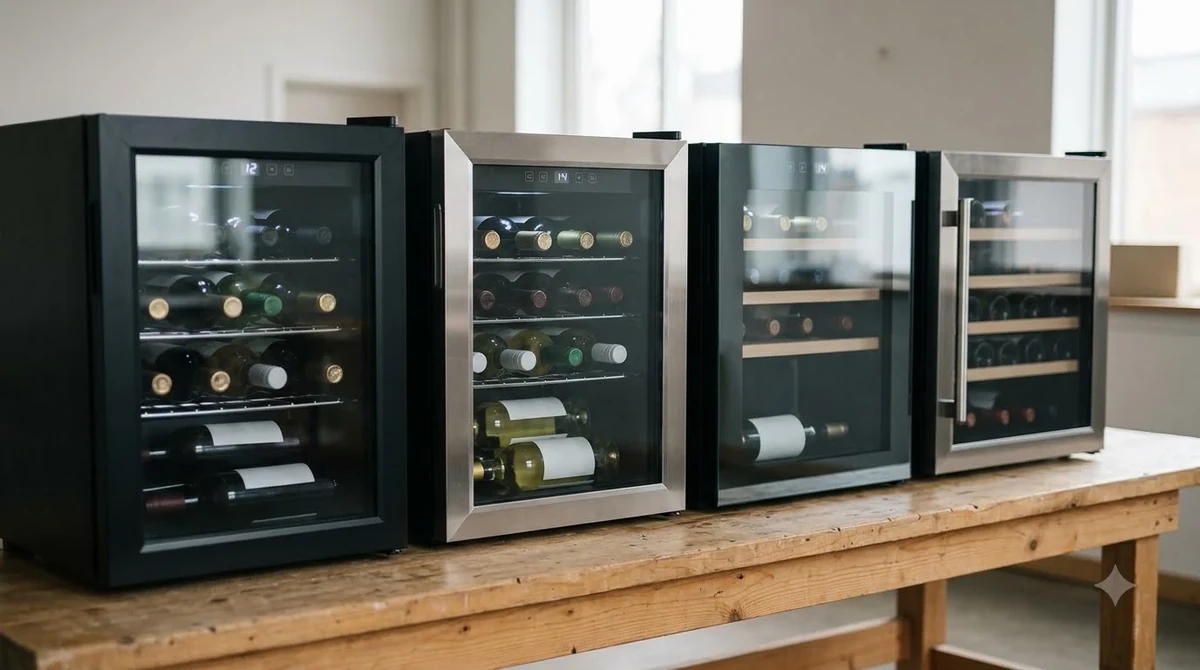
The Danby DWC93BLSDBR1 holds 36 standard bottles and measures 17.52 inches wide, 20.08 inches deep, and 32.72 inches high. Its relatively narrow footprint makes it easier to consider for a smaller kitchen, dining area, or home bar. It is also a sensible capacity for someone who rotates through bottles regularly rather than accumulating a large collection.
For a bigger household collection, the Danby DWC057D1CSS offers 63-bottle capacity in a 5.7-cubic-foot cabinet. Its dimensions are 23.81 inches wide, 25.31 inches deep, and 34.31 inches high. This is a different installation proposition from the smaller 36-bottle appliance, so buyers should measure the intended cabinet opening and surrounding clearance before ordering.
Vinotemp’s comparison includes several larger examples. The Designer Series VT-DS24SBA149 has a stated capacity of 149 bottles. The Butler Series EL-142TSST is listed at 155 bottles, while the Connoisseur Series EL-168WCST has a listed capacity range of 119 to 215 bottles.
The variation in the Connoisseur model’s stated capacity deserves attention. Bottle counts are affected by the shapes and sizes of bottles being stored, as well as the arrangement of shelves. A cabinet advertised for standard Bordeaux bottles may hold fewer bottles if a collection includes wide Burgundy bottles, Champagne bottles, or larger formats.
For buyers with smaller collections, Vinotemp’s medium-capacity comparison also includes 46-bottle models in the Designer, Connoisseur, and Butler families. Its Private Reserve medium-capacity example is listed at 41 bottles. These are not necessarily the right choice for every kitchen, but they show that Vinotemp is not limited to enormous cellar cabinets.
A useful approach is to estimate the collection you expect to own rather than the number of bottles currently in your home. Someone who regularly purchases wine for entertaining may outgrow a 36-bottle cooler sooner than expected. Conversely, purchasing a 150-bottle refrigerator for a collection that rarely exceeds 25 bottles can consume valuable kitchen or living space unnecessarily.
Remember that advertised capacity is not the same as convenient capacity. If a refrigerator technically holds 60 bottles but makes it difficult to retrieve the bottles at the back, its practical value may be lower than a slightly smaller model with better shelf access.
Temperature Zones and Wine Storage Performance
Temperature-zone configuration is one of the most important differences to examine between individual Danby and Vinotemp models. Vinotemp offers several explicitly dual-zone configurations, while Danby’s capabilities vary across its product lineup.
The Danby DWC93BLSDBR1 has a specified temperature range of 43°F to 57°F and a mechanical thermostat. This provides a straightforward temperature-setting arrangement for a household that wants to keep bottles chilled in one cabinet. The DWC057D1CSS takes a different approach with internal sensors designed to monitor and react to temperature changes, along with temperature recall and alarms.
Vinotemp’s comparison includes several models with two independently controlled temperature zones. The Designer VT-DS24SBA149, Connoisseur EL-168WCST, and Butler EL-142TSST all appear as dual-zone examples. The Private Reserve EL-168COMM, by contrast, is listed as a single-zone commercial model.
This distinction is useful for people who regularly serve different styles of wine. A household that keeps Sauvignon Blanc, Chardonnay, Pinot Noir, and Cabernet Sauvignon ready for different meals may appreciate independent temperature settings. The upper compartment can be used for cooler-serving bottles while the other compartment keeps reds at a more suitable service temperature.
However, dual-zone cooling is not automatically necessary for long-term storage. Wine Enthusiast explains that wine intended for aging generally benefits from a consistent storage temperature of approximately 53°F to 57°F, regardless of whether the wine is red, white, or sparkling. The different temperatures associated with individual wine styles are primarily serving preferences.
For that reason, someone building a collection for extended storage may prefer a well-controlled single-zone cabinet. A dual-zone refrigerator makes more sense when the household regularly wants bottles ready to pour at different temperatures without moving them into a separate kitchen refrigerator.
The important consideration is temperature stability rather than the number of settings displayed on the control panel. A refrigerator with two zones is useful only if both compartments can maintain the conditions required by the intended storage routine.
For more detailed guidance, the Wine Enthusiast explanation of single-zone and dual-zone wine refrigerators clarifies why storage temperature and serving temperature should be treated as separate considerations.
Shelving, Controls, and Everyday Convenience
Danby emphasizes practical features such as reversible doors, extendable shelves, and temperature alarms, whereas Vinotemp’s product families offer more varied shelving and presentation arrangements. The best configuration depends on how frequently bottles are accessed and how important display is to the owner.
The Danby DWC057D1CSS includes extendable shelves with natural beechwood trim. Pull-out shelving makes it easier to reach bottles without removing several other bottles first. Its capacitive touch controls also provide a more contemporary interface than a basic mechanical thermostat.
Another useful feature is temperature recall. If the appliance experiences an interruption, this function helps restore the previous setting rather than requiring the owner to remember the last selected temperature. The door-ajar and temperature alarms provide additional awareness of conditions that could affect stored bottles.
The smaller Danby DWC93BLSDBR1 is more basic. It uses a mechanical thermostat and five black wire shelves with trim. Its reversible hinge allows the door to open from either side, which can help when positioning the appliance in a room with limited clearance.
Vinotemp’s shelving varies by product family. The Designer Series uses gliding shelves with black wood lips, while the Connoisseur models feature specially designed racks with secure-hold grooves. The Butler Series uses glide-out metal shelves with side slots. The Private Reserve commercial example includes label-forward Slide nView racks.
These arrangements serve different preferences. Traditional gliding shelves are useful when regular access matters, while label-forward storage makes it easier to identify bottles without pulling them out individually. Secure-hold grooves can also help keep bottles in position as shelves move.
Vinotemp’s comparison lists digital temperature controls and fans across its featured large-capacity examples. Dual-pane glass and door locks also appear throughout the compared families. However, some features are specific to particular series rather than universal across the entire brand.
For example, the Designer Series includes features such as a temperature memory function, door-ajar alarm, and temperature alarm in the compared models. These features should not be assumed to appear on every Connoisseur, Butler, or Private Reserve refrigerator.
Before choosing either brand, consider the everyday experience of opening the cabinet. Can the shelves extend far enough to reach the back row? Will larger sparkling wine bottles fit? Can labels be read easily? Does the door open comfortably without obstructing a nearby cabinet or walkway?
These practical questions can make a bigger difference to long-term satisfaction than decorative lighting or a particular exterior finish. A refrigerator should make storing and retrieving wine straightforward, especially when it is installed in a busy kitchen.
Installation, Warranty, and Long-Term Ownership
Installation requirements and warranty coverage deserve the same attention as bottle capacity and temperature controls. Danby documents specific household installation restrictions, while Vinotemp offers product families intended for several different storage configurations.
The Danby DWC057D1CSS is designed as a 24-inch under-counter wine cooler, with dimensions suited to a kitchen installation. Danby’s guidance explains that ventilation requirements must be followed and the front of the appliance must remain open for air circulation. Buyers should not assume that any freestanding refrigerator can simply be enclosed inside cabinetry.
Danby also specifically warns against installing its wine coolers in garages, porches, carports, or other locations without temperature control. This is important for homeowners who want to place a wine refrigerator in an outdoor entertainment area or an unfinished garage.
Vinotemp offers a wider variety of installation options. Its Private Reserve family includes panel-ready under-counter refrigerators and slim coolers, while other product families cover residential and commercial wine-storage applications. Buyers considering a more complex installation should identify the exact product and obtain the manufacturer’s ventilation and clearance requirements before preparing cabinetry.
Warranty comparisons also need to be model-specific. Danby lists 12 months of parts and labor coverage with in-home service for both the DWC057D1CSS and DWC93BLSDBR1. The DWC057D1CSS warranty page also states that installation and yearly maintenance, including cleaning, are not covered.
Vinotemp’s comparison lists 12 months of parts and labor coverage from the date of sale for its featured large-capacity and medium-capacity products. This includes the compared Designer, Connoisseur, Butler, and Private Reserve examples.
These figures suggest that the compared models have similar stated basic warranty periods. They do not establish that every repair, cooling-system component, or service arrangement is identical. Buyers should review the warranty document for the precise model, including coverage exclusions, registration requirements, and how service appointments are arranged.
Tip: Before installing a wine refrigerator, measure the opening’s width, depth, and height, then account for the required ventilation and door-opening clearance. Also confirm whether the selected appliance is approved for built-in use or must remain freestanding. A few minutes of measurement can prevent an expensive installation problem.
Long-term ownership also involves ordinary maintenance. Keep ventilation openings clear, avoid positioning the appliance next to an oven or other heat source, and clean the interior according to the manufacturer’s instructions. Dust around accessible ventilation areas can interfere with normal heat removal.
If an appliance is delivered after being transported on its side, Danby instructs owners to leave it upright for six hours before connecting the power. This is a particularly useful detail to remember when arranging delivery and installation.
For buyers considering either manufacturer, customer support and replacement-part availability should be part of the final decision. A refrigerator that fits perfectly and has the desired capacity is still a poor choice if obtaining service becomes difficult when a component fails.
Which Should You Pick: Danby or Vinotemp?
Danby is a sensible choice for buyers prioritizing straightforward household refrigeration and practical installation options, while Vinotemp is worth closer consideration for larger collections, dual-zone requirements, and more specialized cabinet designs. Neither brand is automatically the better choice for every home.
Choose Danby for straightforward household storage
Danby makes sense if the main goal is to keep a modest or medium-sized collection organized and chilled. The 36-bottle DWC93BLSDBR1 is a useful example for households that do not need an elaborate wine cabinet. Its reversible door, five shelves, and 43°F to 57°F temperature range cover the basic requirements of everyday wine storage.
For someone who wants a more integrated kitchen appliance, the 63-bottle DWC057D1CSS is another attractive configuration. Its under-counter format, extendable shelves, internal temperature sensors, and alarms offer useful conveniences without requiring a dedicated cellar room.
Danby is particularly appropriate when the buyer has already identified a suitable indoor location and does not need garage-rated operation. The key is selecting a specific model whose installation requirements match the intended space.
Choose Vinotemp for larger or more specialized collections
Vinotemp is worth prioritizing if the collection is growing beyond conventional household capacity. Its compared lineup includes a 149-bottle Designer, a 155-bottle Butler, and a Connoisseur model listed with capacity ranging from 119 to 215 bottles.
It is also the stronger starting point for someone who specifically wants to compare several dual-zone product families. The Designer, Connoisseur, and Butler examples offer independently controlled compartments, while different shelving designs give buyers more ways to organize and display their bottles.
Homeowners planning a custom wine-storage area may also appreciate the Private Reserve selection. Its panel-ready and commercial-style configurations offer options that go beyond a conventional freestanding kitchen cooler.
Think about the collection before choosing the brand
Consider how many bottles are stored at home during an average month, how quickly the collection grows, and whether the wine is primarily intended for immediate consumption or extended storage. Someone who buys a few bottles every week may need more space than someone who purchases wine only for special occasions.
Think about the styles of wine in the collection, too. A household that mainly drinks one category of wine may have little reason to pay extra attention to dual-zone capabilities. A household that regularly serves sparkling wine, crisp whites, and full-bodied reds may benefit from independently controlled compartments.
Food and entertaining habits can also help determine the right arrangement. A cooler that keeps bottles ready for a dinner party is a different purchase from a cabinet intended to preserve a growing collection for several years. For instance, someone planning a dinner featuring chicken Marsala may want a red wine ready for serving, while a separate chilled section can be convenient for guests who prefer white wine.
Finally, compare the precise model numbers rather than assuming the same features apply throughout either brand. Look for verified temperature ranges, bottle capacity, dimensions, shelf configuration, installation instructions, and warranty terms. A model-level comparison is more reliable than choosing based on brand reputation alone.
Readers comparing other wine-storage appliances can also explore the site’s wine cooler versus comparison articles for additional buying considerations.
Frequently Asked Questions
Are Danby and Vinotemp American brands?
Both brands serve the United States appliance market, but their product origins and manufacturing locations should be evaluated separately from their sales and support operations. A brand’s country of origin does not establish where a particular refrigerator is manufactured. Check the individual model’s product labeling and documentation when manufacturing location is important to your purchase.
Can a wine cooler preserve an expensive bottle for ten years?
A wine refrigerator can provide controlled storage conditions, but a basic beverage cooler is not necessarily designed for extended bottle aging. Long-term preservation also depends on humidity, light exposure, temperature consistency, and the wine’s own aging potential. A dedicated cellar-style cabinet is generally a more appropriate consideration for valuable bottles intended to mature over many years.
Do wine refrigerators require a dedicated electrical circuit?
Not every residential wine refrigerator requires its own dedicated circuit. Electrical requirements depend on the appliance’s rated voltage, current, and installation instructions. For example, Danby’s DWC93BLSDBR1 specifies a 115-volt electrical supply, so the electrical rating and outlet suitability should be checked before installation.
Does opening a wine cooler door frequently affect storage?
Repeated door openings introduce warmer room air and can temporarily change the cabinet’s internal conditions. The effect depends on room temperature, opening duration, insulation, and the refrigerator’s cooling capacity. Keeping frequently accessed bottles toward the front can help reduce the time the door remains open.
Can oversized Champagne bottles fit in standard wine cooler shelves?
Not necessarily. Champagne bottles are often wider and heavier than standard Bordeaux bottles, and some sparkling wine bottles have shapes that do not fit conventional shelf grooves. Before purchasing a cooler, confirm the usable shelf dimensions and whether individual shelves can be removed or repositioned to accommodate unusual bottle formats.
Danby is a strong candidate for practical home wine storage, particularly when a compact or under-counter refrigerator meets the household’s needs. Vinotemp deserves serious consideration for larger collections, dual-zone flexibility, and more specialized wine-storage arrangements. Compare the exact models, measure the installation space, and prioritize stable temperature control before making the final decision.
More in Versus
 Edgestar Vs Kalamera: Choose the Right Wine CoolerUpdated Nov 21, 2026
 Frigidaire Vs Magic Chef: Compare Wine Cooler Features and FitUpdated Nov 21, 2026
 EdgeStar Vs Whynter Wine Coolers for Smarter StorageUpdated Nov 21, 2026
 Newair Vs Whynter: Choose the Right 46-Bottle Wine CoolerUpdated Nov 21, 2026
 Kalamera Vs Newair: Choose the Right Wine Cooler for Your HomeUpdated Nov 21, 2026
 Dual Zone vs Single Zone Wine Fridge: Choose the Right Storage SetupUpdated Nov 21, 2026