

We may earn a commission when you buy through links on this page, at no extra cost to you. Learn more.
A dual zone vs single zone wine fridge comparison comes down to whether you need two different serving temperatures or one consistent temperature for your entire collection. A dual-zone refrigerator lets you chill reds and whites separately, while a single-zone model keeps every bottle at the same temperature. For most collectors focused on long-term storage, a stable single-zone cabinet is a practical choice; for households that regularly serve several wine styles, a dual-zone refrigerator offers greater flexibility.
Choosing between these designs affects more than the temperature displayed on the control panel. It determines how you organize bottles, prepare wine for dinner, accommodate different varieties, and use the available storage space. Understanding the distinction between serving temperature and storage temperature makes the decision much easier, particularly if your collection includes Cabernet Sauvignon, Pinot Noir, Chardonnay, Sauvignon Blanc, and sparkling wine.
Temperature Control: One Consistent Setting vs Two Independent Zones
The biggest difference is how each refrigerator manages temperature throughout its interior. A single-zone model maintains one selected temperature across the cabinet, while a dual-zone model provides two independently adjustable compartments for different storage or serving requirements.
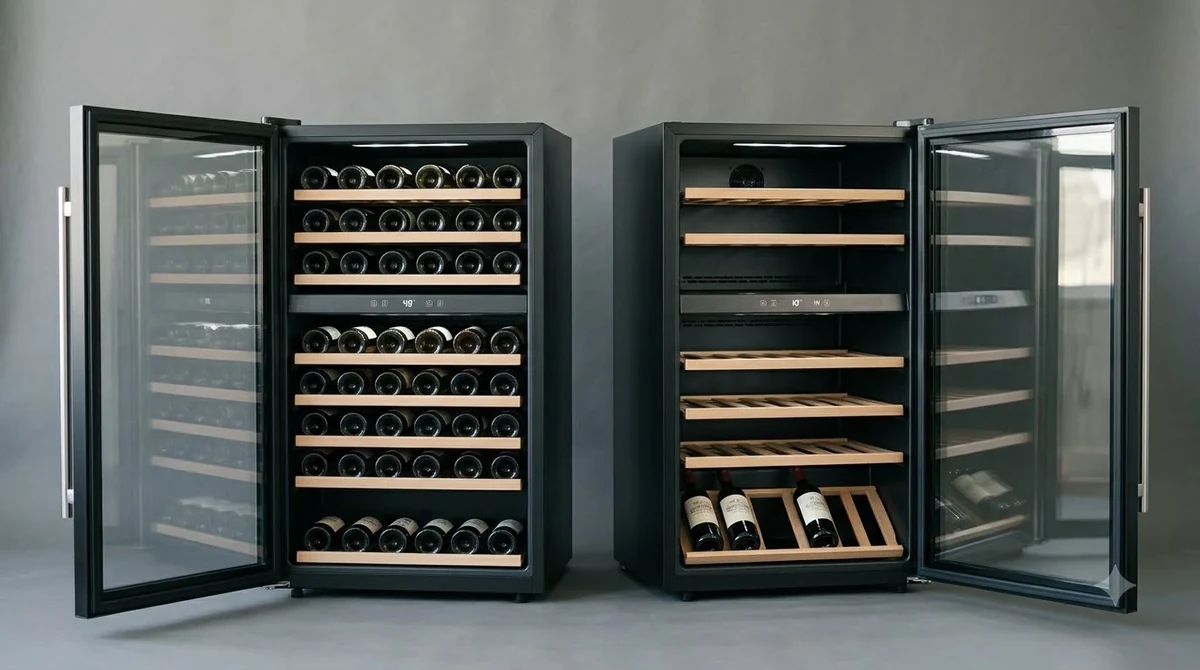
In a single-zone refrigerator, changing the thermostat changes the temperature for the entire collection. This arrangement works particularly well when bottles are being stored rather than prepared for immediate consumption. Wine Enthusiast identifies approximately 53–57°F as a suitable general storage range, regardless of whether the bottle contains red, white, or sparkling wine.
A dual-zone refrigerator separates the interior into two temperature-controlled sections. For example, one compartment might be set around 48°F for white wines, while the other operates around 62°F for red wines. These settings are examples rather than universal requirements; the appropriate temperatures depend on the varieties being served and the manufacturer’s operating range.
The distinction matters because storage and serving are different purposes. A bottle of Sauvignon Blanc might be stored at approximately 55°F but served colder, while a Cabernet Sauvignon can also be stored near 55°F and served somewhat warmer. Separate compartments allow a household to prepare both styles without constantly adjusting one shared thermostat.
There is also a difference between two independently controlled zones and a multi-temperature cabinet. Some multi-temperature designs use a temperature gradient instead of two fully separated compartments. Bosch describes an arrangement in which different levels accommodate heavier reds, lighter reds, rosé, whites, and sparkling wines. Buyers should understand which type of temperature arrangement a particular appliance actually provides.
For buyers who mainly want consistent storage, the simplicity of one temperature setting is often more valuable than additional controls. Those who want bottles ready for different occasions may appreciate the ability to adjust each compartment separately.
Serving Flexibility: Reds, Whites, Rosé, and Sparkling Wine
Dual-zone refrigerators have an advantage when a household regularly serves different wine styles at the same time. Two temperature settings make it possible to prepare lighter whites and fuller reds without compromising the serving conditions of either group.
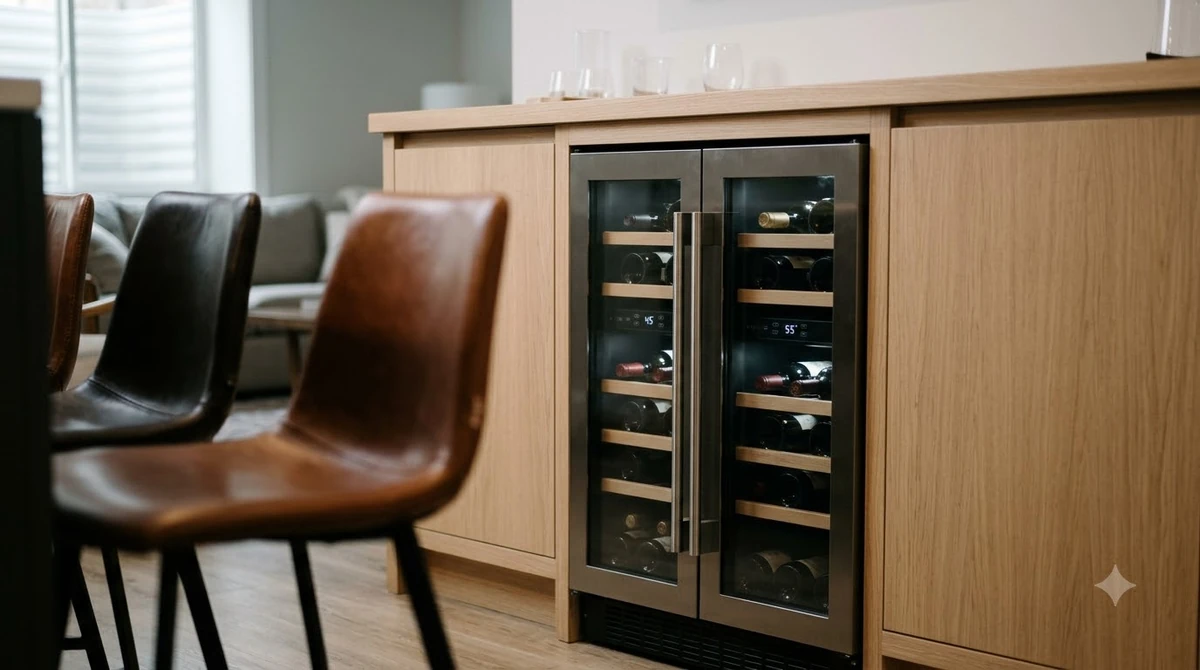
Typical serving temperatures vary considerably by wine style. Light-bodied whites and rosé are generally served around 45–50°F, while fuller-bodied whites are better around 50–55°F. Light reds are commonly served around 55–60°F, and fuller reds around 60–65°F.
That difference explains why a single-zone cabinet can be inconvenient for frequent entertaining. A refrigerator set to 48°F keeps Sauvignon Blanc and sparkling wine appropriately chilled, but a bottle of Cabernet Sauvignon may need time outside the appliance before serving. Conversely, a cabinet set to 60°F is more suitable for fuller reds but leaves many whites warmer than preferred.
A dual-zone design helps address this problem. A household might reserve the cooler compartment for Sauvignon Blanc, Riesling, rosé, and sparkling wine, while the warmer compartment holds Pinot Noir, Merlot, and Cabernet Sauvignon. The exact arrangement should reflect the cabinet’s temperature range rather than assuming every model can reach every desired setting.
Different wines also benefit from different serving conditions within the same broad category. Pinot Noir generally needs less warmth than a full-bodied Cabernet Sauvignon, while Chardonnay can benefit from a slightly warmer serving temperature than a crisp Sauvignon Blanc.
For sparkling wine, the cooler compartment can be especially useful. A serving temperature around 40–50°F helps keep Champagne and other sparkling wines refreshing. Prosecco, which is made primarily from Glera grapes using the tank method, also benefits from being served well chilled.
For occasional entertaining, however, a second temperature zone is not essential. A single-zone refrigerator can store the entire collection at approximately 55°F, with individual bottles moved to a regular refrigerator or chilled separately before serving.
For a detailed explanation of the distinction, Wine Enthusiast’s single-zone and dual-zone comparison explains how storage and serving requirements influence the choice.
Tip: Think about the bottles you want ready to pour rather than simply counting how many red and white wines you own. A collection containing mostly bottles intended for aging may benefit more from stable storage near 55°F than from two serving compartments.
Long-Term Storage: Which Design Is Better for Aging Wine?
A single-zone refrigerator is often the more straightforward option for collectors who prioritize long-term storage. Keeping reds, whites, rosés, and sparkling wines at one consistent temperature avoids the assumption that each variety needs a different aging temperature.
Wine Enthusiast identifies approximately 53–57°F as a suitable general range for storing and aging wine. Vintec recommends 12–14°C, approximately 54–57°F, for cellaring different wine styles. Liebherr similarly identifies a constant range of approximately 50–54°F for its wine-storage approach.
These recommendations differ slightly because manufacturers may design their appliances around different storage philosophies and operating conditions. The common principle is more important than choosing a particular number: maintain a reasonably stable environment instead of repeatedly changing the temperature to suit individual bottles.
For long-term storage, a single-zone cabinet can therefore be an excellent choice for a collection containing Cabernet Sauvignon from Napa Valley, Pinot Noir from Oregon, Chardonnay from Burgundy, and Riesling from Germany. All these wines can be stored at a consistent cellar temperature even though their ideal serving temperatures differ.
Dual-zone refrigerators can also accommodate aging wine, but the arrangement requires more attention. A collector might dedicate one compartment to bottles intended for immediate service and the other to bottles being stored at a cellar temperature. Wine Enthusiast describes this type of storage-and-service arrangement as one of the practical uses of a dual-zone appliance.
However, not every dual-zone refrigerator is designed equally well for long-term cellaring. Some models prioritize serving temperatures, which may leave one compartment too cold or too warm for the intended storage purpose. Temperature stability, humidity management, protection from light, and vibration control remain important considerations.
Vintec recommends humidity above 50% in its single-zone cabinets for maintaining cork integrity. Its guidance also warns that certain multi-temperature cabinets may not maintain sufficient humidity for long-term storage of bottles sealed with natural cork. This illustrates why buyers should evaluate the actual storage specifications rather than assuming that two temperature zones automatically mean better preservation.
For a small collection that is consumed regularly, either design can work. For valuable bottles intended to mature over several years, prioritize stable temperatures and appropriate storage conditions over the number of zones.
Vintec’s wine cabinet storage and serving recommendations provide additional guidance on cellaring temperatures, humidity, and the differences between single-zone, dual-zone, and multi-temperature cabinets.
Capacity, Shelf Arrangement, and Installation Requirements
The number of temperature zones does not automatically determine how many bottles a refrigerator can hold. Capacity depends on the cabinet’s dimensions, shelf design, internal layout, and the size and shape of the bottles being stored.
Single-zone models often appeal to buyers who want a straightforward storage cabinet with one consistent compartment. Dual-zone models divide their interiors into separate temperature-controlled sections, which can affect the available shelf arrangement and usable space in individual compartments.
Consider a household that wants to store 30 bottles, including 18 reds and 12 whites. A dual-zone refrigerator needs enough room in each section for that particular distribution. A model advertised with a total capacity of 30 bottles may not provide the exact balance of shelf space needed for the collection.
Capacity figures also depend on bottle dimensions. Standard Bordeaux bottles are relatively easy to arrange on conventional racks, but wider Burgundy bottles, Champagne bottles, and some specialty formats can reduce the number of bottles that fit comfortably.
For example, Bosch’s operating manual illustrates how bottle orientation affects usable capacity and air circulation. Its particular cabinet is listed as accommodating 114 standard 750 ml bottles in one arrangement or 197 in another. Bosch also warns that the alternative arrangement restricts airflow, demonstrating why maximum advertised capacity should not be treated as the only buying consideration.
Installation is another important factor. Freestanding wine refrigerators typically require ventilation clearance around their designated air outlets. The Home Depot buying guide explains that freestanding models with rear or side vents should not simply be enclosed inside cabinetry.
Built-in refrigerators are designed differently. Front-venting models can be installed into suitable cabinetry, provided the manufacturer’s installation requirements are followed. This distinction applies to both single-zone and dual-zone designs, so ventilation should be checked independently of temperature configuration.
Before purchasing, measure the available opening, account for door clearance, identify the electrical outlet location, and compare the required ventilation space with the appliance specifications. A refrigerator with excellent temperature controls is not a practical choice if it cannot be installed correctly in the intended location.
For additional guidance on choosing an appliance, the broader Versus comparisons can help clarify how different wine refrigerator configurations fit particular household needs.
Operating Complexity, Temperature Adjustments, and Everyday Convenience
Single-zone refrigerators generally have simpler controls because there is only one temperature setting to manage. Dual-zone refrigerators require buyers to monitor two compartments, understand their respective temperature ranges, and distribute bottles according to the intended use of each section.
That additional control can be useful, but it also introduces more decisions. A household might set one compartment to 48°F for whites and another to 62°F for reds. If the collection changes, the owner may need to adjust the settings or reorganize the shelves to accommodate a different mix of bottles.
Some dual-zone designs provide additional flexibility by allowing both sections to operate at the same temperature. Wine Enthusiast’s Dual Zone MAX design, for example, allows its compartments to operate independently or at matching settings. This can be helpful when a collection grows or the owner’s preferences change.
Nevertheless, that capability should not be assumed across all dual-zone models. Some appliances have restricted temperature ranges, different upper and lower compartment limits, or minimum temperature differences between the two sections.
Temperature displays also deserve attention. Digital controls make it easier to monitor settings, but the displayed number does not necessarily represent the exact temperature of every bottle. Bottle placement, air circulation, interior lighting, and frequent door openings can influence temperature conditions.
The Bosch operating manual specifically warns that temperature readings may be affected by bottle positioning and the operation of interior lighting. It also recommends maintaining proper airflow around stored bottles.
Noise is another practical consideration, particularly when a wine refrigerator is installed in an open-plan kitchen or near a living room. Cooling technology, compressor operation, insulation, and cabinet construction can influence operating noise. A Wine Enthusiast specification sheet for one particular 32-bottle dual-zone model lists a compressor cooling system and a 40 dB(A) noise rating, but that figure should not be generalized to all dual-zone refrigerators.
For a simple household setup, fewer controls may mean less day-to-day adjustment. For a household that regularly serves multiple wines, the convenience of independent temperatures may outweigh the extra management.
Which Should You Pick for Your Wine Collection?
The right choice depends on whether your main priority is maintaining a consistent storage environment or keeping different wine styles ready for serving. Neither configuration is automatically superior, and the better option is the one that matches your actual bottle inventory and drinking habits.
Choose a single-zone refrigerator if you primarily collect wine for storage, drink mostly one style, or prefer a simple appliance with one temperature setting. A cabinet maintained around 55°F can accommodate different varieties without requiring separate aging temperatures for reds and whites.
This configuration is particularly suitable for collectors who buy several bottles of the same wine and gradually open them over time. It also makes sense for households that enjoy both red and white wine but do not need every bottle ready to serve immediately.
A single-zone cabinet can also be a practical choice for someone who enjoys occasional wine-based cocktails. For example, an Aperol Spritz recipe calls for chilled sparkling wine, but that does not mean an entire collection needs to be stored at sparkling-wine serving temperature. Individual bottles can be chilled separately before preparation.
Choose a dual-zone refrigerator if you frequently entertain, enjoy several wine styles, or want separate areas for serving and storage. It is particularly useful when guests might choose a chilled Riesling while another person prefers a fuller-bodied red.
For example, a dinner featuring chicken in a creamy mushroom sauce might include a bottle of Pinot Noir as well as a white wine option. Having two compartments makes it easier to prepare both choices without repeatedly changing the temperature of a shared storage cabinet. A suitable chicken Marsala recipe can also provide an occasion to serve different wine styles according to the meal and personal preferences.
Consider the following practical decision points:
- Mostly long-term storage: Choose a single-zone refrigerator with stable temperature control.
- Mostly red wines: A single-zone cabinet is usually sufficient if the collection is stored consistently.
- Mostly white wines: A single-zone cabinet also works when the bottles are stored at a suitable cellar temperature.
- Regular red and white entertaining: Consider a dual-zone model for separate serving temperatures.
- Mixed storage and immediate service: Look for a dual-zone model with suitable temperature ranges and clearly separated compartments.
- Limited installation space: Compare dimensions, ventilation, and usable capacity before choosing either configuration.
Buyers should also consider the collection’s future growth. Someone who currently owns 12 bottles but expects to accumulate 40 may need a different capacity and shelf arrangement from someone who purchases a few bottles at a time and drinks them within weeks.
It is also useful to compare the temperature ranges of specific models rather than relying exclusively on the single-zone or dual-zone label. A dual-zone refrigerator that cannot reach the temperatures you want may offer less practical value than a well-designed single-zone cabinet.
Frequently Asked Questions
Can a dual-zone wine fridge operate with only one compartment in use?
Many dual-zone refrigerators allow both compartments to remain available even when one is not fully stocked, but the recommended loading arrangement varies by manufacturer. Some cabinets perform more consistently when bottles are distributed evenly instead of concentrated in one section. Consult the operating instructions before leaving an entire compartment empty for extended periods.
Can a wine fridge be placed in an unheated garage?
That depends on the appliance’s permitted ambient operating temperature. Some wine refrigerators are designed for indoor environments and may not maintain their intended performance in a garage exposed to extreme seasonal temperatures. Look for the manufacturer’s specified ambient temperature range before choosing a garage installation.
Does opening a wine fridge door frequently affect its temperature?
Yes. Opening the door allows warmer room air to enter, temporarily changing the cabinet’s internal conditions. Frequent or prolonged openings can make temperature recovery more demanding, particularly in a warm kitchen. Keeping bottles organized and retrieving several bottles together can help reduce unnecessary door openings.
Can Champagne bottles fit in every wine refrigerator?
No. Champagne bottles are often wider than standard Bordeaux bottles, and their shape can affect shelf spacing. Some racks also have limited depth or fixed spacing that prevents larger bottles from fitting properly. Check the usable shelf dimensions and the manufacturer’s stated capacity for different bottle shapes.
Is a thermoelectric wine fridge different from a compressor wine fridge?
Yes. Thermoelectric refrigerators use a solid-state cooling system, while compressor models use a refrigeration cycle involving a compressor and refrigerant. Thermoelectric designs are commonly associated with smaller appliances, whereas compressor systems are available in a wider range of cabinet sizes. Cooling performance and suitability depend on ambient conditions, appliance construction, and the manufacturer’s specifications.
For most wine collectors who prioritize consistent storage, a single-zone wine fridge is a sensible starting point because different varieties can share the same cellar temperature. A dual-zone model makes more sense for households that regularly serve reds, whites, and sparkling wines at different temperatures. Compare the actual temperature ranges, usable bottle capacity, ventilation requirements, and storage features before making your final decision.
More in Versus
 Edgestar Vs Kalamera: Choose the Right Wine CoolerUpdated Nov 21, 2026
 Frigidaire Vs Magic Chef: Compare Wine Cooler Features and FitUpdated Nov 21, 2026
 EdgeStar Vs Whynter Wine Coolers for Smarter StorageUpdated Nov 21, 2026
 Newair Vs Whynter: Choose the Right 46-Bottle Wine CoolerUpdated Nov 21, 2026
 Kalamera Vs Newair: Choose the Right Wine Cooler for Your HomeUpdated Nov 21, 2026
 Danby Vs Vinotemp: Choose the Right Wine Cooler for Your SpaceUpdated Nov 21, 2026