

We may earn a commission when you buy through links on this page, at no extra cost to you. Learn more.
Kalamera vs Newair comes down to whether you want dedicated wine storage or a more versatile wine-and-beverage refrigerator. Kalamera offers attractive wine-focused configurations, including a 46-bottle dual-zone model with wooden shelving and temperature memory. Newair stands out with options such as its 20-bottle and 78-can dual-zone combination, a longer advertised warranty, and flexible beverage storage. Both brands offer compressor-based models suitable for serious home use, but the right choice depends on your collection, available space, and installation plans.
Choosing a wine cooler involves more than comparing advertised bottle capacities. Shelf dimensions, temperature ranges, ventilation, door configuration, and after-sales support can make a substantial difference once the appliance becomes part of a kitchen or home bar. Kalamera and Newair both sell built-in and freestanding wine refrigerators, so comparing specific models is more useful than assuming every appliance from one brand has the same advantages. This comparison examines two representative 24-inch appliances: the Kalamera KRC-150DZB and the Newair AWB-365DB.
| Comparison | Kalamera KRC-150DZB | Newair AWB-365DB |
|---|---|---|
| Primary purpose | Dedicated wine storage | Wine and beverage storage |
| Advertised wine capacity | 46 bottles | 20 Bordeaux bottles |
| Additional beverage capacity | Not specified as a separate can compartment | 78 standard cans |
| Cooling zones | 2 | 2 |
| Wine temperature range | 40–50°F upper; 50–66°F lower | 40–66°F wine compartment |
| Beverage temperature range | Not applicable as a separate beverage zone | 37–66°F |
| Installation | Built-in or freestanding | Built-in or freestanding |
| Dimensions | 23.4 x 33 x 22.4 inches | 23 x 33 x 22.4 inches |
| Shelving | 5 removable wooden shelves | 7 removable sapele wood wine shelves and 4 glass beverage shelves |
| Cooling technology | Compressor | Compressor |
| Rated power | 90 watts | 90 watts |
| Advertised warranty | 1 year | 2 years through Newair’s official website |
These specifications describe particular models, not every refrigerator sold under either brand. A smaller Kalamera single-zone appliance and a larger Newair collector cabinet can have very different features. The comparison below therefore focuses on the practical differences between the two representative 24-inch options rather than treating their specifications as universal brand characteristics.
Storage Capacity and Everyday Bottle Organization
Kalamera is the stronger choice for buyers prioritizing dedicated wine capacity, while Newair makes more sense for households that want wine and canned drinks in one appliance. The KRC-150DZB advertises 46 bottles, compared with 20 Bordeaux bottles and 78 standard cans for the Newair AWB-365DB.
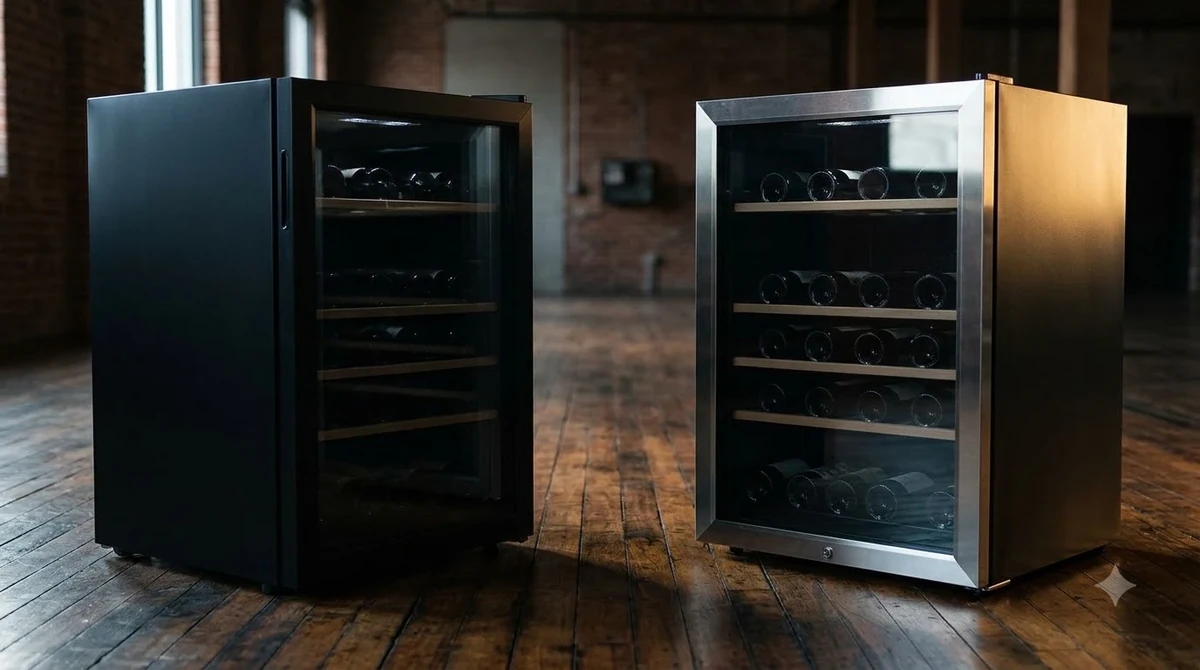
The difference is significant for anyone building a wine collection. A 46-bottle cabinet provides room for multiple producers, grape varieties, and occasions without immediately requiring another storage appliance. Someone who regularly purchases Cabernet Sauvignon, Pinot Noir, Chardonnay, Riesling, and sparkling wine may appreciate having separate shelves for different categories.
Newair approaches capacity differently. Its wine compartment accommodates 20 standard Bordeaux bottles, while the adjoining beverage compartment provides space for 78 standard cans. This arrangement is particularly useful for households that entertain regularly, serve cocktails, or want cold soft drinks and sparkling water readily available alongside wine.
Advertised capacity versus usable capacity
Neither advertised bottle figure should be treated as a guarantee that every collection will fit exactly as illustrated. Wine cooler manufacturers generally calculate capacity using standard Bordeaux-shaped bottles. Burgundy bottles, Champagne bottles, and unusually wide sparkling wine bottles can occupy more shelf space.
For example, a collection containing 15 Bordeaux bottles and several wide Champagne bottles may use the available space differently from a collection containing only conventional 750 ml bottles. The Kalamera product description specifically acknowledges that larger bottles such as Pinot Noir and Champagne can affect capacity. Buyers should therefore consider their actual bottle shapes rather than selecting a cabinet solely by its headline number.
Newair’s separate beverage compartment is another important distinction. Its 78-can capacity is useful, but cans and wine bottles serve different storage purposes. If the primary objective is collecting wine rather than chilling drinks for guests, dedicating cabinet space to beverage storage may be an unnecessary compromise.
For households with fewer than 20 regularly stored bottles, Newair’s combination can be convenient. For collectors who already have 30 or more bottles and expect the collection to grow, Kalamera’s larger dedicated capacity is the more practical starting point.
Temperature Control and Dual-Zone Performance
Both brands offer dual-zone compressor cooling, but the temperature arrangements serve different purposes. Kalamera provides two wine-focused temperature ranges, while Newair combines a wine compartment with a separate beverage compartment that can operate at a colder setting.
The Kalamera KRC-150DZB has an upper zone adjustable from 40–50°F and a lower zone adjustable from 50–66°F. This arrangement accommodates a range of serving preferences, with the upper compartment suited to chilled white wines and the lower compartment offering warmer settings for red wines.
The Newair AWB-365DB specifies a 40–66°F range for its wine compartment and 37–66°F for its beverage compartment. This gives households more flexibility for chilling different drinks. The lower minimum on the beverage side is particularly useful for canned refreshments that are generally served colder than most wines.
Understanding serving temperatures
Dual-zone cooling is helpful because red and white wines are not generally served at identical temperatures. However, storage temperature and serving temperature are two different considerations. A collector who keeps bottles for extended periods may prefer a consistent storage environment rather than continuously adjusting separate compartments to match the next meal.
As a practical serving reference, sparkling wine is generally served around 40–50°F, light whites and rosé around 45–50°F, fuller-bodied whites around 50–55°F, and lighter reds around 55–60°F. Fuller-bodied reds are commonly served around 60–65°F.
These ranges explain why Kalamera’s upper and lower settings are useful for households that regularly serve different styles. Its upper compartment can accommodate chilled Sauvignon Blanc and sparkling wine, while the lower compartment can hold Merlot or Cabernet Sauvignon at warmer settings.
Newair’s separate beverage compartment is more versatile for mixed entertaining. It can hold drinks at settings below the minimum wine-zone temperature, making it a practical option for people who serve beer, canned cocktails, sparkling water, and wine from the same cabinet.
Compressor cooling and temperature stability
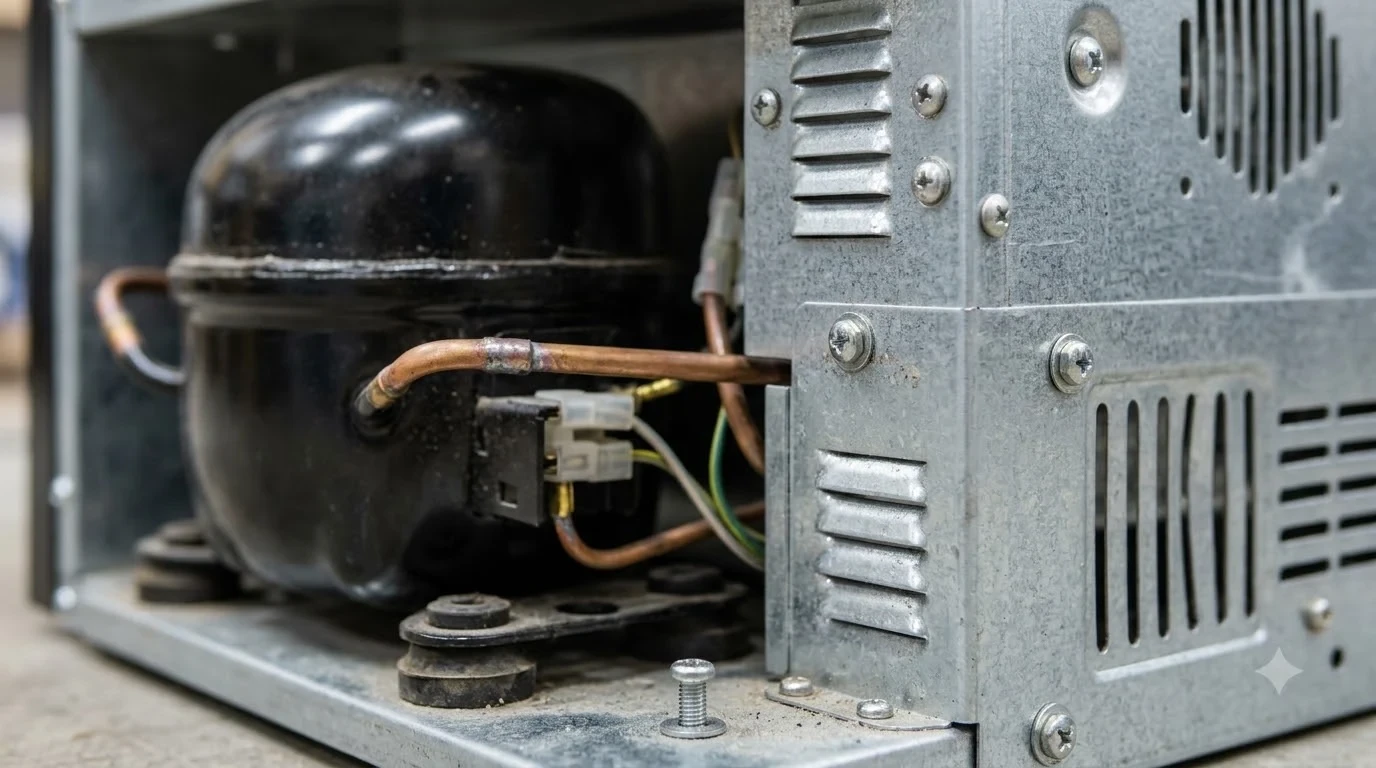
Both comparison models use compressor cooling, which is an important point for buyers placing a refrigerator in a kitchen or other relatively warm room. Compressor systems use refrigerant to remove heat and are generally more capable of maintaining low temperatures under warmer ambient conditions than small thermoelectric units.
Wine Enthusiast explains that compressor coolers can reach lower temperatures and cope with warmer surroundings, although they may be louder and heavier than thermoelectric alternatives. Its explanation is useful for understanding the technology behind both appliances and can be read in its comparison of compressor and thermoelectric wine coolers.
Neither compressor refrigerator should be selected solely because it has two zones. Temperature stability, appropriate placement, and the ability to maintain the desired setting are more important than the number of digital controls on the front panel.
Installation, Dimensions, and Kitchen Fit
Both the Kalamera KRC-150DZB and Newair AWB-365DB are designed for built-in or freestanding installation. Their similar dimensions make them relevant alternatives for a 24-inch kitchen opening, although the precise cabinet cutout and ventilation requirements still need to be checked before purchasing.
Kalamera lists its KRC-150DZB at 23.4 inches wide, 33 inches high, and 22.4 inches deep. Newair specifies 23 inches wide, 33 inches high, and 22.4 inches deep for the AWB-365DB. These measurements are close enough that either model may appear suitable for a similar installation area, but they should not be treated as interchangeable installation specifications.
Built-in installation
Front ventilation is an important feature for under-counter refrigerators. A properly designed front-venting appliance can release warm air through its front ventilation area rather than requiring the same rear clearance as a conventional freestanding refrigerator.
Kalamera describes the KRC-150DZB as front-venting and suitable for under-counter or freestanding use. Newair also specifies a front-venting compressor and flush-hinge configuration for the AWB-365DB.
This makes both appliances relevant to kitchen renovations and dedicated home bars. Nevertheless, buyers should compare the manufacturer’s installation drawings with the actual cabinet opening, including the location of the electrical outlet, door swing, leveling feet, and any trim or filler panels.
Freestanding placement
For a freestanding installation, available floor space and surrounding airflow matter. A refrigerator that fits beneath a counter may also work beside a dining area, in a pantry, or in a home bar, provided its installation instructions permit the arrangement.
Door movement is another consideration. Kalamera specifies a reversible glass door for the KRC-150DZB, which offers flexibility when the appliance needs to fit a particular kitchen layout. Newair’s French-door arrangement on the AWB-365DB creates a different access experience, particularly when both beverage and wine compartments are used regularly.
Measure the available opening at its narrowest point rather than relying on the nominal 24-inch category. Also account for the appliance’s full depth, handles, hinges, and the space needed to remove shelves for cleaning. A refrigerator that fits the cabinet opening but cannot open fully may become frustrating during everyday use.
Shelving, Materials, and Interior Design
Kalamera emphasizes dedicated wooden wine storage, while Newair combines wooden wine racks with separate glass beverage shelves. The better interior depends on whether the refrigerator will primarily hold wine bottles or function as a shared drinks station.
The Kalamera KRC-150DZB includes five removable wooden shelves with protective stoppers. Its product information identifies the wooden frame as FSC-certified and describes it as a design intended to reduce vibration and friction around stored bottles.
Wooden shelving is a familiar feature in wine cabinets because it provides a stable contact surface and a traditional appearance. Removable shelves also make it easier to accommodate bottles that are taller or wider than standard Bordeaux formats. However, shelf removal may reduce the total number of bottles that can be stored at once.
Newair uses seven removable sapele wood shelves in the wine compartment and four tempered-glass shelves in the beverage section. This division makes the appliance more adaptable for people who want to store bottles horizontally while keeping cans and other beverages accessible.
Lighting and visibility
Lighting is another difference. Newair offers three interior LED color options: midnight blue, warm amber, and soft white. These settings let owners coordinate the refrigerator’s appearance with a kitchen, dining room, or home bar.
Kalamera includes built-in LED lighting for viewing its wine collection. Its presentation is more straightforward, with the emphasis on accessing bottles rather than changing the atmosphere of the room.
For a display-focused wine cabinet, the appearance of the shelves and glass door may matter as much as the lighting color. For an everyday storage appliance inside kitchen cabinetry, simple visibility and convenient shelf access are usually more useful than decorative lighting choices.
Newair’s VinoRest holder is another practical distinction. It allows bottles to lie flat in the beverage section, offering additional flexibility when storing drinks that do not fit the standard wine shelving arrangement.
Both designs have a clear purpose. Kalamera favors a traditional wine-storage interior, while Newair prioritizes a mixed-use layout with separate accommodation for bottles and cans.
Warranty Coverage, Replacement Parts, and Customer Support
Newair has an advantage in advertised warranty duration for the specific models compared here. Newair lists a two-year warranty for the AWB-365DB, while Kalamera’s official FAQ specifies one year of coverage for manufacturing defects across its products.
Warranty length is an important comparison point because a wine refrigerator contains several components that may require attention over its service life. The compressor, temperature controls, sensors, door seals, and electrical components all affect whether an appliance continues to maintain the desired environment.
Kalamera warranty and parts availability
Kalamera states that its one-year warranty begins on the purchase date and does not require separate registration. Its FAQ explains that order information serves as proof of purchase and that covered manufacturing defects receive free replacement parts.
There are practical limitations to consider. Kalamera estimates that replacement parts shipped from its overseas factory take approximately 15–25 business days to arrive. This is an important detail for anyone who expects fast access to replacement components.
The company also states that it does not sell replacement compressors separately. If a compressor problem occurs, its guidance is to contact a local refrigeration technician for professional assessment. That makes the availability of local repair expertise an important part of the ownership decision.
Newair warranty and service
Newair advertises a two-year warranty for the AWB-365DB through its official website. This longer stated coverage gives it an advantage over Kalamera in the warranty-duration comparison.
Newair also provides a product manual for the AWB-365DB and maintains a dedicated product-manual section. Having the correct manual is useful when checking installation requirements, cleaning procedures, temperature controls, and troubleshooting instructions.
Buyers should verify the precise warranty terms for the retailer and purchase channel they intend to use. The advertised duration alone does not establish which parts, labor charges, transportation costs, or service procedures are covered.
For either brand, retaining the receipt, recording the model number, and keeping the original documentation can make future service requests easier. These details are particularly important for built-in appliances that may be difficult to access after cabinetry is completed.
Which Brand Offers the Better Overall Fit?
Kalamera is the better match for buyers who prioritize dedicated wine capacity and traditional wine shelving, while Newair is more appealing for households that want a combined wine and beverage station. The difference is clearest between the 46-bottle Kalamera KRC-150DZB and the Newair AWB-365DB with its 20-bottle and 78-can configuration.
Choose Kalamera if wine storage is your main priority
Kalamera makes sense for a household that regularly purchases wine and wants more bottle space in a relatively compact 24-inch appliance. Its 46-bottle advertised capacity provides a substantial advantage over the 20-bottle wine compartment in the Newair comparison model.
The upper 40–50°F and lower 50–66°F zones also make the KRC-150DZB suitable for households that want separate settings for white and red wine. Its reversible door and temperature-memory feature add useful flexibility, particularly in a kitchen installation where door positioning and power interruptions may be concerns.
Buyers should be comfortable with the one-year warranty and the stated replacement-part delivery window. For someone who prioritizes bottle capacity and dedicated storage over beverage versatility, these considerations may be reasonable trade-offs.
Choose Newair if you entertain frequently
Newair is a more natural choice for households that regularly serve different types of drinks. Its 20-bottle wine compartment and 78-can beverage section create a practical arrangement for dinner parties, weekend gatherings, and home bars.
The four tempered-glass beverage shelves, seven removable sapele wood wine shelves, and three LED lighting colors also provide a more specialized entertaining setup. Its advertised two-year warranty is another point in its favor.
The main compromise is dedicated wine capacity. A collector with 35 or 40 bottles will likely find the 20-bottle wine compartment restrictive unless another storage solution is available.
Consider your collection rather than the brand name
There is no universal winner between these two appliances. A 46-bottle wine-focused cabinet is not automatically more useful than a 20-bottle combination refrigerator, just as a longer warranty does not automatically mean better temperature performance.
Think about the drinks that will actually occupy the refrigerator. If wine accounts for nearly all the contents, dedicated shelving and bottle capacity should receive the most attention. If guests regularly request cold cans, sparkling water, and other beverages, the Newair arrangement offers a different kind of convenience.
Buyers comparing additional models can also consult our Versus comparison guides for more appliance comparisons. The same decision-making approach applies to wine service: a chilled bottle for an Aperol Spritz recipe or a refreshing Hugo Spritz recipe may call for different storage and serving arrangements than a collection intended for longer-term keeping.
Frequently Asked Questions
Can wine coolers be used to store opened bottles?
Yes. Opened still wine generally keeps for approximately three to five days in the refrigerator when properly resealed. Sparkling wine usually retains its freshness for around one to three days with a suitable sparkling-wine stopper. Store opened bottles upright to reduce the chance of leakage.
How long should a wine cooler run before the first bottles are added?
Allow the appliance to reach and stabilize at its selected temperature before loading the collection. Kalamera’s instruction manual specifically recommends a 24-hour stabilization period before use. This allows the interior environment to settle rather than immediately filling the cabinet with bottles while temperatures are still changing.
Should Champagne bottles be stored differently from Bordeaux bottles?
Champagne bottles are generally wider and heavier than standard Bordeaux bottles, so they may require additional shelf space. Their shape can reduce the practical capacity of a wine cabinet even when the advertised bottle count appears sufficient. Measure shelf clearance and check whether removable shelves provide enough room before storing a large sparkling-wine collection.
What is the recommended temperature for long-term wine storage?
A consistent temperature around 55°F is a useful general target for long-term wine storage. Stability matters more than repeatedly changing the setting to match individual serving preferences. Keep bottles away from direct sunlight, strong temperature fluctuations, and unnecessary vibration.
How many glasses of wine does a standard bottle provide?
A standard 750 ml bottle provides approximately five servings when poured at the conventional 5-ounce serving size. A dinner for six adults therefore requires at least two bottles if everyone expects one glass. For a longer gathering, plan additional bottles according to the number of guests and the other drinks being served.
For most dedicated wine collectors, Kalamera offers the more compelling storage-focused option, especially when comparing its 46-bottle model with Newair’s 20-bottle wine compartment. Newair is the more versatile choice for households that want wine and canned beverages together, along with a longer advertised warranty. Before making the final decision, compare the exact model dimensions, installation instructions, temperature ranges, and warranty terms against the space and collection you actually have.
More in Versus
 Edgestar Vs Kalamera: Choose the Right Wine CoolerUpdated Nov 21, 2026
 Frigidaire Vs Magic Chef: Compare Wine Cooler Features and FitUpdated Nov 21, 2026
 EdgeStar Vs Whynter Wine Coolers for Smarter StorageUpdated Nov 21, 2026
 Newair Vs Whynter: Choose the Right 46-Bottle Wine CoolerUpdated Nov 21, 2026
 Danby Vs Vinotemp: Choose the Right Wine Cooler for Your SpaceUpdated Nov 21, 2026
 Dual Zone vs Single Zone Wine Fridge: Choose the Right Storage SetupUpdated Nov 21, 2026