

We may earn a commission when you buy through links on this page, at no extra cost to you. Learn more.
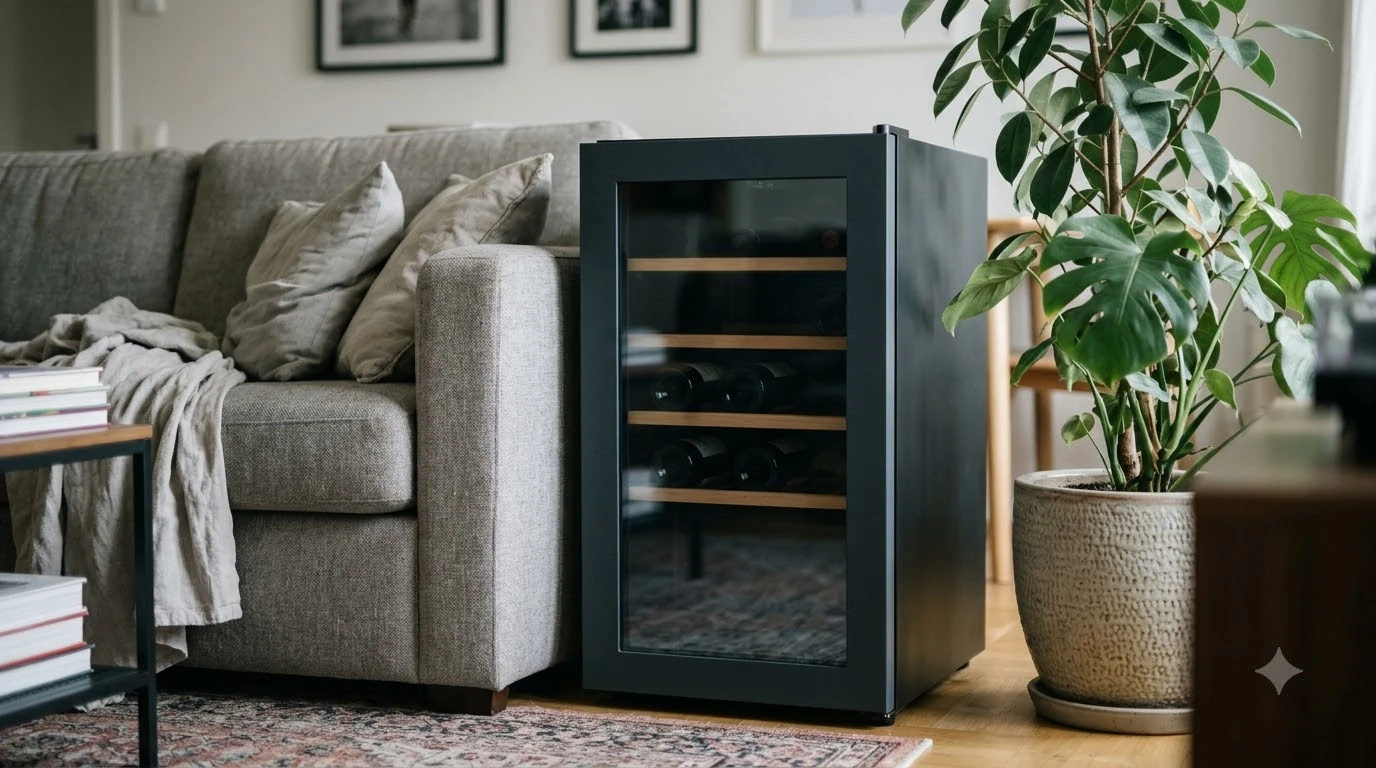
The Newair under counter wine fridge is a practical option for homeowners who want built-in wine storage, separate temperature zones, and room for up to 46 standard bottles. The AWR-460DB combines compressor cooling, removable beechwood shelves, and independent upper and lower temperature controls in a stainless-steel cabinet. Its main advantages are flexible storage and a relatively compact footprint, while installation measurements, bottle compatibility, and long-term reliability deserve careful consideration before buying.
Newair offers several wine refrigerators designed for installation beneath kitchen counters, but the 46-bottle AWR-460DB is a useful starting point for evaluating the brand’s larger built-in options. It provides enough space for a varied household collection without requiring a dedicated wine cellar. Its dual-zone configuration also makes it more versatile than a basic single-temperature beverage refrigerator.
This review examines the AWR-460DB’s specifications, customer feedback, installation requirements, and suitability for different wine collections. It also considers smaller Newair alternatives and explains what to check before committing to an under-counter installation.
Specs and Key Features of the Newair AWR-460DB
The AWR-460DB is a 46-bottle compressor wine refrigerator with two independently controlled temperature zones. Its stainless-steel exterior, front-facing installation design, and wood shelving make it suitable for a kitchen, dining area, or home bar where wine storage needs to remain accessible.
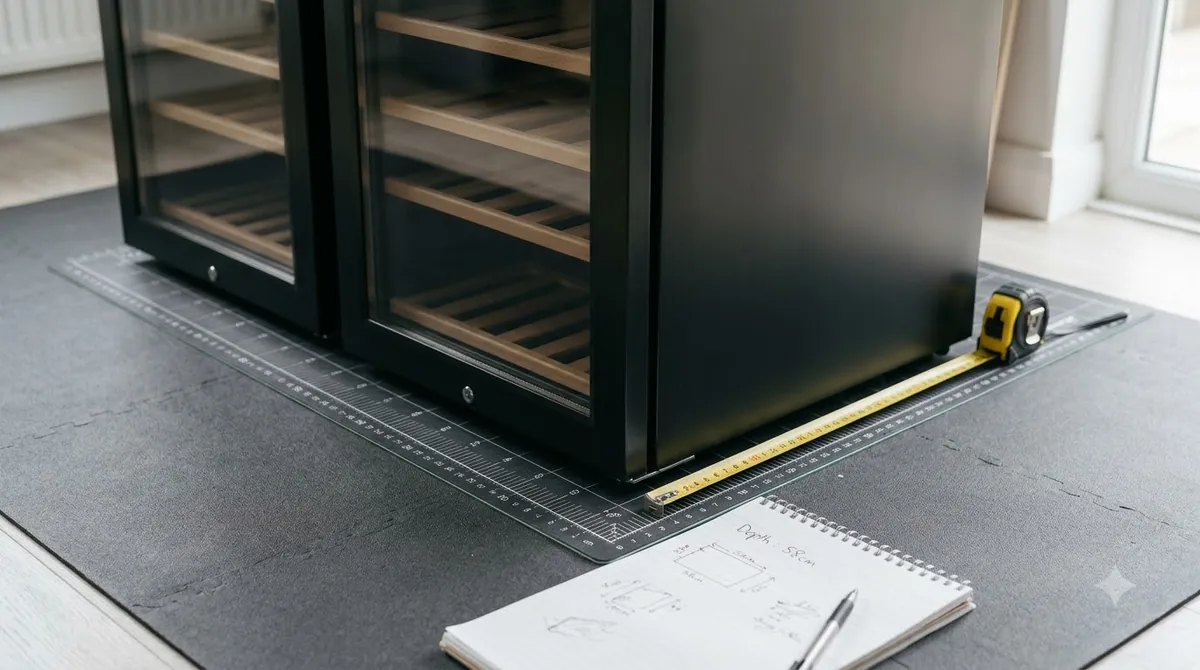
According to Newair’s official product specifications, the refrigerator has a 5.3-cubic-foot interior and measures 23.40 inches wide and 33 inches high. Its depth is 22.40 inches without the handle and 24 inches with the handle. These measurements make it important to assess the complete cabinet opening rather than relying on the nominal 24-inch appliance category.
The most useful feature is the dual-zone arrangement. Newair specifies a temperature range of 40–50°F for the upper compartment and 50–66°F for the lower compartment. This allows a household to keep whites and sparkling wines colder while maintaining a warmer setting for reds. The shared boundary at 50°F does not mean both sections have to run at the same temperature.
| Specification | Newair AWR-460DB |
|---|---|
| Maximum capacity | 46 standard bottles |
| Internal volume | 5.3 cubic feet |
| Width | 23.40 inches |
| Height | 33 inches |
| Depth without handle | 22.40 inches |
| Depth with handle | 24 inches |
| Upper temperature range | 40–50°F |
| Lower temperature range | 50–66°F |
| Cooling system | Compressor |
| Noise level | 39 dB |
| Electrical requirements | 120 volts, 90 watts |
| Weight | 104 pounds |
| Refrigerant | R-600A |
The manufacturer also includes a digital temperature display, push-button controls, removable beechwood shelves, LED interior lighting, and a locking door. Its double-tempered glass door has UV protection, an important consideration for a refrigerator positioned in a bright kitchen or entertaining space.
At 39 dB according to Newair, the appliance is designed for relatively quiet operation. That specification is useful when comparing refrigerators, although actual perceived noise depends on installation, surrounding cabinetry, room acoustics, and the compressor’s operating cycle.
Another practical detail is the listed weight of 104 pounds. The refrigerator is not a lightweight countertop appliance, so moving it into a finished cabinet opening requires appropriate handling and a stable installation surface.
For buyers comparing several appliances, the wine refrigerator model reviews section provides a useful starting point for evaluating different storage formats and capacities.
What Owners Like About the Newair Wine Refrigerator
Customer feedback highlights three recurring strengths: the refrigerator’s appearance, its quiet operation, and the convenience of maintaining separate temperatures for different wines. These qualities matter most in kitchens and home bars where the appliance needs to perform well without dominating the room.
Home Depot’s customer review page for the AWR-460DB reports an overall rating of 4.3 from 799 reviews, with 88% of reviewers recommending the product. These figures suggest generally favorable customer sentiment, although an aggregate rating cannot establish how long an individual refrigerator will last.
Several owners specifically appreciate the relatively quiet operation. One reviewer described the refrigerator as very quiet after several months of use, while another highlighted the convenience of keeping beer and wine at different temperatures. These comments support the appeal of a dual-zone appliance for households that entertain regularly.
The appearance also receives positive attention. A stainless-steel exterior can coordinate with other kitchen appliances, while the glass door and interior lighting make the bottles visible without opening the refrigerator. This can be particularly attractive when the wine cooler is installed beneath a kitchen island or alongside a serving counter.
Flexible storage for different wine styles
The 46-bottle capacity is a reasonable middle ground for a household that buys several types of wine. A collection might include Sauvignon Blanc, Chardonnay, Pinot Noir, Cabernet Sauvignon, sparkling wine, and bottles reserved for special occasions.
The dual-zone arrangement makes this assortment easier to organize. For example, the upper compartment can be set around 45–48°F for sparkling wine and lighter whites, while the lower compartment can be maintained around 55–60°F for lighter reds and selected fuller-bodied bottles.
These are practical storage and pre-serving targets rather than universal requirements. A refrigerator can help organize wines by temperature, but the ideal serving temperature still depends on the wine’s style and the occasion.
Useful shelving and accessibility
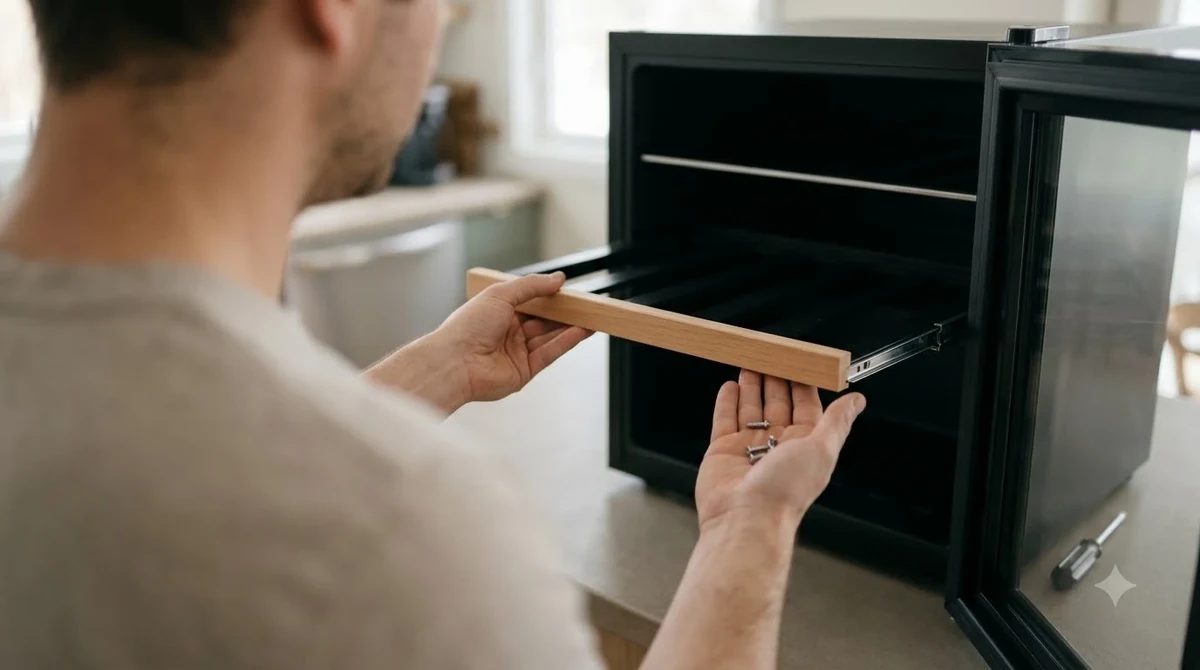
Removable beechwood shelves give owners some flexibility when arranging bottles. Standard Bordeaux-style bottles generally fit more predictably than unusually wide or tall formats, so the ability to remove shelving can be useful when storing a mixed collection.
The digital display also makes temperature adjustments more straightforward than relying on an unmarked mechanical dial. For someone who keeps whites and reds in separate compartments, being able to see the selected settings is a practical advantage.
The locking door is another useful addition in a household with children or frequent visitors. It does not replace responsible appliance placement, but it provides an extra layer of control over access to the collection.
Overall, positive feedback suggests that the AWR-460DB appeals to buyers who value an integrated appearance and convenient everyday access as much as storage capacity.
Common Complaints and Potential Drawbacks
The main concerns raised by customers involve reliability, occasional operating noise, delivery condition, and the possibility of cooling problems. These issues do not mean every unit will experience trouble, but they deserve attention before purchasing an appliance that may be difficult to replace once installed in cabinetry.
Home Depot reviews include an owner who reported that the refrigerator became noticeably noisy after approximately two years. Another reviewer described a cooling failure after five months, with the displayed temperature remaining at 86°F and the fans no longer operating. These are individual experiences rather than evidence of a general defect rate, but they illustrate why warranty coverage matters.
Long-term performance is particularly important for wine storage. A refrigerator that stops maintaining its temperature can disrupt the storage conditions of an entire collection. Owners should therefore pay attention to unusual compressor sounds, repeated temperature fluctuations, and warning signs such as condensation or unexpected interior warming.
Capacity is not guaranteed for every bottle shape
The advertised 46-bottle capacity should be treated as a maximum based on standard bottle dimensions. Wine bottles are not manufactured to one universal shape. Champagne bottles, many sparkling wines, Burgundy bottles, and some specialty formats have wider bodies or different shoulder profiles.
These differences can make a fully loaded refrigerator less practical than the headline capacity suggests. A collection containing numerous Champagne bottles may require more shelf space than one made primarily of standard Bordeaux bottles.
Buyers should also consider the frequency with which they retrieve bottles. Packing every shelf to its maximum capacity may make the refrigerator less convenient to use, particularly when bottles need to be moved to access those stored behind them.
Installation errors can create performance problems
A built-in refrigerator depends on the correct installation environment. An appliance that is pushed into an opening without considering its front ventilation, door movement, electrical connection, and leveling requirements may operate less effectively or become difficult to service.
Another potential drawback is the unit’s weight. At 104 pounds, the AWR-460DB requires careful positioning. A cabinet opening that looks correct on a drawing may still create problems if its floor is uneven or the surrounding trim prevents the door from opening fully.
Shipping damage is also a practical consideration for large glass-door appliances. Inspecting the exterior, shelves, door alignment, and electrical operation before completing the installation can make it easier to address a problem while return or replacement options remain available.
Finally, buyers should examine the actual warranty terms rather than relying only on a headline warranty period. Coverage conditions, labor arrangements, shipping responsibilities, and replacement procedures can materially affect the cost of a future repair.
Who Should Buy the Newair AWR-460DB and Who Should Skip It
The Newair AWR-460DB makes the most sense for households with a moderate wine collection, a suitable under-counter opening, and a preference for keeping red and white wines in separate temperature zones. It is less appropriate for people who need extensive long-term cellar storage or primarily collect large-format bottles.
Who should consider buying it
Home entertainers: People who regularly serve wine with dinner or host guests can benefit from the 46-bottle capacity. Keeping sparkling wine and whites in one compartment and reds in another reduces the need to move bottles between appliances before a gathering.
Owners renovating a kitchen: The built-in configuration is appealing for a planned kitchen renovation or home-bar project. Its 23.40-inch width and 33-inch height provide a useful starting point for cabinet planning, provided the final installation follows the manufacturer’s ventilation and clearance instructions.
Mixed-wine households: A collection containing Cabernet Sauvignon, Pinot Noir, Riesling, Chardonnay, and Prosecco can benefit from separate temperature settings. The two compartments provide more flexibility than a single-zone cooler that forces every bottle into the same temperature environment.
Buyers who value visible storage: The stainless-steel finish, glass door, interior lighting, and wood shelving make the appliance a reasonable choice when appearance matters alongside practical storage.
Who should look elsewhere
Large collectors: A 46-bottle maximum can become restrictive quickly for people who regularly purchase cases or maintain multiple vintages. Newair also offers larger wine refrigerators, including models listed in its built-in collection, that may be more suitable for expanding collections.
Owners with limited cabinet depth: The 24-inch measurement includes the handle, and the appliance is 104 pounds. Anyone working with shallow cabinetry, narrow doorways, or a difficult installation route should assess the complete dimensions before ordering.
Buyers seeking dedicated cellar conditions: A dual-zone refrigerator provides temperature control, but it is not automatically equivalent to a purpose-built wine cellar. People storing valuable bottles for many years should consider temperature stability, humidity, vibration, and protection from light as part of a broader storage plan.
Households with unusually shaped bottles: Collectors who primarily buy Champagne, oversized Burgundy bottles, or other specialty formats may find that the advertised capacity overstates the number of bottles they can comfortably arrange.
In short, the AWR-460DB is most appealing as an accessible household wine refrigerator rather than a high-capacity collector’s cellar.
How It Compares to Smaller Newair Alternatives
Newair’s product range includes several built-in formats, so buyers should compare the exact model number instead of assuming that all Newair under-counter refrigerators share the same dimensions, capacity, or temperature controls. The 46-bottle AWR-460DB is designed for a substantially different storage need than the compact NWC007SS00.
The NWC007SS00 is a 7-bottle single-zone compressor refrigerator. Newair lists its temperature range as 41–65°F and its dimensions as 5.90 inches wide, 20.08 inches deep with the handle, and 34.20 inches high. This slim design serves a different purpose from a conventional 24-inch under-counter wine refrigerator.
It can be useful where an unusually narrow installation space is available, but its limited capacity means it is not a direct substitute for a household wine collection. Its single-zone configuration also offers less flexibility for simultaneously storing different wine styles at separate temperatures.
The AWR-460DB, by comparison, has room for up to 46 standard bottles, two temperature zones, a locking door, and a wider cabinet format. It is the more practical option for people who expect to keep a rotating assortment of reds, whites, and sparkling wines available.
Newair’s manual directory also identifies the NWC046SS01 as a 24-inch, 46-bottle built-in dual-zone refrigerator. This illustrates why the model number matters: similarly described products may have distinct product documentation and configurations. Buyers should not assume that specifications from one 46-bottle model automatically apply to another.
For the full-size AWR-460DB, the manufacturer’s official 46-bottle wine refrigerator specifications are the appropriate reference when checking dimensions, cooling ranges, and electrical requirements.
The most important comparison is therefore not simply capacity. It is the combination of cabinet width, temperature-zone arrangement, bottle shapes, installation requirements, and the size of the collection. A smaller unit may be more sensible for a compact apartment bar, while a 46-bottle refrigerator is better suited to a dedicated kitchen wine-storage area.
Installation, Temperature Settings, and Everyday Use
Correct installation and sensible temperature settings are essential to getting useful performance from an under-counter wine refrigerator. Before placing the appliance in its final position, confirm the cabinet opening, ventilation path, electrical supply, door clearance, and leveling requirements against the instructions for the exact model.
Measure the opening carefully
Begin by measuring the cabinet opening at its narrowest points. For the AWR-460DB, Newair lists a width of 23.40 inches and a height of 33 inches. Its depth is 22.40 inches without the handle, but the full measurement becomes 24 inches with the handle attached.
Do not assume that a cabinet advertised as 24 inches deep will automatically provide enough room. The back of the opening, surrounding trim, electrical outlet, and door projection all affect the usable space.
Front ventilation is particularly important for built-in appliances. A refrigerator designed for under-counter installation needs its ventilation path kept clear. Blocking that area with decorative trim, stored objects, or an incorrectly fitted cabinet panel can interfere with heat removal.
Because the appliance weighs 104 pounds, it is sensible to have suitable assistance when positioning it. The unit should sit securely and level, with the door able to open without striking adjacent cabinets or handles.
Choose practical temperature settings
The upper compartment’s 40–50°F range works for many sparkling wines and light whites. A setting around 45–48°F is a reasonable starting point for Prosecco, Champagne, Sauvignon Blanc, and other wines that benefit from cooler serving temperatures.
The lower compartment’s 50–66°F range provides greater flexibility for reds and fuller-bodied whites. A setting around 55–60°F can work for Pinot Noir and other lighter reds, while fuller reds can be stored toward the warmer end of the available range.
Serving temperature and storage temperature should not be confused. A Cabernet Sauvignon stored in the refrigerator may need time outside the appliance before serving, while a Chardonnay may benefit from a short period of chilling if its storage setting is warmer than the preferred serving temperature.
Tip: Start with the upper zone around 46°F and the lower zone around 57°F for a mixed household collection. Allow the refrigerator to stabilize before making repeated adjustments, and use a separate thermometer if you want to verify the actual compartment temperature rather than relying exclusively on the display.
Organize bottles according to the collection
Keep frequently served bottles in accessible positions and reserve less convenient shelf locations for wines that are not opened as often. This reduces unnecessary rearranging and makes it easier to maintain an organized collection.
Standard Bordeaux bottles are generally easier to arrange than unusually wide sparkling bottles. If your collection contains several bottle formats, leave room to adjust the shelves instead of filling every available position immediately.
For a small dinner gathering, you might organize the upper section around Sauvignon Blanc and sparkling wine, while the lower section holds Pinot Noir, Merlot, and Cabernet Sauvignon. This arrangement is especially convenient when preparing different wines for several courses.
Match wine temperatures to food
Temperature control is only one part of serving wine successfully. Food pairing still matters, especially when choosing bottles for a dinner party.
A bottle of Chardonnay can work well with chicken in a creamy sauce, while Pinot Noir offers a lighter red alternative for poultry and mushroom dishes. A suitable chicken Marsala recipe provides an opportunity to compare how different wine styles work with the savory flavors of mushrooms and fortified cooking wine.
For casual entertaining, keep sparkling wines ready for cocktails and aperitifs. A chilled bottle of Prosecco is useful for an Aperol Spritz recipe, while a fresh, aromatic white sparkling wine can also suit a Hugo Spritz recipe.
After opening a bottle, return unfinished still wine to the refrigerator and use an appropriate closure. As a general guideline, opened still wines are best consumed within approximately three to five days, while sparkling wines usually retain their character for about one to three days with a suitable sparkling-wine stopper.
These practices help make the refrigerator a useful part of everyday wine service rather than simply a place to keep bottles out of sight.
Frequently Asked Questions
Does the Newair AWR-460DB require a special electrical outlet?
Newair lists the AWR-460DB for 120-volt operation, with a rated consumption of 90 watts. This is a standard North American household voltage, but the installation should still follow the electrical requirements in the product manual. Avoid using an extension cord unless the manufacturer explicitly permits it.
Can the Newair wine fridge store Champagne bottles?
Champagne bottles can be more challenging to arrange because their bodies are often wider than standard Bordeaux bottles. The advertised 46-bottle capacity is based on standard bottle dimensions, so a collection containing numerous sparkling bottles may have a lower practical capacity. Check the shelf spacing and usable interior dimensions before relying on the maximum figure.
Does the Newair AWR-460DB have a reversible door?
Door orientation is a model-specific installation detail and should not be assumed from the general Newair product description. Check the AWR-460DB manual and the exact configuration supplied before planning cabinetry around a particular opening direction. This is especially important when the refrigerator sits next to a wall or dishwasher.
Can the Newair refrigerator be installed in a garage?
Installation in a garage depends on the ambient-temperature limits specified in the exact model’s manual. A garage can experience greater seasonal temperature swings than an indoor kitchen, potentially affecting compressor operation and temperature stability. Check the approved operating environment before placing the appliance in an unconditioned space.
Does the AWR-460DB include a built-in humidity control system?
Newair’s published AWR-460DB feature list does not identify a dedicated adjustable humidity-control system. Buyers who need specialized humidity management for long-term bottle aging should investigate a purpose-built wine-storage cabinet rather than assume that a dual-zone refrigerator offers cellar-style humidity regulation. A glass-door wine refrigerator and a dedicated aging cabinet serve related but different storage purposes.
The Newair under counter wine fridge is a compelling option for households that want attractive integrated storage, a practical 46-bottle capacity, and independent temperature settings. The AWR-460DB’s installation dimensions and customer-reported reliability concerns deserve careful attention, but its feature combination makes it worth considering for a kitchen renovation or home bar. Measure the space, verify the exact model documentation, and review warranty conditions before making a final purchase decision.
More in Model Reviews
 Magic Chef 44 Bottle Wine Cooler Review for Flexible StorageUpdated Nov 21, 2026
 Whynter 164 Bottle Wine Cooler Review: Capacity, Features, and FitUpdated Nov 21, 2026
 Insignia NS WC16BK6 Review: Compact 16-Bottle Wine StorageUpdated Nov 21, 2026
 Wine Enthusiast Electric Blue Omega Review: Opening, Pouring, and Preserving Made EasierUpdated Nov 21, 2026
 Koolatron 20 Bottle Wine Cooler Review: Features, Fit, and PerformanceUpdated Nov 21, 2026
 NewAir AWC 330E Review for Home Wine StorageUpdated Nov 21, 2026