

We may earn a commission when you buy through links on this page, at no extra cost to you. Learn more.
The Brookstone electric wine opener is a convenient automatic corkscrew for people who want to open wine bottles with less manual effort, but its value depends on choosing the correct model and understanding its battery requirements. Brookstone has offered both rechargeable and replaceable-battery versions, with features such as automatic cork extraction, foil cutting, and charging stands. Its main advantages are straightforward operation and reduced physical effort, while inconsistent performance reported by some owners makes model identification and reliability important considerations.
Brookstone wine accessories have included several electric opener designs, ranging from compact battery-powered units to rechargeable countertop models. That distinction matters because charging times, expected battery life, included accessories, and operating procedures are not interchangeable. This review examines the documented features, practical advantages, owner feedback, and limitations to consider before buying one. It also explains how the opener compares with traditional corkscrews and other wine accessories.
Specs and Key Features
The Brookstone electric wine opener is designed to remove corks using a motorized corkscrew rather than requiring repeated manual twisting. Depending on the model, it operates with four AA batteries or an integrated rechargeable battery and charging base.
One documented rechargeable model is the Brookstone Aperto Auto-Sensing Bottle Opener. Its instruction manual specifies an approximately eight-hour charging period and an estimated capacity of 60 bottles per full charge. A separate Brookstone Automatic Wine Opener listing at Kohl’s describes a battery-powered version that requires four AA batteries, sold separately. These are different configurations, so buyers should not assume that every Brookstone opener has the same power system.
| Specification | Rechargeable Aperto | AA Battery Model |
|---|---|---|
| Power source | 3.6V, 700mAh NiMH battery | 4 AA batteries |
| Charging time | Approximately 8 hours | No charging required |
| Estimated capacity | Approximately 60 bottles per charge | Not specified in the retailer listing |
| Dimensions | 3.4 inches wide x 9.7 inches high with base | 9 x 6.5 x 28 cm |
| Foil cutter | Included | Included |
| Cork removal | Automatic motorized mechanism | Push-button operation |
| Maintenance | Wipe with a damp cloth | Spot clean |
These specifications come from the Brookstone Aperto instruction manual and the Kohl’s product listing. The dimensions and battery information should be treated as model-specific rather than universal Brookstone specifications.
The automatic extraction mechanism is the central feature. On the traditional rechargeable design described in Brookstone’s documentation, the corkscrew enters the cork and removes it through a motorized rotation. The user does not need to turn a handle through several revolutions or pull against the cork manually.
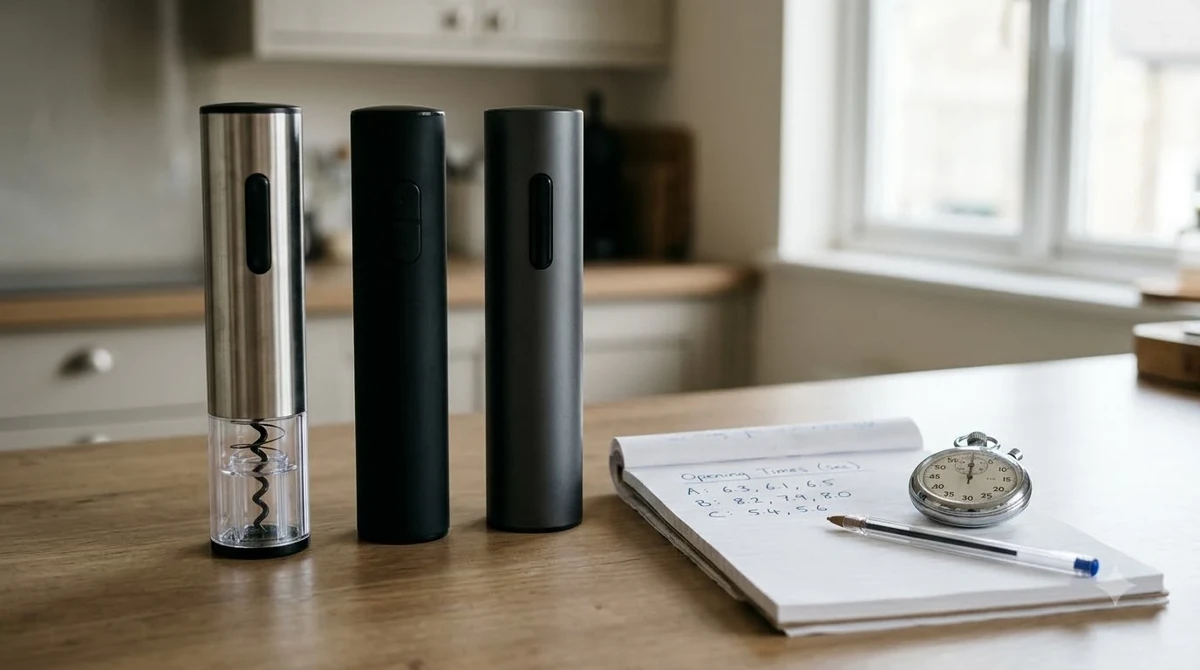
The included foil cutter is another practical feature. Before opening a bottle, the user removes the foil covering the cork. Some Brookstone designs incorporate a cutter that attaches to the opener or its charging base, keeping the two tools together instead of requiring a separate accessory drawer.
Materials also vary by product. Kohl’s identifies ABS, polystyrene, carbon steel, and stainless steel in its listed battery-powered model. Another Brookstone product description identifies a Teflon-coated carbon-steel corkscrew. These details suggest a combination of lightweight housing materials and a metal extraction mechanism, although they should not be attributed to every model.
For a household that opens wine occasionally, the basic automatic mechanism may be sufficient. A household that opens several bottles during dinners or celebrations may find a rechargeable unit more convenient because it avoids keeping spare disposable batteries available.
What Owners Like
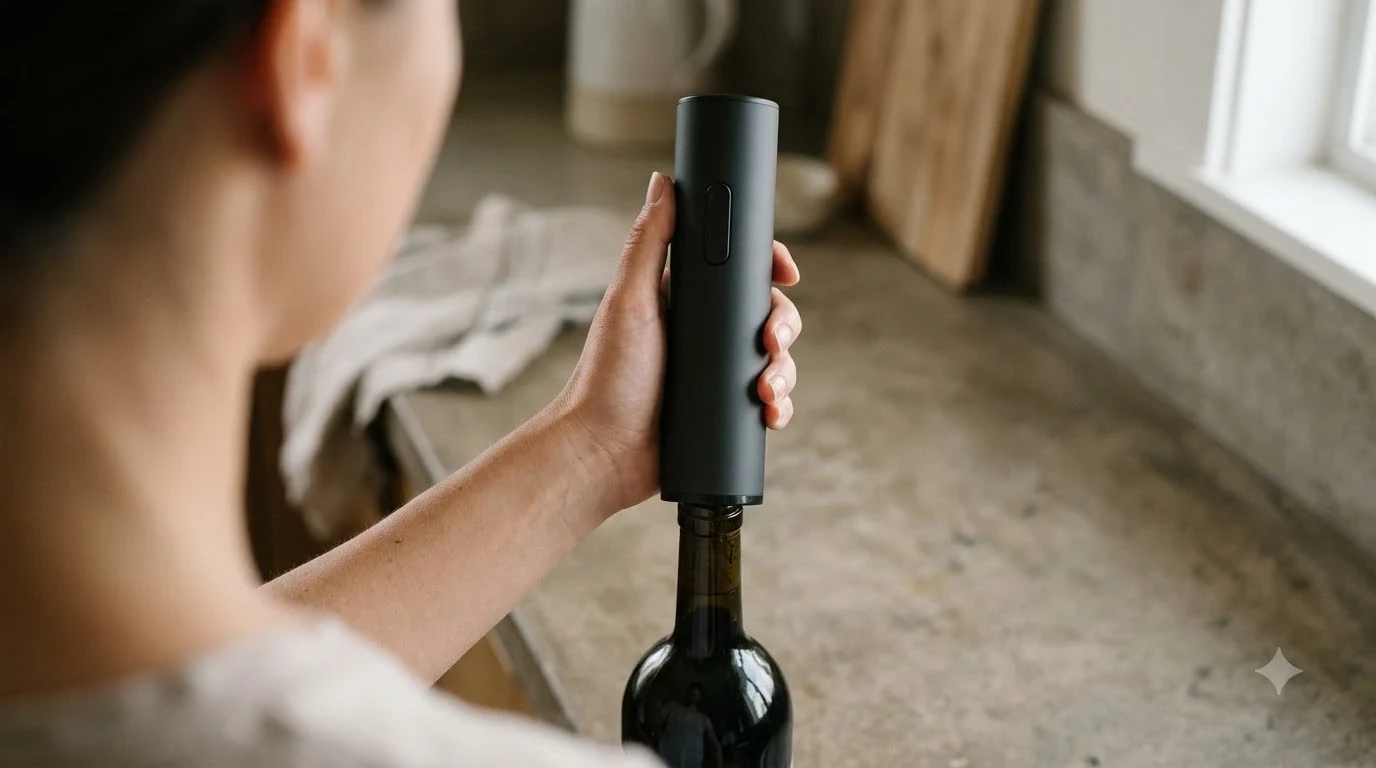
The biggest attraction of an electric wine opener is convenience. Instead of manually working a corkscrew into the cork and pulling upward, users position the device over the bottle and activate its motorized mechanism.
Brookstone’s older automatic opener design uses a down-arrow control to extract the cork and an up-arrow control to release it from the device. The operating sequence is simple enough for someone unfamiliar with traditional corkscrews, provided the opener is positioned correctly.
Another advantage is compatibility with different cork materials. Brookstone’s product description identifies natural and synthetic corks as suitable for its automatic opener. This is useful because contemporary wine bottles use both types, and a household may have bottles from different producers and price categories.
Natural cork is generally extracted using a spiral corkscrew that penetrates the stopper. Synthetic corks can sometimes offer greater resistance because their material and density differ from natural cork. A motorized mechanism reduces the need for the user to supply all the extraction force, although it does not guarantee trouble-free removal from every bottle.
For a person who regularly serves Cabernet Sauvignon, Merlot, Pinot Noir, or Chardonnay, an automatic opener can make opening multiple bottles less repetitive. This can be particularly useful during a dinner party, where several bottles may need to be opened before or during the meal.
Less manual effort during bottle opening
The convenience is especially apparent for people who find traditional corkscrews difficult to operate. A waiter-style opener requires a sequence of movements involving the spiral, lever, and bottle neck. A winged corkscrew also requires sufficient hand strength to drive the spiral into the cork and operate both wings.
An electric opener replaces much of that physical work with a motor. The user still needs to stabilize the bottle and keep the opener aligned, but the mechanism handles the main extraction movement. This makes it an appealing option for people who open wine regularly but prefer not to use a manual corkscrew.
Convenient accessory storage
Some Brookstone versions include a base that holds the opener and foil cutter. The rechargeable Aperto design uses a dedicated charging base, while other automatic models have a cutter that clips onto the stand.
Keeping the accessories together reduces the likelihood of misplacing the foil cutter. It also gives the opener a defined storage location on a kitchen counter or wine station.
For households with limited storage, this arrangement is useful as long as there is sufficient counter space. A charging base does occupy more room than a compact manual corkscrew, so the convenience comes with a small storage trade-off.
The rechargeable Aperto also has a useful documented capacity. Brookstone estimates approximately 60 bottle openings on a full charge, which is a substantial number for normal home use. The manufacturer specifies that the device should be returned to its charging base after use to maintain readiness.
These features make the product attractive as a household wine accessory and a potential gift. A complete set with an opener, foil cutter, and charging base offers a more organized presentation than a standalone corkscrew.
For additional equipment ideas, the site’s Accessory Brands coverage provides a broader starting point for comparing wine-related accessories.
Common Complaints
The main concern with Brookstone electric wine openers is inconsistent reliability across models and individual units. Customer feedback associated with the Kohl’s Automatic Wine Opener and Foil Cutter includes reports of stuck corks, an ineffective foil cutter, and insufficient motor power.
That feedback deserves attention because a motorized corkscrew is only convenient if it can complete the extraction consistently. A device that stalls halfway through removing a cork may require more effort to troubleshoot than a traditional opener would have required in the first place.
The retailer’s product page also shows that customer experiences are mixed. Its review summary describes complaints involving both performance and build quality. These comments relate to the listed product and should not automatically be treated as evidence that every Brookstone model has identical problems.
Battery and charging problems
Rechargeable models depend on battery condition and proper contact with the charging base. The Aperto manual explains that the charging LED should illuminate when the opener is correctly seated. If the indicator does not appear, the unit may not be making proper contact with the charging connectors.
Battery degradation is another consideration with older rechargeable appliances. A unit that has spent years in storage may no longer retain the same charge capacity it had when new. Even if the motor still operates, the battery may provide substantially less service than the documented estimate of 60 bottles per full charge.
AA-powered models avoid dependence on an integrated rechargeable battery, but they introduce another ongoing requirement. Users need to purchase and replace four AA batteries when the existing set becomes depleted. Battery availability is straightforward, but replacement costs and waste accumulate over time.
Corks getting stuck
A stuck cork can result from several factors, including a poorly aligned opener, a damaged cork, or insufficient battery power. The first thing to consider is the position of the appliance. Brookstone’s rechargeable manual specifically warns that the opener must remain as upright as possible during extraction.
Angling the device can prevent the corkscrew from entering the stopper correctly. It can also put uneven pressure on the bottle neck. The user should hold the bottle securely and allow the mechanism to work at its intended speed rather than forcing the opener downward.
Brookstone provides a specific troubleshooting procedure for the Aperto model. If the battery runs out while extracting a cork, the instructions say to rotate the opener counterclockwise to back the spiral out of the cork. The user should not attempt to pull the device away with force.
If the cork remains trapped inside the appliance, the manual describes a reset procedure using the supplied reset tool. The tool is inserted into the reset hole after removing the foil cutter, activating the corkscrew in reverse for several seconds. For another documented Brookstone design, the Brookstone automatic wine opener instruction manual also explains how to reverse the mechanism if the battery runs out during extraction.
Alignment and bottle-rim damage
Correct alignment is not just a matter of operating convenience. It can also help protect the bottle. WIRED’s review of an older Brookstone automatic opener describes an incident in which the reviewer chipped part of a bottle’s glass rim during an initial attempt.
The review emphasizes that the device needs to be held straight over the bottle. This is a particularly important point because the motorized mechanism can make users assume that the appliance will automatically correct its position. It does not replace the need for careful handling.
Anyone using an electric opener should keep the bottle on a stable surface, hold it securely, and position the corkscrew directly above the center of the cork. If the appliance begins to tilt or move unevenly, stop rather than forcing it through the extraction process.
WIRED’s Brookstone Automatic Wine Opener review discusses both the convenience of automatic extraction and the importance of keeping the device upright. Its observations provide useful context for understanding why correct positioning matters.
These limitations do not make an electric opener inherently unsuitable. They do mean that proper technique, a healthy battery, and a correctly functioning mechanism are essential to getting the convenience expected from the product.
Who Should Buy and Who Should Skip
A Brookstone electric wine opener makes the most sense for people who value simple, button-operated cork removal and prefer a dedicated countertop wine accessory. It is less compelling for buyers who prioritize mechanical simplicity, portability, or long-term serviceability.
For households that open wine several times each week, the automatic mechanism can reduce repetitive effort. A rechargeable model with a charging base is particularly practical if it remains on a kitchen counter and is returned to its stand after every use.
Good candidates for an electric opener
Regular home wine drinkers: People who frequently open bottles for meals, entertaining, or casual evenings can appreciate the reduced manual effort. The rechargeable Aperto’s estimated 60-bottle capacity is more than sufficient for many ordinary household routines, assuming the battery remains in good condition.
Hosts who serve multiple bottles: Dinner parties and holiday gatherings often involve opening several bottles in succession. An automatic opener can simplify the process, particularly when guests are waiting for wine service.
People who dislike manual corkscrews: Some users find traditional spiral and lever mechanisms awkward. A motorized opener provides an alternative that requires fewer coordinated hand movements.
Gift shoppers: A Brookstone opener with a foil cutter and stand can make a practical gift for someone who regularly enjoys bottled wine. The combination of accessories gives the product a more complete presentation than a basic corkscrew alone.
Who should consider another option
Frequent travelers: The charging base and relatively tall body make some Brookstone models less convenient to carry. A compact manual corkscrew or a wine bottle opener keychain is easier to pack for picnics, hotel stays, and outdoor gatherings.
People who rarely open wine: If a household opens only one or two bottles every few months, a manual opener may be more practical. It does not need charging, replacement batteries, or a dedicated storage base.
Buyers who prioritize long-term repairability: An electric opener contains a motor, battery system, switches, and moving components. A failure in one of these parts can make the entire appliance inconvenient or uneconomical to repair.
Owners of older or heavily used bottles: Some aged wines have fragile natural corks that can crumble during extraction. A powered corkscrew is not automatically the best solution for delicate closures. A two-prong cork puller or a careful traditional corkscrew technique may be more appropriate for older bottles.
It is also important to consider the wine itself. A bottle with a damaged or unusually tight cork can challenge an electric opener just as it can challenge a manual tool. The motor reduces physical effort, but it cannot eliminate problems caused by deteriorated cork material or an unsuitable bottle closure.
For buyers who primarily want a convenient wine-serving setup, an opener can be part of a larger collection of useful tools. An electric wine chiller, for example, serves a different purpose by helping bring bottles toward their intended serving temperature. The two accessories complement each other rather than compete directly.
How It Compares to Alternatives
Brookstone’s automatic opener occupies a middle ground between basic manual corkscrews and more elaborate electric wine-opening systems. Its primary advantage is reduced effort, while its disadvantages include dependence on batteries or charging and the need for careful positioning.
WIRED’s historical review of the Brookstone automatic design praised its straightforward operation and described a quick opening process. The review also noted that the device needed to remain upright and that the user still had to stabilize the bottle. Those observations illustrate the practical balance of convenience and technique involved with this type of appliance.

Electric versus waiter-style corkscrews
A waiter-style corkscrew is a compact manual tool that uses a spiral and lever to remove the cork. It is common in restaurants because it is portable, relatively inexpensive to maintain, and does not depend on a battery.
The Brookstone electric alternative is easier for users who do not want to provide the twisting and pulling force themselves. However, a waiter-style opener has fewer components that can fail. Its mechanical simplicity makes it a sensible backup even for households that own an electric device.
There is also a difference in control. With a manual opener, the user can feel the resistance of the cork throughout extraction. An electric opener provides less direct feedback because the motor supplies the movement. This distinction matters with delicate corks and bottles that have been stored for many years.
Electric versus winged corkscrews
Winged corkscrews use two levers that rise as the spiral enters the cork. Pushing the wings down pulls the stopper out of the bottle. They are generally easy to understand and do not require a charging station.
A Brookstone opener removes the need to raise and lower those wings. Its motor performs the extraction, which can be useful for people who open multiple bottles or find manual lever movement uncomfortable.
Winged corkscrews, however, are easy to store and have no rechargeable battery to age. For someone who values a simple tool that can remain in a kitchen drawer for years, a winged design may be the more sensible purchase.
Electric versus other wine accessories
Not every electric wine accessory is designed to remove corks. Some products focus on cooling, preserving, or dispensing wine. Buyers should distinguish these functions before assembling a wine station.
An electric wine chiller is intended to help maintain or achieve a suitable serving temperature, rather than open the bottle. For people who regularly serve chilled white wine, sparkling wine, or rosé, this may be a more useful additional appliance than another corkscrew.
The best electric wine chiller options should be evaluated by cooling performance, bottle compatibility, dimensions, and operating convenience. Those are separate considerations from the extraction power and battery life of an electric opener.
For most households, the decision is straightforward. Choose the Brookstone opener if automatic cork removal is the main priority. Choose a manual corkscrew if portability and simplicity matter more. Add cooling or preservation accessories only when those functions address a genuine need in the way wine is served and stored.
Overall buying considerations
Before purchasing a Brookstone opener, verify the exact model name, power source, accessory package, and availability of the correct charging base or replacement parts. A product description that simply says automatic wine opener may not provide enough information to establish which version is being offered.
This is particularly important with older Brookstone appliances. A used rechargeable model might look attractive but have a weakened battery. A battery-powered version might be easier to put back into service, but its owner will need four compatible AA batteries.
It is also sensible to examine the foil cutter and corkscrew mechanism for visible damage if buying a pre-owned unit. Check that the controls respond correctly and that the appliance releases the cork without unusual noise or resistance. For a rechargeable model, confirm that the charging indicator works and that the original adapter and base are included.
Overall, the Brookstone electric wine opener offers a useful convenience feature, but it should be purchased with realistic expectations. The best choice is a complete, correctly identified unit with a functioning motor and a power system that suits the intended frequency of use.
Frequently Asked Questions
Does a Brookstone electric wine opener work with sparkling wine bottles?
No. A standard corkscrew is intended for conventional still-wine corks and should not be used to extract the pressurized closure from a sparkling wine bottle. Champagne and other sparkling wines require a different opening technique because the cork is held in place by internal pressure. Keep the bottle pointed away from people and avoid using a motorized corkscrew on a sparkling wine closure.
Can a Brookstone electric opener remove a cork that has broken in half?
Not reliably. A broken cork may prevent the spiral from engaging securely, especially if the remaining piece is uneven or deteriorated. A two-prong cork puller can be a more suitable tool because its prongs slide between the cork and the bottle neck rather than relying on a conventional spiral extraction. Avoid repeatedly activating the motor against a damaged stopper.
Does an electric wine opener affect the wine’s flavor?
Normal cork extraction does not change the wine’s intended flavor profile. The opener only removes the closure and does not perform the aeration process associated with decanting. Once the bottle is open, serving temperature and exposure to oxygen have a much greater influence on the wine’s presentation than the type of corkscrew used.
Can an electric wine opener be stored in a wine refrigerator?
It is generally better to keep the electrical appliance in a dry indoor storage area rather than inside a wine refrigerator. Condensation and moisture can create problems for electrical contacts, batteries, and charging connectors. Store wine bottles in their appropriate wine-storage environment and keep the opener and its charging equipment separately.
How can you tell whether a rechargeable Brookstone opener needs a new battery?
Repeatedly reduced operating capacity after a complete charge can indicate battery deterioration. Other warning signs include failure to hold a charge, an unusually short operating period, or inconsistent motor performance despite proper contact with the charging base. The Aperto manual specifies a nickel-metal hydride battery, so owners should investigate model-specific replacement and service options rather than assuming that an ordinary external battery pack will work.
The Brookstone electric wine opener is a convenient choice for people who want automatic cork removal and an organized countertop accessory. Its strongest selling points are reduced manual effort, included foil-cutting accessories, and the rechargeable Aperto model’s documented capacity of approximately 60 bottles per charge. However, differences between models and reported reliability complaints make careful product identification essential. For buyers who prefer simplicity and portability, a traditional corkscrew remains a dependable alternative.
More in Wine Accessories
 Vinglace Wine Tumbler Review: A Glass-Lined Choice for Better SippingUpdated Nov 20, 2026
 ZWILLING Electric Wine Opener Review: Features and DrawbacksUpdated Nov 20, 2026
 Vinturi Electric Wine Opener Review for Easy UncorkingUpdated Nov 20, 2026
 Vinabon Wine Aerator Review for Easier, Cleaner Wine ServingUpdated Nov 20, 2026
 Vacu Vin Electric Wine Opener Review: Easy Cork Removal for Home Wine LoversUpdated Nov 20, 2026
 Rabbit Wine Accessories for Easier Home Wine ServiceUpdated Nov 20, 2026