

We may earn a commission when you buy through links on this page, at no extra cost to you. Learn more.
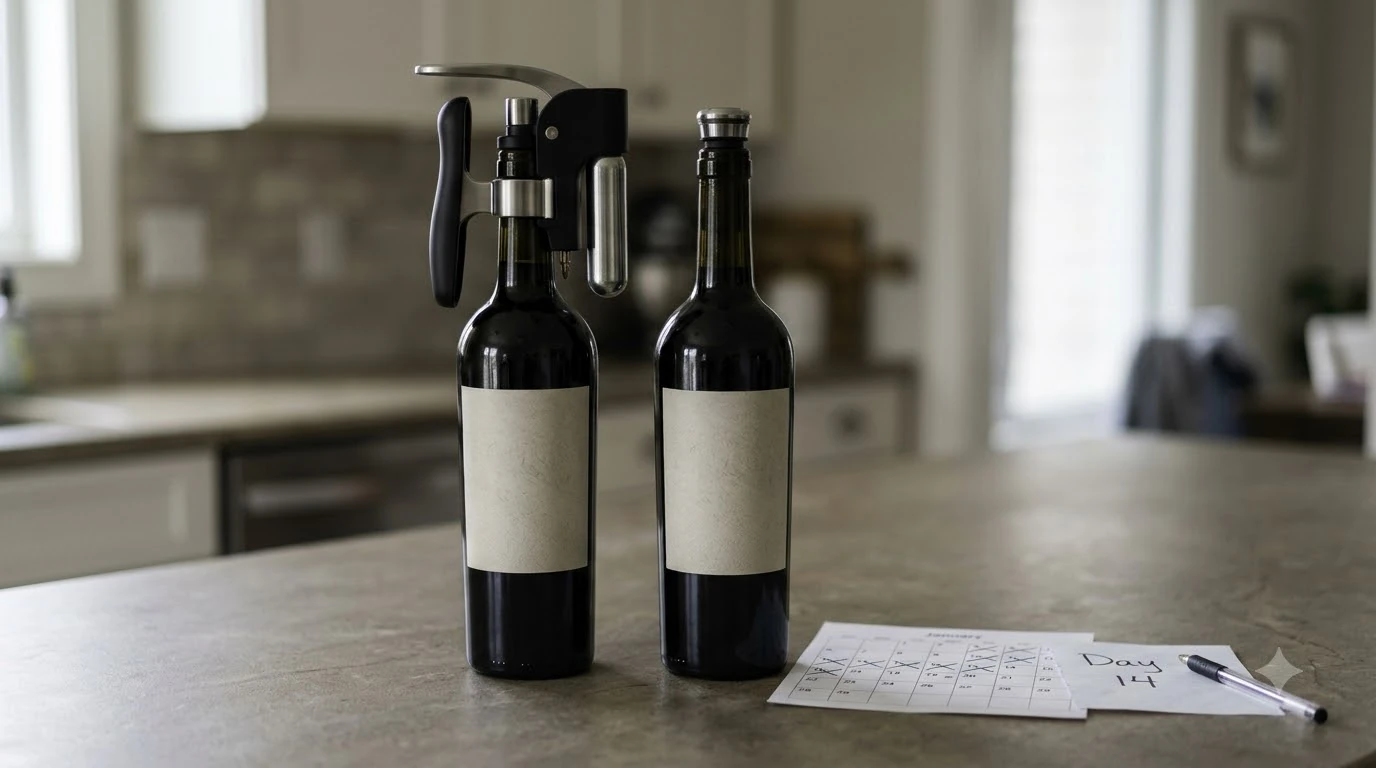
The coravin wine preserver is a useful choice for pouring a glass from a natural-cork bottle without removing the cork, allowing you to save the remaining still wine for another occasion. The Coravin Timeless Three+ is a practical entry point, using a thin needle and argon gas to protect the wine left in the bottle. It is particularly appealing to collectors, frequent tasters, and households that rarely finish a bottle in one sitting. However, its price, capsule requirements, and closure restrictions make it less compelling for people who normally finish wine within a few days.
Coravin is different from a conventional wine stopper or vacuum pump. Rather than opening a bottle and attempting to protect the wine afterward, the Timeless system accesses the wine through the existing cork. That approach can change how a household enjoys wine, especially when several bottles are in rotation or a special bottle is reserved for occasional glasses. This review looks at the Timeless Three+, explains its limitations, and compares it with Coravin’s other preservation options so you can decide whether the system fits your drinking habits.
Specs and Key Features: 750 ml Bottles and 5-Ounce Pours
The Timeless Three+ is designed for still wine in bottles sealed with natural cork, with a dedicated accessory extending compatibility to certain screw-cap bottles. Its main advantage is that you can pour a serving without removing the original cork and exposing the remaining wine to the air.
The system combines a precision-engineered needle with a capsule of 100% Pure Argon. The needle passes through the cork, wine travels through the device into the glass, and argon replaces the volume removed from the bottle. Argon is an inert gas, so it does not react with the wine in the way oxygen does. The remaining wine stays protected while the natural cork expands back into place after the needle is withdrawn. Coravin describes this process on its Timeless Three+ product page, including the system’s supplied accessories and operating steps.
| Specification | Coravin Timeless Three+ |
|---|---|
| Wine type | Still wine |
| Primary closure | Natural cork |
| Additional closure compatibility | Screw-cap bottles with the dedicated Coravin Screw Cap accessory |
| Preservation gas | 100% Pure Argon |
| Capsules included | 2 Pure Argon capsules |
| Claimed capsule capacity | Up to 15 glasses of 150 ml per capsule |
| Accessories included | Aerator, 2 screw caps, needle-clearing tool, and bottle sleeve |
| Finish | Matte black |
| Warranty | 1 year |
| Trial period | 30 days, subject to Coravin’s terms |
The included package makes the Three+ more than a bare dispensing device. The two capsules provide an initial supply of gas, the two screw-cap adapters accommodate compatible screw-top bottles, and the needle-clearing tool supports routine maintenance. The bottle sleeve is an additional precaution for users who prefer extra protection when working with a glass bottle. The aerator is intended to change how wine enters the glass, rather than to provide the preservation function itself.
Coravin states that a capsule can deliver up to 15 servings of 150 ml, approximately the amount of a standard five-ounce wine pour. A 750 ml bottle contains roughly five such servings, so that stated capsule capacity represents about three bottles’ worth of standard pours. Actual yield depends on the amount poured and how efficiently the gas is used. The capsule figure is a maximum claim, not a guarantee that every user will get precisely 15 full glasses.
The operating sequence is straightforward after a little practice. Fit the system over the bottle neck, press down to insert the needle, tilt the bottle to about 45 degrees, and use short trigger presses to dispense wine. Return the bottle upright to stop the pour, then lift the system straight up. Coravin recommends storing the bottle on its side in a cool, dark place suited to wine storage once the cork has resealed.
Tip: Use brief trigger presses instead of holding the trigger down. Short presses help conserve argon, particularly when pouring a small tasting serving rather than a full five-ounce glass.
What Owners Like About One-Glass Pours and Natural Cork
The strongest appeal is flexibility: one bottle can serve a single glass tonight and another glass weeks later, without requiring the drinker to open the bottle in the usual way. For someone who enjoys variety, that freedom can be more useful than simply extending the life of wine after opening.

Consider a household with one person who enjoys wine and another who rarely drinks it. Opening a full bottle of Cabernet Sauvignon for one serving can leave several glasses waiting in the refrigerator. A Timeless system makes it possible to pour a glass and leave the rest of a compatible bottle closed. The same advantage applies to couples who prefer different wines, collectors who want to follow the development of a bottle over time, and people who like to compare producers without committing to finishing each bottle at dinner.
The system can also support more varied tasting at home. A wine enthusiast might pour a small glass of Pinot Noir, compare it with a Merlot, and return to a favorite white wine later in the week. Instead of opening three bottles and managing three partially consumed wines, compatible bottles can remain closed between servings. This is particularly helpful when a cellar contains bottles intended for occasional enjoyment rather than everyday consumption. A wine advent calendar or a collection of small tasting selections can encourage variety, while a preservation system gives a drinker more freedom to sample wines without automatically finishing every bottle.
Independent testing gives some support to the longer-term value. In a comparison published by Quebec’s SAQ, Coravin was considered alongside Vacuvin, AntiOx, and Private Preserve. The test included an Alsace white blend and a Rhône red, with assessments after roughly 30 hours, four days, and nine days. SAQ reported that all four methods were reasonably effective over the first two or three days, but only the Coravin-preserved wines retained their initial character at the final nine-day tasting. The full SAQ wine-preservation comparison offers useful context for why a needle-based system can be attractive to someone who regularly keeps bottles for longer periods.
That result should be read as a comparison, not a promise that every wine will taste unchanged after nine days, months, or years. The number of wines in the SAQ exercise was limited, and each bottle has its own cork quality, age, storage conditions, and sensitivity to oxygen. Nevertheless, the result illustrates the main advantage of the Timeless approach: preventing the bottle from being conventionally opened in the first place can preserve the original wine more effectively over longer intervals than methods applied after opening.
Another practical benefit is the ability to pour different styles in small amounts. A light-bodied Pinot Noir, a structured Cabernet Sauvignon, and an aromatic Riesling do not need to be finished at the same meal just because their bottles have been opened. A person planning food pairings or a tasting flight can compare wines with less pressure to use up the remaining contents. The system can also make a home bar more flexible; a bar cart can hold the serving accessories and glassware while the bottles remain stored in an appropriate wine-storage location.
Common Complaints: 15-Pour Capsules and Closure Limits
The main compromises are ongoing capsule use, careful handling, and the need for the right kind of bottle closure. The Timeless Three+ is a specialized wine tool, not a universal stopper that works with every bottle in a kitchen or wine rack.
First, argon capsules are consumables. The initial package includes two, but additional capsules are needed when those run out. Coravin’s stated yield of up to 15 standard 150 ml servings per capsule helps estimate usage, although people who make larger pours or use the trigger inefficiently may get fewer. Frequent users should include capsule replacement in the ownership calculation rather than comparing the device’s initial cost with the price of a simple stopper. Someone who pours a small glass most evenings may use capsules steadily, while an occasional drinker may find the included supply lasts much longer.
Second, the system is selective about closures. Natural cork is the main intended closure because it can expand after the needle is withdrawn. Synthetic cork does not reliably reseal around the puncture, so the wine may become exposed to oxygen. A glass closure is a different concern: Coravin warns that it can permanently damage the Timeless needle. Neither should be treated as an ordinary natural-cork bottle simply because the bottle neck appears similar.
Screw-cap bottles are possible, but only with the proper Coravin Screw Cap accessory. That is useful for people who buy wines from regions and producers that commonly use screw caps, but it adds another piece of equipment and requires the correct accessory. Coravin says the dedicated screw-cap adapter is engineered for up to 75 punctures and can keep wine fresh for up to six months. Those are manufacturer claims, not a reason to assume every screw-cap wine will behave identically under every storage condition.
Pouring also takes more steps than pulling a cork and using an ordinary stopper. The system must be aligned correctly, the needle needs to pass cleanly through the cork, and the trigger needs to be used in short presses. A rushed or awkward insertion can make the process frustrating, particularly for someone who wants to serve wine quickly to a table of guests. It is worth practicing with a familiar bottle before using the device on a delicate older wine.
Storage and bottle condition still matter. Coravin’s system does not repair a weak, damaged, or poorly fitting cork. A bottle with a compromised closure may not provide the same protection as one with a sound natural cork, and the system cannot reverse oxidation that occurred before the first pour. For chilled wine, Coravin notes that a cold cork may take longer to reseal, so the bottle should remain upright until the closure has recovered. This detail matters if a white wine is poured directly from a refrigerator and immediately returned to storage.
There is also a learning curve around choosing the right wine for the technique. Some young, tannic reds can benefit from exposure to air, depending on their structure and how they are being served. SAQ noted that a young, lively red preserved with Coravin retained some of its astringent character, while other preservation methods allowed more air exposure. That does not make the system unsuitable for red wine; it means that preventing oxidation and helping a young wine open up are two different goals. A bottle that needs aeration may call for a separate serving step.
Who Should Buy and Who Should Skip It for Weekly Tastings
The Timeless Three+ makes the most sense for people who regularly want a glass without committing to a whole bottle. It is less attractive for households that routinely finish a bottle in one sitting or use inexpensive wines that are normally consumed within a short period.
Collectors and enthusiasts are natural candidates. Someone with a cellar of Bordeaux, Burgundy, Barolo, or Napa Cabernet may want to sample an older or more expensive bottle without deciding to open and finish it at once. The device can also help someone follow the development of a wine over several occasions, although bottle condition and cork quality remain important. For these users, the value is not simply the number of days a wine stays fresh; it is the ability to taste from a bottle on their own schedule.
People who enjoy regular wine education can also benefit. A home taster might compare Sauvignon Blanc from two regions, examine differences between Syrah and Cabernet Sauvignon, or revisit a wine after a meal pairing. These activities become easier when the bottle does not need to be finished at the same session. A carefully arranged set of wine glasses, a decanter for wines that need air, and suitable storage space can make the overall experience more useful than treating the preserver as a stand-alone gadget.
The Three+ is also a sensible option for someone who often pours one or two glasses at a time. A single drinker who opens a 750 ml bottle on Friday and would like another glass on the following weekend has a clearer reason to consider Timeless than a household that finishes the bottle on Friday night. Likewise, a host who wants to offer several still wines at a dinner without opening every bottle may appreciate the flexibility. The ability to pour a taste of a special bottle without removing its cork can be valuable even when the bottle is not particularly old.
By contrast, casual drinkers who finish most bottles within one to three days may not gain enough from Timeless to justify the additional equipment and capsule supply. A conventional cork or screw cap, refrigerator storage for opened white wine, and a simple stopper may already meet their needs. If the usual problem is an occasional half bottle left after dinner, a basic wine opener and preserver set may be a more straightforward choice. Such a set also suits someone who wants a familiar opening tool alongside a stopper rather than a needle-and-gas mechanism.
People who mainly buy synthetic-cork wines, bottles with glass closures, or sparkling wine should look at another solution. Timeless is specifically designed around the behavior of natural cork. If the wine collection is dominated by screw caps, the dedicated adapter may work, but Pivot+ can be a more convenient route when closure variety is the priority. If sparkling wine is the main interest, a separate sparkling preservation system is needed. The best choice depends on the bottles in the wine rack, not merely the name of the device.
How It Compares to Pivot+ and Sparkling+ for Still and Bubbly Wine
Coravin’s systems serve different jobs, so the Timeless Three+ should be compared with Pivot+ and Sparkling+ by wine type and closure rather than treated as a universal winner. Timeless is the option for pouring through a natural cork; Pivot+ is designed for opened still wine; Sparkling+ is intended for bottles that need to retain carbonation.
With Timeless, the cork remains in place and the needle provides access to the wine. This is the main difference from ordinary preservation methods. The bottle does not need to be opened first, and the remaining liquid is protected by argon as the wine is poured. The system suits users who want to return to a bottle over a longer period, and it is particularly appealing when the natural cork and bottle condition are suitable for repeated access. Its screw-cap compatibility comes from a dedicated adapter, not from the needle being universally compatible with all closure types.
Pivot+ works in a different sequence. The user opens the bottle as usual, replaces its closure with the Pivot Stopper, then pours through the stopper while argon is introduced. Coravin describes Pivot+ as compatible with any closure type and designed to keep still wine fresh for up to four weeks. That makes it more flexible for a household with synthetic corks, screw caps, and other closure styles. The trade-off is that the original cork or cap is removed, so Pivot+ does not provide the same unopened-bottle approach as Timeless.
Sparkling+ is designed for a separate category. Champagne, Prosecco, Cava, and other sparkling wines need to retain carbonation as well as protect their flavor. Coravin’s Sparkling system uses carbon dioxide rather than argon and works with a stopper fitted to an already opened sparkling bottle. It is not interchangeable with the Timeless Three+, and buying Timeless does not mean a household can preserve its Champagne or sparkling rosé with the same device.
For a household that mainly drinks still wine from natural cork bottles, Timeless is the clearest match. For people with mixed closures or everyday wines they expect to finish over several days or weeks, Pivot+ may be more adaptable. For sparkling wine drinkers, Sparkling+ is the relevant product. The extra-device issue is real: someone who drinks both still and sparkling wine may need to decide whether the benefits of each system justify owning more than one preservation tool.
Another alternative is a simple stopper or a wine opener paired with an ordinary preservation accessory. Those options cost less, involve fewer parts, and suit bottles that are normally finished promptly. They do not provide the same unopened-bottle access, but that may not matter for someone who drinks wine on consecutive evenings. For a wider look at complementary equipment, the Accessory Brands section can help put wine preservation in context with other practical wine tools rather than assuming that one device must handle every serving situation.
Frequently Asked Questions
These answers cover additional setup and care details, including needle placement, repeated cork access, older bottles, and the use of the included aerator. They are useful details to understand before using the system on a treasured bottle.
Does the Coravin needle enter the cork in the same place every time?
No. Coravin designs the needle to be slightly off-center, so successive insertions enter the cork at different points rather than repeatedly puncturing one exact spot. This distributes access points across the closure, although it does not mean a natural cork can withstand unlimited punctures.
How many times can I use Timeless on the same natural cork?
Coravin says a natural cork may begin to lose its ability to seal after around 15 punctures. This is an approximate point rather than a guaranteed limit, because cork quality and condition vary between bottles. Monitor the closure and avoid assuming that every cork will reseal equally well after repeated access.
Should I use a different needle for a bottle older than 20 years?
Coravin recommends its Vintage Needle for wines more than 20 years old. The narrower specialist needle is intended to reduce the risk of damaging an older, potentially fragile cork during insertion. It is an additional accessory rather than part of the standard Timeless Three+ kit.
Does the Timeless Three+ aerator replace decanting?
The included Coravin Aerator is designed to disperse wine into smaller streams as it enters the glass. Coravin describes the effect as equivalent to up to 90 minutes of decanting. That comparison is the manufacturer’s claim; it does not mean every wine will respond exactly like a wine poured into a traditional decanter.
Does the system need extra cleaning after dessert wine?
Yes. Coravin recommends running the cleaning routine twice after dispensing dessert or fortified wine because these wines can contain more sugar. Following the additional cleaning step helps prevent residual wine from remaining inside the system before it is used again with another bottle.
The Coravin Timeless Three+ is best viewed as a specialized tool for people who want to enjoy still wine one glass at a time while keeping compatible bottles closed between servings. Its natural-cork access and argon system offer a meaningful advantage for collectors and frequent tasters, but the ongoing capsule supply and closure requirements make it unnecessary for many casual drinkers. Match the system to the bottles you actually buy, and it can make a varied wine collection easier to enjoy without opening everything at once.
More in Wine Accessories
 Coravin Vs Vacu Vin: Choose the Right Wine Saver for Your BottlesUpdated Nov 21, 2026
 Zwilling Wine Stopper Review: Preserve Open Bottles LongerUpdated Nov 21, 2026
 Wine Enthusiast Wine Preserver Review: Features, Benefits and LimitationsUpdated Nov 21, 2026
 Wine Enthusiast Wine Stopper: An Easier Way to Reseal Open BottlesUpdated Nov 21, 2026
 Vintorio Wine Opener: Two-Step Cork RemovalUpdated Nov 21, 2026
 Zwilling Wine Aerator Review: Aerate, Pour, and Seal With One ToolUpdated Nov 21, 2026