

We may earn a commission when you buy through links on this page, at no extra cost to you. Learn more.
Meursault wine tasting shows how Chardonnay from Burgundy’s Côte de Beaune can combine a rounded, layered texture with firm acidity and a distinctive mineral finish. Expect aromas that may include toasted almond, hazelnut, ripe pear, citrus, butter, honey, and flint. The wines are usually dry and white, with differences shaped by vineyard site, producer choices, and bottle age. A useful tasting looks beyond oak and richness to judge freshness, texture, length, and the character of the individual climat.
Meursault is one of Burgundy’s best-known white-wine villages, but it is not a single flavor profile. A village-level Chardonnay can feel open and fruit-driven, while a Premier Cru from Perrières may show greater structure and a stony edge. Learning to identify those contrasts makes a tasting more informative, whether the glass is poured at a winery, a restaurant, or at home.
Why Meursault Chardonnay Has Such a Recognizable Profile
Meursault is best known for dry Chardonnay with a full, supple texture balanced by fresh acidity. Hazelnut, toasted almond, citrus, orchard fruit, and a flinty or stony impression are recurring reference points, but their intensity varies from bottle to bottle.
The classic aroma set begins with ripe pear, apple, lemon, and sometimes white peach. With air, a wine may reveal almond skin, toasted hazelnut, brioche, butter, or a restrained vanilla note from oak maturation. Floral details such as lime blossom or honeysuckle can sit behind the fruit, while older bottles may develop honeyed, nutty, mushroom-like, or savory nuances. Not every Meursault will show all of these; a younger, cooler-feeling example can emphasize citrus and stone, while a more mature or oak-marked wine may seem broader and more pastry-like.
Texture is central to the identity. The palate often feels broader than a lean, high-acid Chardonnay, yet a successful bottle does not finish heavy or sweet. Acidity gives shape to the mid-palate and helps the finish stay clear. The Bourgogne Wine Board describes a balance between unctuous richness and freshness, with toasted nuts, butter, honey, citrus, and flint among the characteristic notes. Its Meursault appellation profile is a useful reference for the official regional description.
Think of the wine through four elements: fruit, acidity, texture, and savory detail. Ask whether citrus freshness remains as fruit ripens, whether oak supports or masks the vineyard, and whether a stony finish brings definition to a broad palate. This keeps one familiar aroma, such as butter or hazelnut, from dominating the assessment.
The Côte de Beaune Setting and Appellation Structure
Meursault lies in Burgundy’s Côte de Beaune, between Volnay and Puligny-Montrachet, with vineyards climbing the slope above the village. It is a Village appellation with 19 Premier Cru climats and no Grand Cru vineyards, a distinction that makes the names on the label especially useful.
The regional body records the appellation’s recognition in 1937 and identifies the commune of Meursault as its production area. Chardonnay accounts for nearly all of the white wine, while Pinot Noir is used for the much smaller red-wine category. The Bourgogne Wine Board lists 382.64 hectares of white vines and 9.19 hectares of red vines in its appellation data, a striking difference that reflects the village’s strong identity as a white-wine source.
| Appellation detail | Reported figure | What it tells a taster |
|---|---|---|
| Premier Cru climats | 19 | Named sites can appear after Meursault Premier Cru on a label. |
| White-vine area | 382.64 hectares | Chardonnay is the dominant expression of the appellation. |
| Red-vine area | 9.19 hectares | Pinot Noir exists, but is a small part of local production. |
| Grand Cru vineyards | 0 | Top Meursault wines are classified as Premier Cru, not Grand Cru. |
The local terrain is a mix of limestone, marl, and clay, with the regional profile emphasizing Jurassic marls and marly limestone. The Bourgogne Wine Board identifies favored vineyard exposures along an east-to-south arc and gives about 260 meters as a reference elevation for the best soils. Such conditions help explain why wines can carry both ripe fruit and a firm mineral impression. Differences in slope position, soil composition, exposure, and drainage create variation across the village rather than a single uniform taste.
A village name identifies a defined place, and a climat name narrows that origin further. The label hierarchy is a practical tasting clue: Meursault indicates the village appellation; Meursault Premier Cru adds a classified site; and a named Premier Cru climat points to a particular vineyard. For more on regional designations, see the site’s Wine Regions overview.
What Perrières, Genevrières, and Charmes Can Show
The best-known Premier Cru names to recognize are Perrières, Genevrières, and Charmes. Each has a reputation for a different emphasis, although producer decisions and vintage conditions can outweigh a simple ranking of vineyard names.
Perrières is often associated with power, structure, and a pronounced mineral edge. The name refers to a stony place, and the wines are commonly described as complete and tightly defined, with enough concentration to age. Decanter’s regional study discusses sub-sites including Perrières-Dessous, Clos des Perrières, Perrières-Dessus, and Aux Perrières, noting that their exact positioning on the slope can differ. The report also cautions that a grower’s skill has a major influence on the final wine, so a label should be read as a clue rather than a guarantee of a particular flavor.
Genevrières lies just north of Perrières, while Charmes sits downslope. They are among the best-known Premier Crus partly because they are among the largest, but Decanter reports that local growers see no fundamental terroir difference between these sites and nearby Porusot, Bouchères, and Gouttes d’Or. The principal crus share a similar exposure, and several are divided into Dessus and Dessous, or upper and lower sections. At a tasting, use those site details as context rather than expecting a fixed aroma signature from each name.
Other Premier Cru names worth learning include Les Caillerets, Les Bouchères, Porusot, and Gouttes d’Or. Compare two or three sites in one flight, reading each climat name before pouring. For a professional perspective on Meursault’s range, see Decanter’s regional profile of Meursault.
How to Taste Meursault Step by Step
A useful tasting sequence moves from appearance to aroma, texture, acidity, and finish. Use a clear glass, pour a modest sample, and give each wine a few minutes to open rather than judging it from the first sip alone.
Start with the color. Young Meursault can appear pale gold or green-gold, sometimes with silver highlights; deeper gold may accompany age or a richer style. Color alone cannot prove age or quality. Next, smell without swirling, then swirl gently and smell again. The first pass may show citrus, pear, or flowers; the second can expose hazelnut, toast, butter, spice, or stone.
On the palate, identify the sequence rather than reaching immediately for a score. Does lemon or pear arrive first? Does the wine feel creamy, waxy, broad, or tightly drawn? Is the acidity bright enough to balance the texture? Does the finish return to citrus, nut, stone, or spice? A focused Meursault often feels layered, with fruit and texture in the middle and a more savory or mineral impression at the end.
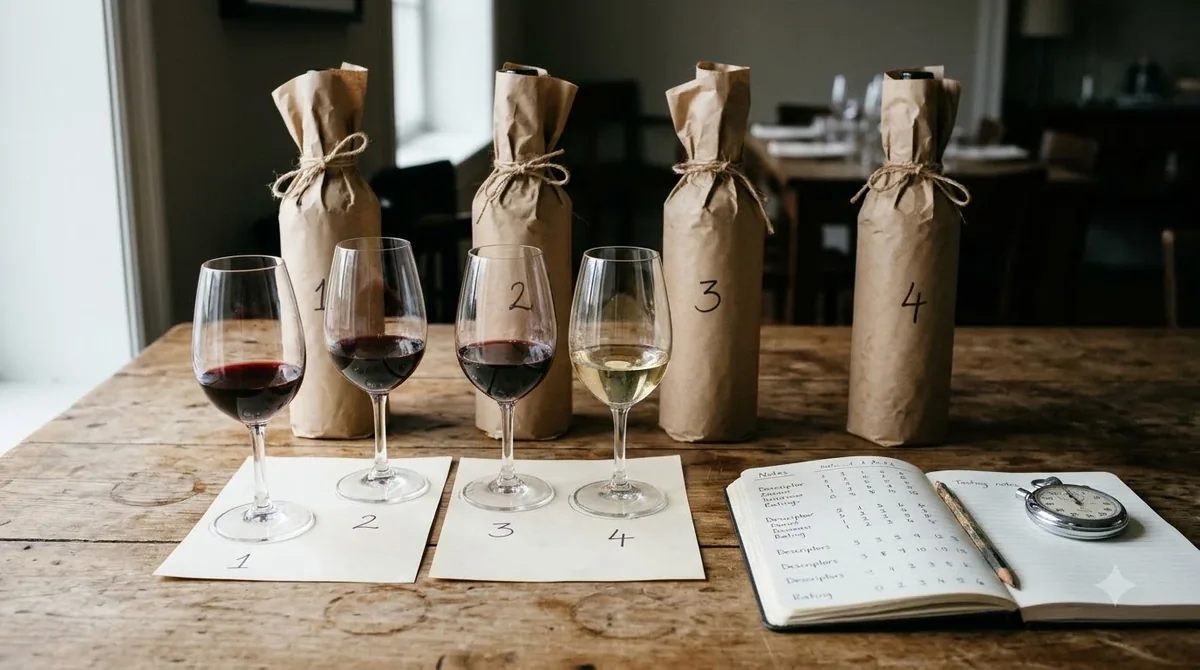
For a consistent comparison, use the same glass shape, similar pour sizes, and a steady temperature. Taste side by side rather than relying on memory. A guided flight can begin with village Meursault, move to a lighter Premier Cru, and finish with a structured site such as Perrières; pour three wines in 2-ounce samples, with water between glasses. Comparing a village wine and Premier Cru from one producer reduces a variable, while tasting two producers from the same climat shows how harvest decisions, fermentation, oak, and maturation can shift the result. Record your notes before discussing the bottles.
Tip: Write down three separate observations for every glass: one fruit or floral aroma, one texture or acidity judgment, and one finish descriptor. This simple pattern makes comparisons clearer than a long list of disconnected tasting terms.
Oak, Winemaking Choices, and Bottle Age
Oak can shape Meursault’s aroma and texture, but the best examples retain fruit and acidity beneath any toast, vanilla, or butter notes. Fermentation vessel, barrel age, lees contact, stirring, and time in cellar all influence how the Chardonnay develops.
New oak may add toast, baking spice, vanilla, and a fuller impression, while older barrels tend to contribute less overt wood flavor. Lees aging can build texture and add bread dough, brioche, or pastry notes. Malolactic fermentation can soften sharper acidity and introduce a creamy impression, although the degree varies by producer. These choices are not a quality ladder: a restrained, bright wine can be just as compelling as a richer version when the components remain balanced.
Age changes the aromatic profile. A young bottle is more likely to emphasize citrus, pear, apple, white flowers, and fresh nuts. With time, aromas can broaden toward roasted hazelnut, honey, beeswax, dried citrus peel, mushroom, and savory spice. Acidity and structure help a wine evolve, but not every bottle needs long cellaring; some village wines are made to be enjoyed while their fruit is primary. Premier Cru bottlings from structured sites such as Perrières may have a longer life, depending on producer, vintage, and storage.
Decanting is a choice rather than a ritual. A young, tightly wound Meursault can benefit from 15 to 30 minutes of air in the glass or decanter, while an older bottle may lose delicate aromas if exposed to too much oxygen. Open carefully, taste a small pour, and decide whether the wine gains definition with air. Store unopened bottles on their sides in a cool, dark place near 55°F, with minimal temperature fluctuation. For an opened still white, reseal it and refrigerate; aim to enjoy it within 3 to 5 days for the clearest expression.
Serving Temperature and Food Pairings
Serve Meursault cool but not ice-cold, so its aroma and texture can show together. A practical range is 50 to 55°F for a fuller white, with a little time in the glass allowing the wine to warm gradually.
Chilled too far, a Meursault can seem muted and hard, with its nutty and floral aromas suppressed. Too warm, it may feel heavy and alcoholic, and its acidity can seem less refreshing. If the bottle comes directly from a refrigerator, give it a few minutes in the glass before assessing it. Use a standard white-wine glass with enough bowl to collect aromas, and pour around 5 ounces so the wine has room to move without warming too quickly.
Food pairings should respect the wine’s weight and acidity. Roast chicken, turkey, veal in a cream sauce, grilled lobster, scallops, prawns, and mild white fish all work well because their textures complement the wine’s body. Butter, cream, and browned surfaces can echo its nutty and pastry notes, while a squeeze of lemon or a light herb sauce keeps the plate lively. The Bourgogne Wine Board specifically names veal and poultry in white sauce, lobster, crawfish, king prawns, blue cheese, and foie gras among fitting partners.
Think about sauce before choosing the dish. Delicate poached fish with lemon butter suits Meursault better than a heavily spiced preparation. Very hot chili can be amplified by alcohol, while pronounced sweetness can make a dry Chardonnay taste austere. A bright Alsace white offers another style of French acidity; the site’s Alsace wine tasting article can help explain the difference. A richer, red-wine-centered meal calls for another regional frame, such as the Cabernet-led wines in its Bolgheri wine tasting guide. Cheese can also work: moderately aged, nutty styles echo toast and hazelnut, while a small portion of blue cheese can meet the wine’s body and acidity.
Frequently Asked Questions
These quick answers cover practical points that often come up when planning a first Meursault tasting. They also help distinguish the village’s white-wine identity from details that are easy to misread on a bottle label.
Why is Perrières sometimes compared with a Grand Cru?
Perrières is a Premier Cru, but its reputation has prompted discussion of a possible upgrade. Decanter reports that a proposal to grant Grand Cru status to Domaine Albert Grivault’s monopole Clos des Perrières failed amid disagreement linked to fragmented vineyard ownership.
Does every Perrières bottle name its exact sub-site?
No. Perrières includes lower-slope sites such as Les Perrières-Dessous and Clos des Perrières, as well as higher sites such as Les Perrières-Dessus and Aux Perrières. Decanter notes that growers in Aux Perrières generally do not use that exact name on the label, instead referring to Perrières-Dessus.
How far back does written winemaking history in Meursault go?
Decanter traces the written record to 1098, when Eudes, Duke of Burgundy, donated vineyards in Meursault to the newly formed Abbey of Cîteaux. Later donations expanded the monks’ vineyard holdings in the village.
Why can a white wine from Blagny carry a Meursault label?
The hamlet of Blagny sits above the boundary between Meursault and Puligny-Montrachet. According to Decanter, white wines from the Meursault side use Meursault Premier Cru, while white wines from the Puligny side use Puligny-Montrachet Premier Cru; red wines are sold as Blagny or Blagny Premier Cru.
Will every Meursault label identify its climat?
No. The Bourgogne Wine Board says the appellation wording Meursault or Meursault Premier Cru may be followed by the climat name, which means the site name is not compulsory on every label. When a climat is shown, it gives a more precise indication of origin than the village name alone.
Meursault rewards attention to both richness and freshness: look for ripe fruit and nutty complexity, then judge how acidity, site, and finish keep the wine in balance. Tasting village and Premier Cru wines side by side is one of the clearest ways to understand why the name covers a range of styles rather than one fixed flavor.
More in Wine Regions
 Willcox Wine Trail: Discover Arizona’s High-Elevation Wine CountryUpdated Nov 20, 2026
 Yakima Valley Wine Region: Find the Best Styles to TryUpdated Nov 20, 2026
 Vosne Romanee Wine Tasting: Identify Aromas and Choose Better PairingsUpdated Nov 20, 2026
 Yakima Valley Wine Festival: Find the Best Seasonal Wine EventsUpdated Nov 20, 2026
 Wales Vineyards: Discover Cool-Climate Wines and Where to VisitUpdated Nov 20, 2026
 Yountville Wine Festival: Discover Napa Wines and Local FoodUpdated Nov 20, 2026