

We may earn a commission when you buy through links on this page, at no extra cost to you. Learn more.
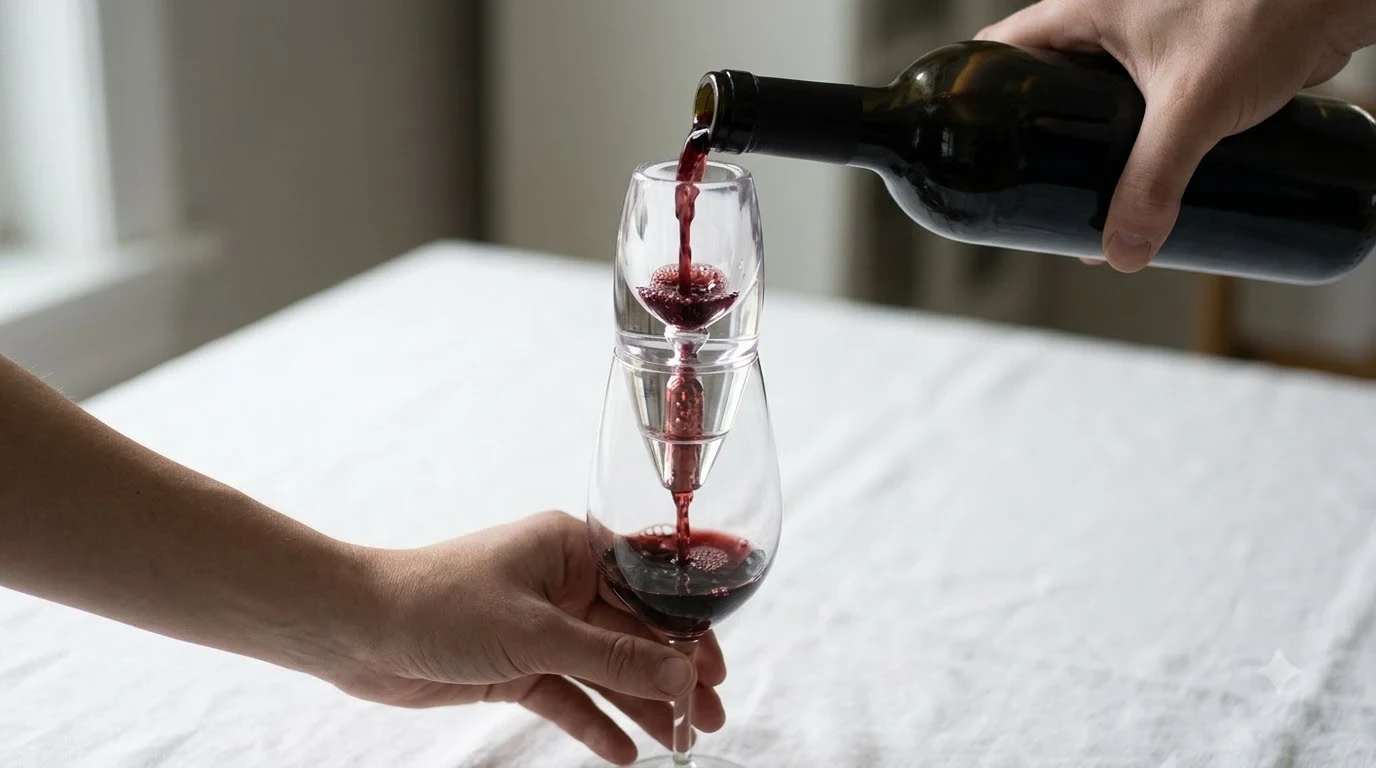
The zazzol wine aerator is a manual, three-stage wine aerator designed to expose wine to air as it pours, helping selected red wines open up faster without waiting for traditional decanting. Its distinguishing feature is a multi-stage system that disperses wine across a cone, sends it through 32 small openings, and introduces additional air before the wine reaches the glass. A stand, travel pouch, and presentation box make it a practical serving accessory, although its extra components mean cleaning and careful handling deserve consideration.
The Zazzol Wine Aerator Decanter occupies an interesting middle ground between a simple bottle-top pourer and a traditional glass decanter. Rather than attaching directly to the bottle, it is a separate handheld device that wine passes through during serving. Its design targets people who regularly open young Cabernet Sauvignon, Merlot, Syrah, and other reds that can benefit from additional oxygen exposure. The important question is whether its multi-stage construction offers enough practical value to justify adding another accessory to the home wine setup.
Specs and Key Features
The Zazzol stands out because its aeration process involves three distinct stages instead of relying on one basic air-mixing chamber. Its included accessories also make it more of a complete serving set than a standalone plastic pourer.

The central feature is the patented multi-stage mechanism. According to the product description, wine first spreads across a cone-shaped surface, then passes through 32 holes in a perforated plate, and finally moves through a tube where additional air enters the flow. This sequence is designed to increase the wine’s contact with air during a relatively short pour.
Wine writer Dave Nershi describes a similar arrangement in his Zazzol Wine Aerator review, identifying an umbrella-shaped disc, a perforated drizzle plate, and a narrow cylindrical opening. These stages spread the wine into smaller streams and droplets before it enters the glass. The visible bubbling reported during pouring is consistent with the device’s purpose, although bubbling alone does not establish that every wine will taste better.
The manufacturer’s product listing also emphasizes a wider opening and deeper chamber. These design choices are intended to make pouring easier and reduce the chance of overflow. A separate stand provides somewhere to rest the device between servings, while the travel pouch protects it during transport.
| Specification | Zazzol Wine Aerator |
|---|---|
| Product type | Manual pour-through wine aerator |
| Aeration design | Three-stage system |
| First stage | Umbrella-shaped cone or disc |
| Second stage | Perforated plate with 32 holes |
| Third stage | Air injection through the final tube |
| Power source | Manual operation; no batteries required |
| Package dimensions | 7.7 x 4.0 x 2.9 inches |
| Included accessories | Stand, gift box, travel pouch, manual |
| Cleaning claim | Manufacturer states dishwasher safe |
| Storage | Separate stand and travel pouch |
The listed package dimensions describe the overall packaged product rather than a verified measurement of the aerator alone. Likewise, the product listing’s glass color designation should not be treated as a complete materials specification. Buyers who need precise information about the composition of individual components should obtain clarification from the seller.
Another important distinction is that the Zazzol is not an electric wine dispenser, bottle stopper, or storage system. It does not preserve an opened bottle, regulate serving temperature, or automatically dispense measured portions. Its job is limited to introducing air during the pouring process.
The manufacturer also promotes the product as a low-mess design. Its claims include reduced side leakage, a larger receiving chamber, and a no-drip resting stand. These are useful practical considerations because an aerator that improves wine but leaves stains on a dining table is unlikely to become a favorite serving tool.
What Owners Like
Positive owner feedback most often centers on the perceived improvement in red wine, the multi-stage pouring action, and the presentation accessories. The combination is particularly appealing to people who want to serve a glass shortly after opening a bottle rather than waiting for a full decanting period.

One of the more useful pieces of independent commentary comes from Dave Nershi’s review at Vino-Sphere. He describes using the Zazzol during a tasting involving six Cabernet Sauvignon bottles and reports favorable results. He also compares it with the Vinturi aerator, which he had previously used, and describes the Zazzol as less messy during pouring.
That comparison is relevant because Cabernet Sauvignon is a grape variety with naturally high tannin. A young Cabernet can feel firm or astringent when first opened, particularly if it has concentrated fruit and substantial structure. Introducing air can make its aromas more accessible and change how its tannins are perceived, although the result depends on the particular bottle.
Owner comments published by Advanced Mixology provide additional practical observations. One customer reports using the aerator since 2020 and describes it as easy to operate and clean. The same reviewer mentions using it for individual glasses and for transferring wine into a traditional decanter. That flexibility is useful because the aerator does not have to replace other serving equipment.
More control over individual glasses
A conventional decanter generally receives a larger quantity of wine at once. This is convenient for a dinner party, but it can be unnecessary when one person wants a single glass after work. The Zazzol offers a different approach: wine passes through the device as each glass is served.
This arrangement is especially practical for households where people drink wine at different times or prefer different styles. One person can aerate a glass of Cabernet Sauvignon while another pours a delicate Pinot Noir directly into a glass without additional treatment.
It also makes side-by-side comparisons easier. Pour a small amount of the same wine into two glasses, send one portion through the aerator, and compare the aromas and texture. This is more informative than assuming that every bottle needs the same treatment.
Presentation and portability
The included stand, presentation box, and travel pouch are meaningful advantages for gift buyers. The stand gives the accessory a dedicated resting position, while the pouch makes it easier to carry to a friend’s dinner or a wine gathering.
The gift packaging also distinguishes the Zazzol from inexpensive, basic pour-through accessories. Someone building a home entertaining setup can place it alongside stemware, a corkscrew, and other items on a bar cart. Its dedicated case also makes storage more organized when the accessory is not in regular use.
However, packaging should remain a secondary consideration. A handsome box does not determine whether an aerator improves a particular wine. The strongest reason to consider the Zazzol is its distinctive pouring mechanism and the convenience of aerating individual servings.
Common Complaints
The main considerations are cleaning the internal aeration components, handling the assembled device carefully, and recognizing that the improvement in wine is not universal. The multi-stage construction is a feature, but it also introduces more places where wine residue can remain.
The aerator has several internal surfaces and narrow passages. Red wine can leave visible residue around these areas, particularly after serving several glasses. One Advanced Mixology customer specifically recommends soaking the device promptly after use to make cleaning easier. This is a practical warning for anyone who tends to leave serving equipment on the table until the following morning.
Although Zazzol advertises dishwasher-safe construction, buyers should follow the instructions supplied with their particular unit. If the components separate for cleaning, check that they are correctly reassembled before the next pour. For an accessory with several stages, an incorrect fit can interfere with the flow of wine.
More components mean more maintenance
A simple bottle-top aerator typically has fewer parts and can be rinsed quickly. The Zazzol’s cone, perforated plate, and final air-mixing section create a more elaborate flow path. That design may appeal to enthusiasts, but it also makes immediate rinsing a sensible habit.
Pay particular attention to the 32-hole plate. Dried wine residue in small openings can make cleaning more difficult. A gentle rinse with warm water soon after serving is preferable to allowing wine to dry inside the mechanism.
The included stand helps keep the device off the table, but it should not be mistaken for a substitute for cleaning. Empty remaining wine from the aerator before placing it in its resting position. If the accessory will not be used again that evening, rinse it before storage.
Durability and fit
Another consideration is long-term durability. BestProducts identifies the Zazzol as a multistage option but also mentions concerns from some reviewers about durability. This does not establish a universal defect, but it is a reason to avoid rough handling.
Because the aerator contains multiple sections, buyers should avoid forcing parts together or pulling them apart unnecessarily. Keep the travel pouch for transport, and avoid storing the accessory loose among heavy metal bar tools or glassware.
There is also the possibility of a poor seal between sections. A customer comment summarized by BestAdvisor mentions leakage around a connection. Such feedback is not proof that every unit leaks, but it reinforces the importance of checking the assembly before pouring wine over a tablecloth.
Finally, the manufacturer’s no-mess positioning should be understood as a design objective rather than a guarantee that spills are impossible. Pouring too quickly, filling the receiving chamber beyond its comfortable capacity, or incorrectly assembling the device can still create problems.
Tip: Rinse the aerator immediately after serving, paying particular attention to the 32-hole plate and internal passages. Let the components dry completely before putting the device away in its travel pouch.
Who Should Buy and Who Should Skip
The Zazzol makes the most sense for regular red-wine drinkers who want to aerate individual servings without preparing a full decanter. It is less compelling for occasional wine drinkers, people who mainly enjoy delicate older bottles, or anyone who prefers the simplest possible serving equipment.
Consider the wines regularly opened at home. Cabernet Sauvignon, Syrah, and many young Bordeaux-style blends can have substantial tannin and structure. These are reasonable candidates for a brief aeration experiment, especially when their aromas seem restrained immediately after opening.
Merlot can also benefit from some air, although its tannins are generally softer than those of Cabernet Sauvignon. Pinot Noir presents a different case: its tannins are usually lower to medium, and its aromas can be more delicate. Some examples respond positively to gentle aeration, but excessive exposure is not always desirable.
Good candidates for the Zazzol
Buyers who regularly serve wine by the glass are the clearest audience. The handheld format avoids the need to transfer an entire bottle into a large vessel. It also suits people who enjoy comparing the same wine before and after aeration.
It can be useful for dinner hosts who serve a young red wine alongside grilled beef, lamb, or a rich mushroom dish. A structured red with firm tannins may become more expressive after additional oxygen exposure. The aerator provides a quick serving option when guests arrive before a bottle has had time to breathe.
Gift buyers are another natural audience. The included presentation box and travel pouch make the set more complete than a basic bottle attachment. It can be a suitable addition to a wine-themed gift, perhaps alongside a bottle opener, glassware, or a wine advent calendar.
Who should skip it
People who mostly drink crisp Sauvignon Blanc, delicate sparkling wines, or older Pinot Noir may not need a dedicated aerator. These wines can be enjoyable without additional aeration, and some can lose their appealing freshness or aromatic detail if handled too aggressively.
Someone who already owns a large decanter and routinely opens wine 30 to 60 minutes before dinner may also find the Zazzol redundant. A traditional decanter provides a broader surface area for wine exposure and can be more convenient when serving several guests from one bottle.
It is also not the right purchase for someone seeking wine preservation. Aeration is the opposite of long-term oxygen exclusion: the device is intended to introduce air during pouring, not protect the remaining wine from oxidation. A vacuum stopper or inert-gas preservation system addresses a different need.
For a broader overview of serving equipment, the site’s wine accessory collection provides a useful starting point for comparing tools with different purposes.
How It Compares to Alternatives
The Zazzol’s main competition comes from traditional decanters, simpler handheld aerators, and bottle-top pourers. The right choice depends on whether the priority is speed, individual-glass convenience, a larger serving capacity, or minimal cleaning.
Vinturi is a particularly relevant comparison because it is specifically discussed in the independent Vino-Sphere review. Nershi describes the Zazzol’s multistage arrangement as an appealing alternative and reports fewer mess-related problems during his comparison. This is one reviewer’s experience, rather than a guarantee that the Zazzol will outperform every Vinturi model.
Zazzol versus Vinturi
The key difference discussed in the available product descriptions is the aeration arrangement. Zazzol uses a three-stage process involving a cone, a perforated plate with 32 holes, and air introduction through a final tube. Vinturi is described by Nershi as a simpler aeration device, and his review notes that it can occasionally back up and spill.
Both products serve the same general purpose: exposing wine to air during pouring. For buyers who prefer a more elaborate internal design and an included resting stand, the Zazzol has a clear appeal. Someone who values a simpler device may prefer to compare the available Vinturi configurations before deciding.
Zazzol versus a traditional decanter
A traditional decanter is a better fit when an entire bottle needs to be prepared for a meal. Pouring 750 ml into a decanter creates an opportunity for air exposure across a broad surface. It also allows sediment to remain behind when older bottles are carefully transferred.
The Zazzol is more convenient when the requirement is one glass at a time. There is no need to move the entire bottle’s contents into another vessel, and the remaining wine stays in its original bottle. However, the aerator does not provide the same resting time or serving presentation as a full decanter.
For readers considering a more substantial serving vessel, a decanter with aerator combines the functions of a decanting vessel and an aeration feature in a different format. That may be preferable for people who frequently host larger dinners.
Which format offers the best convenience?
The Zazzol is most convenient for individual pours, while a traditional decanter is generally more practical for serving multiple people from one prepared bottle. A simple bottle-top aerator is often easier to store and clean, but it does not provide the same separate handheld pouring experience.
The distinction is particularly important for people who open different wine styles throughout the week. A multi-stage aerator is not a requirement for every bottle. Having one available simply provides another way to experiment with how a wine develops in the glass.
Before choosing, consider how many glasses are typically served at once, whether the household has enough storage space, and how willing the user is to clean several internal components after every session. Those practical questions matter more than an advertised claim that one aerator is several times more effective than another.
Frequently Asked Questions
Does the Zazzol Wine Aerator remove wine sediment?
The available product descriptions emphasize aeration rather than a dedicated sediment-filtration specification. Some wine particles may be caught by internal surfaces, but buyers should not treat the device as a replacement for a proper decanting funnel with a sediment filter. Older bottles with substantial deposits are better handled using careful traditional decanting.
Can the Zazzol Wine Aerator be used at a restaurant?
Yes, its separate handheld format and included travel pouch make transportation possible. However, restaurant policies and available serving space vary, so it is sensible to ask before bringing personal wine equipment. The pouch also helps keep the accessory protected between uses.
Does aerating wine change its alcohol content?
Passing wine through a manual aerator does not meaningfully reduce its alcohol content. The device changes the wine’s exposure to oxygen and its serving characteristics, not its original alcoholic strength. A wine labeled at 13.5% ABV remains essentially the same strength after aeration.
Can the aerator be used with a half-full wine bottle?
Yes. The device is used independently during pouring, so it does not depend on the bottle being full. A half-full 750 ml bottle can be poured through the aerator just as a newly opened bottle can, provided the device is assembled correctly.
Is a wine aerator suitable for a bottle that has already been open for several days?
An aerator cannot reverse oxidation or restore wine that has deteriorated after opening. It may change the immediate serving experience, but it cannot repair stale aromas, vinegar-like faults, or other signs of spoilage. For still wines, refrigeration and an appropriate closure are more useful for preserving the remaining contents.
The Zazzol Wine Aerator is a distinctive serving accessory for people who regularly enjoy young red wines and prefer aerating individual glasses rather than preparing an entire bottle in advance. Its three-stage design, included stand, and travel pouch make it an interesting alternative to simpler pourers, although prompt cleaning and careful handling are important. Buyers who frequently serve Cabernet Sauvignon or other structured reds will have the clearest reason to consider it, while occasional drinkers may be better served by a traditional decanter or a simpler aerator.
More in Wine Accessories
 Coravin Vs Vacu Vin: Choose the Right Wine Saver for Your BottlesUpdated Nov 21, 2026
 Zwilling Wine Stopper Review: Preserve Open Bottles LongerUpdated Nov 21, 2026
 Wine Enthusiast Wine Preserver Review: Features, Benefits and LimitationsUpdated Nov 21, 2026
 Wine Enthusiast Wine Stopper: An Easier Way to Reseal Open BottlesUpdated Nov 21, 2026
 Vintorio Wine Opener: Two-Step Cork RemovalUpdated Nov 21, 2026
 Zwilling Wine Aerator Review: Aerate, Pour, and Seal With One ToolUpdated Nov 21, 2026