

We may earn a commission when you buy through links on this page, at no extra cost to you. Learn more.
A wine fridge buying guide helps you choose the right refrigerator by comparing bottle capacity, temperature control, cooling technology, installation requirements, and storage features. The best choice depends on whether you primarily store wine for long-term aging or keep bottles ready to serve. A single-zone model suits many collections, while a dual-zone refrigerator offers more flexibility for households that regularly drink both red and white wines. Proper sizing and ventilation also matter because even a feature-rich refrigerator cannot protect wine effectively if it is installed incorrectly.
A dedicated wine refrigerator provides a controlled environment that an ordinary kitchen refrigerator is not designed to deliver. Instead of cooling food to approximately 38°F, a wine cooler maintains temperatures more appropriate for preserving bottles, with storage conditions that can accommodate reds, whites, rosés, and sparkling wines. The right appliance should fit your collection, your available space, and the way you actually drink wine. This guide explains the features worth comparing before you purchase, including cooling systems, temperature zones, shelving, energy consumption, and everyday maintenance.
Who This Is For
A wine refrigerator is most useful for people who need consistent storage conditions, convenient bottle access, or a dedicated place for a growing collection. The right capacity and cooling configuration depend on whether you buy a few bottles each month or regularly purchase wine by the case.
Casual wine drinkers may benefit from a compact refrigerator holding approximately 12 to 20 bottles. This size can accommodate everyday Chardonnay, Sauvignon Blanc, Pinot Noir, Cabernet Sauvignon, and sparkling wine without taking up an entire kitchen cabinet. It also provides a convenient place to keep bottles chilled without repeatedly filling the kitchen refrigerator.
Collectors and frequent entertainers should consider larger appliances with approximately 30 to 60 bottles or more of stated capacity. A larger collection often includes different bottle shapes, several wine styles, and bottles intended for different occasions. Adjustable shelves and independently controlled compartments become more useful as the collection grows.
Long-term collectors have slightly different priorities from people who simply want chilled wine for dinner. Someone storing bottles for several years should prioritize stable temperatures, suitable humidity, protection from light, and dependable cooling performance. Someone opening most bottles within a few weeks may care more about convenience, capacity, noise, and serving temperatures.
If you are unsure whether a dedicated appliance is necessary, consider the conditions in your current storage area and how frequently you purchase wine. Our explanation of whether you need a wine fridge can help clarify when an ordinary storage area is sufficient and when dedicated refrigeration makes practical sense.
Key Factors to Compare
The most important buying considerations are temperature stability, usable capacity, cooling technology, and installation style. Comparing these characteristics before looking at decorative finishes or extra features makes it easier to identify appliances that genuinely suit your requirements.
Temperature Range and Stability
For long-term storage, a temperature near 55°F is a practical target for many wine collections. The CHOICE buying guide identifies approximately 54°F to 64°F as a suitable storage range, while a steady temperature matters more than constantly changing settings to accommodate individual bottles. Its wine refrigerator buying advice also discusses the practical features and storage conditions worth considering before purchasing.
Look for an appliance that can maintain its selected temperature consistently throughout the interior. A digital display is convenient, but a displayed number does not necessarily prove that every shelf maintains the same conditions. Models with good temperature distribution and reliable thermostatic controls are particularly useful for collections containing bottles intended for extended storage.
Capacity and Bottle Compatibility
Manufacturers generally calculate bottle capacity using standard 750 ml Bordeaux bottles. That number can be misleading if your collection includes wide Champagne bottles, Burgundy bottles, sparkling wine, or larger formats.
For example, a refrigerator advertised for 30 bottles might accommodate fewer when several shelves hold wider bottles. Examine the interior dimensions, shelf spacing, and adjustable rack positions rather than relying exclusively on the advertised capacity.
Noise, Energy, and Construction
Consider where the refrigerator will operate. A model in a kitchen utility area can tolerate more operating noise than one installed beside a bedroom or living room seating area. Compressor refrigerators generally provide stronger cooling, while thermoelectric appliances often appeal to buyers who prioritize quieter operation.
Construction details also matter. Insulated doors, UV-resistant glass, secure shelf stops, adjustable feet, and a reliable door seal contribute to everyday usability. For a more detailed financial comparison, see our article explaining how much a wine fridge costs.
| Feature | What to Compare | Practical Buying Target |
|---|---|---|
| Storage temperature | Adjustable thermostat | Approximately 55°F for long-term storage |
| Small capacity | Compact collections | 12–20 bottles |
| Medium capacity | Regular household use | 30–40 bottles |
| Large capacity | Growing collections | 50–60 bottles or more |
| Humidity | Moisture retention | Approximately 50–70% when controllable |
| Storage orientation | Horizontal bottle racks | Sideways storage for cork-sealed bottles |
| Glass protection | UV-resistant glazing | UV-protected or solid door |
| Temperature zones | One or two compartments | Single zone for storage; dual zone for separate serving temperatures |
These figures are shopping guidelines rather than specifications for every appliance. A refrigerator’s actual performance depends on its design, room conditions, loading pattern, and temperature settings. Prioritize verified operating characteristics over a long list of features that may not improve your storage conditions.
Step-by-Step: How to Choose the Right Wine Fridge
A systematic selection process helps prevent common purchasing problems, particularly choosing an appliance that is too small or unsuitable for its intended installation location. Work through these six steps before comparing individual models.
- Count your current bottles. Start by recording how many bottles you own and how many you typically purchase over a month. If you currently keep 18 bottles but regularly add another 6 each month, a 20-bottle appliance will become restrictive quickly.
- Estimate future storage needs. Think about your buying habits over the next 12 to 24 months. Choose enough additional capacity to accommodate reasonable growth without paying to operate an unnecessarily large empty appliance.
- Decide whether you need one or two zones. If your collection is primarily intended for aging, a single-zone refrigerator near 55°F is usually sufficient. If you regularly serve reds and whites directly from the appliance, two independently controlled zones may be more convenient.
- Measure the installation area. Record the available height, width, and depth, including door clearance and required ventilation space. A refrigerator that fits the cabinet opening but cannot exhaust heat properly is not an appropriate installation.
- Compare cooling systems. Consider compressor technology for stronger cooling and warmer rooms, or thermoelectric technology for smaller collections in temperature-controlled environments. Compare operating noise and manufacturer specifications as well.
- Inspect the details before purchasing. Check shelf adjustability, door direction, UV protection, locks, temperature controls, and warranty coverage. Confirm that the appliance can accommodate your widest bottles and that the manufacturer provides suitable installation instructions.
After narrowing the selection, compare the total ownership requirements rather than just the initial purchase. An appliance with a convenient digital display may still be a poor choice if its shelves cannot accommodate your bottles or its ventilation requirements conflict with your kitchen layout.
Tip: Measure your largest Champagne or Burgundy bottle before buying. A refrigerator’s advertised capacity is often based on standard Bordeaux bottles, and wider bottles can significantly reduce the number of bottles that fit.
It is also helpful to think about the types of wine you actually buy. A household that mainly drinks Cabernet Sauvignon, Merlot, and Pinot Noir may be perfectly comfortable with one consistent storage temperature. A collection containing Champagne, Riesling, Chardonnay, and red wines intended for immediate service may benefit from more flexible temperature controls.
Types of Wine Refrigerators Explained
Wine refrigerators differ primarily in cooling technology, installation design, and temperature-zone configuration. Understanding these distinctions helps you match an appliance to your home rather than paying for specifications that do not serve a useful purpose.
Compressor Wine Refrigerators
Compressor models use a refrigeration system similar in principle to that found in ordinary household refrigerators. They circulate refrigerant through the cooling system to remove heat from the interior and maintain the selected temperature.
The main advantage is cooling capability. Compressor units generally handle larger capacities and warmer room conditions better than thermoelectric alternatives. They are therefore useful for collections stored in kitchens, utility rooms, or other locations where ambient temperatures fluctuate.
The trade-offs include operating noise, mechanical vibration, and potentially higher electricity consumption depending on the appliance. Modern designs can reduce these drawbacks, so compare the manufacturer’s noise and energy specifications instead of assuming every compressor refrigerator performs identically.
Thermoelectric Wine Refrigerators
Thermoelectric models use an electrical cooling system rather than a conventional refrigerant compressor. Their main attractions are quieter operation, relatively low vibration, and compact designs.
They are particularly suitable for smaller collections in rooms that remain reasonably cool throughout the day. However, their cooling capability is more limited. SenseCellar notes that thermoelectric models can struggle to maintain approximately 55°F when ambient temperatures rise above about 81°F.
That limitation makes room temperature an important buying consideration. A compact thermoelectric appliance placed in a consistently air-conditioned room may perform appropriately, while the same model in a hot garage could struggle.
Single-Zone and Dual-Zone Models
A single-zone refrigerator maintains one temperature throughout its storage compartment. It is generally the simpler option for collectors who want to keep different wines under consistent storage conditions.
A dual-zone refrigerator provides two temperature-controlled compartments. This arrangement is useful when one section holds reds and another keeps whites or sparkling wines closer to their serving temperatures.
Remember that storage temperature and serving temperature are different. A bottle stored near 55°F may need additional chilling or warming before pouring. A dual-zone appliance is a convenience feature, not a requirement for storing a mixed collection safely.
Freestanding and Built-In Models
Freestanding wine refrigerators are designed to operate with ventilation around the appliance. Depending on the model, the heat exhaust may be located at the back or sides, so these units should not be enclosed inside cabinetry unless the manufacturer specifically permits that installation.
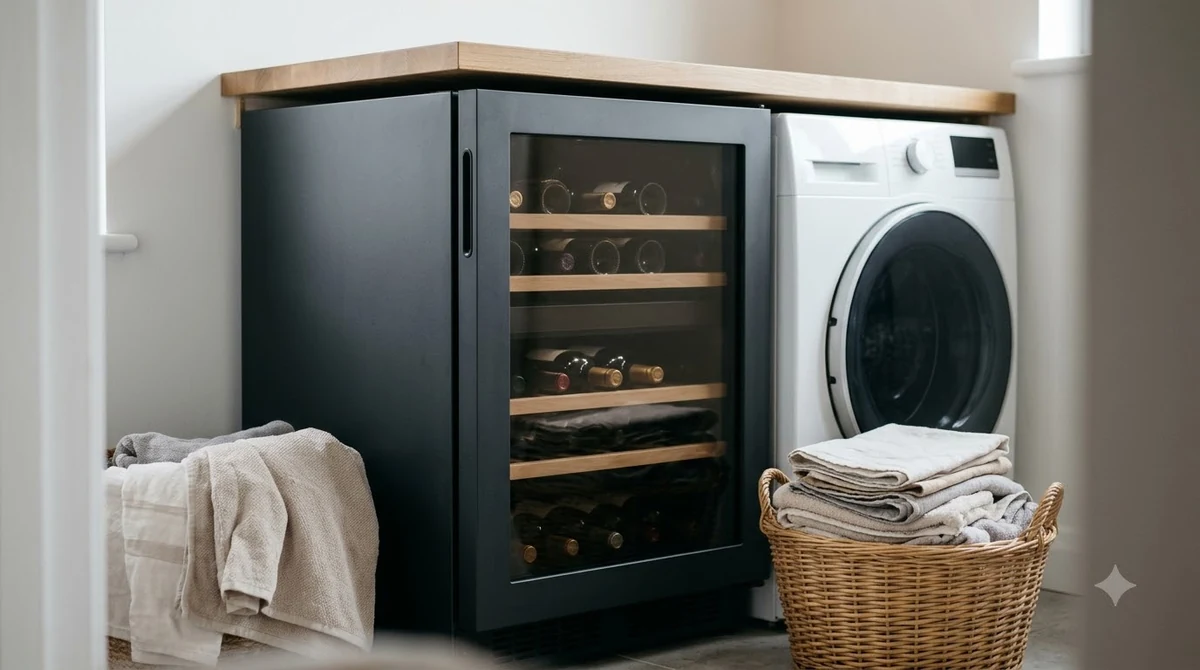
Built-in wine refrigerators generally use front ventilation. This allows the appliance to fit beneath a counter or inside suitable kitchen cabinetry without requiring the same rear ventilation arrangement as a freestanding model.
The installation distinction is particularly important because restricted airflow can cause overheating and reduce cooling performance. Always follow the manufacturer’s clearance and installation requirements.
Common Wine Fridge Buying Mistakes
Many disappointing purchases result from overlooking practical limitations rather than choosing the wrong brand. Capacity assumptions, ventilation problems, and unnecessary temperature-zone features can all reduce the usefulness of an otherwise suitable appliance.
Buying According to Advertised Bottle Capacity
The stated bottle count is not always the number of bottles you can comfortably store. Standard Bordeaux bottles are relatively narrow compared with many Burgundy and Champagne bottles, and oversized bottles require even more room.
Consider a 40-bottle refrigerator. If your collection contains 12 wide sparkling wine bottles, the remaining usable capacity may be considerably lower than the headline specification suggests. Look for diagrams showing the shelf arrangement and ask whether racks can be repositioned.
Confusing Serving Temperature With Storage Temperature
A common misconception is that every red wine needs to be stored at 65°F and every white needs to remain at 45°F. Those figures are closer to certain serving preferences than universal long-term storage requirements.
For longer storage, a consistent temperature around 55°F works well for many styles. When you want to serve a bottle, adjust its temperature separately. Light-bodied reds such as Pinot Noir can be served around 55–60°F, while full-bodied Cabernet Sauvignon is generally served around 60–65°F.
Choosing Two Zones Without a Clear Need
Dual-zone technology sounds appealing, but it is not automatically better. If your collection consists mainly of bottles intended for long-term storage, maintaining one stable temperature is usually more useful than having two separate serving temperatures.
Two-zone models are more practical for households that frequently open different wine styles and want immediate access to chilled whites, rosés, and sparkling wines alongside reds.
Installing a Freestanding Unit Inside a Cabinet
One of the more serious installation mistakes is treating every wine refrigerator as an under-counter appliance. Freestanding models often exhaust heat through the rear or sides, and enclosing those areas can interfere with cooling.
Built-in appliances are specifically designed for cabinetry installation through front-facing ventilation. Confirm the installation category before measuring your kitchen opening or ordering an appliance.
Ignoring Energy Consumption
A larger refrigerator can provide useful flexibility, but extra unused capacity also means cooling space you do not currently need. Energy consumption varies with appliance size, operating temperature, room temperature, and airflow.
Compare annual electricity consumption in kilowatt-hours when the manufacturer provides it. Our guide to wine fridge energy efficiency explains which operating characteristics influence electricity use and how to compare appliances more effectively.
Wine Fridge Care and Storage Tips
Correct installation and routine maintenance help a wine refrigerator maintain stable storage conditions. Keep the appliance ventilated, monitor its internal temperature, protect bottles from light, and avoid unnecessary disturbances to the collection.
Choose a Suitable Location
Place the refrigerator away from direct sunlight, ovens, stovetops, radiators, and other heat sources. These conditions can increase the cooling system’s workload and make it harder to maintain a consistent interior temperature.
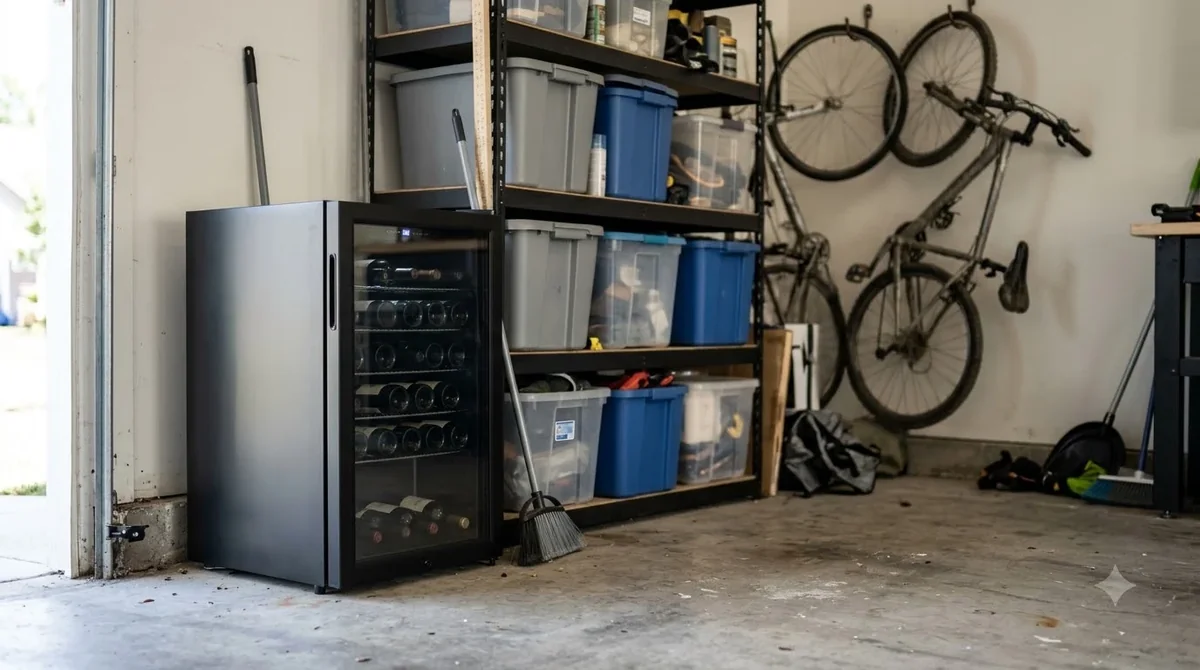
Garages and uninsulated utility areas can also be problematic because temperatures may fluctuate significantly between daytime and nighttime. A climate-controlled interior room is generally a better choice for a domestic wine refrigerator.
Position the appliance on a stable, level surface. Follow the manufacturer’s instructions for ventilation clearance, electrical connections, and installation. Do not block the ventilation openings with furniture, stored boxes, or decorative panels.
Monitor Temperature and Humidity
A digital temperature display is convenient, but an independent thermometer provides an additional way to check the interior conditions. Place it where you can read it without leaving the door open for extended periods.
For long-term storage, aim for approximately 55°F and prioritize consistency. Humidity around 50–70% is a reasonable reference for cork-sealed bottles, although temperature stability is generally the more important consideration.
Some refrigerators include humidity-control systems or water reservoirs. These features can be useful, particularly in dry environments, but they are not equally necessary for every collection. Screw-cap bottles do not depend on cork moisture in the same way as traditionally sealed bottles.
Protect Wine From Light and Vibration
Choose UV-protected glass or a solid door when possible. Ultraviolet exposure can negatively affect wine, so a glass-fronted appliance should not be positioned where sunlight strikes it for long periods.
Interior LED lighting is generally preferable to lighting that generates significant heat. Keep illumination switched off when unnecessary, especially if you are storing bottles for extended periods.
Compressor refrigerators produce some mechanical vibration during operation. Choose a model designed to minimize vibration if your collection contains valuable bottles, but do not assume that every ordinary compressor refrigerator will damage wine. Consumer guidance from CHOICE notes that the relationship between normal refrigerator vibration and wine quality remains debated.
Keep Shelves Clean and Accessible
Store cork-sealed bottles horizontally when the refrigerator is designed for horizontal storage. This keeps wine in contact with the cork and helps prevent the closure from drying out during extended storage.
Do not force bottles into tightly packed shelves. Overloading can obstruct airflow, make individual bottles difficult to remove, and increase the likelihood of damaging labels or neighboring glass.
Use sliding shelves carefully and avoid pulling them beyond their stops. Wooden shelves can provide a convenient, stable surface, while adjustable metal racks may offer more flexibility for different bottle shapes.
Perform Regular Maintenance
Clean the interior shelves and door surfaces with a soft cloth and a gentle cleaning solution. Avoid harsh chemicals and strong fragrances that could leave unwanted odors around stored bottles.
Inspect the door seal periodically for dirt, damage, or gaps. A poorly sealing door allows cool air to escape and can make the cooling system work harder than necessary.
Remove dust from the condenser grille according to the manufacturer’s instructions. SenseCellar recommends cleaning condenser grille dust every 6–12 months. Also check the appliance’s temperature after cleaning or moving it to ensure that normal operation has resumed.
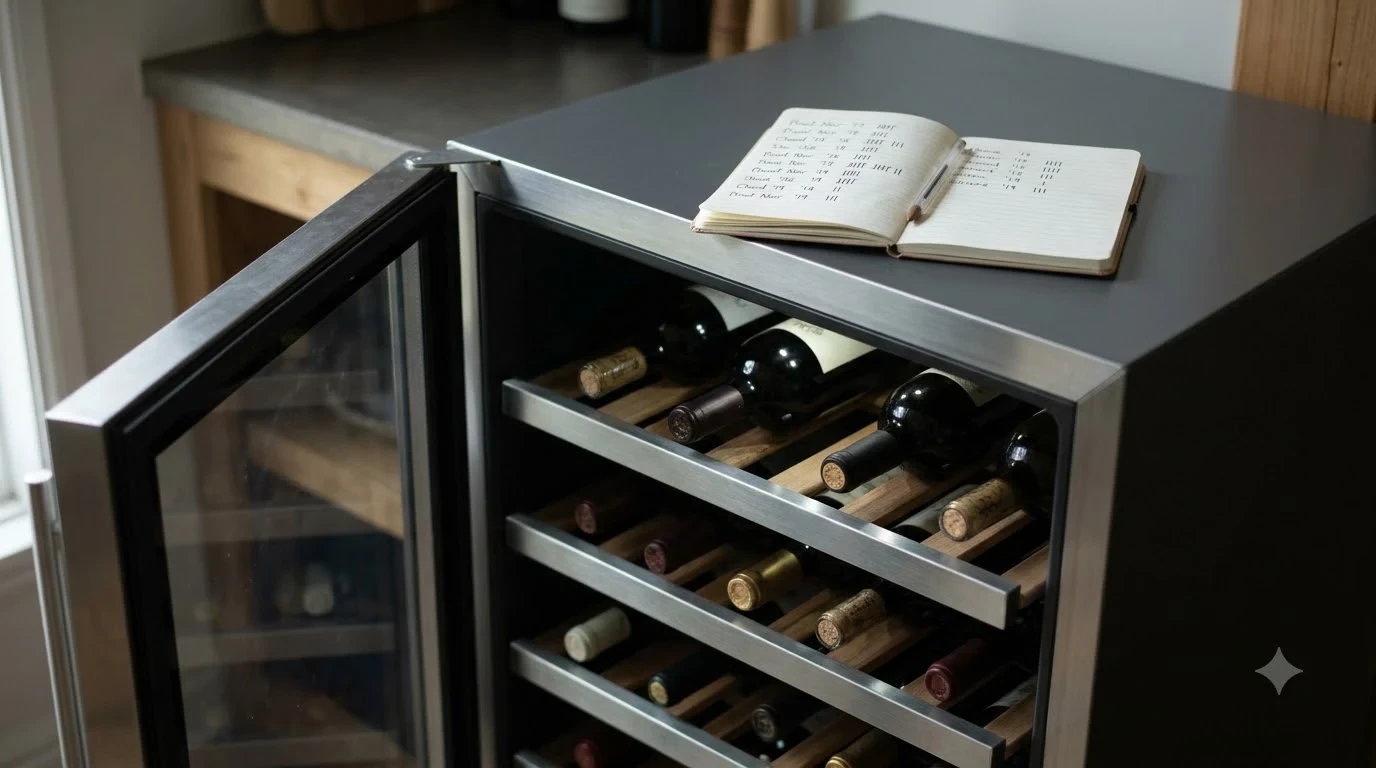
Finally, maintain an inventory of your collection. Record the wine name, vintage, purchase date, and approximate drinking window when that information is available. Good organization reduces unnecessary door opening and helps prevent bottles from being forgotten for years.
Frequently Asked Questions
Can I put beer and other beverages in a wine fridge?
Many wine refrigerators can accommodate canned beverages and some beer bottles if their shelf spacing permits. However, the temperature requirements for beer and other drinks may differ from those for wine. Check the appliance’s minimum temperature and shelf configuration before using it as a mixed beverage refrigerator.
Should a wine fridge run continuously?
Yes. A wine refrigerator is designed to remain connected to power and cycle its cooling system automatically to maintain the selected temperature. The compressor or cooling components will not necessarily run continuously at full power because the thermostat regulates operation according to the interior conditions.
Can wine freeze inside a wine refrigerator?
Yes, if the appliance is set too cold or its temperature control malfunctions. Wine can begin freezing at approximately 15–20°F, depending on its alcohol and sugar content. Frozen wine can expand and push against the closure, potentially causing leakage or bottle damage.
Does opening the wine fridge door damage stored wine?
Normal, brief door openings are not generally a problem. Repeatedly leaving the door open for extended periods can increase interior temperature fluctuations and make the cooling system work harder. An appliance with an audible open-door alarm can be useful in a busy household.
How long can wine remain in a wine refrigerator?
There is no universal storage deadline because aging potential depends on the wine’s structure, vintage, production method, and intended drinking window. Some wines are best enjoyed within a year or two, while certain high-quality Cabernet Sauvignon, Barolo, and vintage Champagne can develop over considerably longer periods. Refrigeration preserves suitable storage conditions but does not make every wine suitable for extended aging.
Choosing the right wine refrigerator starts with your collection, available installation space, and storage goals. Prioritize consistent temperatures, realistic bottle capacity, suitable ventilation, and reliable construction before paying extra for decorative features or additional controls. A properly selected and maintained appliance makes it easier to protect your bottles and enjoy each wine under better storage conditions.
More in Wine Buying Guides
 Riesling Gift: Choose a Bottle They’ll LoveUpdated Nov 21, 2026
 Sweet Red Wine Gift: Choose a Bottle They’ll LoveUpdated Nov 21, 2026
 Malbec Gift: How to Choose a Memorable Bottle for Any OccasionUpdated Nov 21, 2026
 Sherry Gift Ideas That Match Every Wine LoverUpdated Nov 21, 2026
 Moscato Gift: How to Choose a Sweet Wine They’ll LoveUpdated Nov 21, 2026
 Merlot Gift: How to Choose a Bottle They’ll AppreciateUpdated Nov 21, 2026