

We may earn a commission when you buy through links on this page, at no extra cost to you. Learn more.
Do i need a wine fridge? You need one if your home cannot provide consistently cool, dark storage for the bottles you plan to keep for several months or longer. However, occasional wine drinkers with a small collection and a naturally cool, stable storage space can often manage without one. The decision depends on how many bottles you own, how long you intend to keep them, and the temperature conditions inside your home.
A dedicated wine refrigerator is designed to maintain a suitable environment for storing wine rather than simply making bottles cold enough to serve. That distinction matters because excessive heat, temperature fluctuations, light, and unsuitable humidity can affect wine quality over time. Before buying another appliance, consider your drinking habits, available storage space, and the kinds of bottles you want to preserve. A few practical checks can tell you whether a wine fridge is a worthwhile addition or an unnecessary purchase.
When a Wine Fridge Is Worth Buying
A wine fridge makes the most sense when you regularly keep bottles for months, live in a home with changing indoor temperatures, or collect wines intended for future drinking. Its main advantage is maintaining a more consistent storage environment than an ordinary kitchen shelf or cupboard.
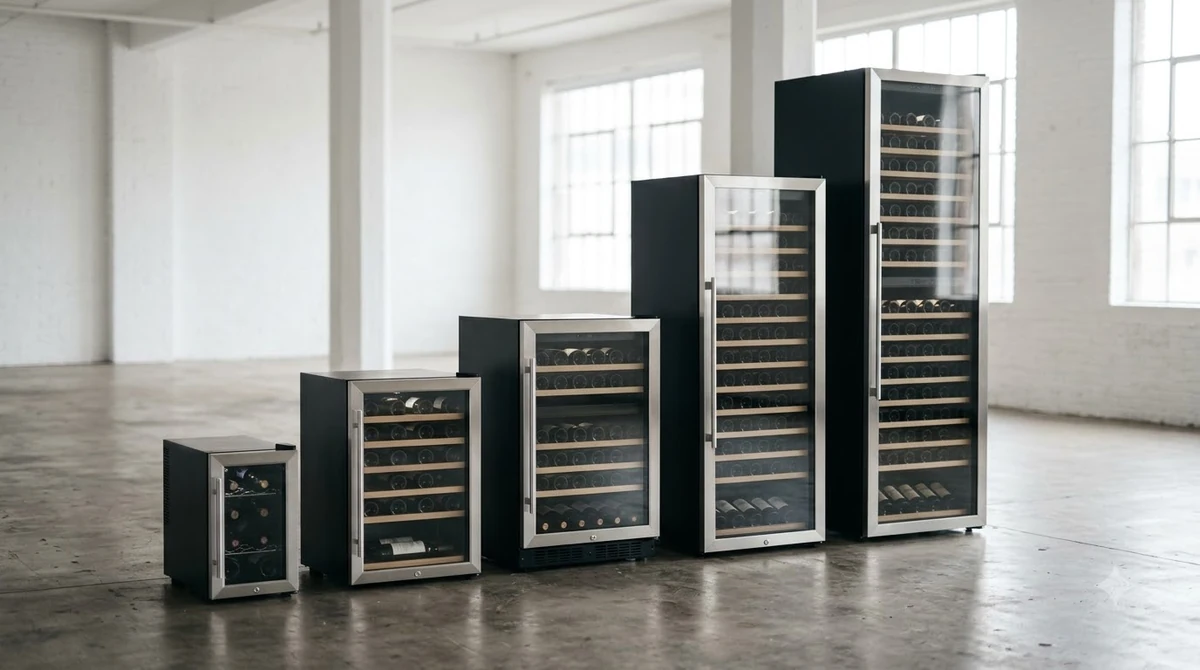
Consider how long a typical bottle stays in your home. If you purchase a Cabernet Sauvignon on Friday and open it the following weekend, specialized storage probably offers little additional value. A bottle that remains in a warm dining room for eighteen months presents a different situation. The longer wine stays in unsuitable conditions, the greater the opportunity for temperature-related deterioration.
Wine Enthusiast recommends 50–59°F for short-term storage and 53–57°F for long-term storage. Those ranges provide a useful starting point for deciding whether your existing storage arrangements are adequate. A dedicated appliance is particularly helpful when your home regularly moves outside those temperatures.
There are several situations in which buying a wine refrigerator becomes a practical decision:
- You keep wine for special occasions: Bottles purchased for birthdays, holidays, anniversaries, or future dinners may remain unopened for six months or longer.
- Your home gets hot: Rooms that regularly reach 75–85°F during warm weather are less suitable for keeping wine over extended periods.
- You purchase wine in cases: Buying six or twelve bottles at once means some bottles may remain in storage considerably longer than others.
- You collect age-worthy wines: Structured Cabernet Sauvignon, Bordeaux blends, and certain Syrah wines may benefit from controlled conditions during extended maturation.
- You want convenient serving temperatures: A wine cooler can keep selected bottles ready for dinner without repeatedly chilling them in a kitchen refrigerator.
Another important consideration is the difference between owning wine and collecting wine. Someone who purchases two bottles every weekend and drinks both immediately has different requirements from someone who keeps thirty bottles for future occasions. Bottle count alone does not determine whether a wine fridge is necessary; storage duration and environmental conditions matter just as much.
There is also no requirement to own an expensive appliance to enjoy good wine. A modest collection of everyday Pinot Noir, Sauvignon Blanc, Chardonnay, and sparkling wine can be managed without dedicated refrigeration if a suitable cool storage location is available.
For readers comparing equipment before making a purchase, understanding how much does a wine fridge cost can help establish whether the convenience and storage protection justify the additional expense.
How Temperature and Humidity Affect Wine
Consistent temperature is the most important reason to consider dedicated wine storage. A suitable environment slows unwanted changes in the bottle, while excessive heat and repeated temperature swings can accelerate aging and reduce freshness.
Wine Enthusiast identifies 53–57°F as a suitable range for long-term storage. Liebherr recommends approximately 50–54°F, equivalent to 10–12°C. Although recommendations differ slightly, both emphasize a cool, stable environment rather than frequent changes between warm and cold conditions.
Temperature matters because wine continues to develop chemical characteristics during storage. Higher temperatures accelerate those reactions. According to Liebherr’s explanation of the Van’t Hoff relationship, chemical reactions can proceed two to four times faster with each 10°C increase in temperature.
That does not mean one afternoon in a warm room automatically ruins a bottle. The greater concern is repeated or prolonged exposure. In an experiment described by Liebherr, Chilean Cabernet Sauvignon stored at 31°C experienced a substantial decline in fruit aroma after six months. Wine stored at 23°C also showed noticeable maturation changes after twelve months.
These findings illustrate why a consistently warm room is not an ideal place for bottles intended to age. A wine that develops prematurely may lose some of its fresh fruit character before you have an opportunity to enjoy it.
Humidity and cork condition
Humidity is another consideration, particularly for bottles sealed with natural cork. Wine Enthusiast and Liebherr identify moisture management as an important part of extended storage. Liebherr gives a relative humidity range of 50–80% as a suitable guideline for protecting corks and maintaining bottle quality.
Very dry surroundings can contribute to cork drying over extended periods, potentially compromising the seal. Excessive humidity, on the other hand, can encourage mold and damage labels or packaging. A wine refrigerator designed for longer-term storage may offer better humidity management than an ordinary household refrigerator.
However, not every compact wine cooler includes active humidity control. Some basic models focus primarily on temperature. If you intend to age valuable bottles for several years, investigate humidity specifications instead of assuming that every appliance provides cellar-quality conditions.
Light, odors, and vibration
Wine also benefits from darkness and relatively quiet surroundings. Strong light can affect wine color, while persistent odors and unnecessary movement are additional storage concerns. Decanter recommends placing wine in a dark location and minimizing movement during extended storage. Its guide to storing wine at home also explains how a cupboard or wardrobe can serve as an alternative to a traditional cellar.
A wine refrigerator with a UV-resistant door can offer useful protection, although a solid-door model can provide an additional barrier against light. A stable shelf away from appliances and strong household odors can also help if you do not own a wine fridge.
The practical lesson is straightforward: temperature control is the primary reason to buy a wine fridge, but the quality of the overall storage environment determines how useful that appliance will be.
Wine Fridge vs. Regular Refrigerator vs. Kitchen Cabinet
A wine refrigerator, household refrigerator, and kitchen cabinet serve different purposes. The best choice depends on whether you are chilling a bottle for tonight, keeping several bottles for the next few weeks, or storing wine for six months or longer.
A standard refrigerator is useful for chilling wine before serving and preserving opened bottles. Its temperature is generally much colder than the recommended long-term wine storage range. It is therefore not an ideal permanent home for an unopened collection.
Most food refrigerators operate around 40°F or below. That temperature is useful for keeping food cold and slowing the deterioration of opened wine, but it is colder than the approximately 53–57°F recommended for extended wine storage.
Another difference is convenience. A kitchen refrigerator is opened repeatedly throughout the day, and its interior contains food, beverages, and other items that can create odors. A dedicated wine refrigerator offers a separate environment intended specifically for bottles.
A kitchen cabinet or pantry can be a reasonable alternative if it stays cool, dark, and relatively stable. A cabinet near an oven, dishwasher, radiator, or sunny window is much less suitable because nearby heat sources can produce substantial temperature changes.
| Storage option | Typical temperature | Best use | Main limitation |
|---|---|---|---|
| Wine refrigerator | 53–57°F | Longer-term storage and convenient chilling | Appliance space and electricity |
| Regular refrigerator | About 35–40°F | Chilling and opened wine | Too cold for ideal long-term storage |
| Cool pantry | 50–59°F | Short- to medium-term storage | Temperature stability varies |
| Kitchen cabinet | About 65–75°F in a typical room | Quick turnover of everyday bottles | May become too warm |
| Warm garage | Highly variable | Generally unsuitable for storage | Heat and seasonal fluctuations |
These temperatures are illustrative rather than guaranteed operating conditions. Actual readings depend on appliance settings, room conditions, insulation, and placement. Measure the location over several days before deciding that a cupboard or pantry is suitable.
For unopened bottles that will be consumed within a few weeks, a cool and dark cupboard may be sufficient. A regular refrigerator is more appropriate for chilling white wine and rosé before serving or keeping an opened bottle for a few days.
For longer storage, a dedicated wine refrigerator offers a more dependable solution. It is especially useful when your kitchen temperature changes significantly between morning, afternoon, and evening.
The important distinction is between chilling and storing. Chilling prepares wine for drinking; proper storage protects its condition while it waits to be opened.
Choosing the Right Wine Fridge for Your Collection
If you decide that dedicated refrigeration makes sense, choose a model based on bottle capacity, temperature control, cooling technology, and the amount of time you intend to store wine. The most expensive appliance is not necessarily the best option for your collection.
Single-zone or dual-zone cooling
A single-zone wine fridge maintains one temperature throughout its storage compartment. This arrangement is generally the simplest choice for someone who wants to keep a mixed collection under consistent long-term storage conditions.
For example, you could store Cabernet Sauvignon, Pinot Noir, Chardonnay, Riesling, and sparkling wine together at approximately 55°F. Although these wines have different ideal serving temperatures, they do not require separate long-term storage temperatures.
A dual-zone appliance has two independently adjustable compartments. This arrangement is useful if you want one section for bottles held near cellar temperature and another for wines kept closer to their preferred serving temperatures.
Before choosing between these configurations, read what is a dual zone wine fridge to understand how separate compartments work and whether the extra flexibility matches your drinking habits.
A dual-zone appliance is not automatically superior. If you primarily store wine rather than keeping bottles ready for immediate serving, a well-designed single-zone refrigerator may be more practical.
Compressor versus thermoelectric cooling
Wine refrigerators commonly use compressor or thermoelectric cooling systems. Each technology has advantages, and the right choice depends partly on the room where the appliance will operate.
Compressor models are generally more suitable for warmer environments and can achieve lower temperatures when surrounding conditions are hot. Wine Enthusiast specifically identifies their suitability for rooms above 80°F.
Thermoelectric models tend to operate more quietly, making them appealing for apartments, dining rooms, or living spaces where compressor noise would be distracting. However, their cooling performance can be more dependent on the surrounding room temperature.
If your home regularly becomes hot during summer, a compressor model is generally the safer starting point. If your storage area stays relatively cool and quiet operation is a priority, a thermoelectric unit may be worth considering.
Capacity and bottle dimensions
Capacity is another important buying consideration. Manufacturers typically advertise the maximum number of standard Bordeaux-style bottles that fit inside a unit. Larger Burgundy bottles, Champagne bottles, and other unusually shaped containers may reduce the actual number you can store.
Think about your future collection rather than purchasing a refrigerator that fits only your current inventory. If you usually own eight bottles but expect to build a collection of twenty, a slightly larger unit may provide more practical storage.
Also consider shelf spacing. Sliding shelves, removable racks, and adjustable positions make it easier to accommodate bottles with wider bodies or longer necks. These features can matter more in everyday use than decorative lighting or a touchscreen control panel.
Wine Enthusiast also cautions against overfilling a refrigerator because excessive loading can interfere with its ability to maintain consistent temperatures. Leave enough room for the appliance to operate as intended.
Where to Place a Wine Refrigerator and How to Set It Up
Correct placement helps a wine fridge maintain its temperature and operate efficiently. Choose a location with stable surrounding conditions, adequate ventilation, limited sunlight, and enough clearance for the appliance to function properly.
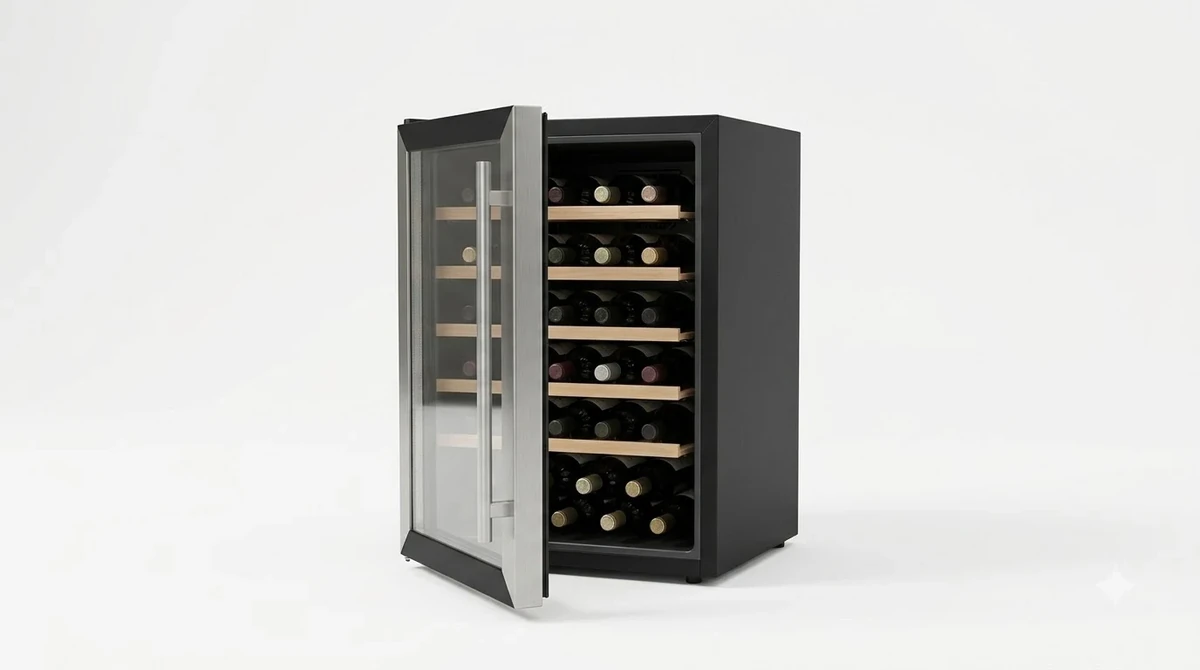
A temperature-controlled room is generally preferable to a garage, patio, or kitchen corner exposed to cooking heat. Wine Enthusiast specifically advises against non-air-conditioned garages and hot patios because harsh ambient conditions can force a cooler to work harder. Liebherr’s wine storage recommendations also explain why stable temperatures, suitable humidity, darkness, and protection from odors matter.
Before installation, consider the following practical points:
- Keep it away from direct sunlight: Sunlight can heat the appliance and expose bottles to unwanted light.
- Avoid cooking appliances: Do not position the unit beside an oven, stove, or dishwasher that releases substantial heat.
- Allow ventilation: Follow the manufacturer’s clearance requirements, particularly for compressor models.
- Use a stable surface: An uneven floor or shelf can cause unnecessary movement and operational noise.
- Consider ambient temperature: A room that remains around 65–75°F is generally more suitable for operating a wine refrigerator than a very hot garage.
- Check the power supply: Use an appropriate electrical outlet and follow the appliance’s installation instructions.
Set the correct storage temperature
For a mixed collection intended for storage, approximately 55°F is a useful target. It provides a practical setting within the long-term temperature recommendations discussed by Wine Enthusiast and other wine-storage specialists.
You do not need to store red wine at one temperature and white wine at another simply because they are served differently. Storage and serving are separate decisions.
For example, a Cabernet Sauvignon may be stored at 55°F and served at 60–65°F. A Chardonnay stored at the same temperature can be chilled further before serving, while a Sauvignon Blanc can be served colder still.
Use the following serving-temperature references when preparing bottles for dinner:
- Sparkling wine: 40–50°F.
- Light white wine and rosé: 45–50°F.
- Full-bodied white wine: 50–55°F.
- Light-bodied red wine: 55–60°F.
- Full-bodied red wine: 60–65°F.
- Sweet white wine: 43–50°F.
These are serving temperatures, not separate long-term storage requirements. A single-zone refrigerator set near 55°F can therefore work perfectly well for a mixed collection.
Organize bottles for convenient access
Place bottles you expect to open soon where they are easiest to reach. Keep longer-term bottles in stable positions where they will not be repeatedly moved whenever you retrieve another wine.
For cork-sealed bottles intended for extended storage, horizontal positioning helps maintain cork moisture. Screw-cap bottles do not have the same requirement, although horizontal storage can still make better use of available shelving.
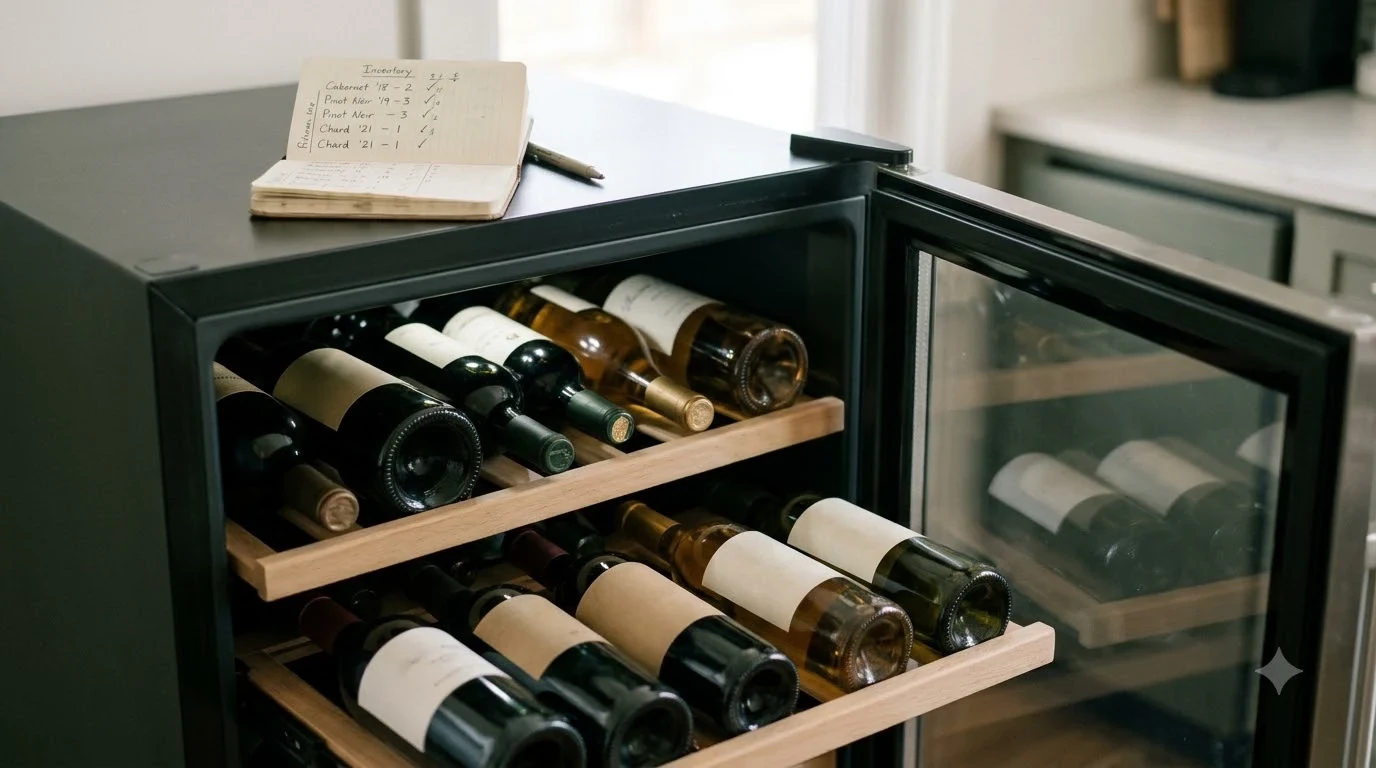
Keep your collection organized by grape variety, region, drinking occasion, or expected opening date. A simple inventory on your phone or a notebook can help you identify which bottles should be enjoyed first.
Tip: Place an inexpensive independent thermometer inside your wine fridge and compare its reading with the digital display. Check the temperature again after 24 hours and after loading new bottles. This helps identify inaccurate settings, uneven cooling, or problems caused by an overloaded compartment.
Wine Fridge Costs, Energy Use, and Everyday Ownership
A wine refrigerator is an ongoing household appliance, so the purchase decision should include electricity consumption, maintenance, noise, and the available installation space. These practical considerations help determine whether dedicated storage will remain convenient after the initial purchase.
Small countertop models generally take up less space and suit people with modest collections. Freestanding cabinets accommodate more bottles, while built-in models are designed for particular kitchen or cabinetry installations. Each category has different ventilation and installation requirements.
Consider electricity consumption
Wine refrigerators use electricity continuously to maintain their selected temperatures. The amount depends on insulation, cooling technology, cabinet size, room temperature, frequency of door opening, and the appliance’s overall efficiency.
A refrigerator placed in a hot garage may consume more energy because it must remove additional heat. A unit installed in a reasonably cool indoor room will generally have an easier operating environment.
Look for the manufacturer’s annual energy-consumption information where available. Comparing annual kilowatt-hour figures is more useful than judging efficiency based solely on cabinet size or advertised cooling performance.
Our article about wine fridge energy efficiency provides additional context for comparing electricity requirements and understanding the long-term operating implications of different appliances.
Account for maintenance
Most wine refrigerators require relatively little routine maintenance, but they still benefit from occasional attention. Clean the interior shelves, wipe up spills, inspect door seals, and keep ventilation openings clear.
Dust accumulation around ventilation areas can affect cooling performance. Follow the manufacturer’s cleaning instructions and avoid using strong-smelling cleaning products inside the cabinet immediately before loading wine.
Door seals deserve particular attention because gaps allow warm air to enter the refrigerator. If the door does not close properly, the appliance may struggle to maintain its selected temperature.
Think about noise and placement
Noise is easy to overlook during the shopping process. A compressor refrigerator may produce noticeable operating sounds, especially when its cooling system starts. Thermoelectric models are generally quieter, although their performance can be more limited in warm surroundings.
If the appliance will sit beside a bedroom, home office, or dining table, noise may influence which technology you prefer. Read installation specifications and consider the manufacturer’s operating-noise information before making a decision.
Also consider whether the refrigerator can be moved into your intended location. A large wine cabinet may require more clearance than expected, particularly when doors must open fully or shelves slide outward.
Finally, avoid buying more capacity than you can reasonably use. A 100-bottle refrigerator may look appealing, but a smaller 20- or 30-bottle unit can be a better match for someone who normally keeps a dozen bottles at home.
Wine storage should support your drinking habits rather than create a new obligation to maintain a collection. A good appliance is one that fits naturally into your home and makes keeping wine in suitable conditions easier.
Alternatives for Wine Drinkers Who Do Not Need a Fridge
Not every wine drinker needs a dedicated appliance. A cool, dark, and stable cupboard can work well for a small collection, particularly when bottles are purchased for consumption within a few weeks or months.
The first step is finding a location that avoids direct sunlight and significant temperature fluctuations. A hallway cupboard, interior closet, or suitable pantry may offer better conditions than a kitchen counter or open dining-room shelf.
Decanter identifies a dark cupboard under the stairs and a wardrobe as possible alternatives to a traditional cellar. These locations can be useful because they are often removed from direct sunlight and kitchen heat.
However, do not assume that every closet is suitable. An upstairs cupboard that becomes hot during summer may be worse than a cooler interior storage space. A thermometer provides a simple way to check whether the temperature remains stable throughout the day.
Buy smaller quantities more frequently
One of the easiest alternatives to buying a wine refrigerator is adjusting how much wine you keep at home. If you typically drink two bottles each week, purchasing two or three at a time may eliminate the need for extended storage.
This approach works particularly well with everyday wines that are intended for relatively early consumption. Fresh Sauvignon Blanc, inexpensive rosé, and many uncomplicated Pinot Grigio wines are commonly enjoyed young rather than held for many years.
For bottles purchased ahead of special occasions, select a storage location away from heat sources and bright light. Avoid keeping them beside the oven or on top of a refrigerator, where temperatures may rise during normal household use.
Use your regular refrigerator strategically
Your household refrigerator remains useful even without a dedicated wine appliance. Chill white wines, rosé, and sparkling bottles before serving, and return opened bottles to the refrigerator after replacing their closures.
Opened still wines generally keep for approximately three to five days in the refrigerator, depending on the wine and how well the bottle is sealed. Sparkling wines usually retain their quality for around one to three days when properly stopped and refrigerated.
For unopened bottles, use the regular refrigerator for temporary chilling rather than treating it as a permanent cellar. Extended exposure to very cold conditions is not necessary for everyday wine storage.
Learn which wines deserve longer storage
Not every wine improves with age. Many bottles sold for everyday enjoyment are intended to be opened relatively soon after purchase. Buying a wine fridge specifically to store wines that are unlikely to benefit from extended aging may not make much sense.
Some structured Cabernet Sauvignon, selected Bordeaux blends, and certain Syrah wines can develop additional complexity over several years when stored under appropriate conditions. Many fresh white wines and rosés, by contrast, are best enjoyed while their youthful fruit characteristics remain prominent.
For a broader understanding of choosing bottles, serving occasions, and planning purchases, explore our Buying Basics resources before investing in specialized storage equipment.
Ultimately, the best alternative to a wine fridge is not simply leaving bottles wherever there is room. It is choosing a storage location that protects them from excessive heat, light, and unnecessary temperature changes while matching the length of time you intend to keep them.
Frequently Asked Questions
Can wine go bad if it is stored upright?
Upright storage does not automatically spoil wine. Screw-cap bottles can generally be stored upright because their closures do not depend on cork moisture. For natural-cork bottles intended for extended storage, horizontal positioning is generally preferred to maintain contact between the wine and cork.
Does an unopened wine bottle expire?
Wine does not have one universal expiration date. Its useful drinking window depends on grape variety, acidity, tannin, winemaking, closure, and storage conditions. Some premium wines can develop for decades, while many inexpensive everyday bottles are intended to be enjoyed within a few years of release.
Can a wine fridge be used for champagne and sparkling wine?
Yes. Champagne, Cava, and other sparkling wines can be stored in a wine refrigerator at approximately 55°F for longer-term storage. Their serving temperature is colder, generally 40–50°F, so allow time for additional chilling before opening. Check shelf dimensions because sparkling bottles are often wider than standard Bordeaux bottles.
Does a wine refrigerator need to run continuously?
Yes. A wine refrigerator is designed to maintain its selected temperature automatically, so it should remain connected to power during normal operation. Its compressor or cooling system cycles on and off as necessary rather than running continuously at full capacity. Switching it off for extended periods can expose the collection to unwanted temperature changes.
Can I put an opened wine bottle back into a wine fridge?
Yes. Replace the original closure or use a suitable wine stopper before returning the bottle to refrigerated storage. A vacuum stopper can help limit oxygen exposure in still wines, while a dedicated sparkling-wine stopper helps retain carbonation. Keep opened bottles upright to reduce the risk of leakage.
A wine fridge is a worthwhile investment when your collection needs consistent storage conditions that your home cannot provide naturally. If you drink wine quickly and have access to a cool, dark cupboard, you may be perfectly comfortable without one. Start with your storage habits and home temperature, then choose an appliance only if it solves a genuine problem for your collection.
More in Wine Buying Guides
 Cheap Red Blend: How to Find a Flavorful Bottle for LessUpdated Nov 20, 2026
 Pinot Grigio Gift: How to Choose a Bottle They’ll EnjoyUpdated Nov 20, 2026
 Best White Wine at Total Wine for Every MealUpdated Nov 20, 2026
 Wine Fridge Replacement Shelves: Find the Right FitUpdated Nov 20, 2026
 Best Sparkling Wine Under 20: Find Bubbles Worth BuyingUpdated Nov 20, 2026
 Best Wine For Birthday Celebrations With Perfect Party PairingsUpdated Nov 20, 2026