

We may earn a commission when you buy through links on this page, at no extra cost to you. Learn more.
The wine enthusiast electric wine opener is a compact, buttonless corkscrew that extracts and releases a cork when you press it onto a bottle, making everyday uncorking simpler than using a manual twist opener. The current Electric Blue model combines a rechargeable 3.7V battery, a blue-lit viewing window, and a supplied foil cutter in a body measuring 7.87 inches tall. Its main advantage is convenience and a light footprint; its limits are an unpublished bottle-per-charge figure and a lack of demonstrated suitability for old, fragile corks.
This review focuses on the Electric Blue Automatic Wine Opener with Foil Cutter, manufacturer SKU 495 15 08. Wine Enthusiast has sold other Electric Blue openers as well, including button-operated and wine-preserver versions, so details from those related products and earlier owner reviews are identified separately rather than treated as specifications for the current opener.
Specs and Key Features
The current Electric Blue is built around one simple action: center it over the bottle neck, press down, and let the mechanism pull and release the cork. Its published measurements—2.05 inches wide, 7.87 inches high, and 0.29 pound—make it notably compact compared with many countertop electric openers.
| Specification | Published detail |
|---|---|
| Product | Electric Blue Automatic Wine Opener With Foil Cutter |
| Manufacturer SKU | 495 15 08 |
| Battery | Rechargeable lithium-ion, 3.7V, 500mAh |
| Dimensions | 2.05 in. long × 2.05 in. wide × 7.87 in. high |
| Weight | 0.29 lb. |
| Housing | Blue-coated stainless steel |
| Included accessories | Foil cutter, USB charging cord, and reset tool |
| Operation | Automatic cork extraction and release; no buttons |
| Lighting | Blue-lit action window; charge light is blue while charging and white when fully charged |
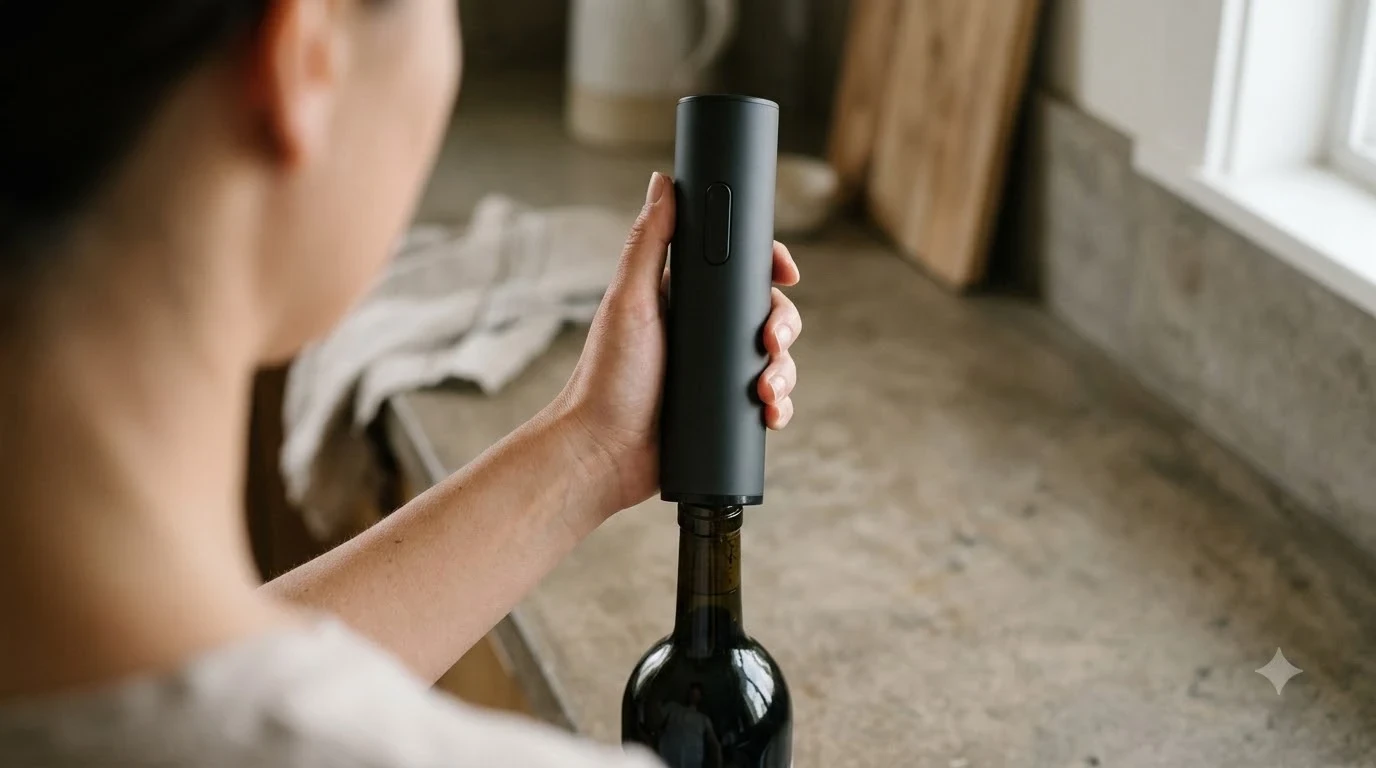
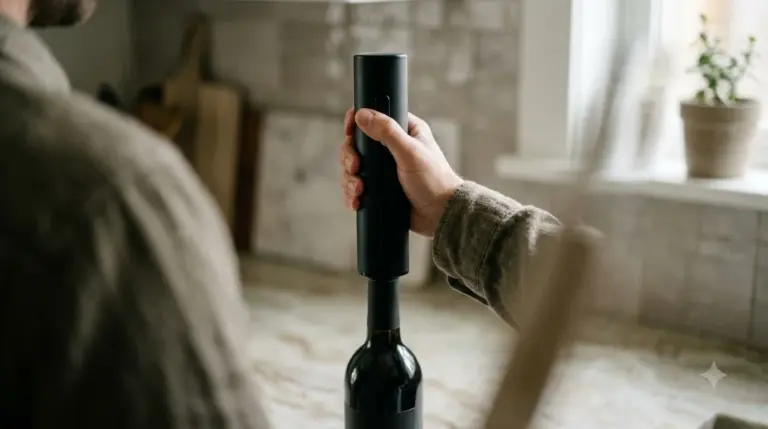
The most distinctive feature is its automatic start and release. Rather than locating an up or down switch, position the unit over the bottleneck and apply gentle downward pressure. The internal screw engages the cork, extracts it, and releases it from the opener. Center the tool squarely and keep the bottle steady as the mechanism begins to work; alignment matters more than it does with a manual lever opener.
The blue-coated stainless-steel body has a lower action window that illuminates during operation, letting you watch the cork move instead of relying on motor sound alone. A separate top indicator is blue while charging and white when fully charged. The listing does not give a charging time, so there is no reliable basis for promising that a short top-up will prepare it for a set number of bottles.
Included accessories are a foil cutter, USB charging cord, and reset tool. The manufacturer does not list a dock, stopper, vacuum pump, aerator, or carrying case. It also omits a published runtime, warranty term, and cork-size range; ask the seller about any of those requirements rather than borrowing specifications from another Electric Blue set.
At just over 2 inches across and under 8 inches tall, it can fit a narrow bar-tools area or a drawer with enough vertical clearance. Its 0.29-pound weight also makes it easy to lift. Those compact dimensions do not establish motor strength, however; the listing gives no torque figure or tested cork-removal rate. See the Electric Blue product listing for the manufacturer’s full description.
What Owners Like
Owner comments on earlier Electric Blue versions point to the same appeal as the current model: less twisting, quick cork removal, and a visible blue light. The strongest owner feedback is about convenience rather than technical performance, and it should be treated as historical evidence because the reviewed older SKU was 495 10 51, not the current 495 15 08.

Verified-purchase comments on Best Buy’s earlier Electric Blue listing describe quick opening and convenience at gatherings. Other owners praised straightforward charging, the blue illumination, and reduced gripping and twisting. One appreciated being able to see the cork move; another found the powered design helpful when gripping an object was difficult. Those are the practical strengths of an automatic opener: positioning a powered tool replaces managing a manual spiral and lever.
The illuminated window is also a visible design feature for an opener kept beside glasses or a wine rack. Owners of earlier Electric Blue versions mentioned the light and polished appearance positively, which may appeal to someone buying a host gift or setting up a small home bar. That is a subjective advantage rather than evidence of better cork removal, but the design does give the tool a more distinctive look than a basic plastic model.
Speed is another recurring theme in the older feedback, including comments about using the opener during parties. The benefit is not necessarily a dramatic time saving on one bottle; it is avoiding repeated hand movements across several bottles. For a host pouring at the table, an automatic cycle can feel simpler than repeatedly unfolding and operating a waiter’s corkscrew.
There is a limit to what these comments establish. Best Buy’s reviews concern model 495 10 51, while the current manufacturer page identifies 495 15 08. Do not assume the two SKUs share every component or durability characteristic; the older comments are context about the Electric Blue concept, not a reliability study of the current opener. The comments can be read on the earlier Electric Blue owner-review page.
Common Complaints
The main caution is that convenience does not guarantee enough pulling power for every cork, and earlier Electric Blue owners also reported a unit that stopped working. Because those reports concern the older 495 10 51 model, they are a reason to consider durability carefully, not proof that the current 495 15 08 has the same fault.
One earlier owner said the opener handled most bottles but lacked power for some corks. Another verified owner reported that it had worked on only about three bottles before stopping; the review page says the person had owned it for around 10 months at the time. A few comments cannot establish a failure rate, but they are a reminder not to treat an electric corkscrew as a guaranteed replacement for a basic manual opener. Keep a backup nearby for a dinner party or a bottle saved for a special occasion.
Cork condition is a separate limitation. In Wine Enthusiast’s discussion of opener styles, sommeliers caution against using automatic electric openers on older bottles or on corks that are moldy, damaged, or otherwise in poor condition. A weakened cork can crumble or split under the pulling action. That warning matters most for aged bottles that have spent years in storage, where the cork may no longer behave like the firm, intact closure found on a young everyday wine. For a fragile older bottle, a careful manual approach is the safer choice than asking a motor to extract the cork in one automatic movement.
Electric openers can wobble as the screw enters the cork. America’s Test Kitchen reports movement across the models it evaluated and notes that powered designs may still require hand strength to stabilize. Automation reduces twisting, but it does not remove the need to hold the bottle and keep the tool aligned. A slippery bottle or difficult cork can make operation less straightforward than product photos suggest.
Tip: Keep the bottle upright on a stable counter, center the opener over the cork, and let the mechanism run without tilting the tool. For a brittle or damaged cork, put the electric opener aside and use a controlled manual method.
The current sheet gives no motor torque or sound level for SKU 495 15 08. Its 500mAh rating is useful context, but battery capacity alone does not show how the motor handles a stubborn cork. Treat it as a compact home tool, not a proven high-volume bar appliance.
Who Should Buy and Who Should Skip
This opener is best suited to someone who opens standard cork-finished wine regularly and values a low-effort, compact tool more than a detailed battery specification. Its 7.87-inch height and 0.29-pound weight make it easy to store and lift, while the buttonless cycle keeps the operation simple once the bottle is steady.
It suits an everyday home wine drinker, a host who wants a tidy bar accessory, or a gift buyer seeking more convenience than a basic corkscrew. The supplied foil cutter covers capsule removal, while the blue action window makes the extraction process easy to follow. Once charged, the cordless opener can move between a kitchen counter, dining room, or serving cart.
The 2.05-inch square footprint and sub-8-inch height are useful if a bulky dock would crowd the bar cabinet. The 0.29-pound body is also light to pass around the table. In a small kitchen, those measurements may matter more than decorative extras or a large charging stand.
Skip it if you mainly open collectible bottles with old corks, want a confirmed bottle count per charge, or need an opener designed for repeated commercial service. Sommeliers quoted in Wine Enthusiast’s opener guide advise keeping automatic models away from fragile, moldy, or damaged corks. The current manufacturer listing also does not provide a per-charge figure or a motor-strength rating, so a bar that opens bottles continuously would benefit from choosing a model with clearly documented endurance and support. A manual two-step waiter’s corkscrew is a better tool for fragile corks and remains a practical fallback if the battery is empty.
Think about the kind of friction you want to remove. If you dislike the repeated twist-and-pull action, this electric model directly addresses that step. If your main frustration is carrying an opener when traveling, a small wine bottle opener keychain is a more portable solution. If you want a useful accessory collection rather than one gadget, browse the site’s Accessory Brands section and compare tools by storage needs, power source, and the kind of bottles you usually open.
How It Compares to Alternatives
The Electric Blue’s strongest comparison point is its compact size, while other styles offer different strengths such as endurance, manual control, or preservation. The current 495 15 08 weighs 0.29 pound; America’s Test Kitchen lists its Secura Electric Wine Opener at 14.7 ounces and 11 inches tall on its charging stand.
America’s Test Kitchen named the Secura Electric Wine Opener its top pick after opening more than 200 bottles across the models it evaluated. The tested Secura handled natural and synthetic corks and opened over 30 bottles in a row without losing charge. Those results belong to the Secura, not Wine Enthusiast. The Electric Blue is lighter on published figures, but its endurance is not documented in the same way. Choose Secura for documented capacity; choose the compact Electric Blue if easy storage matters more.
A waiter’s corkscrew remains the more versatile manual alternative. Wine Enthusiast describes it as a pocket-sized favorite among sommeliers, with a metal spiral, hinge, and serrated blade. Its two-step lever gives more control over a stubborn cork and needs no charging, but the user must insert the spiral and pull by hand. Choose it for portability and control; choose Electric Blue for easier everyday opening.
There are also different Electric Blue products within the Wine Enthusiast range. The brand’s buying guide names an Electric Blue 1 Automatic Wine Opener and Preserver Kit and an Electric Blue Push-Button Corkscrew. It describes the preserver kit as adding vacuum sealing for leftover wine, while the button-operated design uses a button to start the extraction. The current 495 15 08 listing instead describes buttonless contact activation and lists no stopper or vacuum pump among its included parts. Buyers who want both opening and preservation should look at a preserver set, not assume that the compact single opener seals an unfinished bottle.
An opener does not chill wine. Cooling is a separate job for a bucket, refrigerator, or an electric wine chiller. Match the corkscrew to your opening habits, then choose temperature-control equipment separately for whites, rosé, or sparkling wines.
Frequently Asked Questions
These five answers address details not fully settled by the current product listing, including cork compatibility, charging accessories, and the difference between compact SKU 495 15 08 and earlier Electric Blue models.
Does the current Electric Blue opener work with synthetic corks?
The current 495 15 08 listing does not expressly state whether it is rated for synthetic corks. A separate Wayfair listing for a Wine Enthusiast Automatic Electric Wine Opener says that older product extracts both natural and synthetic corks, but that is a different listing and should not be treated as confirmation for this SKU.
Can I use it to open screw-cap wine bottles?
No electric corkscrew is needed for a screw cap. Twist the cap by hand using its normal opening action; the Electric Blue is designed around a spiral that engages a cork, not a threaded metal closure.
Is it suitable for Champagne or other sparkling wine?
Use a proper sparkling-wine opening method instead of an electric corkscrew. Sparkling bottles contain pressure, and their mushroom-shaped corks are retained by a wire cage; keep the bottle pointed away from people and maintain control of the cork as the cage is loosened.
Does the USB charging cord include a wall adapter?
The current manufacturer listing names a USB charging cord but does not separately list a wall adapter. Do not assume a power brick is in the box; check the package details with the seller and use a suitable USB power source for charging.
Can it open a bottle while the USB cord is connected?
The manufacturer does not describe pass-through operation or say whether the opener can be used while charging. Charge it before serving and consult the supplied instructions rather than assuming it is designed to operate with the cable attached.
The Wine Enthusiast Electric Blue Automatic Wine Opener is an appealing compact choice for routine corked bottles, especially if buttonless operation and simple storage matter most. Its missing runtime data and the mixed history of an earlier Electric Blue model call for realistic expectations, while fragile old corks are still better handled with a manual opener.
More in Wine Accessories
 Vinglace Wine Tumbler Review: A Glass-Lined Choice for Better SippingUpdated Nov 20, 2026
 ZWILLING Electric Wine Opener Review: Features and DrawbacksUpdated Nov 20, 2026
 Vinturi Electric Wine Opener Review for Easy UncorkingUpdated Nov 20, 2026
 Vinabon Wine Aerator Review for Easier, Cleaner Wine ServingUpdated Nov 20, 2026
 Vacu Vin Electric Wine Opener Review: Easy Cork Removal for Home Wine LoversUpdated Nov 20, 2026
 Rabbit Wine Accessories for Easier Home Wine ServiceUpdated Nov 20, 2026