

We may earn a commission when you buy through links on this page, at no extra cost to you. Learn more.
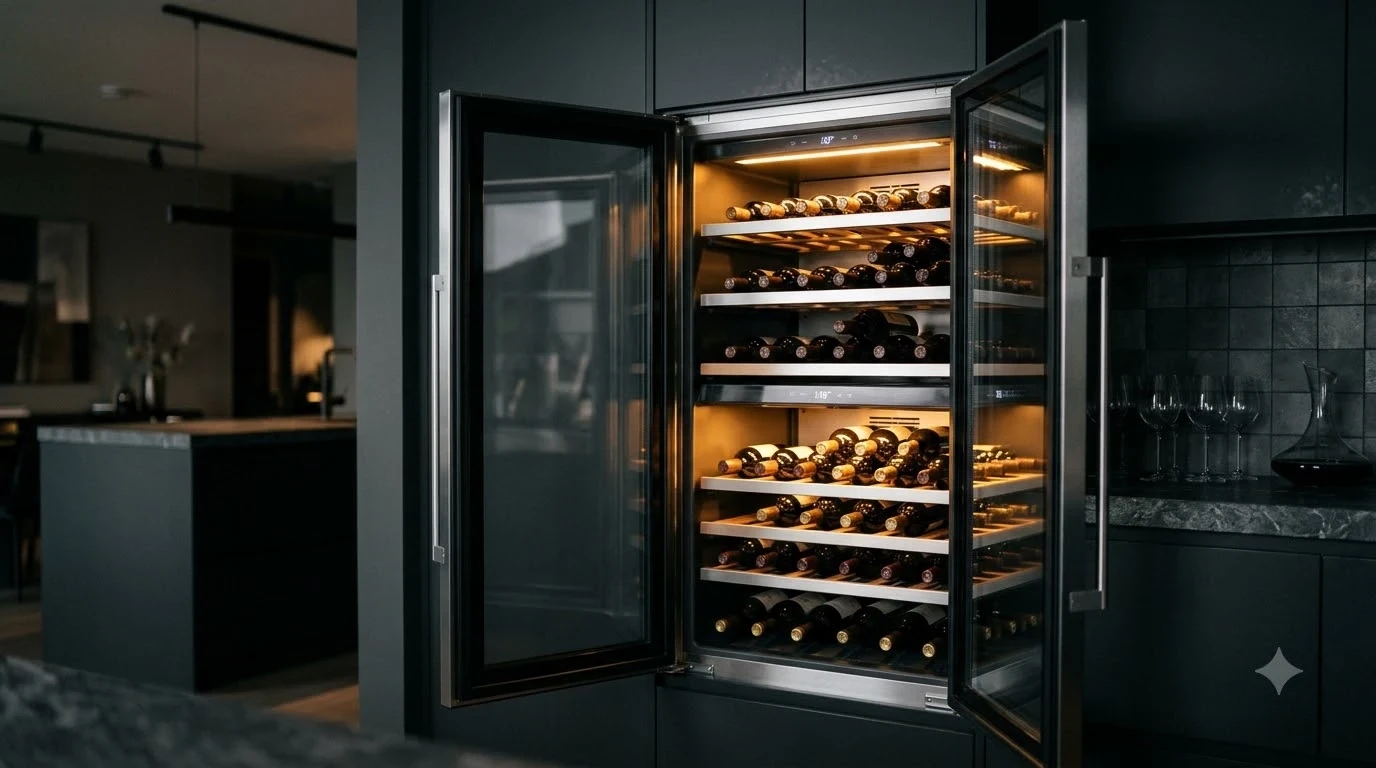
The Wine Enthusiast dual zone wine fridge is a worthwhile choice for wine drinkers who want separate temperature settings for reds and whites without dedicating an entire room to wine storage. The 32-Bottle Dual Zone MAX Compressor Wine Cooler combines two adjustable temperature compartments, compressor cooling, removable chrome racks, and a compact freestanding design. Its main limitations are its non-reversible door, top-and-side ventilation requirements, and advertised capacity that assumes standard Bordeaux bottles.
The Wine Enthusiast 32-Bottle Dual Zone MAX is designed for households that regularly keep several varieties of wine ready to serve. Rather than forcing every bottle into one temperature setting, it allows separate compartments to operate at different temperatures. The result is a practical combination of storage flexibility and serving convenience, although buyers should understand its installation requirements and bottle-size limitations before purchasing.
Specs and Key Features
The Wine Enthusiast 32-Bottle Dual Zone MAX combines compressor cooling with two independently controlled compartments in a relatively narrow cabinet. Its strongest features are the broad temperature adjustment range, removable shelving, and larger lower storage area.
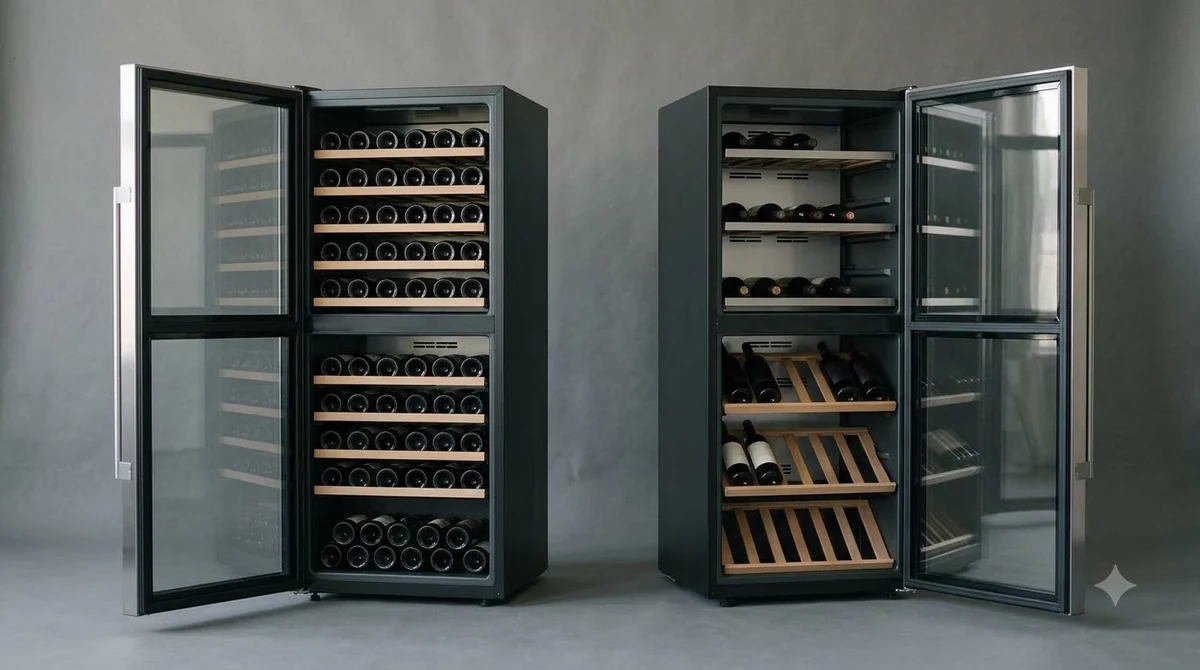
Wine Enthusiast identifies this refrigerator as model 288 03 32 03. Both compartments have a published temperature range of 41°F to 64°F, giving owners flexibility to organize a collection around different wine styles. The manufacturer also describes its Dual Zone MAX configuration as suitable for using one section for cooler service temperatures and another for longer-term storage, or setting both compartments to the same temperature.
The compressor cooling system distinguishes this appliance from smaller thermoelectric wine coolers. Compressor systems are designed to provide active refrigeration across a broader range of operating conditions. This is useful for households that want to keep several bottles chilled without depending on the temperature of the surrounding room alone.
Its 3.2-cubic-foot interior has six storage positions, consisting of five wavy chrome-wire racks and one fixed bottom bin. The removable rack arrangement provides some flexibility for bottles with wider shoulders, while the bottom section offers additional room for larger formats. However, the manufacturer’s 32-bottle maximum is based on standard Bordeaux-style bottles, not a mixed collection of unusually shaped bottles.
The manufacturer’s 32-Bottle Dual Zone MAX product specification sheet provides the detailed dimensions, electrical requirements, temperature range, and storage configuration for this model.
| Specification | Manufacturer’s listed details |
|---|---|
| Model | 288 03 32 03 |
| Maximum capacity | 32 standard Bordeaux bottles |
| Usable volume | 3.2 cubic feet |
| Temperature zones | 2 independent zones |
| Temperature range | 41°F–64°F in both zones |
| Cooling system | Compressor |
| Dimensions | 33⅜ × 19½ × 17 inches |
| Shelving | 5 wavy chrome-wire racks and 1 fixed bin |
| Door | Dual-pane mirrored glass |
| Door configuration | Right-hinged, non-reversible |
| Installation | Freestanding only |
| Ventilation | Top and sides |
| Noise rating | 40 dB(A) |
| Electrical requirements | 115V, 60Hz, 1.2 amps |
| Warranty | 1 year parts and labor; 3 years sealed system |
These specifications matter particularly for placement because the cabinet needs appropriate clearance for ventilation and door movement. A narrow footprint does not make this a built-in appliance.
The dual-pane mirrored glass door gives the refrigerator a more polished appearance than an ordinary opaque mini fridge. An integrated handle keeps the exterior relatively simple, while electronic touch controls and a blue LED display make temperature adjustments straightforward.
One specification deserves particular attention: the door cannot be reversed. Buyers should measure the available opening and consider nearby walls, cabinets, and furniture before deciding where the refrigerator will stand.
What Owners Like
The main appeal of the Wine Enthusiast 32-Bottle Dual Zone MAX is its combination of independent temperature controls and useful storage capacity. Independent editorial reviews and published product assessments frequently highlight its flexibility, compact proportions, and practical removable shelving.
For households that drink Cabernet Sauvignon, Merlot, Chardonnay, Sauvignon Blanc, or sparkling wine, separate compartments offer a meaningful advantage. Full-bodied reds generally benefit from warmer serving temperatures than chilled whites, while sparkling wines need colder conditions. Keeping these bottles in separate compartments reduces the need to repeatedly adjust one refrigerator to accommodate different drinking preferences.
Liquor.com selected this model as its best overall wine fridge, highlighting the dual-zone configuration, removable chrome racks, quiet operation, and larger bottom rack. Its editorial assessment also emphasizes the compact dimensions and freestanding design. These are useful strengths for a household that wants a dedicated wine appliance without installing a full-size cellar.
Popular Mechanics also highlights the removable racks and compressor performance. Its review discusses the ability to rearrange storage for larger bottles, as well as the relatively quiet operation of the unit. These observations suggest that the refrigerator’s practical advantages extend beyond its headline bottle count.
Another appealing feature is the ability to operate both compartments at the same temperature. Owners do not necessarily need to maintain separate red and white sections forever. Someone who later develops a preference for one wine category can use the same-temperature configuration to create a more unified storage environment.
The temperature flexibility also makes it easier to organize a collection around drinking schedules. For example, the upper compartment can hold chilled white wines and rosé for upcoming dinners, while the lower compartment keeps reds closer to their preferred serving temperatures.
That arrangement is particularly useful for people who entertain regularly. A dinner featuring roasted chicken, vegetables, and several wine options does not require every bottle to be moved between the kitchen refrigerator and a countertop. The wine cooler can keep different categories organized and ready for use.
The refrigerator’s proportions are another positive. At approximately 19½ inches wide and 33⅜ inches high, it can fit into many dedicated beverage-storage areas without occupying the same amount of floor space as a conventional refrigerator. Its compact cabinet is also more manageable to position than a large wine cellar, although careful handling is still important.
For wine drinkers planning meals around different bottles, this flexibility can be particularly useful. A chilled white wine can accompany lighter dishes, while a medium-bodied red can be prepared for a richer meal such as one featuring the flavors in a chicken Marsala recipe.
Overall, the strongest positive is not any single feature. It is the way the two temperature zones, removable racks, compressor cooling, and moderate cabinet size work together for everyday home wine storage.
Common Complaints
The Wine Enthusiast Dual Zone MAX has several practical limitations that deserve attention before purchase. Its most important drawbacks involve installation flexibility, bottle capacity, door placement, and the possibility of noticeable compressor sounds.
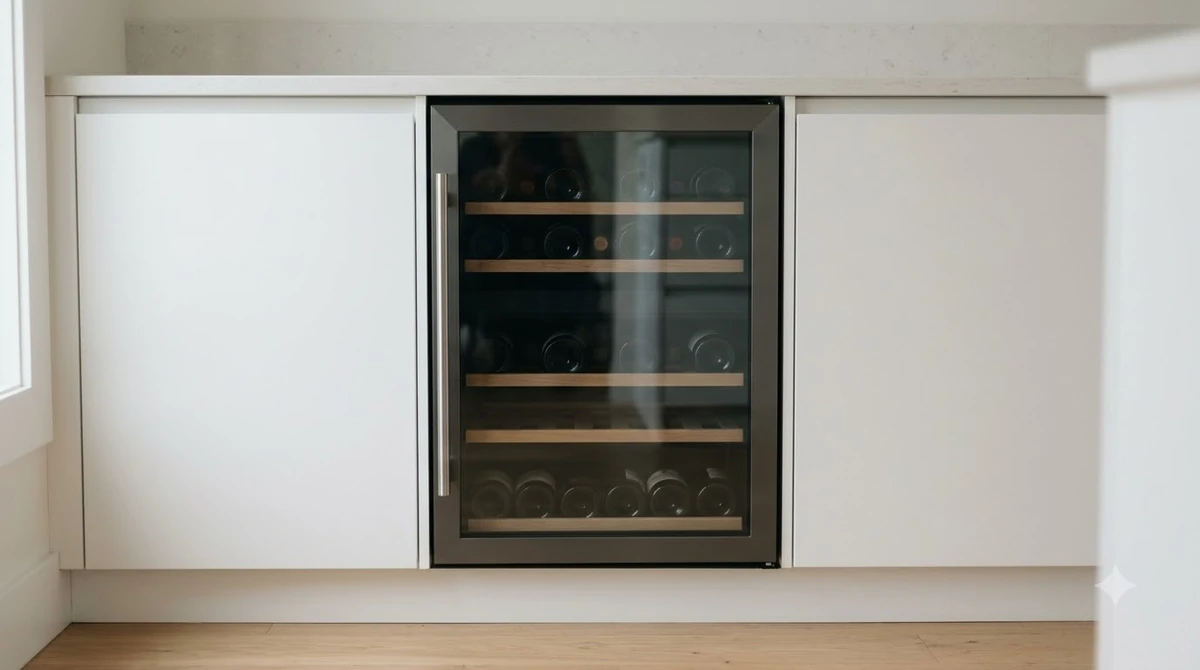
First, this refrigerator is freestanding only. The manufacturer specifies ventilation through the top and sides, meaning it should not be treated like a front-vented under-counter appliance. Placing it inside a tightly enclosed cabinet can interfere with heat dissipation and make temperature control more difficult.
This limitation matters because its height and width can make it look suitable for an under-counter space. However, physical dimensions alone do not determine installation compatibility. A refrigerator needs the ventilation arrangement specified by its manufacturer, and this model requires an appropriately open location.
Second, the 32-bottle capacity is a maximum rather than a guarantee for every collection. The manufacturer bases its figure on standard Bordeaux bottles. Champagne, Burgundy, and some Pinot Noir bottles have wider shoulders or different proportions that can occupy more space.
Popular Mechanics specifically identifies larger bottle shapes as a factor that can reduce practical capacity. Its review also points out that removable racks help accommodate these bottles, although removing shelving means sacrificing some of the advertised storage positions.
For collectors who regularly buy Champagne or larger-format Burgundy bottles, this is an important consideration. A refrigerator filled with a mixture of standard Bordeaux bottles and wider bottles will not necessarily accommodate 32 bottles comfortably. Owners should plan their storage around the bottles they actually purchase rather than relying exclusively on the manufacturer’s maximum figure.
The door arrangement is another drawback. The specification sheet lists a right-hinged, non-reversible door, while Popular Mechanics identifies the fixed opening direction as a practical limitation. A nearby wall or cabinet can make access awkward if the door cannot swing comfortably.
The refrigerator also does not list a built-in security lock in its specification sheet. This may not matter in an adult household, but it can be inconvenient for families who want additional protection against children opening the appliance.
Noise deserves a balanced assessment. Wine Enthusiast publishes a 40 dB(A) rating, and independent editorial coverage describes its compressor operation as relatively quiet. However, a compressor refrigerator is not completely silent. It can produce humming, clicking, gurgling, and vibration as its cooling system operates.
The manufacturer’s manual specifically identifies several sounds as normal, including refrigerant gurgling, thermostat clicks, and occasional popping or crackling during defrost. These sounds should not automatically be interpreted as a malfunction.
Nevertheless, buyers who are highly sensitive to background noise may prefer to position the appliance in a kitchen, dedicated beverage area, or home bar rather than directly beside a bed or quiet reading space.
Finally, the warranty deserves careful consideration. The published specification lists one year of parts-and-labor coverage and three years of sealed-system coverage. These are different coverage periods, not three years of complete protection for every component. Buyers should retain their purchase documentation and review the applicable warranty conditions.
Who Should Buy and Who Should Skip
The Wine Enthusiast 32-Bottle Dual Zone MAX makes the most sense for households with a growing wine collection that includes both reds and whites. It is less suitable for people who need built-in installation, extensive capacity for oversized bottles, or a completely silent appliance.
It is a particularly practical option for casual collectors who typically maintain between a dozen and several dozen bottles. A household that regularly buys wine for dinners, weekend gatherings, and special occasions can benefit from having different varieties available at their preferred temperatures.
For example, a collection might include Cabernet Sauvignon, Merlot, Pinot Noir, Chardonnay, Riesling, and Prosecco. These wines do not all benefit from identical serving conditions. Two independent temperature zones make it easier to prepare different bottles without compromising the entire collection.
The appliance is also suitable for people who want to separate short-term serving preparation from longer-term storage. Wine Enthusiast’s Dual Zone MAX design allows the two compartments to operate at different temperatures or the same temperature, making it adaptable as drinking habits change.
However, a buyer who primarily stores wine for long-term aging may not need dual-zone cooling. Wine intended for aging generally benefits from a relatively consistent storage environment around 55°F, regardless of whether it is red, white, or sparkling. A single-zone wine cellar can therefore be sufficient for collections that do not require separate serving temperatures.
People who want a kitchen appliance installed flush beneath a countertop should also skip this particular model. Its top-and-side ventilation requirements make it unsuitable for a standard enclosed built-in installation. A dedicated front-vented wine refrigerator is a more appropriate choice for that situation.
Likewise, serious collectors with a substantial collection may find 32 bottles restrictive. A growing collection can quickly exceed this capacity, particularly if it includes multiple bottles from different vintages or larger-format Champagne and Burgundy bottles.
Tip: Before purchasing, count the bottles you currently own and estimate your collection over the next year. If you regularly store 25 bottles, a refrigerator advertised for 32 standard bottles may leave less room than expected once wider bottle shapes are included.
Another group that should think carefully before buying includes households with limited floor space. Although the refrigerator is relatively narrow, it still requires a suitable open location, clearance for ventilation, and room for the right-hinged door to swing.
In short, the model is best suited to wine drinkers who value flexibility and organization more than premium cabinetry or very large capacity. It delivers a useful balance for a moderate home collection, provided the installation environment is appropriate.
How It Compares to Alternatives
The Wine Enthusiast 32-Bottle Dual Zone MAX competes in a category that includes compact single-zone refrigerators, built-in wine cellars, and larger multi-compartment storage systems. Its main distinction is the combination of two independently adjustable temperature zones and a freestanding cabinet that occupies relatively little floor space.
Liquor.com compares the Wine Enthusiast model with other wine refrigerators and identifies its dual-zone configuration as a major advantage. Its assessment also emphasizes the removable shelving and larger lower rack, which provide more flexibility than some smaller wine coolers.
One alternative is a single-zone refrigerator such as the Kalamera 18-Bottle Built-in Wine Refrigerator discussed by Liquor.com. That appliance is designed around a single storage temperature and offers front ventilation, making it more appropriate for certain built-in installations. However, it does not provide the same independent red-and-white temperature arrangement as the Wine Enthusiast model.
Another alternative is the Wine Enthusiast Latitude S 24-inch Smart Wi-Fi Undercounter Dual Zone Wine Cellar, which Wine Enthusiast describes as a larger-capacity, built-in-friendly option with compressor cooling, touchscreen controls, and smartphone connectivity. Its 46-bottle capacity offers more room for a growing collection, while front ventilation supports a different installation approach.
The Latitude S is therefore more appropriate for someone who wants a wine cellar integrated into kitchen cabinetry. The 32-Bottle Dual Zone MAX is more appropriate for someone who wants a separate freestanding appliance and does not need remote monitoring.
The difference between these categories is important. A larger refrigerator is not automatically better if the owner does not have enough space for it. Likewise, a compact model is not necessarily the better choice if the intended location requires front ventilation.
There is also a distinction between a dual-zone serving refrigerator and a dedicated wine-aging cellar. The former prioritizes convenient access to bottles at different drinking temperatures. The latter generally emphasizes stable storage conditions for a collection that may remain undisturbed for extended periods.
Wine Enthusiast’s Dual Zone MAX design attempts to bridge those two purposes. Its separate compartments can be configured for different temperatures, but both can also be set alike when the owner wants a more consistent storage environment.
For most households with a moderate collection, that flexibility is the strongest reason to consider this refrigerator over a basic single-zone alternative. However, the decision should depend on actual storage requirements, installation space, and the type of bottles in the collection.
Buyers comparing additional appliance categories can also browse our wine and appliance model reviews for a broader look at product features and practical purchasing considerations.
Frequently Asked Questions
Does the Wine Enthusiast 32-Bottle Dual Zone MAX have a lock?
The manufacturer’s specification sheet does not list a security lock among the standard features. The electronic touch controls provide temperature adjustment, but they should not be confused with a physical door-security mechanism. Households that need child-resistant storage should consider this limitation before purchasing.
Does the Wine Enthusiast wine fridge have an automatic defrost system?
The operating manual discusses frost buildup and identifies occasional popping or crackling sounds associated with defrost operation. It does not establish that every configuration or production version uses the same defrost arrangement. Consult the documentation supplied with the exact appliance for maintenance instructions rather than assuming that no defrost-related maintenance will ever be necessary.
Can the Wine Enthusiast 32-Bottle MAX store unopened bottles of spirits?
The appliance is designed and specified as a wine refrigerator, not a general-purpose beverage refrigerator. Its manufacturer recommends using the interior for its intended wine-storage purpose and warns against storing food because the internal temperature may not be appropriate for food preservation. Other beverage types should not be assumed to have manufacturer approval.
Does the Wine Enthusiast 32-Bottle Dual Zone MAX have Wi-Fi connectivity?
The 32-Bottle Dual Zone MAX specification lists electronic touch controls and a blue LED display, not built-in Wi-Fi or smartphone connectivity. Owners should expect to make temperature adjustments directly on the appliance. Buyers who specifically want remote monitoring should investigate Wine Enthusiast’s separate smart-cellar product lines.
Can the Wine Enthusiast wine fridge be transported lying on its side?
No. The manufacturer’s operating manual recommends moving the refrigerator vertically to avoid potential damage to the sealed cooling system. If it has been moved, the manual recommends waiting approximately 24 hours before plugging it back into power. Following these transportation instructions is an important part of initial setup and relocation.
The Wine Enthusiast 32-Bottle Dual Zone MAX Compressor Wine Cooler is a sensible option for households that want practical red-and-white wine storage in a compact freestanding appliance. Its dual temperature controls, compressor cooling, and removable racks make it versatile, although the non-reversible door, ventilation requirements, and standard-bottle capacity limit its suitability for some homes. For a moderate collection and an appropriately ventilated location, it offers a useful balance of storage flexibility and everyday convenience.
More in Model Reviews
 Magic Chef 44 Bottle Wine Cooler Review for Flexible StorageUpdated Nov 21, 2026
 Whynter 164 Bottle Wine Cooler Review: Capacity, Features, and FitUpdated Nov 21, 2026
 Insignia NS WC16BK6 Review: Compact 16-Bottle Wine StorageUpdated Nov 21, 2026
 Wine Enthusiast Electric Blue Omega Review: Opening, Pouring, and Preserving Made EasierUpdated Nov 21, 2026
 Koolatron 20 Bottle Wine Cooler Review: Features, Fit, and PerformanceUpdated Nov 21, 2026
 NewAir AWC 330E Review for Home Wine StorageUpdated Nov 21, 2026