

We may earn a commission when you buy through links on this page, at no extra cost to you. Learn more.
The answer to “why do wine bottles have corks” is that natural cork compresses to fit tightly inside the neck, expands to form a dependable seal, and can support the slow development of wines intended for aging. Cork is also a renewable material harvested from the bark of cork oak trees, and its long history has made opening a cork-finished bottle part of wine culture. It is not the only effective closure, however: screw caps, technical corks, and synthetic stoppers each suit different bottling goals.
The small stopper at the top of a bottle has a practical job that is easy to overlook. It must keep liquid in, limit unwanted oxygen, tolerate storage and transport, and work with the bottle’s neck without changing the wine in undesirable ways. Natural cork became the familiar answer because its physical properties fit those demands unusually well. Understanding how it works also explains why a cork does not automatically mean a wine is better, older, or more expensive.
How cork became the familiar wine-bottle closure
Natural cork became a leading wine closure because it offered a reliable seal as glass bottles became more practical and standardized. Its history stretches from ancient Mediterranean storage vessels to the sparkling-wine cellars of 17th-century Europe and the corkscrew-equipped bottles that became common in the 18th century.

Ancient Egyptians, Greeks, and Romans used cork stoppers for valuable liquids, including wine and olive oil. Early vessels were sealed in different ways and had less standardized openings than modern glass bottles, but cork’s light weight and ability to compress made it useful long before the modern wine trade.
Cork gained importance for sparkling wine in the 1600s, when producers needed a closure capable of holding pressure; wooden stoppers used for still wines were less suitable. The Natural Cork Council’s history links this shift to the Champagne method associated with Dom Pérignon, while advances in glassmaking also helped make cork practical.
Over the next two centuries, mass-produced glass and more consistent neck dimensions made cork closures easier to use at scale. The familiar close-fitting stopper was popularized in the 18th century alongside practical corkscrews, creating the bottle-and-opener pairing that remains a visual shorthand for wine.
How a natural cork seals the neck of a bottle
A natural cork works because it is both compressible and elastic: a bottling machine narrows the stopper, inserts it into the neck, and allows it to expand against the glass. The fit helps prevent wine from leaking while limiting the uncontrolled exchange of air that can damage a bottle.
Most natural wine corks are cut from the bark of the cork oak, Quercus suber, rather than its trunk. Cork’s microscopic structure resembles a honeycomb of tiny cells. This gives it resilience: it can be squeezed into a smaller diameter, then recover enough of its shape to press against the bottle neck.
A cork must be correctly sized, compressed, and inserted so it contacts the glass around its circumference. The stopper and bottle neck form a system; a damaged cork, mismatched neck finish, or faulty bottling operation can undermine the seal.
Cork can adapt to small variations in bottle-neck shape and changes in temperature or moisture. That flexibility helps during shipping and storage, but it does not protect wine from prolonged heat, which can still accelerate deterioration and raise pressure inside the bottle.
What oxygen does inside a cork-finished bottle
Oxygen management is one reason winemakers choose a closure carefully. Natural cork allows a limited, variable exchange of gases, but that does not mean a cork should act like an open window or that every wine needs oxygen to improve.
The Natural Cork Council describes oxygen movement through natural cork mainly as diffusion. It cites an estimated 3.5 milliliters of oxygen in a typical 44-millimeter cork; when compressed, the stopper’s internal pressure is reported at roughly 6 to 9 atmospheres. Some trapped oxygen can move toward the bottle’s headspace and wine as gases gradually equalize.
| Reported figure | What it describes |
|---|---|
| 44 mm | Dimension of the cork used in the council’s example |
| 3.5 ml | Estimated oxygen held in that typical cork |
| 6–9 atmospheres | Internal pressure reported after cork compression |
| 6–9 months | Period when the cited research found a small initial oxygen uptake |
| 36 months | Duration of the study summarized by the council |
The council’s summary says that small initial oxygen uptake occurred during roughly the first 6 to 9 months, with further ingress becoming insignificant in the 36-month study. These figures describe specific research, not a guarantee that every bottle follows the same curve; cork structure and bottling conditions create variation.
That exchange can matter for age-worthy wines. Gradual development may soften tannin in a structured red and integrate aromas, but too much oxygen can flatten fruit and produce stale notes. Natural cork’s early oxygen movement differs from the continuing permeation described for many synthetic closures. Modern screw-cap liners also vary, so the question is whether the closure suits the wine and its planned time in bottle. Closure does not age wine on its own: acidity, tannin, sulfur-dioxide protection, initial oxygen, fill height, and storage temperature also shape its development. The same stopper can produce different results with a young Sauvignon Blanc and a structured Cabernet Sauvignon. The Natural Cork Council’s overview of wine aging summarizes the physical properties and research behind cork use.
Natural cork, technical cork, and synthetic stoppers
Not every stopper that looks like cork is cut from a single piece of bark. Natural cork, technical cork, and synthetic stoppers are made differently, and producers choose among them based on consistency, intended aging time, bottling equipment, and the wine’s style.
Natural cork
A natural cork stopper is punched from cork oak bark and graded for appearance, structure, and defects. Its elastic fit makes it a traditional choice for still wines, including bottles designed to mature in a cellar. As a natural material, individual stoppers can differ in density and oxygen transmission.
Technical and agglomerated cork
Technical corks are engineered products. Some use bound cork granules, while others use engineered constructions tailored to a wine style. Micro-agglomerated products can deliver more consistent dimensions and oxygen behavior, although specifications vary.
Some technical versions are intended for wines to be enjoyed young, while higher-specification products are made for longer storage. “Technical cork” covers several constructions, not one fixed aging window or oxygen-transfer rate.
Synthetic cork and other closures
Synthetic stoppers use petroleum-derived or plant-based polymers. They offer consistent dimensions and avoid cork-specific TCA taint, but opening ease and oxygen behavior depend on the design; some are difficult to reinsert and are chosen for wines meant to be enjoyed young. Other systems include screw caps, glass stoppers, and crown caps. A screw cap pairs a metal cap with a liner matched to the bottle neck, while crown caps are also used during some stages of traditional-method sparkling-wine production. A closure is a technical choice, not a quality badge.
Cork versus screw cap: what the closure says about quality
A cork does not prove that a wine is premium, and a screw cap does not mean that a wine is cheap or meant to be consumed immediately. The best closure depends on the wine, the producer’s aging plan, the consistency required, and the expectations of the market where the bottle will be sold.
Wine Enthusiast describes Penfolds using screw caps for red wines in Australia while some of those same wines are sealed with natural cork for the U.S. market. This illustrates how regional habits can influence packaging even when the wine itself is not fundamentally different. Australia and New Zealand widely use screw caps across wine styles and quality levels. Screw caps are consistent and easy to open, and they greatly reduce the risk of TCA-related cork taint; their liners can also have different oxygen transmission rates.
There is no universal winner for bottle aging: some wines mature successfully under screw cap, while others are bottled under cork because the producer prefers its performance or customers expect the traditional format. Research by the Australian Wine Research Institute documents differences in oxygen transmission among closure classes and variation within natural corks, supporting evaluation by measured specifications rather than appearance. One fault associated with cork is TCA, short for 2,4,6-trichloroanisole, which can give wine musty aromas compared with damp cardboard or a moldy cellar. A musty wine is not necessarily corked, since poor storage and other faults can also affect aroma.
Cork oak bark can be harvested without felling the tree, and the outer layer regenerates. Wine Enthusiast reports that harvesting is typically spaced about a decade apart and that cork oaks can live up to 200 years; Portugal and Spain are major growing regions. The environmental impact still depends on forestry, processing, transport, and disposal, not just the raw material. For more on the strengths and limits of cork, screw caps, and synthetic options, read Wine Enthusiast’s guide to wine closures.
Tip: Choose a wine for its producer, grape, region, and intended style rather than the stopper alone. A carefully made Riesling under screw cap can be just as thoughtfully produced as an age-worthy Cabernet Sauvignon under natural cork.
Storing and opening a cork-finished bottle
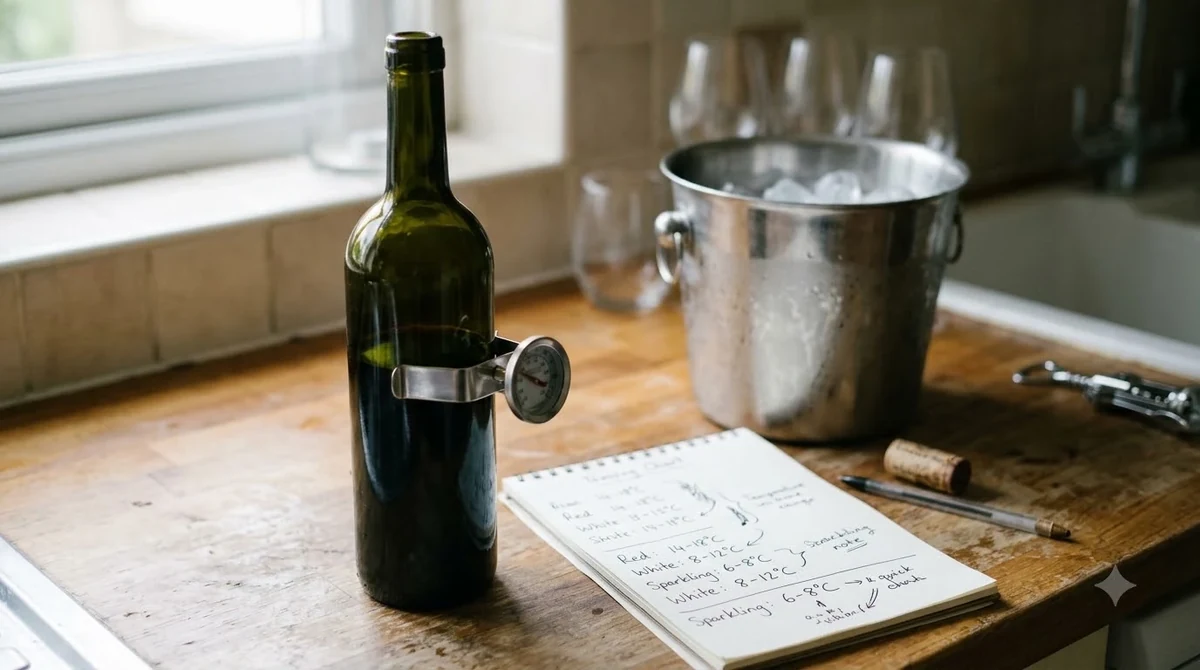
Good storage protects both the wine and the seal. Keep bottles away from strong heat, direct sunlight, and large temperature swings; for longer-term storage, a cool, steady cellar near 55°F is a useful target.
For traditional natural-cork bottles intended for extended storage, keeping them on their sides helps maintain contact between the wine and the cork. That contact can reduce the risk of the exposed end drying and losing resilience. The advice is most relevant to bottles stored for months or years, not a bottle resting in the refrigerator for a few days before dinner.
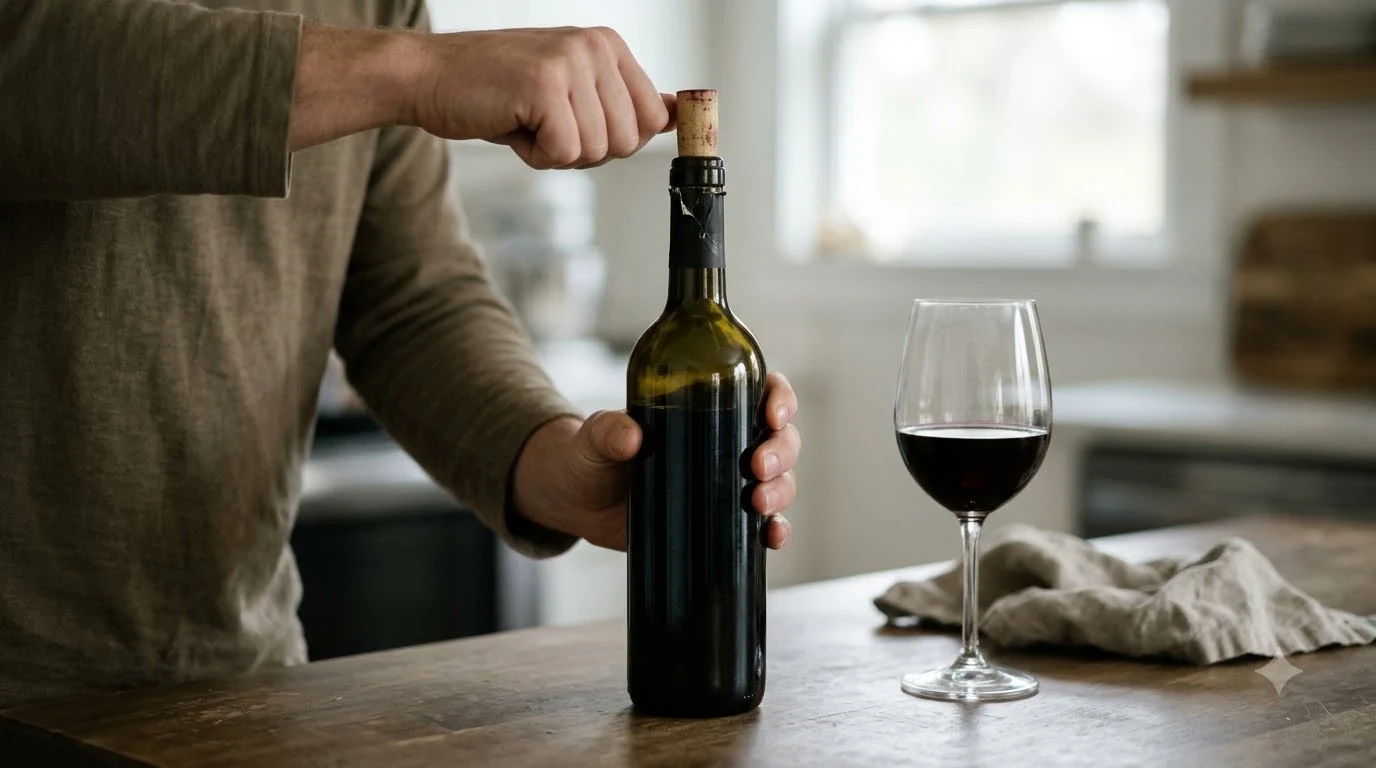
Use a corkscrew that enters near the center of the stopper and draw the cork out steadily. Older corks can be fragile, so a two-pronged opener or a slow extraction may help when the stopper looks brittle. If it breaks, pour through a fine mesh or carefully around the fragments; crumbs are unpleasant but do not automatically mean the wine is spoiled.
After opening, reseal and refrigerate leftover wine. Cold storage slows changes after exposure to air, although it cannot reverse oxidation that has already occurred; a dedicated stopper can reduce further air contact. The article on why are wine bottles green explains how bottle color can also help protect wine from light. Clean, dry used corks can be saved for craft projects, but they are not a reliable replacement for a new stopper because they have already been compressed and may no longer fit. A batch of old corks can find a second use in a project such as how to make a cork board from wine corks.
Frequently Asked Questions
Questions about cork often come down to details that are easy to miss: the cage on sparkling wine, the construction of a Champagne stopper, and the difference between the seal and the hardware around it. These distinctions are useful whether the bottle is from Champagne, another sparkling region, or a still-wine producer using an unusual closure.
Why does a sparkling-wine cork have a mushroom shape?
The cork is compressed to fit inside the neck, while pressure inside the bottle pushes outward against the part above the glass. After removal, the exposed end can expand more freely than the portion that stayed compressed, creating the familiar mushroom shape.
What does the wire cage on a sparkling-wine bottle do?
The wire cage, or muselet, holds the cork in place against bottle pressure; the cork and its fit with the neck create the seal. A metal plaque spreads force across the cork, and Adolphe Jacquesson patented a protective version in 1844.
Are Champagne corks always made from one solid piece?
No. Many Champagne corks are multi-piece constructions, made by gluing two or more pieces of cork together rather than cutting the stopper from one single piece. After removal, these corks expand and generally cannot be pushed back into the neck in their original form.
Can a wine bottle be sold with a crown cap instead of a cork?
Yes. Some pétillant-naturel wines are released under crown caps, and traditional-method sparkling wines may use them during production before the final cork, cage, and foil are fitted. A crown cap is crimped metal, not a screw cap, and it needs a compatible bottle finish.
Is the wine closure the same thing as the bottle’s foil?
No. The foil or capsule covers the top of the bottle and neck; it is not normally the part that seals the wine. On a cork-finished sparkling bottle, the cork seals and the cage retains it, while the capsule covers the assembly.
Wine bottles have corks because cork combines a tight, adaptable seal with a useful history in bottle aging and a renewable source material. But modern closures give winemakers more than one way to protect wine, and no stopper can tell the whole story of what is in the glass. For more practical explanations of wine terms and bottle choices, visit Wine Q&A.
More in Wine Basics
 What Is The Best Wine For Mimosas? Choose Bubbly That Balances Orange JuiceUpdated Nov 20, 2026
 Which Prosecco Is Best for Your Taste and OccasionUpdated Nov 20, 2026
 Which Wine Is Best For Health? Understand the Risks and BenefitsUpdated Nov 20, 2026
 Which Champagne Is Best for Your Taste and OccasionUpdated Nov 20, 2026
 What To Put In A Wine Gift Basket For A Thoughtful, Memorable GiftUpdated Nov 20, 2026
 What Is the Best Wine for Mulled Wine? Choose a Smooth, Fruity RedUpdated Nov 20, 2026