
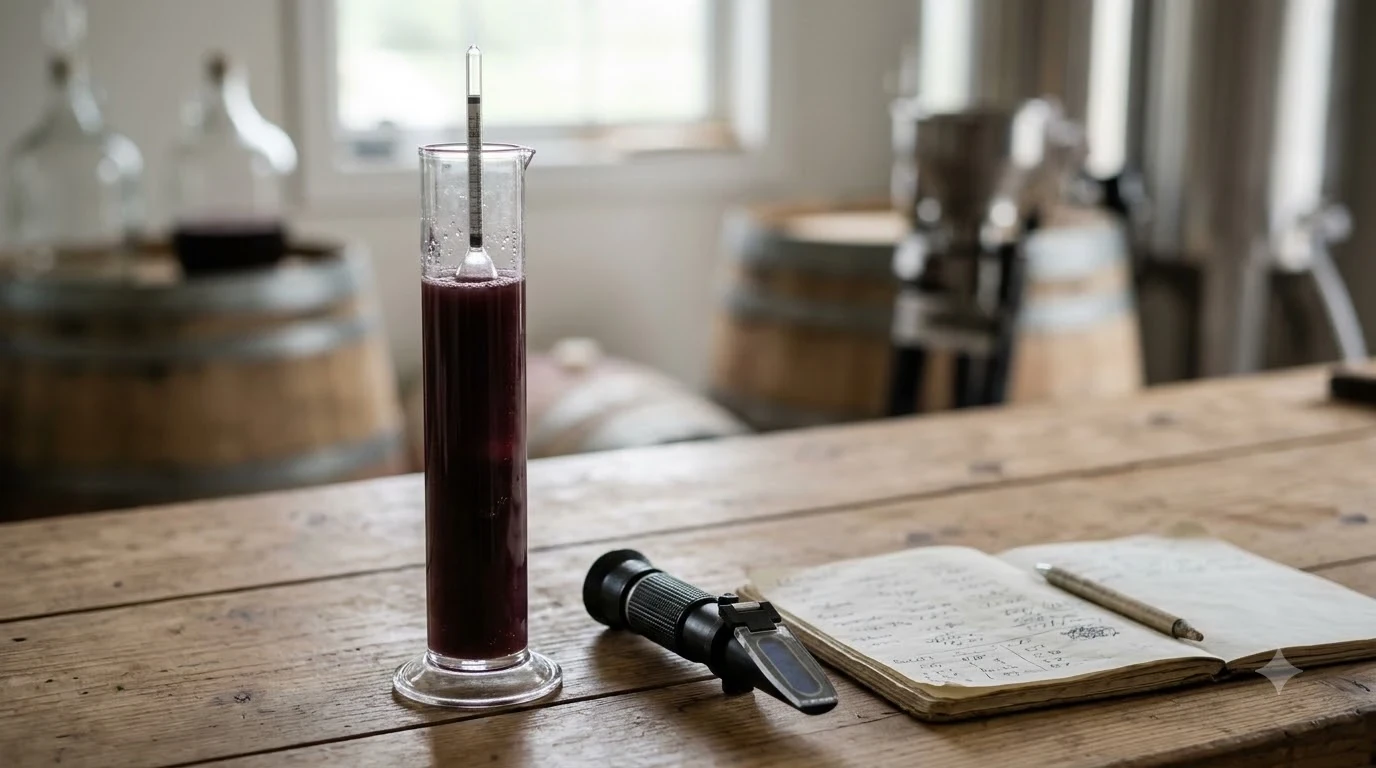

We may earn a commission when you buy through links on this page, at no extra cost to you. Learn more.
Wine harvest dates answer the question of when do grapes get harvested: most Northern Hemisphere picking takes place from August through October, while Southern Hemisphere harvests commonly run from February through April. Those are seasonal guideposts, not fixed appointments, because each variety ripens at a different pace and every growing season brings its own weather. Growers decide when to pick by weighing sugar, acidity, flavor, tannin development, fruit condition, and the style of wine they intend to make. A vineyard may harvest several varieties over a number of weeks rather than bring every grape in on one day.
The harvest date is one of the most consequential choices in winemaking. Pick too early and the fruit may lack ripe flavors or developed tannins; wait too long and sugar can climb while acidity falls, changing the balance and potential alcohol of the finished wine. The calendar gives a useful starting point, but measurements and careful tasting determine the moment.
Harvest Seasons in the Northern and Southern Hemispheres
The usual harvest calendar is shifted by roughly six months between hemispheres, but it remains a broad seasonal guide rather than a fixed schedule. August, September, and October are common harvest months in the north; February, March, and April are common in the south, according to the Orange County Wine Society.
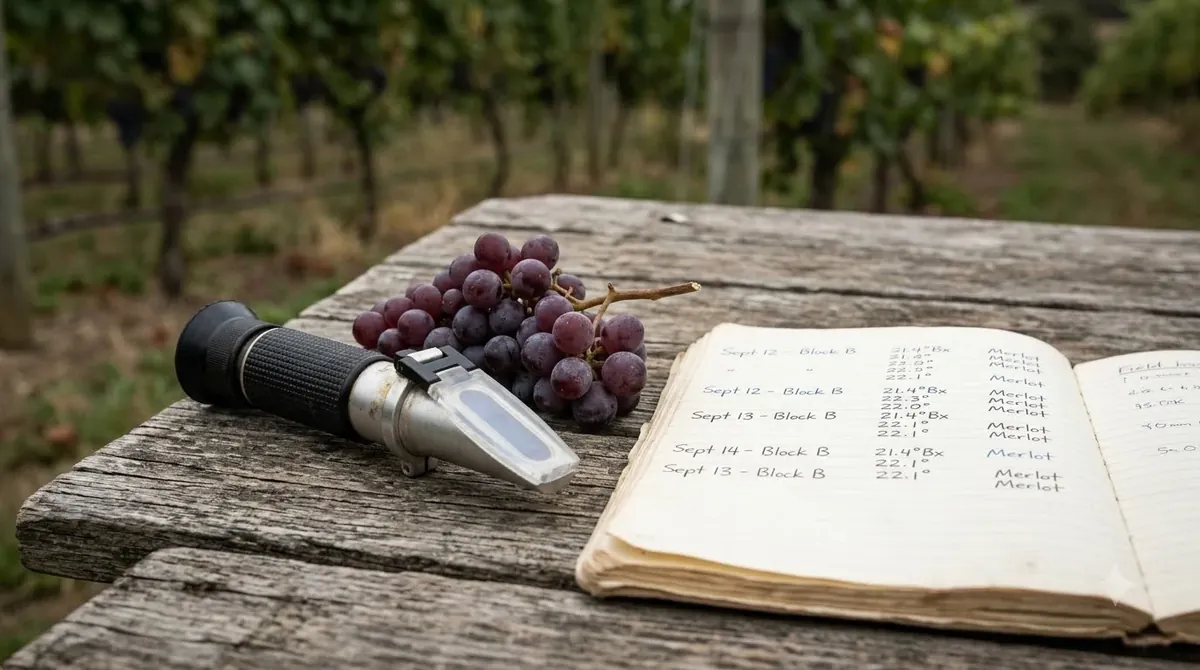
In the Northern Hemisphere, harvest typically gathers pace toward the end of summer and continues through autumn. In California, early-ripening Sauvignon Blanc, Chardonnay, Muscat, and Pinot Noir can come in during late August. Later-ripening Cabernet Sauvignon, Cabernet Franc, Zinfandel, and Syrah may remain on the vine until early November. That range within one state shows why a single month cannot describe every vineyard. A cool coastal site and a warmer inland site can reach maturity at different times, even when they grow the same grape.
Southern Hemisphere seasons follow the opposite calendar. Harvest in countries such as Chile, Argentina, South Africa, Australia, and New Zealand generally falls during the first part of the calendar year, with February through April serving as a practical seasonal window. The date printed on a bottle from a Southern Hemisphere producer therefore refers to fruit picked earlier in that calendar year, rather than the autumn harvest familiar to many North American and European drinkers.
How Climate and Vineyard Location Shift the Date
Climate sets the pace of ripening, and the vineyard’s exact position determines how that climate reaches the grapes. A warm site often reaches harvest readiness before a cool coastal, high-elevation, or north-facing site; in California, that can mean picking an early variety in August while a later variety waits into November.
Temperature affects the accumulation of sugar and the retention of acidity. Warm conditions generally speed ripening and can push sugar upward while acids decline. Cooler conditions can slow sugar accumulation and preserve freshness for longer, although a cold or short growing season may leave grapes with sharp acidity or underdeveloped flavors. The goal is not simply to make the grapes as sweet as possible. It is to reach a useful balance for the intended wine.
Sun exposure, slope, elevation, soil drainage, vine vigor, and crop load also influence the pace. Grapes on a sun-exposed part of a row may develop differently from shaded fruit, and clusters on opposite sides of a canopy do not always receive the same light or heat. Growers therefore assess each variety block, and sometimes separate sections within a block, rather than assuming all the fruit on one property will ripen together.
How Growers Measure Grape Ripeness
Growers combine laboratory-style measurements with berry tasting before they schedule a pick. The main chemical indicators are sugar measured in degrees Brix, titratable acidity (TA), and pH; none of them gives a complete answer on its own.
Brix estimates the sugar concentration in grape juice and helps predict potential alcohol after fermentation. Wine Enthusiast’s explanation of Brix notes that sparkling-wine grapes may be picked around 17–18 degrees Brix, white-wine grapes commonly around 20–24, and red-wine grapes around 22–26, although variety, region, vintage, and house style shift those targets. These are practical reference ranges, not universal pass-or-fail thresholds.
| Intended wine style | Common harvest Brix guide | What the range helps indicate |
|---|---|---|
| Sparkling wine | 17–18 °Bx | Earlier picking and a fresher acid profile |
| White wine | 20–24 °Bx | A balance of ripe fruit and retained acidity |
| Red wine | 22–26 °Bx | More sugar potential alongside developing skin and seed character |
Acidity readings help explain what a Brix number cannot. As grapes ripen, sugar usually rises while acid levels fall and pH tends to rise. The Orange County Wine Society gives typical TA ranges of 7–9 grams per liter for white wines and 6–8 grams per liter for red wines, while noting that targets vary with grape and style. A white wine intended to be crisp may be harvested with higher acidity than a broad, full-bodied style. Sampling must also represent the fruit that will be picked: Rutgers Cooperative Extension recommends collecting at least 100 berries across at least 20 clusters on at least 20 vines, taking berries from the top, middle, and bottom of clusters and alternating between the east and west sides of rows. The Orange County Wine Society describes collecting about 100–200 berries from different parts of a variety block, beginning roughly three to four weeks before expected maturity. Repeating samples gives the grower a trend, not just a single number.
Tip: Compare the latest Brix, TA, and pH readings with the previous sample, then taste berries from several parts of the block. A rising sugar reading does not automatically mean the fruit has reached its best flavor or tannin maturity.
Berry tasting adds information that instruments cannot capture. Growers look for the appearance of recognizable fruit flavors and the fading of harsh, green or vegetal notes. They can also assess seed and skin character: hard, bitter seeds or aggressively astringent skins may suggest that the phenolic components have not reached the texture desired for a red wine. A winemaker may choose to harvest before every indicator reaches an ideal number if the weather or fruit condition makes waiting risky.
What Veraison Reveals About the Coming Harvest
Veraison is the visible onset of ripening, when berries soften and begin changing color; it often signals that harvest is approaching, not that the grapes are ready to pick. Wine Enthusiast reports that the interval from veraison to harvest can be about 45–60 days, depending on variety, vineyard site, canopy, and climate.
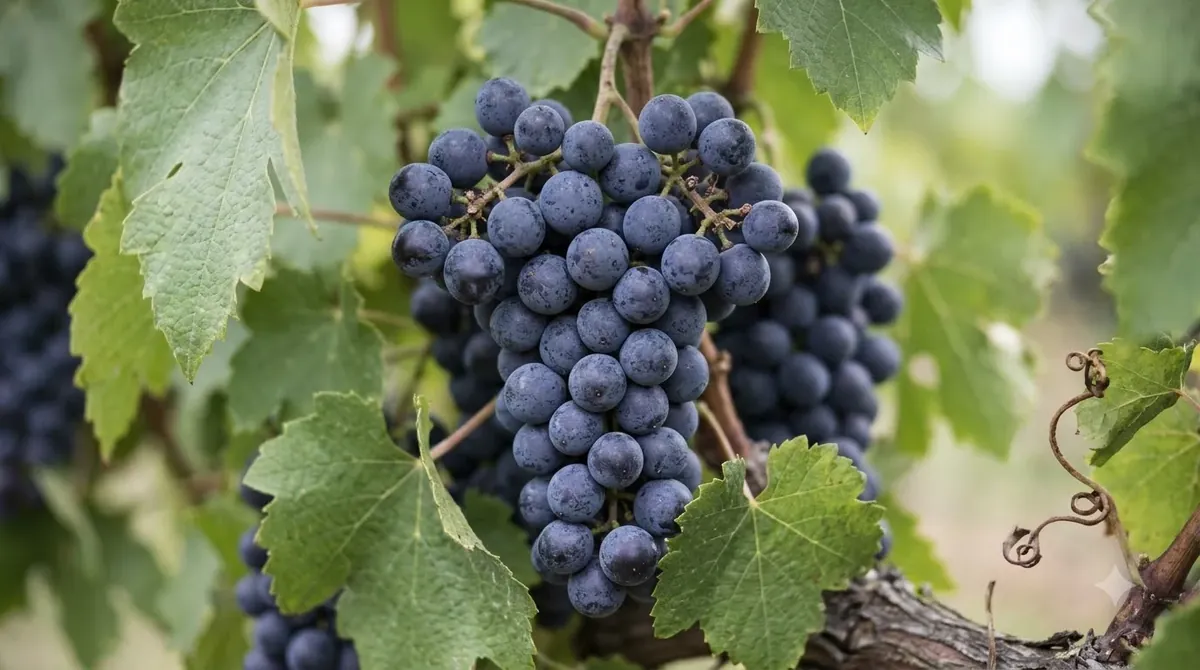
Before veraison, wine grapes are generally small, hard, and green. As ripening begins, white grapes become more translucent, while red grapes shift through pink toward darker purple or blue. The berries soften and swell, sugar accumulates, acidity falls, and aroma and phenolic compounds develop. This visible change gives vineyard teams a useful milestone for intensifying their monitoring, but color alone is not a harvest test.
Veraison timing differs by hemisphere. Wine Enthusiast describes it as generally beginning in July or August in the Northern Hemisphere and in January in the Southern Hemisphere. From there, the wait depends on the grape and growing conditions. Merlot may reach maturity sooner than Cabernet Sauvignon in a comparable setting because Cabernet Sauvignon typically needs more heat accumulation to finish ripening.
Growers use veraison to organize the weeks ahead. They may begin regular berry sampling, review labor and winery capacity, and watch the forecast more closely. If the fruit is still developing flavor and the weather is stable, it may remain on the vine. If ripeness is close and a storm or heat event is approaching, the team may decide that the risk of waiting is greater than the possible benefit.
How Grape Variety and Wine Style Influence Picking
Variety matters because grapes do not all ripen at the same speed or reach their best balance at the same sugar level. Wine style matters just as much: a grower picking for sparkling wine may favor higher acidity and lower sugar, while a red-wine producer may wait for suitable skin and seed maturity as well as the desired sugar level.
In California, the Orange County Wine Society lists Sauvignon Blanc, Chardonnay, Muscat, and Pinot Noir among varieties that may be harvested in late August, while Cabernet Sauvignon, Cabernet Franc, Zinfandel, and Syrah can extend into early November. This is an example of one region’s broad seasonal range, not a universal ranking for every climate. In a cooler location, even an early variety may take longer to ripen; in a hot season, the same variety may be ready sooner.
Winemaking goals can move the date in either direction. Sparkling bases are often picked earlier to preserve acidity and moderate potential alcohol. A still white wine may be held longer for a riper fruit profile, provided the acid balance remains suitable. Red wines require attention to the skins and seeds because those tissues contribute color, texture, and tannin. A target of 24 Brix may suit one red wine, while another producer may consider flavor, acidity, and tannin more important than reaching that exact figure.
Some sweet and late-harvest wines use fruit left on the vine longer so sugars and flavors can concentrate. That is not simply a matter of waiting for maximum sweetness: growers must also watch cluster health and local conditions. Botrytis, or noble rot, is useful for certain styles only under particular conditions; ordinary bunch rot is damaging. For more context on how vineyard decisions affect the glass, the site’s Wine Q&A and wine basics section explains grape varieties and wine styles.
How Weather and Harvest Methods Affect the Picking Window
Even when a vineyard has a target date, weather can change the plan quickly. Heat can accelerate sugar accumulation and reduce acidity, while heavy rain close to harvest can swell berries, encourage splitting, or increase pressure from rot; a prolonged delay may leave ripe clusters exposed to pests and deteriorating fruit. Growers balance the forecast against the crop’s condition: a short wait may help firm, healthy fruit develop flavor, while a storm can make picking before the rain the safer choice. Vineyard teams monitor the forecast alongside Brix, TA, pH, and tasting notes rather than treat weather as a separate issue.
Harvest can take place by hand or machine. Hand picking allows workers to select bunches and remove unsuitable fruit in the vineyard, and it can be useful on steep or irregular terrain; mechanical harvesters can cover large, accessible blocks quickly before weather changes. The choice depends on vineyard layout, labor availability, winery equipment, and the level of sorting needed. Some producers also pick at night or before dawn to keep fruit cool. In its report on night harvesting, Decanter says workers at Tzora Vineyards in the Judean Hills described manual picking from 8 p.m. to about 5 a.m.; the grapes reached the sorting table at 18°C, compared with daytime fruit that could reach 35°C or more. Cooler fruit can help preserve aromatic freshness and provide better control at the start of fermentation.
Once grapes reach the winery, they are sorted, crushed or pressed, and moved into fermentation. The harvest date cannot be reversed after the fruit is picked, which is why growers and winemakers coordinate vineyard sampling, available crews, bins, transport, and cellar space ahead of time. The next stages of winemaking eventually lead to bottling and closure choices, including the reason wine bottles have corks. The picking decision is the beginning of that chain, and the quality of the fruit sets the limits for what follows.
Frequently Asked Questions
These five answers cover practical details that often come up once the harvest calendar and ripeness checks are clear. They focus on how measurements work and what happens as grapes move from the vineyard into the winery.
What does one degree Brix mean?
One degree Brix represents about one gram of sugar per 100 grams of solution. The scale is used as an estimate of soluble sugar in grape juice, so a reading of 23 °Bx gives the winemaker a quick way to compare samples and estimate potential alcohol.
How much potential alcohol can 24 Brix suggest?
A common rule of thumb is to multiply Brix by 0.6, so 24 °Bx suggests about 14.4% potential alcohol. The conversion is approximate: Wine Enthusiast notes that the factor can vary from roughly 0.55 to 0.65 depending on fermentation and other conditions.
Can grapes double in size during veraison?
Yes. As ripening begins, berries soften and take on water and stored sugars, and grape-extension guidance cited by Wine Enthusiast says berries can double in size during veraison. That expansion is one reason vineyard teams watch both berry appearance and juice chemistry instead of relying on color alone.
Why do winemakers keep measuring Brix after picking?
After crushing, Brix readings help the cellar team monitor fermentation as yeast converts grape sugar into alcohol. Wine Enthusiast explains that readings are commonly checked daily and should fall as fermentation progresses, giving the winemaker a way to spot a process that is slowing or stopping.
What does a stalled Brix reading during fermentation indicate?
If Brix does not change for two or three days during an active fermentation, it can signal a problem such as a stuck fermentation. The winemaking team then investigates rather than assuming that the wine has finished fermenting; a dry wine can eventually register below zero on the Brix scale.
For most wine grapes, harvest falls somewhere between late summer and autumn in the north and between late summer and early autumn in the south, but the right date is decided block by block. Sugar, acidity, flavor, tannin development, and the weather all matter, so the best answer is the moment when the fruit fits the wine the grower intends to make.
More in Wine Basics
 Which Rose Is Best for Your Taste, Budget, and Food PairingsUpdated Nov 21, 2026
 Is Cheap Wine Bad? How to Find Bottles Worth DrinkingUpdated Nov 21, 2026
 What To Write On A Wine Gift Tag: Thoughtful Messages For Every OccasionUpdated Nov 21, 2026
 Which Wine Is Best For Weight Loss? Compare Lower-Calorie ChoicesUpdated Nov 21, 2026
 What Is The Best Wine For Mimosas? Choose Bubbly That Balances Orange JuiceUpdated Nov 20, 2026
 Which Prosecco Is Best for Your Taste and OccasionUpdated Nov 20, 2026