


We may earn a commission when you buy through links on this page, at no extra cost to you. Learn more.
For anyone asking what is kisi, it is a native white wine grape from Kakheti in eastern Georgia, used to make both pale, aromatic dry whites and textured amber wines, including qvevri bottlings. Its flavor can suggest pear, citrus, peach, apricot, flowers, and green tea, depending on the winemaking method. Kisi is a grape variety, not a sweetness level or a single fixed wine style.
Kisi offers two useful starting points: a fresh, fruit-forward white made with a European approach, or an amber wine with more grip and savory complexity from extended skin contact. Knowing the style makes it easier to choose a serving temperature and food match.
What Kisi Is and Where It Comes From
Kisi is a native white grape of Kakheti, the wine-producing region in eastern Georgia. It is one of Georgia’s distinctive traditional varieties, alongside better-known grapes such as Rkatsiteli and Mtsvane, and it can be bottled on its own rather than appearing only as a blending grape.
Kakheti lies in the eastern part of Georgia, with vineyards around places such as Telavi, Akhmeta, and Tsinandali. The National Wine Agency of Georgia’s grape profile identifies Kisi as indigenous to Kakheti and notes that older vines survived in the Telavi district even after the variety became rare. That local identity matters: a bottle labeled Kisi points to a Georgian grape with a specific regional history, not to a generic international white variety.
The grape nearly disappeared around the turn of the 21st century. The National Wine Agency attributes the decline to the Soviet-era preference for Rkatsiteli and to the loss of Georgian vineyard land after the Soviet Union collapsed. It reports that some 50- to 60-year-old vines remained in the Telavi district while new plantings were being established. The same agency lists 20 hectares planted in 2004, with 18 hectares in the Akhmeta district; those figures are a historical snapshot, not a current vineyard census.
Kisi ripens before Rkatsiteli, usually in the last two weeks of September, according to the Georgian agency. It buds late and is relatively resistant to frost, drought, and downy mildew, but is susceptible to powdery mildew and black rot.
How Kakheti Shapes the Grape
Kisi’s home is Kakheti, especially the area around Telavi and Akhmeta, where the variety has a long local association. Individual producers also identify vineyards in places such as Maghraani and the Tsinandali micro-viticultural area, giving drinkers a more specific sense of origin than the broad country name alone.

The National Wine Agency places surviving old Kisi vines in the Telavi district and notes that 18 of the 20 hectares it recorded in 2004 were in Akhmeta. A producer description from Askaneli identifies its Kisi vineyards in Maghraani, within Akhmeta municipality, while Corporation Georgian Wine describes a dry Kisi grown in the Tsinandali micro-viticultural area. These examples show that the grape is associated with several parts of Kakheti rather than one single village.
Growing conditions influence the fruit before cellar choices begin. Kisi’s late budding and resistance to frost and drought do not make it immune to disease: powdery mildew and black rot remain concerns. Its typical ripening window is the final half of September.
A producer may emphasize a village, vineyard, or micro-zone, but the main clue is still the grape name. Kisi from Kakheti can be made in either a pale or amber style.
Taste, Aroma, Acidity, and Body
Kisi is aromatic, but its flavor is not identical in every bottle. In a lighter European-style wine, expect a floral nose and fruit notes such as pear, citrus, green apple, apricot, or green tea; in some examples, pineapple, grapefruit peel, and yellow melon also appear.
The National Wine Agency describes European-style Kisi as straw-colored, floral, and marked by pear, citrus, and green tea. Producer examples add useful detail: Askaneli lists green apple, green pear, apricot, and meadow flowers, while Corporation Georgian Wine describes pineapple, grapefruit peel, and yellow melon with a crisp finish. Wine Enthusiast’s review of a 2024 Kisi from Kakheti also highlights juicy stone fruit and citrus. The overlap is a combination of orchard fruit and bright citrus, with the exact emphasis varying by producer and vintage.
Qvevri Kisi often moves toward ripe peach, dried apricot, orange, mango, lime, walnut, and other dried-fruit or nut-like impressions. Skin contact can give the wine a firmer, gently tannic feel than many familiar tank-fermented whites. The Natural Wine Association’s profile of a dry Kisi qvevri wine describes bright acidity, smooth, velvety tannins, and ripe peach, dried apricot, and almond aromas.
Body can range from light to medium, with the more structured amber versions feeling broader because of their skin-derived texture. Kisi should not be treated as automatically sweet: dry examples are common, and producers also make other expressions. A producer’s technical sheet for one 100% Kisi dry white lists 4.0 grams per liter of residual sugar, which illustrates that a dry bottle can retain a small amount of sugar without tasting like a sweet wine.
European-Style White and Traditional Qvevri Amber
The most important style distinction is how the grapes are handled in the cellar. European-style Kisi is generally pale and fruit-led, while qvevri Kisi is often amber, more textured, and marked by dried fruit, spice, and nutty flavors.
In a European-style approach, producers aim to preserve the grape’s fresh fruit and floral character. The resulting wine is usually straw or light lemon in color, with pear, citrus, green apple, and a crisp finish. It can be a good introduction for someone who enjoys aromatic whites but wants to try a Georgian variety beyond familiar Sauvignon Blanc, Pinot Grigio, or Chardonnay.
Traditional Georgian qvevri winemaking uses large clay vessels called qvevri, often buried in the ground. Georgia’s National Wine Agency dates the tradition to about 8,000 years ago and notes that UNESCO recognized the traditional method as Intangible Cultural Heritage in 2013. In Kakheti, the full amount of grape solids is used during fermentation; white wine can remain with skins, seeds, and other solids until spring. The underground vessels maintain a relatively steady 13–15°C during fermentation. This extended contact can give Kisi a deeper amber color and more phenolic structure than a white wine made with little or no skin contact. Its flavor may include dried apricot, peach, orange peel, walnut, tea, and spice, along with a gentle tannic sensation on the finish.
Neither approach is automatically better. Qvevri offers a distinctive encounter with Georgian cellar tradition, while the pale style can show floral and citrus notes with greater clarity. Pour both side by side and compare color, fruit freshness, palate grip, and finish.
Tip: When choosing your first bottle, look for the words “dry white” or “qvevri” on the label or producer description. “Qvevri” is a clue to a more textured, often amber style; it does not mean the wine is sweet.
Serving Temperature and Bottle Details
Serve a fresh, pale Kisi cool enough to keep its citrus and floral notes lively, but not so cold that the aromas disappear. A structured amber Kisi usually benefits from a slightly warmer pour, which helps its dried-fruit and savory notes come forward.
For a lighter European-style white, aim for about 45–50°F. A fuller or skin-contact amber version is often more expressive around 50–55°F. Producer guidance varies: Corporation Georgian Wine recommends 8–10°C, roughly 46–50°F, for its dry Kisi, while the Natural Wine Association lists 10–12°C, roughly 50–54°F, for a qvevri example. These are producer-specific recommendations, not a universal rule for every bottle.
Once opened, keep the bottle in the refrigerator and use a stopper. A still white wine is generally best within 3–5 days after opening, although an amber wine with more structure may hold its character differently from a light, delicate white. Pour a standard 5-ounce serving; a 750-milliliter bottle yields about five glasses.
| Producer example | Grape stated | Alcohol | Other published figures |
|---|---|---|---|
| Askaneli Kisi, dry white | 100% Kisi | 12.5% ABV | 5.7 g/L acidity; 4.0 g/L residual sugar |
| Corporation Georgian Wine Kisi, dry white | Kisi | 12.5% ABV | Recommended serving: 8–10°C (46–50°F) |
Alcohol levels also vary by bottling. Two producer examples provide a useful reference point: Corporation Georgian Wine lists its Kisi at 12.5% alcohol, and Askaneli lists a 100% Kisi dry white at 12.5% ABV. Those figures describe those wines, not a fixed alcohol range for the entire grape variety. If a technical sheet gives acidity or residual-sugar figures, treat them as details for that specific wine rather than universal properties of Kisi.
Food Pairings for Fresh and Amber Kisi
Fresh Kisi works well with dishes that echo its citrus and orchard-fruit notes, while amber qvevri Kisi can stand up to richer foods because of its texture and gentle tannin. Match the intensity of the dish to the style in the glass rather than assuming every wine made from the same grape needs the same menu.
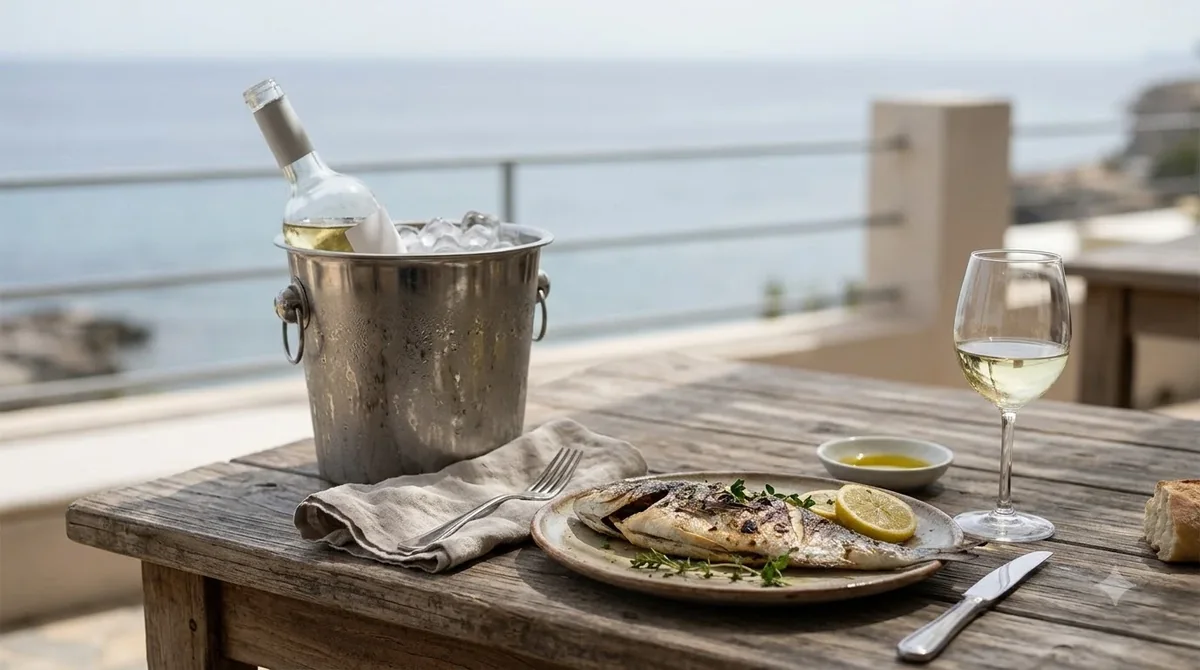
For a pale, crisp Kisi, try grilled white fish, shrimp, lemon-roasted chicken, fresh cheeses, or a salad with herbs and citrus. The wine’s freshness can cut through modest richness, and its fruit notes complement mild seafood without overwhelming it. Corporation Georgian Wine recommends its dry Kisi with seafood and a cheese platter, while Wine Enthusiast suggests a Kisi bottling alongside cheeseboards and salty snacks.
Amber Kisi has a broader range of options. Pair it with roasted poultry, mushrooms, grilled vegetables, pork, walnut sauces, or dishes with browned edges and savory herbs. The extra texture and light tannic grip can work with roasted food and nut-based sauces in a way that a delicate white might not. Dried apricot, peach, and orange notes can also make a natural bridge to dishes seasoned with coriander, cumin, or warm spices.
Be careful with very spicy dishes. Alcohol and tannin can amplify chili heat, so an amber Kisi with noticeable grip may make a hot pepper sauce feel hotter. For a spicy meal, choose a fresher, lower-alcohol example or reduce the chili intensity. For salmon or other oily fish, a pale, crisp Kisi is usually an easier match than a strongly structured amber version.
How Kisi Compares with Other Georgian White Grapes
Kisi shares its home region with Rkatsiteli and Mtsvane, but it has its own balance of aroma and structure. Comparing the three helps clarify what to expect when a wine list or shop shelf offers more than one Georgian white.
Rkatsiteli is more widely planted and often serves as a reference point for Kakheti’s white wines. The National Wine Agency describes its European-style expression with subtle flowers, citrus, quince, and apple, while qvevri versions can develop honey, dried orange peel, spice, apricot, and other stone-fruit notes. Kisi can be more openly aromatic, with green tea and pear in pale styles and a strong apricot, mango, citrus, and walnut profile in amber versions.
Mtsvane Kakhuri, whose name is commonly shortened to Mtsvane, is known for high-toned floral, peach, citrus, and tropical aromas in European-style wines. The National Wine Agency notes that Mtsvane can be blended with Kisi or Rkatsiteli, so the varieties may appear together rather than only as separate single-grape wines. If you enjoy aromatic whites, Mtsvane is a useful comparison; if you want a wine that can show more skin-derived grip, compare Kisi in its qvevri form.
To explore further, read about the kisi grape as a variety, then compare it with the airen grape, a very different white variety often associated with Spain. For a broader look at Georgian white wine styles, the arinto wine page offers another point of comparison with a grape from Portugal, while the site’s guide to Wine by Type helps place these bottles among still whites and other styles.
Frequently Asked Questions
These quick answers cover practical details that can be hard to infer from the grape name alone. They also help distinguish Kisi from other Georgian varieties and from the broader category of amber wine.
Can Kisi be made as a fortified wine?
Yes. The Georgian National Wine Agency notes that Kisi is occasionally made as a fortified wine, in addition to its better-known dry white and amber qvevri expressions. That makes fortification part of the grape’s documented range, even though it is not the style most drinkers are likely to encounter first.
What does chacha mean in qvevri winemaking?
In the Georgian National Wine Agency’s description, chacha refers to the grape husks, skins, and pips that remain in contact with the fermenting wine. The term describes the grape solids in the vessel, rather than the clear finished wine.
Does Kisi have red-wine tannins?
No. Even in amber qvevri form, Kisi remains a white-grape wine, and its tannin is generally gentler than the firm structure found in many red wines. The grip comes from contact with grape skins and other solids, not from the use of a red grape.
What shape is a traditional Georgian qvevri?
The Georgian National Wine Agency describes the modern Georgian qvevri as most commonly egg-shaped. It says this form dates to the third millennium BC, while earlier pottery vessels found in Georgia included smaller forms with flatter bases and broader bodies.
Are all qvevri buried underground?
No. In Kakheti, qvevri are generally buried in the cellar, but the National Wine Agency describes a different practice in western Georgia, where qvevri may be sealed and kept outdoors. The vessel and its placement can therefore reflect the region’s local winemaking tradition.
Kisi is a Georgian white grape with two compelling faces: a fresh, aromatic white and a more textured amber wine shaped by qvevri tradition. Start with the style that suits your palate, serve it at the right temperature, and use the grape’s fruit and structure to guide the food pairing.
More in Wine Types & Grapes
 Zinfandel Sugar Content: Dry Red vs. White Zinfandel GramsUpdated Nov 21, 2026
 Best Zinfandel Substitute Options for Sipping and CookingUpdated Nov 21, 2026
 Zweigelt Food Pairing: Best Dishes, Cheeses, and Serving TipsUpdated Nov 21, 2026
 Zinfandel Tannins Explained: How Structure Shapes Every BottleUpdated Nov 21, 2026
 Zinfandel Sweetness Level: Dry Red vs. Sweet White Zin ExplainedUpdated Nov 21, 2026
 Xinomavro Food Pairing: Best Dishes, Styles, and Serving TipsUpdated Nov 21, 2026