

We may earn a commission when you buy through links on this page, at no extra cost to you. Learn more.
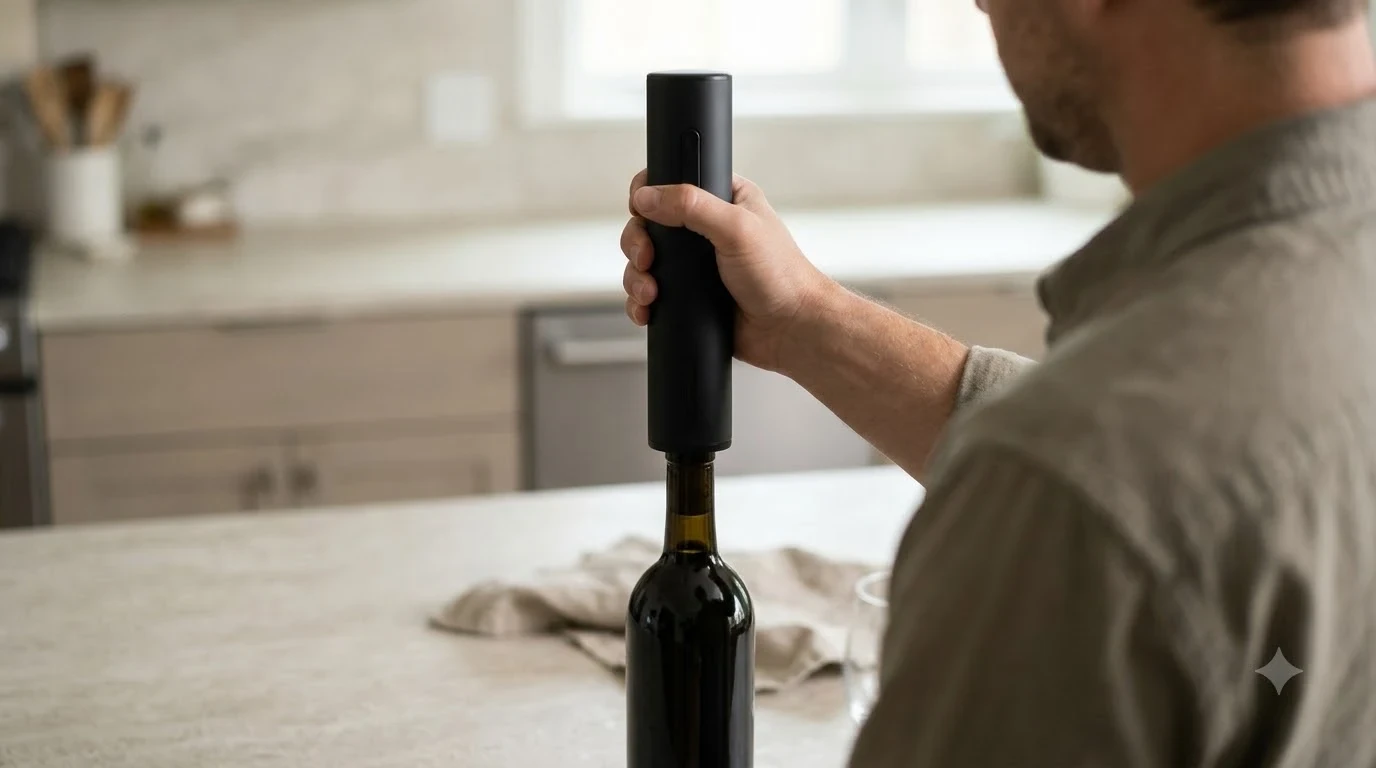
The Waring electric wine opener is a commercial-oriented rechargeable corkscrew designed to simplify repeated bottle opening, with the WWO120 offering stainless steel construction, a removable foil cutter, and a manufacturer-rated capacity of approximately 120 corks per full charge. Its forward-and-reverse motor handles natural and synthetic corks, while the charging base doubles as a storage stand. It makes the most sense for restaurants, catering operations, and frequent wine servers, although its commercial design, countertop footprint, and limited one-year warranty deserve consideration before buying.
An electric wine opener can make a noticeable difference during a busy dinner service, tasting event, or gathering where several bottles need to be opened in succession. Waring approaches this task with equipment-oriented construction rather than the compact, gift-focused styling common among household wine accessories. The WWO120 combines a rechargeable battery, stainless steel body, and replaceable auger in a straightforward two-button design. Understanding its capacity, charging routine, and operating requirements helps determine whether it is a sensible addition to a home bar or professional wine station.
Specs and Key Features
The Waring WWO120 is a rechargeable commercial-style wine opener with a stainless steel housing and a dedicated charging base. Its most notable specification is the manufacturer’s claim of approximately 120 cork removals per full charge, supported by a NiMH battery and a forward-and-reverse motor.
The overall design prioritizes repeated operation. Rather than relying on a manual lever or twisting handle, the WWO120 uses a motorized auger to enter the cork and extract it from the bottle. The upper and lower controls handle the two directions of operation, keeping the basic process uncomplicated for restaurant employees and other frequent users.
Waring includes several practical accessories. The charging base stores the opener between uses and incorporates a removable foil cutter. A replacement auger is also included, which gives owners an additional service component instead of requiring them to replace the entire appliance if the original spiral eventually needs attention.
| Specification | Waring WWO120 |
|---|---|
| Product type | Rechargeable electric wine opener |
| Model | WWO120 |
| Housing material | Stainless steel |
| Battery type | Rechargeable NiMH |
| Rated opening capacity | Approximately 120 corks per full charge |
| Cork compatibility | Natural and synthetic corks |
| Motor operation | Forward and reverse |
| Overall dimensions with base | 5.5 inches wide x 12 inches high x 4 inches deep |
| Electrical connection | 120 volts |
| Initial charging recommendation | At least 10 hours |
| Charging indicator | Flashing green during charging; steady green when full |
| Included accessories | Charging base, foil cutter, replacement auger |
| Warranty | Limited one-year warranty |
These specifications come from Waring’s product information and instruction manual, with additional dimensional details published by WebstaurantStore. The listed dimensions describe the complete assembly with its charging base, not just the handheld opener. The opener itself is narrower, while the base provides the footprint needed to keep it upright and connected for charging.
One important distinction is that 120 corks represents a manufacturer-stated full-charge capacity, not a guarantee that every individual battery will produce exactly that result under every operating condition. Battery condition, charging habits, and the condition of the corks can influence practical performance.
The manufacturer’s Waring WWO120 product specifications identify the main construction materials, included accessories, voltage, capacity, and warranty. Those details make the model easier to evaluate against smaller household electric openers.
What Owners Like
The strongest appeal of the Waring WWO120 is its combination of commercial-oriented construction, rechargeable operation, and straightforward controls. For users opening multiple bottles during a service period, the motorized extraction system can reduce the repetitive twisting associated with manual corkscrews.
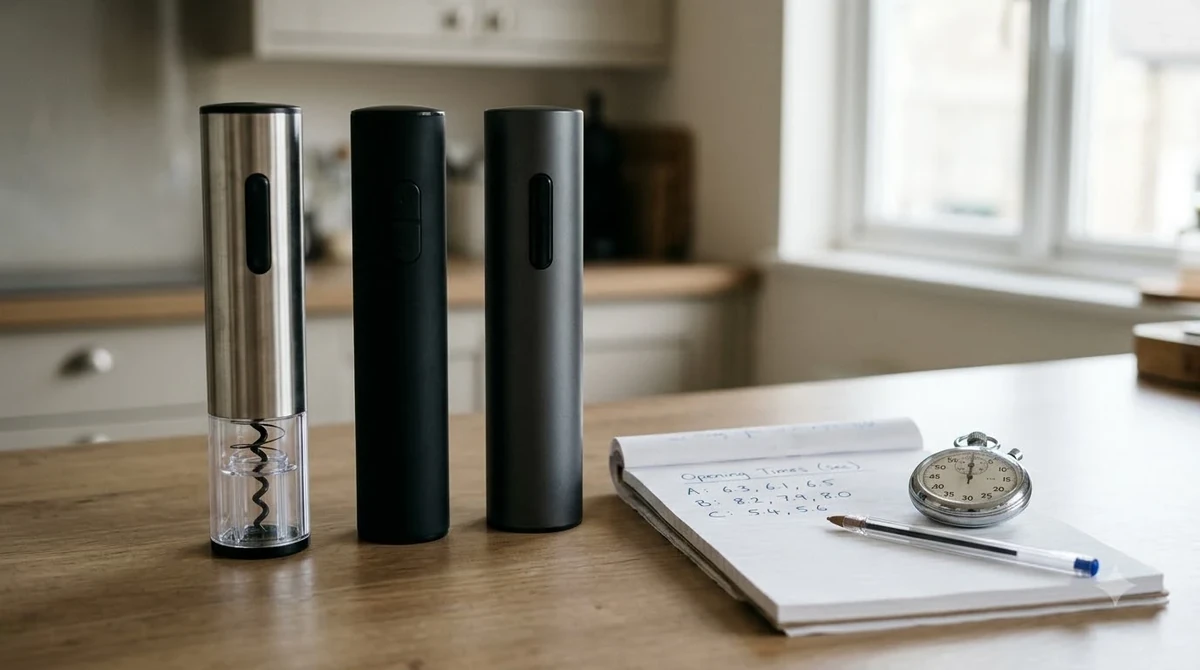
The stainless steel housing gives the opener a professional appearance that fits naturally into a bar, restaurant service area, or dedicated wine station. It also provides a substantial feel compared with lightweight plastic household accessories. The polished finish is consistent with Waring’s equipment-oriented presentation, while the compact base keeps the opener upright when it is not in use.
Another appealing feature is the claimed 120-cork capacity. That figure is particularly relevant to catering teams and hospitality businesses that may open multiple bottles during a single event. Instead of worrying about replacing disposable batteries or keeping several manual corkscrews available, staff can use one rechargeable appliance and return it to its charging base after service.
Convenient two-direction operation
The controls are simple enough for a new user to understand after a brief demonstration. The lower button operates the cork-removal process, while the upper button reverses the auger to release the extracted cork. This separation of functions reduces confusion during repeated use.
The motor also handles both natural and synthetic corks according to Waring. That versatility matters in restaurants and tasting rooms where bottles may use different closure materials. Staff do not need to choose a separate opening mechanism simply because a bottle has a synthetic closure instead of traditional cork.
Useful accessories included
The integrated storage arrangement is another practical advantage. The foil cutter is stored in the charging base, making it easier to keep the preparation accessory alongside the opener. Removing bottle foil before extraction helps expose the cork and gives the auger direct access to the closure.
The replacement auger is a particularly useful inclusion. The auger is the working spiral that enters the cork, so having a spare can extend the usefulness of the appliance if that component becomes worn or damaged. Buyers should still follow Waring’s replacement instructions rather than attempting to dismantle the mechanism without the appropriate guidance.
For businesses already using a dedicated wine service station, this arrangement makes more sense than keeping several unrelated tools scattered around the counter. A range of wine accessory brands can offer different solutions, but the Waring system stands out for its emphasis on repeated operation and replaceable working components.
Positive ownership feedback
Published retailer feedback provides a useful, although limited, picture of ownership. WebstaurantStore’s customer feedback summary highlights ease of use, portability, and rechargeable operation as recurring positive themes. Individual comments also describe the convenience of keeping the opener on its charging base and avoiding disposable batteries.
That feedback is relevant because it addresses everyday ownership rather than specifications alone. A rechargeable opener can be useful only if owners find its controls understandable and its charging arrangement manageable. The reported convenience of the WWO120’s storage base supports its intended use in a permanent wine-service location.
Customer feedback should not be treated as a guarantee of identical performance from every unit. Individual experiences depend on usage frequency, maintenance, battery condition, and the corks being removed. Still, the combination of practical accessories and simple controls gives the WWO120 a clear purpose.
Common Complaints and Limitations
The Waring WWO120 has a few important compromises: it requires advance charging, occupies more counter space than a basic manual corkscrew, and carries a limited one-year warranty. Its commercial positioning may be useful in a restaurant, but it does not automatically make it the right choice for every household.
The first consideration is the charging routine. The instruction manual recommends an initial charge of at least 10 hours and describes approximately 8 to 10 hours for the first charging process. That is a substantial waiting period compared with a manual corkscrew, which is ready whenever it is needed.
For a restaurant that keeps the opener on its base between service periods, this may be manageable. A household that opens a bottle occasionally might find the charging arrangement less convenient, particularly if the appliance has been left unused and its battery needs attention before a dinner gathering.
Countertop space and electrical access
The WWO120 is not a particularly discreet accessory. Its 12-inch height and dedicated charging base require a permanent or semi-permanent storage location. The base also needs access to an electrical outlet, so it is less convenient for someone who wants to keep every wine accessory inside a small kitchen drawer.
Its stainless steel construction and charging equipment contribute to a more substantial setup than a simple hand-operated corkscrew. This is not necessarily a defect, but buyers should consider the available space around their wine station before purchasing.
Battery and replacement considerations
The rechargeable NiMH battery is convenient because it avoids frequent disposable battery changes. However, rechargeable components still depend on their condition, charging connections, and proper handling. An appliance that is stored without attention to its charging routine may not be ready when a busy service begins.
Waring’s manual says the battery should last the lifetime of the opener when charging instructions are followed. It also provides replacement instructions for situations where the battery no longer charges correctly. The battery should not be removed casually or disassembled, and replacement should follow the manufacturer’s guidance.
Replacement battery availability is another point to investigate before purchasing. WebstaurantStore identifies the CAC115 battery pack as a compatible accessory. This is useful information for commercial buyers who want to understand whether a rechargeable component can be serviced rather than automatically replacing the complete appliance.
Operating technique matters
The opener needs to remain upright over the bottle during cork extraction. Waring warns that holding it at an angle can prevent proper removal. This requirement is easy to understand, but it means users should not treat the appliance as a mechanism that can be pushed onto a bottle from any position.
The manual also warns against forcing the opener or trying to accelerate its mechanism. Users should allow the motor to operate at its intended speed and keep their hands away from the moving auger. These instructions are particularly important in commercial environments where several employees may share the same appliance.
The warranty is relatively short
Waring lists a limited one-year warranty. That is an important purchasing consideration for equipment expected to see repeated use in hospitality environments. Businesses should retain their purchase documentation and understand the warranty conditions before relying on the opener for daily service.
Buyers looking for long-term coverage beyond the manufacturer’s stated warranty should investigate available service arrangements and replacement-part availability before committing. The included replacement auger is helpful, but it does not replace a comprehensive warranty for every possible electrical or mechanical failure.
Who Should Buy and Who Should Skip
The Waring WWO120 is best suited to frequent wine service, especially when staff open several bottles during a shift or event. Home users who regularly host large dinners may also appreciate the reduced manual effort, but occasional wine drinkers have fewer reasons to choose this commercial-style design.
Restaurants, wine bars, catering operations, banquet facilities, and hospitality businesses are the clearest potential buyers. These environments can benefit from a rechargeable opener that stays in one location and is available throughout service. The manufacturer’s claimed 120-cork capacity is particularly relevant when multiple bottles need to be opened in succession.
A wine bar might use the WWO120 for routine table service, while a catering team could keep it at a beverage station during an event. The stainless steel exterior and storage base also make it a practical option for a dedicated back-bar workspace where appearance and organization matter.
When it makes sense for home use
Frequent entertainers may find the WWO120 worthwhile. Consider a household that hosts regular dinners with several bottles of Cabernet Sauvignon, Pinot Noir, Chardonnay, or other still wines. An electric opener can make the process of opening multiple bottles easier, especially when the host prefers to spend less time handling corkscrews.
However, the WWO120 is designed around traditional cork extraction. It should not be treated as a universal solution for every wine closure. Sparkling wine bottles, for example, have their own closure and pressure considerations and should be opened using the appropriate bottle-opening procedure rather than an electric corkscrew.
Home buyers who already have a reliable manual corkscrew may not notice enough practical benefit to justify adding a relatively large charging station. The value depends more on how frequently the appliance will be used than on the number printed in its capacity specification.
Who should skip it
Occasional wine drinkers, travelers, and people with limited kitchen storage may prefer a smaller alternative. A basic manual corkscrew requires no charging station and can remain in a drawer until needed. It also avoids battery-related maintenance and electrical access requirements.
People who regularly carry wine accessories to picnics or outdoor events may also find the WWO120 less convenient than a compact manual tool. Although the opener is portable in the sense that it can be moved between locations, its charging base and power requirements make it better suited to an established service station.
Buyers who require a long warranty should also compare other equipment options before purchasing. The limited one-year coverage may be less attractive to businesses that want extended protection for frequently used equipment.
Tip: Before relying on the WWO120 for an event, complete the recommended initial charging process, confirm the green indicator becomes steady, and practice the upright bottle position with a regular corked bottle. A short familiarization session can help prevent avoidable operating problems during busy service.
How It Compares to Alternatives
The Waring WWO120 occupies a different position from a basic manual corkscrew because it combines motorized extraction with a rechargeable battery and dedicated storage base. Its closest practical comparison is not necessarily another specific electric model, but the broader choice between manual and powered wine-opening equipment.
A manual corkscrew is smaller, less complicated, and independent of electricity. It can be a sensible choice for occasional home use, while the Waring offers a more convenient approach when repeated opening is part of the daily routine.
Waring electric opener versus manual corkscrew
A manual corkscrew depends on the user to position the spiral, turn it into the cork, and extract the closure. Different designs use different mechanical advantages, but all require some degree of physical operation. The Waring replaces much of that repeated twisting with a motor-driven auger.
The difference becomes more noticeable when opening multiple bottles. A restaurant employee serving a large group may prefer an electric opener to repeating the same manual motion throughout the evening. At home, someone opening one bottle with dinner may find a traditional corkscrew perfectly adequate.
The manual option also wins on storage and readiness. It does not require an 8-to-10-hour initial charging process, a dedicated charging base, or battery replacement considerations. The Waring, on the other hand, provides the convenience of powered extraction and a dedicated location for its foil cutter.
Waring versus compact electric openers
Compact household electric openers generally appeal to buyers who want a smaller accessory for occasional use. The WWO120 instead emphasizes commercial-oriented features, including its stainless steel housing, rechargeable NiMH battery, replaceable auger, and claimed 120-cork capacity.
That does not mean every commercial specification translates into a better home experience. A compact opener may be easier to store in a kitchen cabinet, while the Waring’s dedicated base and taller housing require more room. The right choice depends on usage frequency, available storage, and the importance of a commercial-style construction.
Buyers comparing broader wine-service equipment may also want to consider temperature-control accessories. An electric wine chiller addresses serving temperature rather than cork extraction, so it solves a different problem. Likewise, a comparison of the best electric wine chiller options is useful when the priority is keeping wine ready to serve rather than opening bottles.
What matters more than the headline capacity?
It is tempting to choose an electric opener primarily because of the number of corks it claims to remove on one charge. However, buyers should consider the whole ownership experience. Charging access, the quality of the operating instructions, replacement-part availability, warranty coverage, and the physical size of the charging base all affect everyday usefulness.
The WWO120 has a convincing feature combination for repeated service, but a smaller opener may be sufficient for a home that opens only a few bottles each month. The commercial-style specification is most valuable when the appliance is used often enough to justify its dedicated storage and charging requirements.
Another useful distinction is whether the buyer needs portability or merely cordless operation. The Waring operates from its rechargeable battery during cork removal, but it still depends on a charging base and electrical outlet to maintain readiness. Someone looking for a compact travel accessory may prefer a wine bottle opener keychain instead. That option serves a different purpose and is easier to carry without planning around battery charge.
Frequently Asked Questions
Is the Waring WWO120 suitable for restaurant service?
Yes, Waring positions this model for catering events, banquets, restaurant wait staff, and bar operations. Its commercial-oriented design is intended for repeated cork extraction, although individual businesses should establish cleaning and charging procedures appropriate to their service environment.
Can the Waring WWO120 open bottles with damaged corks?
The manufacturer specifies compatibility with natural and synthetic corks but does not promise successful extraction of every damaged or deteriorated closure. Very fragile natural corks may crumble during removal regardless of the opener used. A suitable manual corkscrew or specialized extraction tool may be preferable when a cork is already breaking apart.
Can the Waring electric opener remain plugged in all the time?
Waring recommends keeping the opener on its charging base when it is not in use to maintain a full charge. The base should be positioned in a dry, stable location, and users should follow the supplied adapter and charging instructions rather than substituting an unrelated power supply.
Does the WWO120 work with screw-cap wine bottles?
No electric corkscrew is necessary for a conventional screw-cap closure because there is no cork to extract. The WWO120 is designed around an auger mechanism that enters corks. A screw-cap bottle should be opened using its intended twist-off closure rather than the motorized mechanism.
Can the Waring opener be cleaned in a dishwasher?
No. The manufacturer’s instructions prohibit immersing the housing, charging base, battery, or power adapter in water and do not recommend dishwasher cleaning. The exterior housing should be wiped with a clean, damp cloth after the appliance has been disconnected from its electrical supply.
The Waring WWO120 is a specialized electric wine opener with a useful feature set for frequent bottle service. Its stainless steel construction, rechargeable NiMH battery, replacement auger, and claimed 120-cork capacity make it particularly appealing to hospitality businesses and serious entertainers. For occasional home use, a smaller electric model or manual corkscrew may be more practical, but buyers who regularly open multiple bottles will find the Waring’s commercial-oriented design worth considering.
More in Wine Accessories
 Coravin Vs Vacu Vin: Choose the Right Wine Saver for Your BottlesUpdated Nov 21, 2026
 Zwilling Wine Stopper Review: Preserve Open Bottles LongerUpdated Nov 21, 2026
 Wine Enthusiast Wine Preserver Review: Features, Benefits and LimitationsUpdated Nov 21, 2026
 Wine Enthusiast Wine Stopper: An Easier Way to Reseal Open BottlesUpdated Nov 21, 2026
 Vintorio Wine Opener: Two-Step Cork RemovalUpdated Nov 21, 2026
 Zwilling Wine Aerator Review: Aerate, Pour, and Seal With One ToolUpdated Nov 21, 2026