


We may earn a commission when you buy through links on this page, at no extra cost to you. Learn more.
A nutrichef wine cooler is a practical choice for home wine storage if you want a compact, compressor-cooled refrigerator with adjustable temperatures and several bottle-capacity options. NutriChef offers single-zone and dual-zone models, with documented capacities ranging from 12 to 34 bottles in its product families. Its strongest selling points are accessible controls, glass-door designs, and space-conscious cabinets, although buyers should compare individual dimensions, ventilation requirements, and warranty terms before choosing a model.
NutriChef wine refrigerators appeal to homeowners who want a dedicated place for wine without installing a full-size cellar. The range includes small freestanding cabinets for a modest collection and larger configurations that can separate different wine styles into individual temperature zones. Understanding the model numbers is particularly important because similar-looking NutriChef wine fridges can have different capacities, layouts, and controls. This brand overview explains the product families, their practical differences, and what to check before purchasing.
Brand Overview: Is NutriChef a Good Brand?
NutriChef is a recognizable name in home kitchen appliances and beverage equipment, with wine coolers designed primarily for convenient residential storage. Its wine refrigerator range emphasizes freestanding installation, compressor cooling, adjustable temperature settings, and glass-door presentation rather than elaborate cellar-management features.
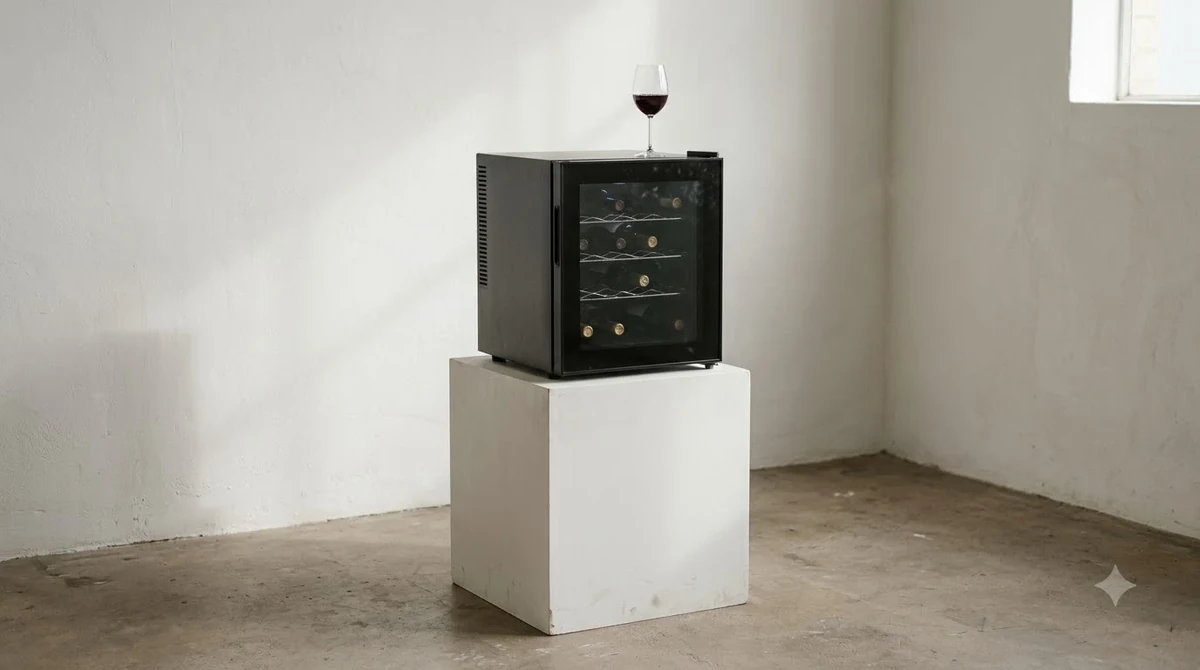
The available specifications make NutriChef an interesting option for people with limited floor space. For example, the PKCWC120 is a 12-bottle compressor wine cooler measuring just 9.9 inches wide, 17.7 inches deep, and 31.2 inches high. That narrow footprint can be useful in an apartment, dining area, or home bar where a conventional refrigerator would take up too much room.
The brand also offers larger cabinets and dual-zone configurations. Its documented model families include 18-, 24-, 27-, 28-, 33-, and 34-bottle options, depending on the series. This variety gives buyers more flexibility than a brand that only sells small countertop wine refrigerators.
However, a brand name alone does not establish how well a particular refrigerator will perform over several years. Compressor quality, ventilation, temperature stability, door sealing, and customer support are important considerations. The available manufacturer documentation provides useful installation and troubleshooting instructions, but buyers should evaluate the exact model rather than assume every NutriChef wine cooler shares identical specifications.
Customer feedback provides another useful perspective. Wayfair’s review summary for its 15-bottle NutriChef model identifies compact sizing, quiet operation, effective cooling, and appearance as recurring positive themes. These are encouraging indicators for everyday residential use, although individual experiences can differ and a review summary cannot establish long-term reliability.
NutriChef is therefore worth considering if your priorities are compact dimensions, straightforward controls, and a choice of single-zone or dual-zone storage. It may be less suitable if you require a professionally specified wine cellar, extensive service documentation for every model, or specialized installation features.
For shoppers comparing appliance manufacturers, our guides to whether Black and Decker is a good brand and whether Galanz is a good brand provide additional brand-level context.
Product Lines Explained: NutriChef Wine Fridge Options
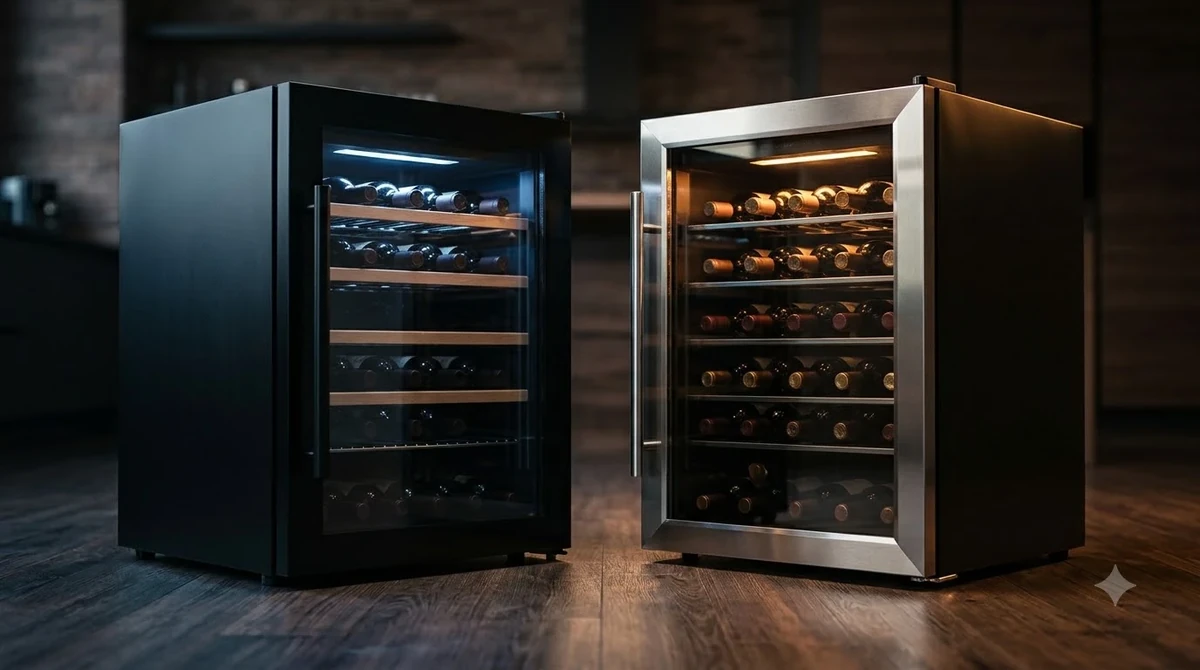
NutriChef’s documented wine refrigerator range includes classic glass-door models, stainless-steel-door models, and dual-zone refrigerators. These categories are more useful than relying on appearance alone because they help identify the intended capacity and storage arrangement.
The classic glass-door series includes smaller cabinets such as the PKCWC120, PKCWC150, and PKCWC180. The stainless-steel-door series includes comparable smaller models alongside larger capacities. Dual-zone products have separate temperature-controlled storage areas intended for households that keep different wine styles together.
| Product family | Example models | Documented capacity | Primary purpose |
|---|---|---|---|
| Classic glass door | PKCWC120 | 12 bottles | Compact single-zone storage |
| Classic glass door | PKCWC150 | 15 bottles | Small household collections |
| Classic glass door | PKCWC180 | 18 bottles | Medium-sized collections |
| Classic glass door | PKCWC340 | 34 bottles | Larger single-zone collections |
| Stainless-steel door | PKCWC12 | 12 bottles | Compact alternative finish |
| Stainless-steel door | PKCWC280 | 28 bottles | Higher-capacity storage |
| Dual-zone | PKCWCDS188 | 18 bottles | Two-temperature storage |
| Dual-zone | PKCWCDS275 | 27 bottles | Separate upper and lower zones |
| Dual-zone | PKCWCDS335 | 33 bottles | Higher-capacity dual-zone storage |
The capacities in this table come from NutriChef’s published PKCWC series manual. They describe the listed model families, not a guarantee that every bottle shape will fit in every rack position. Oversized sparkling wine bottles, wider Burgundy bottles, and unusual bottle shapes can reduce practical storage capacity.
One important distinction is that the model number does not always communicate the entire product configuration. A PKCWC model and a PKCWCDS model can have different storage arrangements even when their stated capacities are similar. Buyers should therefore confirm the exact model suffix, dimensions, and zone arrangement before ordering.
The official NutriChef PKCWC120 product specifications provide a useful example of how detailed a product listing can be. They identify the compressor system, bottle capacity, temperature range, included racks, power requirements, and exterior dimensions.
It is also important to distinguish a current product listing from an older model number appearing in a manual. Manuals can cover multiple product generations and configurations. A model appearing in the documentation does not automatically mean it is currently available through every retailer.
Single-zone models
A single-zone wine cooler uses one main temperature setting throughout the storage compartment. This makes it a straightforward choice for people who primarily collect one type of wine or prefer to store their bottles at a consistent cellar temperature.
Smaller models such as the PKCWC120 and PKCWC150 are suitable starting points for a household that wants a dedicated wine refrigerator without reserving a large area for storage. Larger single-zone cabinets make more sense when the collection is growing but there is little need to keep different wine categories at separate temperatures.
Dual-zone models
A NutriChef dual zone wine cooler provides two temperature-controlled areas. This arrangement can be convenient for households that regularly keep both reds and whites available for serving.
Models such as the PKCWCDS188 and PKCWCDS275 appear in the documented dual-zone family. The manual identifies separate upper and lower temperature ranges for several of these models. However, the exact available range differs by model, so buyers should not assume every dual-zone cabinet has identical controls.
For example, the documented PKCWCDS335 uses an upper-zone range of 54°F to 64°F and a lower-zone range of 41°F to 67°F in the manual’s listed specifications. That is a model-specific configuration rather than a universal NutriChef dual-zone specification.
What NutriChef Wine Coolers Do Well
NutriChef’s strongest advantages are its range of compact cabinet sizes, accessible temperature controls, and availability of both single-zone and dual-zone configurations. These features address common household storage needs without requiring a dedicated wine cellar.
The PKCWC120 illustrates the brand’s approach particularly well. Its compressor cooling system is paired with a digital soft-touch panel, adjustable temperature settings, an interior LED light, and a glass door. The manufacturer also lists selectable Fahrenheit and Celsius displays, which makes temperature adjustment easier for households using either measurement system.
Its stated temperature range is 41°F to 64°F, or 5°C to 18°C. This range accommodates several common wine-storage and serving preferences, although the best setting depends on the wine being stored and whether the refrigerator is intended for long-term storage or short-term chilling.
Another positive feature is the use of a circulation fan and ventilation grill. Compressor refrigerators need to release heat generated by the cooling system, so ventilation is not merely a cosmetic consideration. Proper clearance helps the appliance operate within its intended conditions.
The PKCWC120 also includes five chrome wine racks and a bottom standing rack. The lower section offers an alternative arrangement for a bottle that does not fit conveniently into a conventional horizontal rack position. This is useful when the collection includes a mixture of standard bottles and occasional larger formats.
NutriChef’s documented range is another advantage. A buyer who initially needs a 12-bottle refrigerator may later decide that a larger cabinet or a dual-zone configuration is more appropriate. Having several capacity categories makes it easier to compare different storage approaches within the same brand.
Convenient controls and everyday operation
Digital temperature controls are a practical feature for home use. On the covered PKCWC models, the manufacturer describes temperature adjustment in increments of 1°F or 1°C. The control panel also provides a way to switch between temperature units and operate the interior lighting.
The manual explains that the control panel locks automatically after 20 seconds without button activity on the specified PKCWC12, PKCWC120, PKCWC15, and PKCWC150 models. This helps prevent accidental changes after the temperature has been selected.
The lighting arrangement is useful when checking the collection without relying entirely on outside room lighting. However, interior illumination should not be confused with a dedicated wine-preservation system. The more important considerations remain stable temperatures, suitable storage conditions, and proper door sealing.
Compact dimensions for smaller homes
Many households do not have room for a large beverage refrigerator. A narrow wine cooler can fit into a dining room, kitchen corner, or home bar more easily than a wider appliance.
The PKCWC120 measures 9.9 inches wide, while the separately listed 15-bottle NutriChef model at Wayfair measures 13.6 inches wide. That difference matters when planning an installation area. Even a few inches can determine whether a cabinet fits between existing furniture or kitchen equipment.
Wayfair’s customer-review summary for the 15-bottle refrigerator also identifies compact dimensions and quiet operation as positive themes. Buyers who prioritize a smaller footprint may find those characteristics particularly attractive.
Tip: Measure the entire installation area, including rear and side ventilation clearance, before selecting a NutriChef wine fridge. A cabinet that fits the available opening but cannot release heat properly is not a suitable installation.
Common Complaints and Limitations
NutriChef wine coolers offer practical household features, but there are limitations worth considering before purchasing. The most important are the differences between advertised and practical bottle capacity, the need for adequate ventilation, and the possibility of temperature fluctuations in unsuitable environments.
First, advertised bottle counts are based on standard bottle dimensions. A refrigerator listed for 12 bottles may not accommodate 12 unusually wide bottles in the same arrangement. Burgundy bottles, Champagne bottles, and other larger formats can take up more space than standard Bordeaux-style bottles.
This issue is not unique to NutriChef. It is a common limitation of wine refrigerators with fixed or closely spaced racks. Buyers with collections containing many large-format bottles should prioritize interior dimensions and shelf flexibility over the headline bottle count.
Second, compressor cooling requires attention to the surrounding environment. NutriChef’s manual recommends an ambient operating temperature of approximately 60°F to 80°F for the covered models. It also explains that unusually hot or cold surroundings can affect performance and cause interior temperatures to fluctuate.
Third, the manufacturer specifies meaningful ventilation requirements. For the models covered in the manual, it recommends approximately six inches of rear clearance and ten inches on both sides. That is a substantial amount of space for a compact appliance, especially when compared with furniture designed to sit close against a wall.
Another consideration is that some NutriChef product specifications are available across multiple manuals rather than through one simple model-by-model comparison chart. A buyer researching a dual-zone model may encounter documentation that covers several versions together. This makes it particularly important to match the manual to the exact product number.
What customer feedback suggests
Available customer feedback for the NutriChef 15-bottle single-zone refrigerator is generally positive about size, cooling, appearance, and operating noise. Wayfair’s published review summary identifies these themes, suggesting that the product appeals to people looking for a compact home appliance rather than a commercial wine-storage installation.
However, positive feedback about everyday convenience does not establish that every unit will have the same performance. Buyers should also look for comments about temperature consistency, door alignment, delivery damage, noise over time, and the retailer’s handling of warranty claims.
It is useful to separate a complaint about a specific installation from a product defect. A refrigerator installed too close to a wall, positioned on an uneven floor, or placed near a heat-generating appliance may struggle even if its cooling system is functioning correctly.
Capacity is not the same as collection flexibility
A 24-bottle refrigerator is not necessarily more useful than an 18-bottle model for every household. If the larger cabinet takes up too much space or has racks that do not accommodate the bottles you regularly purchase, its extra advertised capacity may not provide much practical value.
Likewise, a dual-zone cabinet is not automatically the better purchase. It offers more flexibility for storing different wine styles, but a single-zone refrigerator may be simpler and more appropriate for someone who primarily collects reds or keeps bottles at one consistent temperature.
For a broader comparison of appliance manufacturers and product categories, the wine and appliance brand hubs offer another starting point when narrowing down alternatives.
How to Choose a NutriChef Wine Cooler Model
The right NutriChef refrigerator depends on how many bottles you own, the types of wine you keep, and the amount of space available. Begin with the collection itself rather than choosing a model simply because it has the largest advertised capacity.
1. Calculate your realistic bottle requirement
Count the bottles you currently store and consider how much the collection is likely to grow. A 12-bottle refrigerator may be sufficient for occasional wine drinkers, while an 18- or 24-bottle cabinet provides more room for a regular household collection.
If you expect to keep sparkling wines or larger Burgundy-style bottles, allow additional space. A collection of 12 standard Bordeaux bottles is easier to accommodate than a mixed collection containing Champagne, Pinot Noir, and unusually shaped bottles.
It is generally sensible to leave some unused capacity rather than filling every available rack position immediately. This makes it easier to reorganize the collection and retrieve bottles without disturbing neighboring ones.
2. Decide whether you need one temperature zone or two
A single-zone refrigerator is suitable when most bottles can be stored at one common temperature. It is usually the simpler choice for people who collect mostly one wine category or use their refrigerator for general storage rather than separate serving temperatures.
A dual-zone model is more appropriate if you regularly keep both reds and whites available. For example, a household that serves Cabernet Sauvignon and Sauvignon Blanc throughout the week may appreciate having separate compartments.
Remember that dual-zone temperature ranges vary by model. Consult the documentation for the exact model number instead of assuming that the upper compartment is always colder or that both zones have identical adjustment limits.
3. Check the dimensions and ventilation space
Measure width, depth, and height at the actual installation location. Also consider how far the door extends when open and whether there is enough space to remove bottles comfortably.
The PKCWC120 measures 9.9 inches wide, 17.7 inches deep, and 31.2 inches high. Those dimensions describe the appliance itself, not the full installation footprint. Its manual recommends six inches behind the unit and ten inches on either side.
Do not assume that a freestanding refrigerator can be placed inside a closed cabinet simply because its exterior dimensions fit. NutriChef’s instructions specifically caution against installing the cooler in an enclosed cabinet without proper ventilation.
4. Match the temperature range to your wine
For general wine storage, a moderate, stable temperature is more important than constantly changing settings to match individual bottles. A single-zone refrigerator with a range of 41°F to 64°F can accommodate a broad variety of wine preferences.
For serving, the ideal temperature depends on the wine style. Sparkling wine is generally served around 40°F to 50°F, light whites and rosé around 45°F to 50°F, and full-bodied whites around 50°F to 55°F. Light reds are commonly served around 55°F to 60°F, while fuller reds are generally served around 60°F to 65°F.
A wine cooler is therefore useful for both storage and preparation, but it should not be assumed that every bottle must be kept at its serving temperature throughout storage.
5. Review the exact specifications and included accessories
Check the model’s rack count, bottle capacity, power supply, door arrangement, dimensions, and temperature controls. The PKCWC120, for example, includes five chrome racks and a bottom standing rack, whereas other models may use different internal arrangements.
Also consider whether the door finish suits your kitchen or home bar. The NutriChef range includes classic glass-door and stainless-steel-door configurations. The appearance may be important when the refrigerator is placed in a visible entertaining area, but it should not take priority over cooling performance and installation requirements.
Finally, confirm the return policy and warranty coverage offered by the actual retailer. A manufacturer’s product page, a retailer listing, and a third-party review page may describe different purchasing conditions.
Warranty, Manual, Installation, and Support
Documentation is an important part of owning a NutriChef wine refrigerator because the correct installation and troubleshooting procedures can prevent avoidable operating problems. The brand’s PKCWC manual covers safety, temperature controls, installation, ventilation, cleaning, and common faults.
The first step is identifying the complete model number. The PKCWC120 and PKCWC12, for example, belong to different listed configurations even though their names look similar. The same applies to several other model families. A manual that covers multiple models may contain sections that do not apply to every refrigerator.
Finding the NutriChef wine cooler manual
For the PKCWC120, the manufacturer’s product page provides a manuals and downloads section. The model-specific documentation can also be found through the manual references associated with the PKCWC family.
Before following instructions, compare the model number on the appliance identification label with the number shown in the manual. This is particularly important for dual-zone refrigerators because their controls and internal temperature arrangements can differ from single-zone versions.
The published manual is useful for understanding how the controls operate. On specified single-zone models, the temperature buttons adjust the setting in 1°F or 1°C increments. The panel also has a locking function that activates automatically after a period without button activity.
Installation and first use
NutriChef’s instructions recommend positioning the refrigerator on a level surface that can support the appliance when fully loaded. The adjustable front feet can help correct uneven positioning.
After transportation, the manual recommends allowing the unit to stand upright for approximately two hours before connecting it to power. This waiting period is intended to reduce the possibility of problems associated with transportation and handling.
Keep the appliance away from direct sunlight and heat-producing equipment. Use a grounded three-pin electrical outlet and avoid relying on an extension cord. The refrigerator also needs sufficient space around its ventilation areas.
Once the refrigerator is operating, give it time to reach a stable temperature before loading it completely. The troubleshooting guidance recommends allowing up to 24 hours when an overloaded or newly loaded refrigerator needs time to cool and stabilize.
Cleaning and routine care
Before cleaning, unplug the refrigerator and remove its bottles and removable shelves. NutriChef’s manual describes cleaning the interior with a warm-water solution containing approximately two tablespoons of baking soda per quart of water.
Use a mild detergent solution for the shelves and a soft cloth for the outside cabinet. Avoid allowing excess water to enter the control panel or other electrical components. Dry the surfaces before replacing the shelves and returning bottles to the cabinet.
Regularly inspect the door gasket for dirt or visible damage. A poor door seal can allow warm air to enter and interfere with temperature stability. Keeping the refrigerator level also helps the door close properly.
Understanding warranty and support
Warranty coverage should be checked against the specific model and seller. Wayfair lists a one-year warranty for its 15-bottle NutriChef refrigerator, but that retailer listing should not be treated as a universal warranty statement for every model in the brand’s range.
Before buying, confirm whether the warranty covers parts, labor, and the compressor, and whether shipping or service costs are included. Also determine whether the retailer or manufacturer handles the initial claim.
Keep the original receipt, model number, and purchase documentation. If the refrigerator develops a cooling problem, these details can help support a warranty inquiry. Avoid attempting repairs involving electrical components or sealed refrigeration systems unless the manufacturer specifically authorizes the work.
Frequently Asked Questions
Is a NutriChef wine cooler suitable for long-term wine aging?
NutriChef wine coolers are primarily presented as household beverage-storage appliances rather than specialist wine-aging cabinets. Long-term collectors should consider documented temperature stability, humidity management, vibration control, and protection from light before selecting any refrigerator. A dedicated wine cellar may be more appropriate for valuable bottles intended to mature over many years.
Can NutriChef wine coolers accommodate Champagne bottles?
Some Champagne bottles are wider and heavier than standard 750 ml Bordeaux bottles. This can make them difficult to fit into closely spaced wine racks. Check the usable shelf dimensions and whether the shelves can be removed or repositioned before assuming the advertised bottle capacity will accommodate a sparkling wine collection.
Can a NutriChef wine refrigerator store beverages other than wine?
Some owners may use wine refrigerators for other bottled beverages, but the interior racks are designed around wine-bottle shapes. Tall cans, large bottles, and containers with unusual dimensions may not fit securely. Confirm that the intended beverage containers can be stored without obstructing the fan or restricting airflow.
Does a NutriChef wine cooler require a special electrical circuit?
The covered PKCWC models specify a standard grounded three-pin electrical connection rather than a dedicated wine-cellar power system. The manual identifies a 110V-60Hz connection for the documented models, while the PKCWC120 product listing specifies 120V. Follow the electrical rating printed on the exact appliance and use an appropriately grounded outlet.
Why does condensation sometimes appear on a wine refrigerator door?
Condensation can form when humid room air contacts a cooler glass surface, particularly in environments with substantial temperature and humidity differences. Frequent door opening can introduce additional warm, moist air. Check that the door closes properly and that the gasket is clean, and avoid placing the appliance in an excessively humid location.
NutriChef offers a useful range of compact and larger wine refrigerators, with single-zone and dual-zone choices for different household collections. The best purchase depends on the exact model’s capacity, dimensions, temperature controls, ventilation requirements, and warranty coverage. Compare the full model specifications before ordering, and choose a refrigerator that provides enough room for your actual bottles rather than relying on advertised capacity alone.
More in Brand Hubs
 Icyglee Wine Fridge: Compare Capacities, Features and ModelsUpdated Nov 20, 2026
 Fomup Wine Fridge: Explore Models, Features, and Buying TipsUpdated Nov 20, 2026
 Aaobosi Wine Fridge: Compare Models and Choose the Right CoolerUpdated Nov 20, 2026
 Orymuse Wine Fridge Reviews: Compare Capacities, Features and WarrantyUpdated Nov 20, 2026
 Tylza Wine Fridge: Find the Right Cooler for Your CollectionUpdated Nov 20, 2026
 Vintec Wine Fridge: Features, Warranty, and Buying AdviceUpdated Nov 20, 2026