

We may earn a commission when you buy through links on this page, at no extra cost to you. Learn more.
A laguiole corkscrew is a premium waiter-style wine opener that combines a stainless-steel extraction mechanism, a folding foil cutter, and a distinctive handle for controlled bottle opening. It is particularly appealing to wine enthusiasts, frequent hosts, and collectors who appreciate traditional French cutlery craftsmanship. Its main advantages are compact construction, attractive materials, and a practical lever-operated design, while its higher-end positioning and single-lever operation on certain models may not suit everyone.
A good wine opener should do more than look attractive on a serving tray. It needs to penetrate cork cleanly, provide enough leverage for controlled extraction, and remain comfortable during repeated use. Laguiole sommelier knives occupy an interesting position between professional wine-service equipment and collectible accessories. Several manufacturers produce them, and their construction, mechanisms, materials, and finishing details can differ considerably. Understanding those differences makes it easier to decide whether a particular Laguiole opener deserves a place in a home wine collection.
Specs and Key Features of a Laguiole Corkscrew
A Laguiole sommelier knife combines the functions of a traditional waiter’s friend in a compact folding tool. The Château Laguiole Classic illustrates the category particularly well, with a stainless-steel spiral, foil-cutting blade, and bottle-lip lever designed for controlled extraction.
It is important to distinguish between the different manufacturers associated with Laguiole. Château Laguiole and Forge de Laguiole are separate makers, and Laguiole en Aubrac is another established name associated with French sommelier accessories. Their products share traditional design influences, but specifications should not automatically be transferred from one maker to another.
The Château Laguiole Classic provides a useful reference point for evaluating construction. Its manufacturer describes a five-turn stainless-steel worm, a serrated foil blade, and a lever that rests on the bottle lip. The body and lever use Sandvik 12C27 stainless steel, while handle choices range from traditional natural materials to metal and precious finishes.
| Feature | Château Laguiole Classic specification | Practical significance |
|---|---|---|
| Closed length | 11.4 cm | Compact storage and portability |
| Weight | Approximately 90 g | Light enough for a pocket or serving drawer |
| Worm | Five-turn stainless steel | Engages the cork during extraction |
| Blade | Serrated foil cutter | Helps remove bottle capsules |
| Body and lever | Sandvik 12C27 stainless steel | Corrosion-resistant metal construction |
| Handle choices | More than 20 materials | Different appearance and handling characteristics |
| Lever arrangement | Single bottle-lip support point | Requires controlled positioning and pulling |
These specifications apply to the Château Laguiole Classic described by its manufacturer, not every product sold under the broader Laguiole name. Other versions can differ in handle construction, blade shape, finish, and mechanism. A Forge de Laguiole sommelier knife, for example, also uses a five-turn conical spiral, but its manufacturer describes a distinct patented lever construction and a sharpened capsule-cutting blade.
Construction and materials
Stainless steel is central to the functional parts of a premium sommelier knife. The worm must resist bending during cork extraction, while the lever and its joints must withstand repeated movement. The blade also needs to remain sufficiently sharp to separate the capsule without excessive pressure against the bottle neck.
Handle materials provide a different kind of distinction. Wood offers visible grain and a traditional appearance. Horn has a distinctive natural pattern, while metal handles create a more contemporary look. Some versions use stabilized or processed materials intended to provide a consistent finished surface.
Natural materials are not identical from one item to another. Forge de Laguiole specifically notes that color, grain, and surface appearance can vary between products. Buyers who expect an exact match to a product photograph should account for that variation before choosing a natural-material handle.
The folding wine-service components
The three main working components are the worm, foil cutter, and lever. The worm enters the cork, the blade removes the capsule, and the lever provides the support needed to lift the cork. Their integration into one folding tool makes the sommelier knife practical for table service and home entertaining.
For anyone assembling a dedicated entertaining setup, a quality opener works naturally alongside the other essentials found in a bar cart. The compact shape also makes a Laguiole-style tool easier to store than a larger electric or winged opener.
What Owners and Wine Enthusiasts Appreciate
The strongest appeal of a premium Laguiole opener is the combination of practical operation and traditional craftsmanship. Buyers looking beyond basic bottle opening often value its materials, compact proportions, and distinctive appearance as much as the mechanical function.
The first advantage is the integration of the working components. Instead of keeping a separate capsule cutter and corkscrew, the user has a folding knife with a built-in blade, worm, and lever. This arrangement is familiar to professional wine servers because it keeps the necessary tools together and allows the opener to fit into a pocket or small storage compartment.
The five-turn worm found on the Château Laguiole Classic and Forge de Laguiole sommelier designs is another notable feature. A properly centered worm engages the cork while leaving enough material above it for controlled removal. The user still needs to select an appropriate insertion depth and maintain alignment, but the design offers a familiar approach to opening traditional cork-finished bottles.
Natural handle materials and individual character
Handle selection is one of the most attractive parts of the buying process. A walnut or other wood handle can complement traditional dining furniture, while horn and polished metal provide different visual styles. Natural grain gives individual pieces a character that mass-produced plastic handles generally cannot reproduce.
This individuality can be particularly appealing when choosing a gift. A Laguiole sommelier knife is a functional accessory, but its decorative finish can also make it appropriate for a wedding present, housewarming gift, retirement gift, or addition to a wine enthusiast’s collection.
There is a practical trade-off, however. Natural handles require more careful maintenance than an all-metal opener. Water, heat, and prolonged humidity can affect certain materials, so buyers should consider the care requirements alongside appearance.
Compact dimensions for service and storage
The Château Laguiole Classic’s closed length of 11.4 cm makes it suitable for compact storage. At approximately 90 grams, it is also relatively light compared with many larger mechanical wine openers. Those dimensions help explain why this style appeals to people who want a traditional folding tool rather than a countertop appliance.
Portability matters for wine dinners, picnics, restaurant service, and travel where bringing a personal opener is appropriate. A folded sommelier knife occupies considerably less space than a winged opener, and its components remain protected inside the closed body.
The result is a tool that combines presentation with everyday utility. Buyers should still judge the specific mechanism and handle comfort rather than assuming that decorative details automatically indicate superior extraction performance.
Common Complaints and Practical Limitations
A Laguiole opener is not automatically the easiest corkscrew to operate. Single-lever models require good positioning and a controlled pulling motion, and natural handle materials need more attention than basic synthetic alternatives.
The most significant functional limitation is the difference between single-lever and double-lever extraction. Some Laguiole sommelier knives use a single support point. With this arrangement, the user lifts the cork through one continuous leverage movement. A double-hinged waiter’s corkscrew divides extraction into two stages, allowing the cork to rise progressively with a second support position.
Food & Wine identified this difference in its evaluation of the Laguiole en Aubrac buffalo-horn sommelier opener. Its review noted that the single-lever design required more force than double-lever alternatives. The publication also found that the un-serrated blade could be harder to use on thicker foil. Its corkscrew comparison and evaluation provides further context on how this luxury-style opener compares with practical alternatives.
Technique matters more than appearance
A premium opener cannot compensate for incorrect technique. If the worm enters at an angle, the cork may become difficult to remove or the metal spiral may experience unnecessary sideways pressure. A user who twists the tool while pulling can also place additional stress on the mechanism.
These limitations are especially relevant when opening older bottles. Corks can become fragile with age, and excessive pulling can cause them to crumble. A traditional waiter-style corkscrew is suitable for many bottles, but very delicate corks may require a specialized two-pronged opener or another method designed for fragile closures.
Natural materials require careful handling
Wood, horn, and other natural handle materials can change in appearance through use. Some users appreciate this aging process, but others may prefer a more uniform finish. Prolonged water exposure, excessive heat, and unsuitable cleaning products can damage certain handles or affect their appearance.
The folding mechanism also contains moving joints that need periodic attention. A stiff pivot can make opening and closing less comfortable, while neglecting the joints can reduce the smooth operation expected from a premium tool.
Tip: Keep the corkscrew aligned with the bottle neck throughout extraction. Apply steady upward pressure through the lever instead of twisting the handle sideways or pulling against an unsupported bottle.
Authenticity and inconsistent product descriptions
The word Laguiole appears on products from several manufacturers and is also used in descriptions of generic Laguiole-style accessories. Consequently, the name alone does not establish who made a particular opener, where it was manufactured, or what materials it contains.
Buyers should identify the actual maker before purchasing. Look for a clearly named manufacturer, specific material descriptions, accurate dimensions, and accessible after-sales information. A listing that provides only decorative photographs and a general Laguiole description offers less confidence than one that identifies the exact product and its construction.
For a more extensive overview of manufacturers and related accessories, the Accessory Brands section provides a useful starting point for comparing wine-service equipment.
Who Should Buy a Laguiole Corkscrew and Who Should Skip It
A premium Laguiole sommelier knife makes the most sense for someone who values traditional design, durable metal components, and attractive materials in a compact wine opener. It is less suitable for buyers whose only priorities are the lowest cost or the easiest possible extraction mechanism.
Frequent wine drinkers who regularly open bottles with natural cork closures can appreciate the folding design. The integrated blade and lever are convenient for dinner parties, wine tastings, and restaurant-style service at home. The tool also has a visual presence that makes it more appealing than a basic utility opener for some collections.
Good reasons to choose one
- Regular wine service: People who open several bottles during dinners or gatherings can benefit from having the blade, worm, and lever together.
- Traditional cutlery appreciation: Buyers who value French-style craftsmanship may prefer a carefully finished metal tool with a distinctive handle.
- Gift shopping: Natural wood, horn, and polished metal finishes provide more visual variety than standard plastic wine openers.
- Compact storage: The folding format is convenient for a kitchen drawer, wine cabinet, or serving station.
- Wine accessories collecting: A well-made sommelier knife can serve as a functional collectible rather than simply a disposable kitchen accessory.
Reasons to consider another opener
Someone who opens wine only occasionally may not need the additional craftsmanship or material selection. A straightforward double-hinged waiter opener can provide the essential functions without the same emphasis on decorative finishing.
Beginners who struggle with leverage may also prefer a model with a more forgiving double-hinged mechanism. The second support position can make cork removal easier to control, especially when dealing with a tight closure. A larger electric opener may be more appropriate for someone who prioritizes button-operated convenience over portability and manual technique.
Buyers should also consider the handle. If the opener will be used frequently in a busy kitchen, a material that tolerates routine handling and simple wiping may be more practical than a delicate natural finish that requires additional attention.
Those who prefer the extraction style of a Rabbit mechanism can compare options in our best Rabbit corkscrew selection. The operating principles are different, so the choice depends on whether compact manual control or assisted extraction matters more.
How It Compares to Alternative Corkscrews
Laguiole sommelier knives compete with conventional waiter-style openers, double-hinged professional tools, and larger mechanical alternatives. The main differences are the handle construction, lever design, overall size, and degree of manual effort required.
Food & Wine’s corkscrew comparison provides useful context by identifying the OXO Steel Double Lever Waiter’s Corkscrew and Pulltap’s Professional Waiter’s Corkscrew as practical alternatives. It also discusses the Laguiole en Aubrac model as a luxury option. These examples illustrate why a premium opener should be evaluated on both construction and functionality.
Laguiole versus OXO Steel Double Lever
The OXO Steel Double Lever Waiter’s Corkscrew prioritizes practical handling. Its stainless-steel construction, ergonomic handle, long screw, and double-lever arrangement make it a functional choice for regular bottle opening. Food & Wine particularly highlighted its curved handle and comfortable grip.
A Laguiole sommelier knife offers a different emphasis. Its traditional finishing, handle-material choices, and distinctive appearance are central attractions. Depending on the model, the single-lever arrangement may also require more effort than the OXO’s double-lever system.
Choose OXO if ease of use and ergonomic handling are more important than decorative materials. Choose Laguiole if craftsmanship, traditional design, and the character of the handle are important parts of the purchase.
Laguiole versus Pulltap’s Professional
Pulltap’s Professional Waiter’s Corkscrew is a compact double-hinged design with a serrated blade and a stainless-steel handle. Its straightforward construction makes it an appealing option for people who want familiar professional-style operation without a focus on collectible materials.
The Laguiole alternative is more distinctive in presentation. Its natural-material handles and decorative finishing can make it more attractive as a gift or collection piece. Pulltap’s approach is more utilitarian, with its double-hinged mechanism offering a practical advantage for users who want staged extraction.
Neither design is universally superior. The right choice depends on whether the priority is a traditional luxury accessory or a functional opener intended for frequent routine use.
Laguiole versus Rabbit winged openers
A Rabbit winged corkscrew uses a different mechanism. The screw enters the cork while the side wings rise, and pressing those wings down extracts the cork. This arrangement is easier for some beginners to understand because the mechanism provides a visible indication of when the cork is ready to be lifted.
The trade-off is size. Winged openers are generally bulkier than folding waiter-style corkscrews, and the Rabbit Wing Corkscrew reviewed by Food & Wine does not include a foil cutter. A separate capsule-cutting tool may therefore be necessary.
For a wider comparison of traditional and mechanical alternatives, our Rabbit corkscrew reviews can help clarify which opening style fits a particular kitchen or serving setup.
Alternative styles at a glance
| Opener | Mechanism | Main advantage | Main limitation |
|---|---|---|---|
| Laguiole sommelier knife | Manual lever | Craftsmanship and compact design | Requires practiced technique |
| OXO Steel Double Lever | Two-stage lever | Comfortable grip and controlled extraction | Less emphasis on traditional decorative materials |
| Pulltap’s Professional | Double-hinged lever | Compact professional-style operation | More utilitarian appearance |
| Rabbit Wing Corkscrew | Winged extraction | Accessible operating method | Larger and requires separate foil cutting |
The most important comparison is the actual mechanism, not the brand name. A well-made single-lever opener can provide dependable service, but a double-hinged model may be more forgiving for someone who opens bottles frequently or has limited experience with manual corkscrews.
Care, Maintenance, and Proper Storage
Proper maintenance helps preserve the appearance and function of a premium sommelier knife. The manufacturer’s instructions emphasize wiping rather than soaking, protecting natural handles from moisture, and maintaining the moving joints when necessary.
For the Château Laguiole Classic, the manufacturer specifically recommends hand washing rather than dishwasher cleaning. Forge de Laguiole likewise advises wiping its sommelier knife instead of washing it. These instructions are particularly important for products that combine metal components with natural wood or horn.
Cleaning after opening a bottle
- Close the mechanism carefully: Fold the blade, worm, and lever into their proper positions after use, taking care not to force any stiff joint.
- Wipe the metal: Use a soft cloth to remove fingerprints, wine residue, and moisture from the exposed surfaces.
- Dry immediately: Use a clean, dry cloth after wiping with a slightly damp cloth, particularly around metal joints.
- Protect the handle: Avoid soaking natural wood or horn and keep the tool away from prolonged humidity.
- Inspect the worm: Check for visible bending, damage, or accumulated residue before storing the opener.
Do not place a natural-handle sommelier knife in a dishwasher. High heat, detergents, and extended moisture exposure can damage the handle and compromise the appearance of the finish. Immersion is also unnecessary for routine cleaning.
Lubricating the moving mechanism
Moving joints may need occasional lubrication if the blade, lever, or worm becomes stiff. The Château Laguiole manufacturer recommends applying food-grade mineral oil to the lever and worm pivots when the mechanism requires attention.
Forge de Laguiole provides separate maintenance guidance for its products, including occasional attention to the joint between the blade and spring. Its guidance also recommends a little linseed oil for wooden handles when appropriate. These recommendations should be applied to the corresponding manufacturer’s products rather than treated as universal instructions for every Laguiole-style opener.
Storing a premium opener
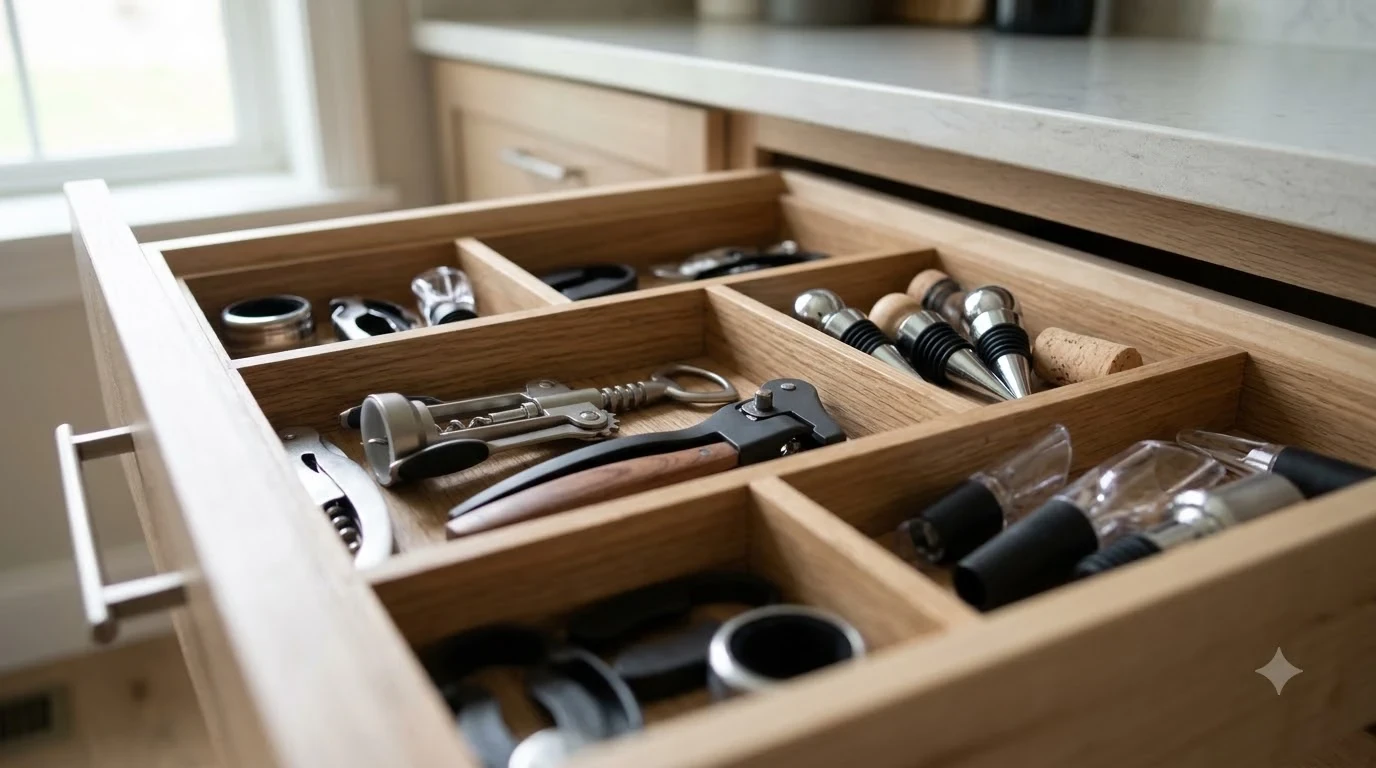
Keep the opener dry and away from direct heat. If a protective sheath or presentation case is supplied, use it to reduce scratches and protect the folding components. A drawer divider or dedicated accessory compartment is another practical option.
Do not store a damp opener inside a closed leather sheath. Allow the tool to dry first, since trapped moisture can affect both metal surfaces and natural materials. Keeping the worm and blade folded also reduces the likelihood of accidental contact when retrieving the tool.
For a wine enthusiast who maintains several accessories, a consistent storage location makes it easier to keep the sommelier knife, bottle stopper, foil cutter, and other serving tools together. A well-organized storage arrangement also reduces the risk of damage from loose utensils.
With sensible cleaning and storage, a well-made Laguiole opener can remain a useful part of a wine-service collection for many years. For repairable models, the manufacturer’s service arrangements are another consideration worth reviewing before purchase.
Frequently Asked Questions
Does Laguiole refer to a single corkscrew manufacturer?
No. Laguiole is associated with a French cutlery tradition and place, and multiple manufacturers produce Laguiole-style accessories. Château Laguiole, Forge de Laguiole, and Laguiole en Aubrac are distinct names, so buyers should identify the actual maker rather than relying on the general product description.
What is the difference between a Château Laguiole and a Forge de Laguiole opener?
They are separate manufacturers with their own product designs and construction details. Both offer sommelier knives with five-turn spirals, but their lever arrangements, blade specifications, handle choices, and finishing can differ. Their respective manufacturer documentation is the appropriate source for model-specific details.
Can a Laguiole corkscrew open bottles with synthetic corks?
Generally, yes, provided the closure is compatible with a conventional spiral corkscrew. Synthetic closures can have different friction and compression characteristics from natural cork, so extraction may feel different. Keep the worm centered and avoid excessive force if the closure resists movement.
Can the corkscrew be carried in hand luggage on a flight?
Not necessarily. Sommelier knives often include a folding blade, which can be subject to aviation security restrictions even when the worm itself is not the concern. Travelers should check the applicable airport and airline rules before packing one in cabin baggage, and checked baggage may be the more appropriate option where permitted.
What should buyers do if the worm becomes bent?
Stop using the opener if the spiral is visibly bent or no longer enters the cork straight. Continued use can increase the risk of breakage or damage to the cork. Contact the manufacturer or an authorized repair service to determine whether the component can be restored or replaced.
A Laguiole sommelier knife is a compelling choice for wine enthusiasts who appreciate traditional craftsmanship, compact design, and distinctive handle materials. Its value depends on the specific maker and mechanism, so buyers should compare construction and operating style rather than treating every Laguiole-branded opener as identical. For someone who wants a refined, practical wine accessory and is comfortable with manual extraction, a well-specified model can be a lasting addition to a home wine collection.
More in Wine Accessories
 Coravin Vs Vacu Vin: Choose the Right Wine Saver for Your BottlesUpdated Nov 21, 2026
 Zwilling Wine Stopper Review: Preserve Open Bottles LongerUpdated Nov 21, 2026
 Wine Enthusiast Wine Preserver Review: Features, Benefits and LimitationsUpdated Nov 21, 2026
 Wine Enthusiast Wine Stopper: An Easier Way to Reseal Open BottlesUpdated Nov 21, 2026
 Vintorio Wine Opener: Two-Step Cork RemovalUpdated Nov 21, 2026
 Zwilling Wine Aerator Review: Aerate, Pour, and Seal With One ToolUpdated Nov 21, 2026