

We may earn a commission when you buy through links on this page, at no extra cost to you. Learn more.
How to store wine in an apartment comes down to keeping bottles cool, dark, stable, and away from heat, sunlight, and vibration. A temperature near 55°F is a useful target, although consistency matters more than achieving an exact reading. A dark closet, interior cabinet, or suitable pantry can protect everyday bottles without taking up valuable living space. For longer storage, a temperature-controlled wine refrigerator offers better protection than an ordinary kitchen refrigerator.
Apartment living creates particular challenges for wine enthusiasts. There may be no basement, limited closet space, strong afternoon sunlight, and considerable temperature changes between air-conditioned rooms and warm kitchens. These conditions do not mean that a wine collection needs an expensive cellar. A few sensible choices about location, bottle positioning, and temperature monitoring can make a substantial difference. The best approach depends on how many bottles you own and whether you plan to drink them next weekend or several years from now.
Build a Practical Wine Storage Area in Your Apartment
The best apartment wine storage area is an interior location that stays relatively cool and dark throughout the day. A small cabinet or closet can work better than an attractive open wine rack beside a sunny window, particularly if the bottles will remain there for several months.

Start by identifying the rooms that experience the least temperature variation. An interior hallway closet, a bedroom wardrobe, or a pantry away from cooking appliances may be suitable. Avoid assuming that the coolest room at one particular moment will remain the coolest throughout the year. A bedroom that feels comfortable in the morning could become considerably warmer when afternoon sunlight enters through large windows.
Think about the amount of wine you actually need to store. Someone keeping four bottles for occasional dinners has different requirements from someone maintaining 30 bottles for future celebrations. A small, stable cabinet may be enough for the first collection, while the second may justify a dedicated wine refrigerator or a more organized storage system.
Before choosing a location, examine its surroundings. Check whether heating pipes run behind the wall, whether an appliance generates heat nearby, and whether direct sunlight reaches the cabinet during any part of the day. Also consider whether the floor or furniture vibrates when nearby doors close or appliances operate.
A useful starting arrangement for an apartment is straightforward:
- Choose an interior closet or cabinet away from windows.
- Keep bottles away from ovens, radiators, water heaters, and heating vents.
- Use a stable rack or padded shelf to prevent bottles from rolling.
- Leave enough clearance to remove bottles without disturbing the rest of the collection.
- Keep wine away from garbage bins, cleaning chemicals, and strong household odors.
Organization matters because wine storage should not become another source of household inconvenience. Arrange frequently opened bottles where they are accessible, while placing bottles intended for longer storage in a quieter, less frequently disturbed section.
It is also sensible to keep an inventory. Write down the producer, grape variety, vintage, and intended drinking occasion. For a small collection, a simple phone note or spreadsheet is sufficient. This prevents bottles from being forgotten at the back of a closet and makes it easier to rotate everyday wines before their freshness declines.
For additional practical advice on choosing a location without dedicated cooling equipment, see how to store wine without a wine fridge.
Maintain a Cool and Consistent Temperature
Temperature is the most important factor to consider when selecting apartment wine storage. Aim for approximately 55°F, and prioritize a location that avoids repeated heating and cooling rather than one that briefly reaches the perfect temperature.
According to Wine Enthusiast, approximately 55°F is a suitable storage temperature across red, white, sparkling, and fortified wines. Decanter identifies 53°F as a classic cellar temperature and describes approximately 46–59°F as a reasonable range for home storage. These figures provide useful reference points rather than a requirement to maintain one exact reading at every moment.
For additional background on temperature, humidity, and the other conditions that affect stored bottles, consult Wine Enthusiast’s explanation of proper wine storage.
The reason consistency matters is that wine responds to its surroundings over time. Repeated temperature changes can accelerate development, alter aromas, and contribute to leakage when the liquid and closure expand and contract. A bottle kept at a reasonably steady 60°F may fare better than one repeatedly exposed to temperatures of 50°F at night and 80°F during the afternoon.
Apartment kitchens are particularly problematic. Cooking appliances, hot water, ovens, and fluctuating ventilation can produce considerable temperature changes. A cabinet above a refrigerator might appear convenient, but the heat released by the appliance makes it a poor location for wine that will remain there for months.
In warmer apartments, air conditioning can help stabilize indoor conditions, but it should not be treated as a substitute for monitoring the actual storage area. The temperature inside a closed cabinet may differ from the thermostat reading in the living room. A small digital thermometer with a minimum-and-maximum recording function can reveal whether the location experiences significant daily changes.
| Storage consideration | Useful target or limit | Practical application |
|---|---|---|
| Ideal reference temperature | About 55°F | Suitable target for long-term storage |
| Classic cellar reference | 53°F | Useful benchmark for a stable storage area |
| Reasonable home storage range | 46–59°F | Prioritize consistency within this range |
| Prolonged heat exposure concern | Above 77°F | Avoid warm locations for extended periods |
| Extreme heat concern | Above 104°F | Can cause visible and sensory changes within days |
| Short-term serving of light whites | 45–50°F | Chill before pouring rather than storing permanently at serving temperature |
The Australian Wine Research Institute discusses research showing that prolonged exposure to 86°F for 12 months can result in faulty flavors and reduced wine quality. Its storage guidance also identifies temperatures above 104°F as capable of producing visible and sensory changes within days. These examples illustrate why a hot apartment window or enclosed balcony is a poor storage choice.
Remember that storage temperature and serving temperature are different. A bottle of Sauvignon Blanc may be served at 45–50°F, but that does not mean it should spend several months in an ordinary refrigerator. A full-bodied red may be served at 60–65°F while being stored at approximately 55°F.
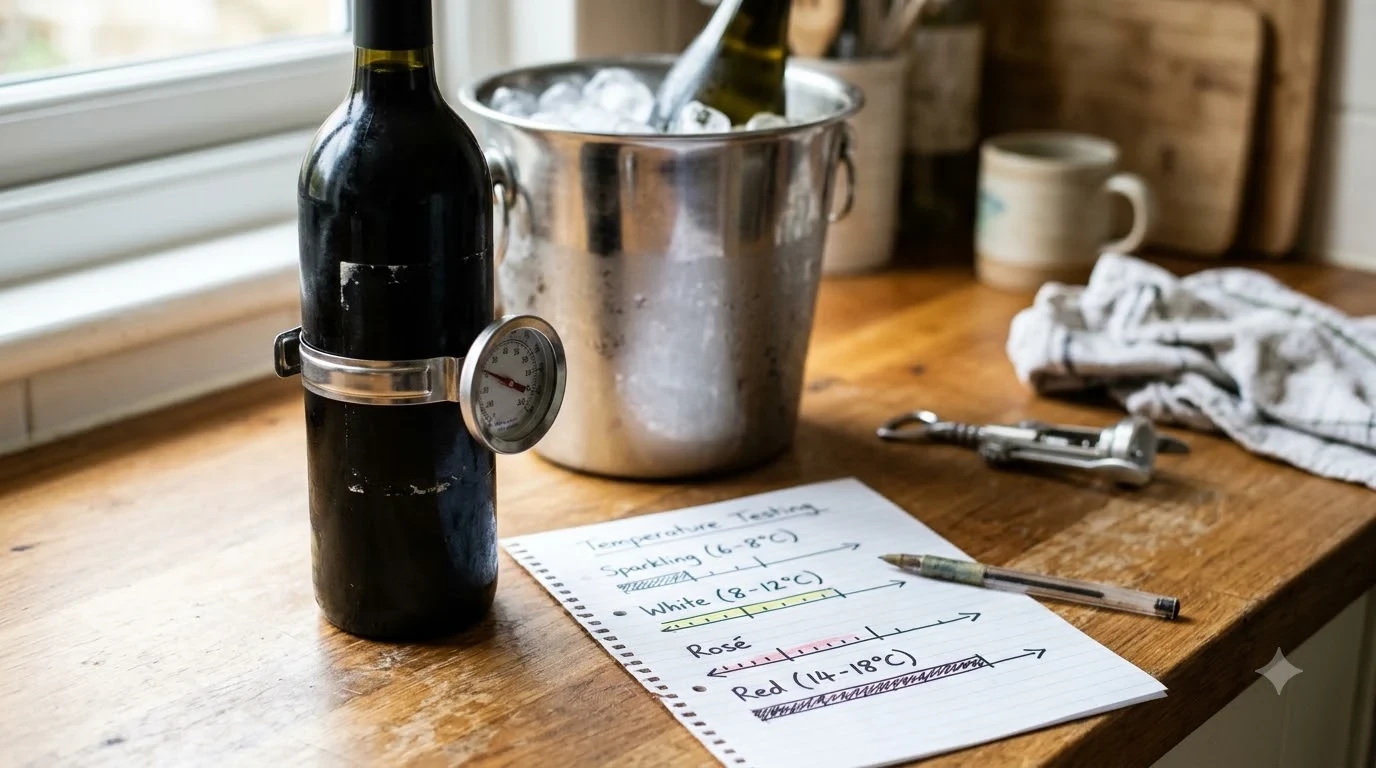
Tip: Place a digital thermometer inside your proposed wine cabinet for at least several days before filling it. Check the readings in the morning, afternoon, and evening. If the temperature repeatedly climbs above 70°F, choose another location or consider controlled storage.
Protect Bottles From Sunlight, Heat, and Household Odors
Darkness is an important part of good wine storage, especially in apartments with large windows and strong natural light. Keep bottles away from direct sunlight and avoid decorative displays that expose wine to bright light for extended periods.
Ultraviolet radiation can affect wine’s chemical composition and contribute to undesirable aromas and flavor changes. This problem is commonly described as light strike. Dark glass provides some protection, but it does not make a bottle immune to prolonged exposure. White wines can be particularly vulnerable because they generally have less protective tannin than red wines.
A practical solution is to use an enclosed cabinet with solid doors. If a cabinet has glass panels, cover them with an opaque material or position the unit in a naturally dark part of the apartment. A wardrobe or interior pantry can be an excellent alternative because it provides protection without requiring specialized equipment.

Heat sources deserve equal attention. Do not place wine on top of a refrigerator, beside an oven, above a microwave, near a radiator, or directly next to an air-conditioning compressor. Even if the general room temperature seems acceptable, localized heat can make these positions unsuitable.
Balconies are also unreliable. A covered balcony may seem shaded, but outdoor temperatures can rise sharply during the day. Direct sunlight on the balcony floor, warm exterior walls, and changing nighttime temperatures make it difficult to maintain stable storage conditions. A closed storage box does not automatically solve the problem because it can trap heat.
Household odors are another consideration that is easy to overlook in a compact apartment. Natural cork is not a completely impermeable barrier, and Wine Enthusiast identifies strong environmental smells as a potential concern during prolonged storage. Avoid placing bottles beside paint, solvents, cleaning products, garbage, or strongly scented materials.
For the same reason, a cabinet used for wine should not double as a general chemical storage area. If the apartment has a laundry closet containing detergents and cleaning agents, select a separate location for bottles.
There is no need to keep wine in total darkness every minute of its existence. Ordinary room lighting while selecting a bottle is not the same as prolonged direct sunlight. The objective is to avoid unnecessary exposure over weeks and months, especially when a simple closed cabinet can provide protection.
A dark, interior location with limited temperature variation is generally a better choice than a stylish open display rack. Good storage should protect the wine first and complement the apartment’s appearance second.
Choose the Right Bottle Position and Storage Rack
Natural cork bottles are traditionally stored horizontally so the wine remains in contact with the cork. This arrangement is especially useful for bottles intended to remain unopened for several months or longer.
Horizontal storage helps maintain cork moisture and can reduce the risk of the closure drying out. A dry natural cork may lose some of its sealing effectiveness, allowing additional oxygen to enter the bottle. Over time, excess oxygen exposure can damage freshness and accelerate oxidation.
For a small apartment, a compact wooden rack or a sturdy modular metal rack can keep bottles organized without requiring a full cellar. Choose a design that supports the bottle securely and prevents rolling. Avoid placing heavy bottles on narrow, unstable shelves or stacking them in ways that make removal difficult.
Not every wine bottle requires horizontal storage. Screw-cap bottles do not depend on wine contact to keep a cork moist, so they can generally remain upright. Some alternative closures also have different storage requirements, making the closure type relevant when organizing a mixed collection.
The Australian Wine Research Institute discusses studies comparing horizontal and upright bottle storage. One study involving Chardonnay and Riesling found little difference in chemical composition and sensory properties across a 60-month period. Other research identified higher oxidation in certain upright-stored wines with agglomerated cork closures. These findings show that closure type and storage conditions matter, rather than suggesting that every bottle must always lie down.
For everyday apartment storage, horizontal positioning remains a sensible default for natural cork bottles. It is practical, easy to organize, and consistent with traditional cellar practice.
Make the Most of Limited Space
Small spaces benefit from vertical organization, but vertical organization does not necessarily mean standing every bottle upright. A narrow rack with horizontally positioned bottles can fit inside a wardrobe, under a counter, or along an interior wall.
Measure the available space before buying a rack. Standard 750 ml bottles differ in diameter and shape, and Champagne bottles are generally wider than many still-wine bottles. A rack designed for narrow Bordeaux bottles may not comfortably accommodate larger sparkling wine bottles or unusually shaped Burgundy bottles.
Leave enough space around the rack for ventilation and safe access. Do not force bottles into undersized compartments or allow the rack to press against a warm appliance. If the storage furniture is close to a frequently used door, make sure normal household movement will not knock it.
For collections that include older red wines, minimizing disturbance becomes especially useful. Sediment can develop during aging, and frequent handling may redistribute it throughout the bottle. Keep these bottles in a stable section of the rack and move them only when necessary.
If space is particularly restricted, an organized arrangement of six or eight bottles is more useful than a large, decorative rack that forces wine into an unsuitable location. Storage capacity should match the available environment, not the other way around.
Decide Whether an Apartment Needs a Wine Refrigerator
A dedicated wine refrigerator is useful when the apartment cannot provide a sufficiently cool, stable location or when the collection includes bottles intended for extended storage. However, it is not essential for every wine drinker.
Most everyday wines are purchased to be enjoyed relatively young. If a bottle will be opened within a few weeks, a dark interior cabinet with reasonable temperature stability may be perfectly adequate. A dedicated appliance becomes more valuable when bottles need protection for many months or years.
A standard kitchen refrigerator and a wine refrigerator serve different purposes. An ordinary refrigerator generally operates around 40°F, according to Wine Enthusiast, which is colder and drier than the preferred environment for extended wine storage. It is useful for chilling bottles and preserving opened wine over a short period, but it is not an ideal permanent home for an entire collection.
A wine refrigerator is designed to maintain more suitable storage temperatures. Depending on the model, it may also provide adjustable shelving, reduced vibration, and more controlled conditions. Single-zone models maintain one temperature throughout the cabinet, while dual-zone models offer separate temperature areas.
For an apartment collection of mostly red and white wines intended for storage rather than immediate service, a single-zone model near 55°F is often sufficient. A dual-zone model can be useful when the owner regularly wants sparkling wine and whites chilled separately from red wines, although serving bottles can always be chilled shortly before opening.
What to Check Before Buying
Apartment residents should consider the following practical details:
- Capacity: Choose a model that accommodates the number of bottles you actually own. A 12-bottle unit may be sufficient for a small collection, while a larger collection may need 24 or 30 bottle positions.
- Dimensions: Measure the width, depth, and height of the intended location before ordering.
- Ventilation: Follow the manufacturer’s clearance requirements so the cooling system can release heat properly.
- Noise: Check the operating noise level if the refrigerator will be installed in a bedroom or open-plan living area.
- Vibration: Look for stable shelves and a cooling system suitable for wine storage.
- Temperature control: Choose a model that can maintain a consistent temperature close to your storage target.
Do not assume that a wine refrigerator can be installed inside any closed cabinet. Some models require clearance around their ventilation openings. Blocking those openings can interfere with cooling performance and cause the unit to work harder.
There is also no reason to purchase a large appliance simply because it looks impressive. A smaller, properly installed refrigerator is more useful than a large model placed beside an oven or in a location exposed to direct sunlight.
For renters, portability matters too. Freestanding units are often easier to move between apartments than built-in storage systems. Before installation, check the electrical requirements and any restrictions in the rental agreement.
Finally, consider the type of wine you intend to keep. Most inexpensive, fresh-drinking wines do not require years of controlled aging. If the collection consists mainly of bottles intended for consumption within a month or two, an appropriate cabinet may provide all the protection necessary.
Adjust Storage Habits for Everyday, Long-Term, and Opened Wine
The correct storage method depends on how long the wine will remain in your apartment. Everyday bottles, age-worthy wines, and opened bottles have different practical requirements.
For wine intended to be opened within a few weeks, a cool, dark cabinet is usually enough. Keep the bottles away from kitchen heat and sunlight, and avoid unnecessary movement. Most wines sold for everyday drinking are not designed to improve through extended cellaring, so there is little advantage in keeping them for years.
Long-term storage requires greater attention to temperature stability, humidity, and bottle position. If a wine is intended to age for three, five, or ten years, a temperature-controlled wine refrigerator or suitable professional storage facility may be preferable to an ordinary apartment closet.
Humidity is relevant mainly for natural cork closures. Wine Enthusiast identifies approximately 50–80% relative humidity as a suitable range, although ordinary apartment dwellers do not necessarily need to measure and control humidity for every bottle. The priority is to avoid extremely dry conditions over long periods while preventing excessive moisture that can damage labels and encourage mold.
What to Do With Opened Bottles
Once a bottle has been opened, oxygen exposure becomes the immediate concern. Reseal it promptly with its original cork or a suitable stopper and place it in the refrigerator. This applies to both red and white wine, even if the red wine was originally served at a warmer temperature.
As a general reference, opened sparkling wine lasts approximately one to three days in the refrigerator when properly sealed. Most opened still wines remain enjoyable for approximately three to five days, while fortified wines can last several weeks depending on their style and storage conditions. Bag-in-box wine can remain usable for approximately four to six weeks after opening.
These are typical storage windows, not guarantees. Wine condition, oxygen exposure, closure quality, and the amount remaining in the bottle all influence how quickly an opened wine loses its character.
When only a small amount remains, transferring the wine into a smaller, clean, airtight container can reduce the amount of oxygen in contact with it. Avoid leaving an opened bottle on the kitchen counter overnight, particularly in a warm apartment.
Remember that freezing wine is not a substitute for suitable long-term storage. Wine contains water and expands when frozen, potentially pushing out the cork or damaging the bottle. For a detailed explanation, see can you store wine in the freezer.
Understand the Difference Between Storage and Serving
A bottle stored at 55°F may need additional chilling or a brief period outside the refrigerator before serving. Serving temperatures depend on the wine’s style, not simply the temperature at which it was stored.
Use these general serving references:
- Sparkling wine: 40–50°F.
- Light-bodied white wine and rosé: 45–50°F.
- Full-bodied white wine: 50–55°F.
- Light-bodied red wine: 55–60°F.
- Full-bodied red wine: 60–65°F.
- Sweet white wine: 43–50°F.
A standard refrigerator can help bring a bottle to serving temperature without requiring permanent cold storage. Plan ahead rather than keeping every bottle chilled for months.
Apartment residents who want a broader introduction to storage, serving, and other wine fundamentals can explore Wine Basics. Understanding the difference between everyday drinking wine and bottles designed for aging makes it easier to decide which storage arrangements are worthwhile.
Frequently Asked Questions
Can wine be stored in a bedroom closet?
Yes, provided the closet remains relatively cool, dark, and free from significant temperature changes. An interior bedroom closet is often more suitable than a wardrobe against a sun-heated exterior wall. Avoid storing wine beside heated electrical equipment or strongly scented clothing products.
Does wine go bad if it is stored upright?
Not necessarily. Screw-cap wines can generally remain upright without the cork-moisture concerns associated with natural cork. Research discussed by the Australian Wine Research Institute also found little difference between horizontal and upright storage in certain Chardonnay and Riesling samples over 60 months. For natural cork bottles intended for extended storage, horizontal positioning remains a sensible precaution.
Can wine be stored under a bed in an apartment?
It can be, if the space is clean, dark, and consistently cool. However, some under-bed areas collect dust, experience floor vibrations, or sit near heating equipment. Use a protective rack or storage box that allows bottles to remain stable and can be accessed without repeatedly disturbing the collection.
Should wine bottles be washed before storage?
Washing bottles before putting them into storage is generally unnecessary. If the exterior is dusty or sticky, wipe it with a clean, slightly damp cloth and allow it to dry completely. Keeping the storage area clean is more useful than routinely washing every bottle, especially when labels are made of moisture-sensitive paper.
Can wine be stored in cardboard boxes for several months?
Yes, provided the boxes remain dry, clean, and away from heat and sunlight. Original wine cartons can help shield bottles from light and reduce unnecessary handling. However, cardboard offers little protection against sustained high temperatures, so the storage location remains more important than the packaging itself.
Good apartment wine storage does not require a basement, a custom cellar, or an elaborate collection of equipment. Start with a cool interior location, protect bottles from light and heat, and use stable horizontal storage for natural cork bottles intended for longer keeping. As the collection grows or storage conditions become less predictable, a dedicated wine refrigerator can provide additional control and peace of mind.
More in Wine Basics
 Which Rose Is Best for Your Taste, Budget, and Food PairingsUpdated Nov 21, 2026
 Is Cheap Wine Bad? How to Find Bottles Worth DrinkingUpdated Nov 21, 2026
 What To Write On A Wine Gift Tag: Thoughtful Messages For Every OccasionUpdated Nov 21, 2026
 Which Wine Is Best For Weight Loss? Compare Lower-Calorie ChoicesUpdated Nov 21, 2026
 What Is The Best Wine For Mimosas? Choose Bubbly That Balances Orange JuiceUpdated Nov 20, 2026
 Which Prosecco Is Best for Your Taste and OccasionUpdated Nov 20, 2026