

We may earn a commission when you buy through links on this page, at no extra cost to you. Learn more.
How to pronounce cinsault: Say “SAN-soh,” using two equally emphasized syllables and leaving the final L and T silent. The first syllable resembles the beginning of “San Francisco,” but you stop before completing the n sound. The second syllable sounds like the English word “so.” This southern French red grape also appears under the spelling Cinsaut, which refers to the same variety.
French wine names can look intimidating on a restaurant list, particularly when their spelling gives little indication of how they sound. Cinsault is a good example: its unusual combination of letters can lead English speakers to pronounce every consonant, even though several letters are silent. Learning the two-syllable pronunciation makes it easier to order this versatile grape, recognize it in wine descriptions, and understand why it appears in bottles from France, South Africa, and other Mediterranean wine regions.
The Correct Cinsault Pronunciation and Its Two Syllables
The easiest English-language pronunciation guide for Cinsault is “SAN-soh.” Both syllables receive approximately equal emphasis, rather than placing a strong stress on the first or last part of the name. Think of the opening of “San Francisco,” followed by the familiar English word “so.”
To pronounce the first syllable, begin with the sound you make when saying “San.” However, do not complete the n sound as you normally would in English. The French nasal vowel is different from a fully pronounced English n. The sound should flow directly into the second syllable instead of ending with a distinct consonant.
The second syllable is much simpler. Say “so,” keeping the vowel rounded and the sound relatively short. Avoid turning it into “sow” with a strongly pronounced final w. The two parts should connect naturally: SAN-soh.
Wine educator Jacky Blisson uses the phonetic guide “San-so” in her French wine grape pronunciation guide. Her explanation specifically advises speakers to stop the first syllable before completing the n. Tablas Creek Vineyard gives a closely related explanation, describing the first sound as the beginning of San Francisco and the second as the English word “so.”
A practical pronunciation breakdown
Practice the name in three stages:
- Start with SAN: Say the beginning of San Francisco, but avoid a fully articulated final n.
- Add SOH: Follow the nasal first sound with a clear, rounded “so” sound.
- Join the sounds: Repeat SAN-soh smoothly, giving both syllables similar emphasis.
You do not need an exaggerated French accent to pronounce the grape name correctly. A natural, relaxed delivery is more useful than attempting to imitate an unfamiliar accent. The main goal is to avoid reading the name as though it were an English word with every letter pronounced.
Tip: Remember “San Francisco without the finished n, followed by so.” This short comparison is an easy way to recall the pronunciation when ordering wine or discussing a bottle with a server.
Why the Final Letters in Cinsault Are Silent
The spelling Cinsault contains eight letters, but its spoken name has only two syllables. The final L and T are not pronounced in the commonly used French pronunciation. Understanding this spelling-to-sound difference makes the grape name much easier to remember.
English speakers often approach unfamiliar wine names by sounding out each letter. That approach does not work particularly well with French grape varieties because French spelling follows pronunciation patterns that differ from English conventions. Cinsault is a useful example of how written consonants can remain silent at the end of a French word.
The final sequence “ault” should not be read as “alt,” “ault” with a pronounced t, or “awlt.” Instead, the entire ending contributes to the final “soh” sound in the grape’s name. There is no separate l or t sound after the vowel.
Which letters should you pronounce?
The following breakdown shows the practical difference between the written form and the spoken result.
| Written part | Pronunciation guidance | What to remember |
|---|---|---|
| Cin | SAN (nasal) | Do not finish with a strong n. |
| s | S | Creates the opening sound of the second syllable. |
| ault | OH | The final L and T are silent. |
| Entire name | SAN-soh | Two syllables with similar emphasis. |
One useful distinction is that the silent letters are not unusual exceptions invented specifically for this grape. They reflect French pronunciation conventions. Other French wine terms also contain letters that are written but not spoken. For example, the ending of Chardonnay is pronounced differently from its English-looking spelling, which is why learning how to pronounce chardonnay can be helpful when building familiarity with French wine vocabulary.
It is also useful to remember that Cinsault is not pronounced like “sin-salt.” Although that reading seems reasonable from an English spelling perspective, it introduces consonants and vowel sounds that do not belong in the usual French pronunciation. Practice the complete two-syllable name instead of trying to pronounce individual letters.
Cinsault Versus Cinsaut: Understanding the Two Spellings
Cinsault and Cinsaut are alternative spellings of the same grape variety, not two different types of wine grapes. The version without the final L is widely used in official grape references, while the spelling Cinsault is familiar in French wine discussions and international wine writing.
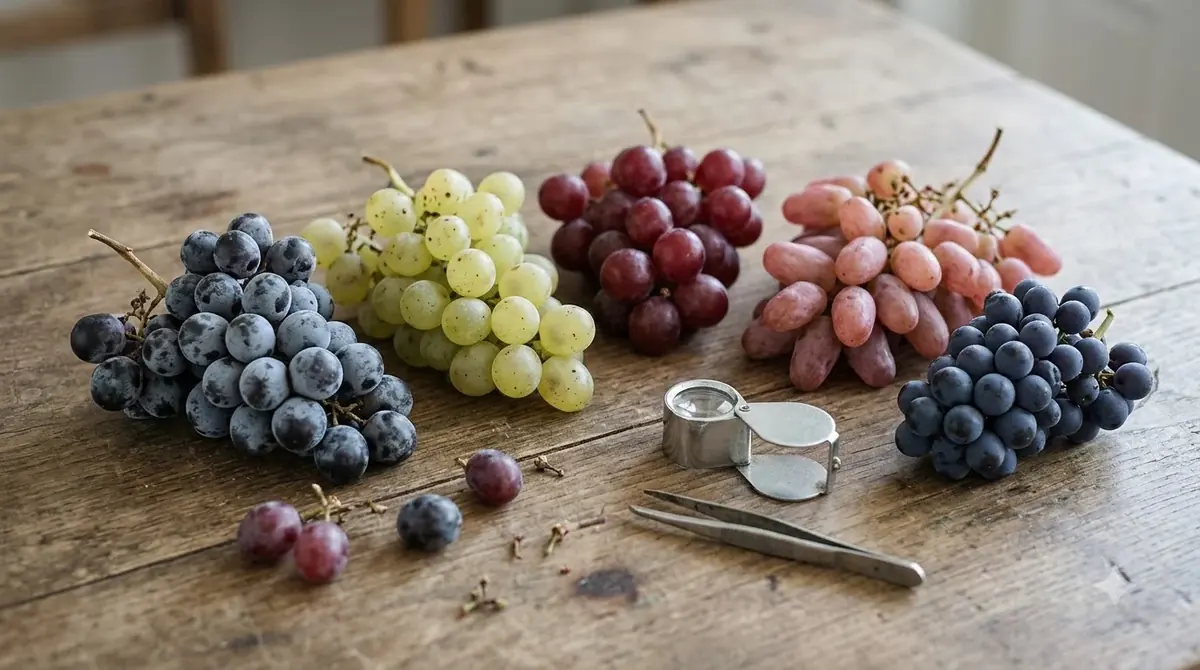
The distinction is particularly visible in institutional references. UC Davis Foundation Plant Services lists Cinsaut as the variety name and identifies Cinsault among its recognized synonyms. The Australian Wine Research Institute also uses Cinsaut as its main spelling and provides the pronunciation “SIN-soh.” These references demonstrate that the two written forms describe the same variety.
French pronunciation references use the phonetic representation /sɛ̃.so/. The first symbol represents a nasal vowel, which is why a simple English approximation cannot reproduce every detail of the original sound. For everyday wine conversations, however, SAN-soh is an accessible pronunciation that communicates the name clearly.
Why does the spelling change?
Grape names can develop different spellings through regional usage, historical documents, wine labeling practices, and official classification systems. A variety grown in several countries may acquire local names or retain older spellings even when its botanical identity remains unchanged.
UC Davis Foundation Plant Services records numerous synonyms for Cinsaut, including Black Malvoisie, Hermitage, Ottavianello, and Sinsó-related forms. These names reflect the grape’s history across different wine-producing countries. They should not be mistaken for entirely unrelated varieties simply because the words look different.
The spelling Cinsaut is particularly useful when consulting technical grapevine records. Cinsault is also widely recognizable among wine consumers, especially when reading about southern French wines and Mediterranean rosés. Both forms should lead you toward the same grape.
For pronunciation purposes, the additional L in Cinsault does not create another sound. Whether the label says Cinsaut or Cinsault, the practical pronunciation remains SAN-soh.
Where Cinsault Comes From and Where It Grows
Cinsault is associated with southern France, particularly Provence, Languedoc, and Roussillon. It has also developed a significant identity in South Africa, where it was historically known as Hermitage, and it appears in wine-growing areas across the Mediterranean and beyond.
The grape’s precise historical origin is uncertain, but Tablas Creek describes it as a variety that likely evolved in southern France. The Australian Wine Research Institute reports that it was mentioned there during the 17th century. Its ability to grow successfully in warm, dry conditions helped it spread to other regions with Mediterranean-style climates.
In France, Cinsault has an established role in southern red wine blends and rosé production. Provence is especially important for consumers who encounter the grape in pale, dry rosés. Languedoc and Roussillon also have a long association with the variety, often alongside other regional grapes such as Grenache and Carignan.
South Africa and the name Hermitage
South Africa provides one of the most interesting examples of Cinsault’s international history. The grape was traditionally called Hermitage there, a name that can cause confusion because Hermitage is also a famous wine appellation in France’s northern Rhône Valley.
The distinction matters because the two names do not describe the same thing. Hermitage in the South African historical grape context refers to Cinsault, whereas Hermitage in the northern Rhône refers to a wine appellation associated principally with Syrah. This historical naming connection also helps explain the name Pinotage, which comes from the crossing of Pinot Noir and the grape historically called Hermitage in South Africa.
Other countries have their own names for the variety. The Australian Wine Research Institute identifies Black Prince and Blue Imperial among Australian synonyms, Black Malvoisie in California, and Ottavianello in Italy. The variety is also grown in Chile, Lebanon, and Morocco.
These different regional names are useful clues when researching old wine descriptions or reading about traditional vineyards. However, they do not change the pronunciation of the modern Cinsault name. The same two-syllable SAN-soh guide remains useful across these regions.
What Cinsault Wine Tastes Like and Why Producers Use It
Cinsault typically produces soft, fruit-forward red wines with relatively low tannin, approachable texture, and aromatic character. Common flavor descriptions include strawberry, raspberry, cherry, redcurrant, violet, and subtle spice, although the final profile depends on the growing region and winemaking approach.
The Australian Wine Research Institute describes the variety as generally light-bodied, soft, fruity, and aromatic. Its relatively low tannin makes it different from more structured red grapes such as Cabernet Sauvignon and Syrah. This softer structure is one reason Cinsault can work particularly well in blends.
Tablas Creek identifies spicy raspberry, violet, and black tea among the aromas associated with its Cinsaut wines. It also describes flavors of tart cherry, redcurrant, and new leather. These examples demonstrate that Cinsault is not limited to simple strawberry flavors; carefully grown fruit can produce wines with additional aromatic detail.
Red wines, rosés, and blends
Cinsault is versatile in the cellar. It can be bottled as a single-variety red, incorporated into southern French blends, or used to produce rosé. In blends, its fruit character and relatively gentle tannin can complement varieties that contribute more alcohol, color, or structure.
Grenache, Syrah, and Carignan are useful reference points when learning about southern French red wine combinations. Cinsault can contribute fresh red-fruit character alongside the fuller body or stronger tannin of its blending partners. The resulting wine may feel more approachable than a blend dominated by heavily structured grapes.
Rosé is another important expression. Cinsault’s red-fruit aromas and relatively soft tannins make it suitable for dry rosés, particularly in southern France. These wines can feature strawberry, watermelon, citrus, and floral notes, depending on the blend and production method.
Why Cinsault matters in South African wine history
The grape’s relationship with Pinotage is one of its most interesting historical contributions. Pinotage was created by crossing Pinot Noir with Cinsault, which was then commonly called Hermitage in South Africa.
This connection gives Cinsault a place in the history of South African wine beyond its use in traditional red blends. It also explains why discussions of Pinotage frequently mention the older Hermitage name. Knowing that relationship makes wine descriptions and conversations about South African grape varieties easier to follow.
For readers exploring different grape varieties, the broader Wine by Type collection provides a useful starting point for comparing grapes, wine styles, and their characteristics.
How to Order Cinsault and Discuss It Confidently
Ordering Cinsault becomes straightforward once you remember the pronunciation SAN-soh. You can use the name naturally when asking a restaurant server about a bottle, discussing a French red blend, or looking for a lighter red wine with fresh berry flavors.
A simple ordering sentence is, “Do you have a Cinsault or a southern French red blend with Cinsault?” This phrasing is clear and gives the server room to suggest either a single-variety bottle or a blend. You can also ask whether the wine comes from Provence, Languedoc, or another region associated with the grape.
When reading a wine list, distinguish the grape from the broader wine style. A Cinsault-based wine may be a dry red, a rosé, or part of a regional blend. The grape name alone does not establish whether the finished wine is light, full-bodied, youthful, or suitable for aging.
Food pairing and serving suggestions
Light-bodied Cinsault reds generally work well with roasted chicken, grilled vegetables, tomato-based pasta, mushroom dishes, and moderately seasoned pork. Their red-fruit character and softer tannins can complement foods without overwhelming delicate flavors.
For a classic Mediterranean meal, try a Cinsault-based red with grilled lamb, herb-seasoned chicken, ratatouille, or a tomato and olive pasta dish. A dry Cinsault rosé is a natural option for seafood, salads, grilled vegetables, and lighter summer meals.
Serving temperature influences how the wine’s aromas and texture are perceived. A lighter red Cinsault is best served around 55–60°F rather than at a warm room temperature. A fuller red blend can be served closer to 60–65°F, while a rosé generally benefits from a cooler 45–50°F serving temperature.
Tip: If you are ordering Cinsault alongside other French wines, practice the names before visiting the restaurant. The pronunciation of Cinsault is SAN-soh, Chardonnay is commonly rendered “shard-oh-nay,” and Claret is generally pronounced “CLAIR-it.” Familiarity with how to pronounce claret also helps when discussing traditional French-inspired red wine styles.
There is no need to give the grape an elaborate French accent. A relaxed SAN-soh is easy to understand, and knowing that the final L and T are silent will help you recognize the name on a label. The most useful next step is to associate the pronunciation with the grape’s fresh red-fruit character and its role in southern French and South African wines.
Frequently Asked Questions
Is Cinsault pronounced differently in American English and French?
The French pronunciation is represented by the International Phonetic Alphabet as /sɛ̃.so/. American English speakers often approximate it as SAN-soh or SIN-soh. The nasal vowel in the French version does not have an exact equivalent in ordinary American English, so either phonetic guide is an approximation rather than a perfect reproduction.
Does Cinsault have a masculine or feminine grammatical gender in French?
In French, cinsault is a masculine noun. It is therefore written with the masculine article “le,” as in “le cinsault.” This grammatical detail applies to the grape name and does not indicate anything about the wine’s color, body, or sweetness.
Is Cinsault related to Picpoul?
Tablas Creek describes Cinsaut as distantly related to Picpoul. The two grape names are not interchangeable, however, and they produce distinct wine styles. Picpoul is particularly associated with fresh white wines, while Cinsault is primarily known as a red grape used for red wines and rosé.
What is the French word for a Cinsault grapevine?
The French word “cépage” refers to a grape variety, while “vigne” refers to a vine or vineyard context. You may encounter the expression “cépage Cinsault” in French wine descriptions. It identifies Cinsault as the grape variety used in the wine rather than naming a separate production method.
Can Cinsault be used to make sparkling wine?
Yes, Cinsault can be used in experimental or regional sparkling wine production, although its best-known roles are still red wine, rosé, and blending. Its red-fruit aromas can contribute an interesting character to sparkling styles. The grape itself does not determine whether a wine is sparkling; the producer’s fermentation and production choices do.
Cinsault is easier to say than its spelling suggests: remember SAN-soh, leave the final L and T silent, and give both syllables similar emphasis. Once the pronunciation is familiar, this southern French grape becomes easier to recognize in rosés, lighter reds, and blends from France and South Africa. The next time you see Cinsault on a wine list, you can order it confidently.
More in Wine Types & Grapes
 Zinfandel Sugar Content: Dry Red vs. White Zinfandel GramsUpdated Nov 21, 2026
 Best Zinfandel Substitute Options for Sipping and CookingUpdated Nov 21, 2026
 Zweigelt Food Pairing: Best Dishes, Cheeses, and Serving TipsUpdated Nov 21, 2026
 Zinfandel Tannins Explained: How Structure Shapes Every BottleUpdated Nov 21, 2026
 Zinfandel Sweetness Level: Dry Red vs. Sweet White Zin ExplainedUpdated Nov 21, 2026
 Xinomavro Food Pairing: Best Dishes, Styles, and Serving TipsUpdated Nov 21, 2026