
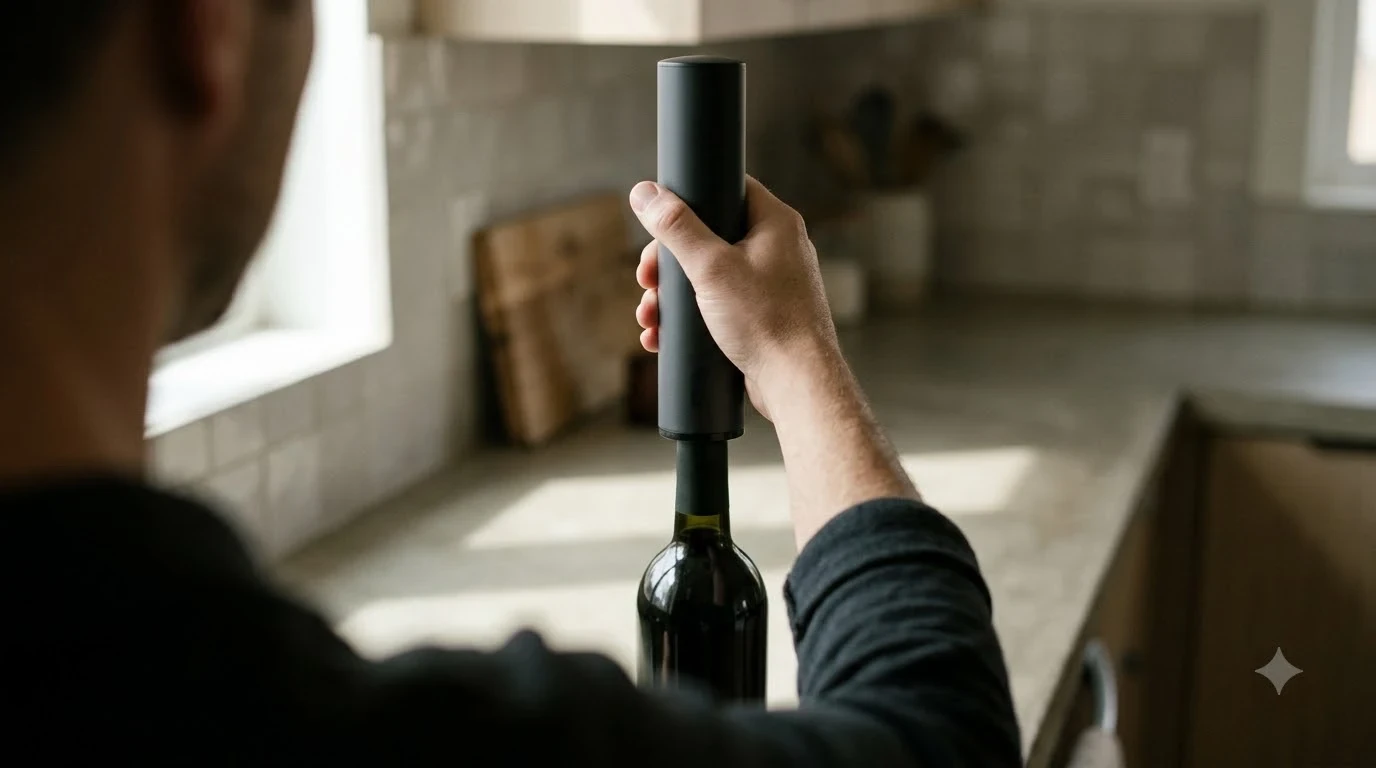

We may earn a commission when you buy through links on this page, at no extra cost to you. Learn more.
The houdini electric wine opener is a convenient cordless corkscrew for everyday wine opening, offering push-button operation, four AA batteries, and compatibility with natural and synthetic corks. Its recessed spiral helps position the opener on a bottle neck, while separate buttons handle cork extraction and release. However, inconsistent owner experiences, concerns about mechanical reliability, and the need to replace batteries make it a better choice for occasional household use than for anyone seeking a particularly durable, high-volume wine opener.
An electric wine opener can make serving wine easier, especially when opening several bottles for a dinner party or when using a traditional corkscrew requires more hand strength than desired. Houdini takes a relatively straightforward approach: a cordless electric mechanism, a stainless steel and plastic exterior, and two-button operation. The design prioritizes convenience over elaborate features. Understanding its battery requirements, operating procedure, limitations, and owner feedback helps establish whether this particular corkscrew belongs in a home bar.
Specs and Key Features
The Houdini Electric Corkscrew is a battery-powered appliance with a recessed extraction spiral and two-button operation. Its straightforward design makes it easy to understand, although the battery arrangement and physical dimensions are important considerations before purchasing.
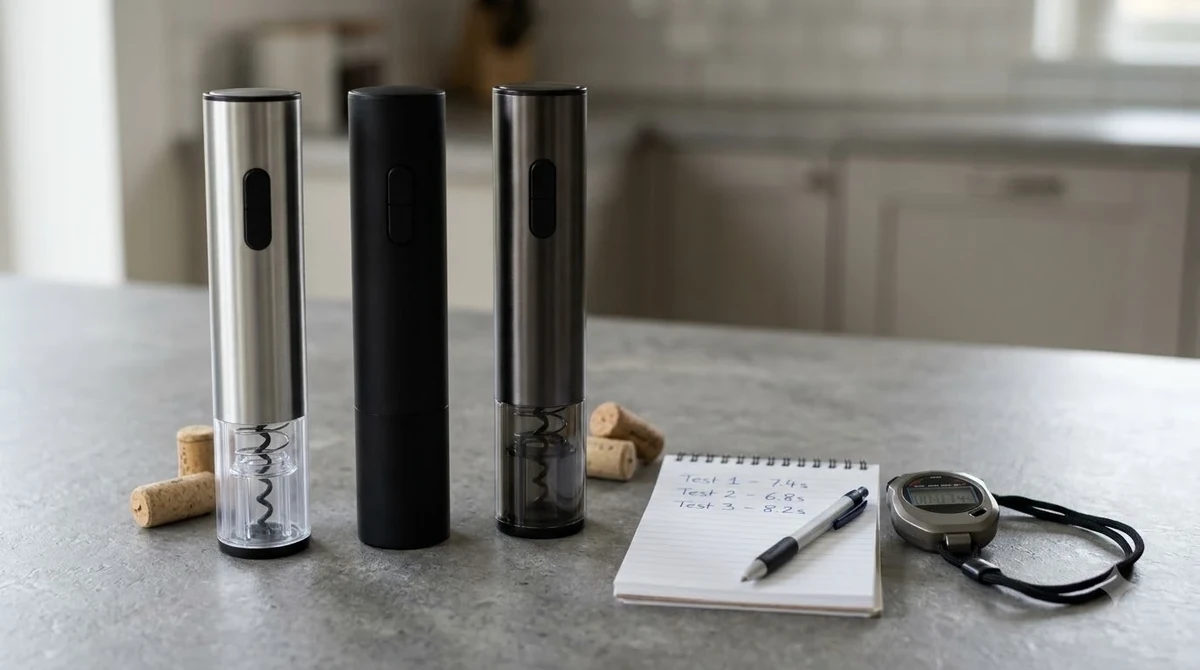
The standard silver version is constructed from stainless steel and plastic. According to Target’s product specifications, it measures 10.31 inches tall, 2.81 inches wide, and 2.81 inches long, with a listed weight of 0.95 pounds. That relatively tall cylindrical profile gives the opener a noticeable presence on a kitchen counter or bar shelf. It is not a particularly compact accessory, so storage space deserves consideration if kitchen drawers and cabinets are already crowded.
Four AA alkaline batteries power the mechanism. The standard version listed by Target includes the batteries, which means buyers can generally begin using the opener without purchasing a separate power supply. Unlike rechargeable corkscrews that sit on a charging base, this version does not require a permanent charging station. The trade-off is that depleted batteries must eventually be replaced.
| Specification | Houdini Electric Corkscrew |
|---|---|
| Product type | Cordless electric wine opener |
| Power source | 4 AA alkaline batteries |
| Batteries included | Yes, standard silver version |
| Construction | Stainless steel and plastic |
| Height | 10.31 inches |
| Width | 2.81 inches |
| Length | 2.81 inches |
| Listed weight | 0.95 pounds |
| Cork compatibility | Natural and synthetic corks |
| Controls | Down-arrow and up-arrow buttons |
| Cleaning | Spot clean or wipe clean |
| Warranty | One-year limited warranty, according to the brand representative |
One of the more useful design features is the recessed spiral. It helps the opener sit over the bottle neck and provides a defined position before extraction begins. This matters because electric corkscrews need to remain properly aligned to work effectively. A device that tilts or moves during operation can place unnecessary pressure on the cork and extraction mechanism.
The two-button arrangement is equally uncomplicated. The lower button operates the extraction mechanism, while the upper button reverses its movement to release the extracted cork. This eliminates the need to pull the cork manually from the spiral. For someone opening several bottles consecutively, that small convenience can make the serving process less repetitive.
It is important to distinguish the standard opener from Houdini’s bundled electric wine opener sets. Some packages include additional accessories, such as a foil cutter, aerating pourer, wine stoppers, and a storage base. These extras should not automatically be assumed to come with the standalone silver model.
Overall, the specifications describe a relatively simple electric corkscrew rather than a sophisticated wine preservation system. Its principal selling points are cordless operation, familiar battery power, and compatibility with different cork materials.
What Owners Like
Positive owner feedback focuses on convenience, straightforward operation, and the ability to remove corks without the twisting and pulling associated with manual corkscrews. The design is particularly appealing to households that want an uncomplicated electric accessory rather than a complicated bar appliance.

The most obvious advantage is push-button extraction. With a traditional corkscrew, the user must position the worm, rotate it into the cork, and pull upward while keeping the bottle steady. The Houdini reduces much of that physical work to positioning the appliance and operating its controls. The extraction mechanism does the repetitive movement.
This feature can be particularly useful when entertaining. Imagine serving a dinner for six guests and opening several bottles over the course of an evening. An electric opener eliminates the repeated twisting action, making it easier to move between bottles. It also creates a consistent opening routine that guests can understand without needing much instruction.
People who have difficulty gripping small handles or applying twisting force may also appreciate the design. Electric openers are often practical alternatives for individuals with limited hand strength or temporary hand injuries. The Houdini still requires the user to hold and position the device, but it removes much of the physical cork extraction work.
Another advantage is its compatibility with synthetic corks. Not every wine bottle uses the same closure material. Natural cork remains common, but synthetic alternatives are also widely used, particularly for wines intended for relatively early consumption. Having one opener that accommodates both types makes the device more versatile for a mixed household wine collection.
Target’s customer feedback includes positive comments from buyers who report that the opener removes corks without difficulty. Some purchasers also describe it as a useful replacement for an older electric corkscrew. Other positive experiences emphasize how quickly someone can understand the basic operating procedure.
The recessed spiral contributes to this convenience. Rather than requiring the user to estimate exactly where the mechanism should enter the cork, the design provides a more defined position over the bottle opening. Proper alignment remains necessary, but the recessed construction helps make the process more intuitive.
Battery operation is another practical advantage for people who do not want a charging base permanently occupying counter space. There is no need to remember to return the device to a charging station after every bottle. Spare AA batteries can be stored in a kitchen drawer, making replacement relatively straightforward.
The stainless steel exterior also gives the standard silver version a conventional kitchen-bar appearance. It fits naturally alongside stainless steel wine accessories, bottle stoppers, cocktail tools, and other serving equipment. Its upright shape can also make it easier to retrieve from a shelf than a small accessory buried in a drawer.
For occasional use, these advantages can be sufficient. Someone who opens one or two bottles during a weekend dinner may appreciate the convenience without requiring professional-grade extraction performance. The important distinction is that positive feedback demonstrates that the mechanism can work well for some owners, not that every unit will deliver the same experience over its entire service life.
Common Complaints
The most important concern with the Houdini Electric Corkscrew is inconsistent reliability, with some owners reporting incomplete cork removal, damaged corks, and mechanisms that stop functioning. Its convenience is appealing, but these complaints deserve serious consideration before choosing it as a primary household opener.
One recurring complaint concerns insufficient extraction power. Some buyers describe the mechanism entering the cork but failing to pull it completely out of the bottle. This creates an especially frustrating situation because the user may need to finish the job with a manual corkscrew after the electric mechanism has already damaged or loosened the cork.
Incomplete extraction is not simply an inconvenience. If the spiral enters the cork but does not complete its upward movement, the cork can become more difficult to remove conventionally. Pieces may break away, and fragments can potentially fall into the wine. A second attempt may not solve the problem if the original cork has already been compromised.
Another concern involves mechanical longevity. Some Target reviewers report that their openers stopped working after relatively little use. Other complaints mention controls or mechanisms becoming unreliable shortly after purchase. These experiences suggest that buyers should consider durability rather than judging the product solely by how easily it opens the first bottle.
Battery-related complaints also appear in owner feedback. The standard version relies on four AA alkaline batteries, so its performance depends partly on having adequately powered cells installed. Weak batteries can make an electric mechanism less effective, and replacing them is an additional ownership responsibility.
However, battery replacement should not be treated as a universal solution. If a fully powered opener repeatedly fails to extract a properly aligned cork, the issue may involve the mechanism, cork condition, or product malfunction rather than insufficient battery power.
Some buyers also find the opener heavier or larger than expected. At 0.95 pounds and more than 10 inches tall, it is not the smallest electric wine opener. This is particularly relevant for people who want a lightweight accessory for travel, picnics, or a compact home bar.
There is also a practical accessory limitation. The standalone silver model should not be confused with the bundled sets that include additional wine tools. Target’s product questions specifically address the absence of a foil cutter with the standalone version. Since foil must be removed before the spiral contacts the cork, buyers should plan to use a separate cutter or another appropriate method.
Older natural corks present a separate challenge. Over time, cork can become fragile, dry, or structurally weakened. An electric extraction mechanism may place stress on these closures, increasing the chance of breakage. This is not unique to Houdini, but it is an important limitation of electric corkscrews generally.
For these reasons, the Houdini is not the ideal universal solution for every bottle. A manual waiter’s corkscrew remains useful as a backup, particularly for older wines, damaged closures, and bottles that resist normal extraction.
Tip: Before operating the Houdini, remove the entire foil covering the cork area, check that the batteries are fresh, and position the opener vertically over the bottle neck. If the cork does not move normally, stop rather than repeatedly forcing the mechanism.
Who Should Buy and Who Should Skip
The Houdini is most appropriate for casual wine drinkers who value convenient battery-powered operation and prefer a simple two-button appliance. It is less suitable for people who open many bottles every day or expect an electric opener to handle every difficult and fragile cork without assistance.
Consider buying it if you want a convenient household opener. For someone who regularly serves wine with dinner, the push-button mechanism can make an ordinary task easier. The four-AA battery arrangement also avoids the need for a dedicated charging station, and the included batteries on the standard silver version make initial setup straightforward.
It may also suit households that frequently purchase wines with synthetic closures. The ability to work with both natural and synthetic corks makes it a flexible option for everyday bottles. This is useful when a household buys a mixture of Cabernet Sauvignon, Pinot Noir, Chardonnay, Sauvignon Blanc, and other wines from different producers.
People who entertain occasionally may also appreciate its simple controls. A guest does not need to understand a complex mechanism or learn how to operate a lever system. The down-arrow and up-arrow arrangement communicates the basic process clearly.
Consider skipping it if long-term reliability is your highest priority. The customer feedback includes enough reports of failed extraction and premature malfunction to make durability a legitimate purchasing concern. Someone who wants an opener for frequent entertaining may prefer a model with a charging base, clearly documented bottle capacity, and a stronger record of consistent performance.
It is also not the most suitable choice for someone who needs a particularly lightweight or compact tool. Its 10.31-inch height and 0.95-pound listed weight make it relatively substantial compared with smaller manual corkscrews.
Professional wine service presents another reason to consider alternatives. Restaurants and wine bars may open numerous bottles during a service period, making consistency and rapid recovery from mechanical problems especially important. A simple battery-operated consumer accessory may not be the most appropriate primary tool for that environment.
Collectors who frequently open mature wines should also maintain a traditional corkscrew. Fragile natural corks can crumble during extraction, and electric mechanisms are not always the best option for bottles that have spent many years in storage.
Finally, buyers who expect a complete wine accessory package should compare the standalone opener with Houdini’s bundled sets. The six-piece set listed by Target includes a battery-operated corkscrew, an aerating pourer, a foil cutter, two preserving stoppers, and a base. Those extras may be useful for someone establishing a home bar, although the battery requirements and included accessories differ between packages.
The buying decision therefore depends on the intended use. For occasional home entertaining, its convenience may outweigh its limitations. For frequent opening, fragile older wines, or buyers who place reliability above simplicity, a different type of corkscrew may be more appropriate.
How It Compares to Alternatives
The Houdini competes with other electric corkscrews that use either replaceable batteries or rechargeable power systems. Its main distinction is its four-AA arrangement and relatively uncomplicated operation, while some competing models place greater emphasis on charging convenience, speed, or a more substantial accessory package.
One useful comparison is the Secura Electric Wine Opener discussed by Liquor.com. That model uses a rechargeable base and is described as capable of opening up to 30 bottles on a full charge. The publication also highlights its illuminated transparent compartment, which allows users to see the cork moving through the mechanism. The full comparison appears in Liquor.com’s electric wine opener guide.
The Secura approach is different from Houdini’s. Instead of keeping replacement AA batteries available, the owner returns the opener to a charging base. This can be convenient in a frequently used home bar, although it requires a permanent storage and charging location.
Liquor.com also discusses the Oster Electric Wine Opener. That model uses a rechargeable base, includes a foil cutter, and is described as capable of opening up to 30 bottles per charge. Its soft plastic sleeve is another distinguishing feature, providing a different grip experience from Houdini’s stainless steel and plastic exterior.
A third alternative is the Peugeot Elis Electric Corkscrew. Liquor.com describes it as a rechargeable model with a streamlined design and capacity for approximately 40 bottles per charge. The publication also highlights its quiet operation, making it an interesting option for buyers who prioritize a refined electric mechanism.
These comparisons illustrate why battery type alone should not determine the purchase. A rechargeable model can offer more convenient routine operation if it stays on a charging base, while a replaceable-battery model may be easier to keep ready when the owner does not want another charging station.
The following comparison focuses on the main differences described in Liquor.com’s electric opener coverage and the Houdini product specifications.
| Comparison point | Houdini Electric | Secura Electric | Oster Electric | Peugeot Elis |
|---|---|---|---|---|
| Power system | 4 AA batteries | Rechargeable base | Rechargeable base | Rechargeable |
| Published bottle capacity | Not specified | Up to 30 per charge | Up to 30 per charge | About 40 per charge |
| Foil cutter | Not included with standard version | Not specified in comparison | Included | Not specified in comparison |
| Standout feature | Replaceable batteries | Illuminated transparent compartment | Soft plastic grip sleeve | Quiet operation |
| Main consideration | Mixed owner reliability feedback | Requires charging base | Requires charging base | Premium positioning |
There is no reason to assume that the model with the highest published bottle capacity is automatically the right choice. Household usage patterns vary considerably. Someone who opens three bottles a month may not benefit much from a rechargeable model rated for dozens of bottles per charge.
Conversely, someone who regularly hosts large gatherings may appreciate a charging system that reduces the need to keep replacement batteries on hand. In that situation, a rechargeable Secura or Oster may be more convenient than Houdini.
Manual corkscrews remain relevant alternatives, too. A traditional waiter’s corkscrew takes more physical effort but requires no batteries or charging station. It also offers greater control when dealing with an older bottle whose cork may not withstand a powered extraction mechanism.
For anyone building a broader collection of wine accessories, the Accessory Brands section provides another starting point for comparing products. Buyers considering a complete serving setup may also find it useful to explore an electric wine chiller, although chilling and cork removal are separate functions and require different appliances.
Frequently Asked Questions
Can the Houdini Electric Wine Opener open champagne bottles?
No. The Houdini Electric Corkscrew is designed for standard corked wine bottles, not sparkling wine closures. Champagne and other traditional-method sparkling wines use a pressure-bearing cork secured with a wire cage, which must be removed using the appropriate hand technique. Never use an electric corkscrew to extract a pressurized sparkling wine closure.
Can the Houdini opener remove a cork that has broken inside the bottle?
It is not specifically designed as a broken-cork removal tool. If a cork has already fractured, the remaining material may not provide enough structure for the spiral to extract it cleanly. A dedicated broken-cork technique or a suitable manual extraction tool is more appropriate than repeatedly operating the electric mechanism.
Does the Houdini Electric Wine Opener work with screw-cap wine bottles?
No. A screw-cap closure does not require cork extraction, so an electric corkscrew serves no useful purpose. Simply twist the cap off by hand. The Houdini is intended for cork-closed bottles rather than screw caps or crown caps.
Can the Houdini opener be used for restaurant service?
It is a consumer-oriented accessory rather than a specifically documented commercial wine-service appliance. Its replaceable AA batteries and simple controls may suit occasional serving, but frequent restaurant service places greater demands on mechanical durability and consistent performance. A commercial setting should prioritize an opener designed for repeated use.
Does the Houdini Electric Wine Opener preserve opened wine?
No. Removing a cork and preserving an opened bottle are separate tasks. Some Houdini accessory bundles include wine-preserving stoppers, but the electric corkscrew itself does not create a vacuum or prevent oxidation. For longer storage after opening, a suitable preservation stopper or vacuum system is a separate purchase.
The Houdini Electric Wine Corkscrew offers a straightforward way to open everyday wine bottles without the repeated twisting required by manual tools. Its battery-powered operation, synthetic-cork compatibility, and simple controls make it appealing for casual home use, although owner reports of inconsistent extraction and durability deserve attention. Buyers who prioritize convenience may find it suitable, while frequent wine servers and collectors of mature bottles should compare rechargeable and manual alternatives before making their choice.
More in Wine Accessories
 Coravin Vs Vacu Vin: Choose the Right Wine Saver for Your BottlesUpdated Nov 21, 2026
 Zwilling Wine Stopper Review: Preserve Open Bottles LongerUpdated Nov 21, 2026
 Wine Enthusiast Wine Preserver Review: Features, Benefits and LimitationsUpdated Nov 21, 2026
 Wine Enthusiast Wine Stopper: An Easier Way to Reseal Open BottlesUpdated Nov 21, 2026
 Vintorio Wine Opener: Two-Step Cork RemovalUpdated Nov 21, 2026
 Zwilling Wine Aerator Review: Aerate, Pour, and Seal With One ToolUpdated Nov 21, 2026